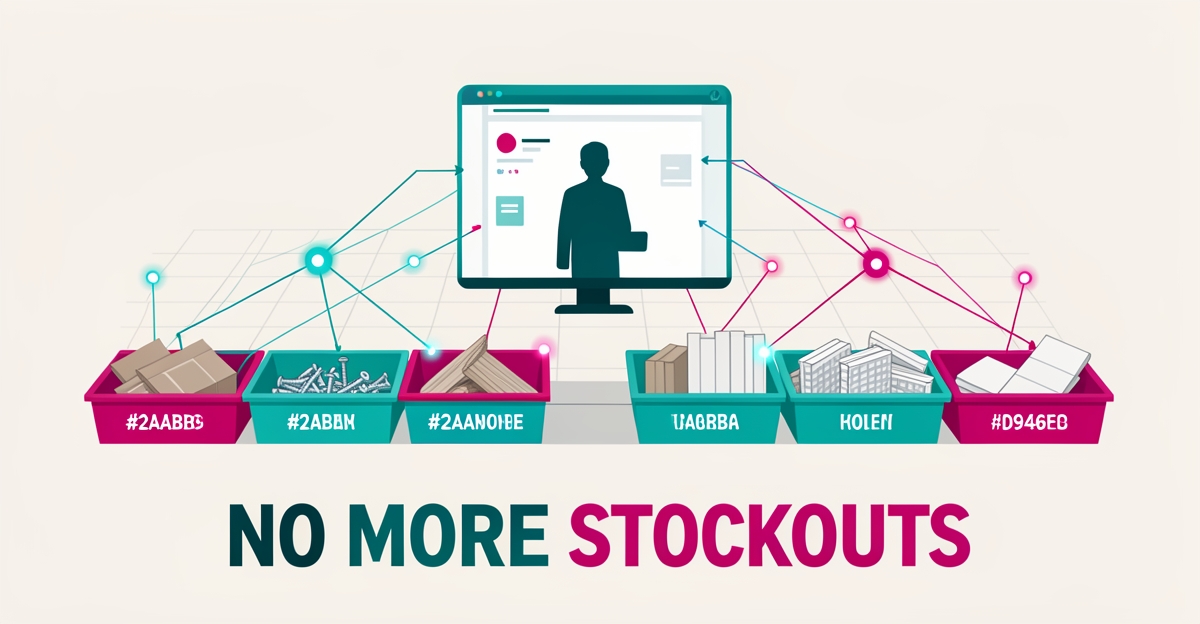
AI-Powered Inventory Tracking for Furniture Assembly Parts
Key Facts
- Inventory management software was $2.38 billion in 2025 according to industry analysis.
- Market projected to reach $4.8 billion by 2035 with 13.1% CAGR per market research.
- A $450M manufacturer had 7–9% valuation drift from master data errors per industry research.
- Work-in-progress was overstated by $4.6M due to inconsistent material naming according to LinkedIn analysis.
- Planners manually override 60%+ of planned orders due to MRP distrust per supply chain research.
- Synchronizing production cut lead time 28% and lifted on-time delivery 72% to 93% based on documented case results.
- NetSuite serves over 43,000+ customers with AI-powered inventory dashboards per company data.
Hire a team member that works 24/7 — for less than a part-time wage.
AI receptionists, SDRs, dispatchers and 99+ roles. Trained on your business, fully managed.
Not sure where to start? Ask our AI planner
Why Furniture Assembly Inventory Breaks Down
Furniture assembly lines stop for reasons that never show up on a purchase order. The parts are ordered, received, and logged, yet the bin is empty when the kit is needed. That gap between record and reality is where margin leaks out.
Phantom stock is the most common and least discussed failure mode. The ERP counts what was received; the warehouse counts what is actually pickable. Somewhere between those two numbers is inventory the planning model treats as real. Shipments sit in quarantine, items live in unmapped staging areas, or damage is never written down. As supply chain analysis explains, the data layer must know the difference between received and available in real time, not eventually.
Master data quality compounds the problem. ERPs fail silently when humans speak five dialects of the same data. A $450M metals manufacturer saw month-end inventory valuation drift 7–9% because the same raw material appeared as “Aluminum Alloy,” “Aluminium Alloy,” “Alu Alloy,” and more. Work-in-progress was overstated by $4.6M from that naming variance alone. In furniture, inconsistent item naming splits demand across records, makes forecasts unreliable, and triggers duplicate buys.
Poor master data also breaks bills of materials and planning logic. Wrong quantities or outdated revisions cause shortages mid-production and line stoppages. Incorrect lead times force expediting or inflate safety stock. Unit-of-measure errors, purchasing in KG but consuming in NOS without conversion, create invisible shortfalls. Expert breakdowns show how these errors cascade into procurement mistakes, invoice disputes, and blocked cash.
Flow management failures turn those data problems into physical bloat. One manufacturer kept releasing projects earlier to improve on-time delivery and instead increased multitasking. Inventory rose 35% while service levels fell 8% in a Fortune 500 case. Planners manually override 60%+ of planned orders due to lack of trust in MRP plans, a symptom of the precision trap where forecast accuracy is chased while flow dynamics are ignored.
The result is a system that looks healthy on dashboards but cannot deliver a full kit. High inventory is never a root cause. It is always a symptom of poor flow management.
Common breakdown points in furniture assembly include:
- Phantom stock from received vs available gaps, quarantine, and unmapped staging
- Master data drift with duplicate names, BOM inaccuracies, and UOM mismatches
- Multitasking and early release of work orders that inflate WIP and starve bottleneck capacity
AIQ Labs works in the category of AI Inventory & Supply Chain Management, where the focus is tracking parts used in assembly, predicting shortages, and alerting staff before thresholds are breached. Without clean master data and real-time availability validation, even the most advanced forecasting will amplify the noise.
How AI Transforms Parts Visibility and Forecasting
For furniture assembly operations, an inventory record that says "in stock" is only the beginning of the question. AI is changing what that record means, from a static number in an MRP system to a live signal that gets validated, interpreted, and acted on before a missing bracket or panel ever stops an assembly line.
The core shift is this: traditional MRP treats inventory records as facts, while AI treats them as signals that need validation. As supply chain expert Heather Sye puts it, "The ERP is counting what was received. The warehouse is counting what's actually pickable. Somewhere between those two numbers is a gap your planning model is treating as real inventory." This gap, known as phantom stock, arises from quarantined shipments, unmapped staging areas, and damage that hasn't been written down yet. AI-driven systems close it by distinguishing between received and available inventory in real time.
The problem is widespread. After analyzing more than 200 MRP implementations, Alan Jansen van Vuuren found that planners manually override over 60% of planned orders because they simply don't trust the plan, a signal that the system, not the people, is failing. AI addresses this distrust with continuous validation rather than periodic snapshots.
Modern platforms are embedding this capability directly. Microsoft Dynamics 365 is deploying agentic AI across the inventory-to-deliver process, with specialized agents that handle discrete operational tasks:
- Supplier Communications Agent: automates routine vendor follow-ups on purchase orders and confirms order changes that were traditionally manual and repetitive
- Warehouse Advisor Agent: uses machine learning and predictive analytics to automate slotting, inventory consolidation, and cycle counting
- Inventory Acquisition and Re-Balancing Agent: analyzes demand signals, supply availability, and stock imbalances to recommend rebalancing actions that reduce stockouts and excess inventory
- Inbound Load Agent: intelligently composes and optimizes inbound loads based on demand, capacity, and operational constraints
NetSuite, whose products serve over 43,000 customers, takes a complementary approach with AI-powered dashboards that surface stock pressures, delivery risks, and sales patterns so teams can act early and make sharp daily decisions. This is particularly valuable in furniture, where products spread across multiple warehouses and showrooms make reliable availability data notoriously difficult to maintain.
Predictive shortage alerts complete the picture. Automated threshold-based alerts notify teams the moment stock falls below a defined reorder point, replacing error-prone manual supervision. Layered on top, AI forecasting models analyze demand signals and supplier lead times to flag shortages before they occur, not after.
The market is responding to this shift. Inventory management software is projected to grow from $2.38 billion in 2025 to $4.8 billion by 2035, a 13.1% CAGR, according to industry analysis. For operations ready to move, the practical path is integrating AI with the inventory tools already in place, the approach AIQ Labs takes when connecting predictive tracking, shortage alerts, and threshold monitoring to existing systems so no assembly ever waits on a missing component.
Implementation Roadmap for Assembly Parts Tracking
Implementing AI-powered inventory tracking for furniture assembly parts requires a structured approach grounded in proven data practices. Begin by cleaning master data through spelling audits to eliminate inconsistencies that cause forecasting errors and phantom stock, issues that cost a UAE manufacturer $4.6M in overstated work-in-progress due to inconsistent raw material naming according to industry research. This step ensures your system operates on accurate foundations, reducing valuation errors by 7–9% as seen in real-world implementations.
Next, distinguish between received and available inventory in real time to prevent planning systems from treating quarantined or staged stock as usable components, a critical gap highlighted by supply chain experts who note that ERP failures often stem from not validating inventory signals per industry analysis. Configure automated reorder alerts triggered when stock falls below defined thresholds, replacing error-prone manual supervision with timely notifications that keep assembly lines supplied. Integrate barcode or RFID tracking for real-time data capture, reducing labor-intensive processes and improving accuracy across multiple warehouse locations. Deploy AI-powered forecasting models that analyze historical patterns and seasonality to optimize ordering, then synchronize production around bottleneck capacity to guarantee full-kit availability, this approach reduced lead time by 28% and improved on-time delivery from 72% to 93% in a manufacturer of customized equipment based on documented case results. Finally, implement regular cycle counting using ABC analysis and deploy specialized AI agents for supplier communications, warehouse slotting, and inventory rebalancing to maintain continuous accuracy and adaptive replenishment. AIQ Labs supports this end-to-end transformation through managed AI employees that integrate with your existing inventory tools.
Building an Owned AI Inventory System with AIQ Labs
Furniture assembly stops for one reason: a missing part. AI-powered tracking closes the gap between what the ERP says is on hand and what is actually pickable on the line, preventing stockouts that halt production and inflate carrying costs.
An owned system starts with clean master data and real-time availability validation. Poor item masters silently break planning, a $450M metals manufacturer saw month-end valuation errors of 7–9% and WIP overstated by $4.6M from inconsistent raw material names. ERP failures often trace back to data quality, not software limits. AIQ Labs builds custom AI inventory systems that businesses own, integrating directly with platforms like Dynamics 365 and NetSuite to enforce a single language for parts, BOMs and locations.
Integration replaces subscription chaos with a unified operational layer. Microsoft positions agentic AI for inventory-to-deliver with agents that automate supplier communications, warehouse slotting and rebalancing. NetSuite serves over 43,000+ customers with AI-powered dashboards that surface stock pressures and delivery risks so teams can act early. NetSuite highlights AI planning for furniture operations.
With AI Employees, the system is monitored and acted on 24/7. A managed AI Inventory Manager works alongside human teams to validate received vs. available inventory, trigger reorder points and predict shortages before they impact assembly. This is not a chatbot widget; it is a production-grade agent that books replenishment, flags phantom stock and learns from flow patterns.
The approach delivers measurable control:
- Real-time alerts when stock falls below thresholds, replacing manual supervision prone to error
- Predictive shortage alerts based on demand signals, lead times and bottleneck capacity
- Automated vendor follow-ups and rebalancing recommendations via ERP-integrated agents
- Full ownership of code, agents and data with no vendor lock-in
Market momentum supports the shift. The inventory management software market is estimated at $2.38 billion as of 2025 and is expected to reach $4.8 billion by 2035, witnessing a 13.1% CAGR. Industry research shows accelerating adoption of automation and cloud solutions. For furniture assembly, that means real-time component monitoring and shortage prediction that keeps kits complete and lines moving.
AIQ Labs architects these systems through its AI Operating Systems and managed AI employees, with custom two-way API integrations and ongoing optimization. The result is an owned AI inventory system that ensures no assembly goes without essential components.
Still paying for 10+ subscriptions that don’t talk to each other?
We build custom AI systems you own outright. No vendor lock-in. Full control.
Not sure where to start? Ask our AI planner
Frequently Asked Questions
Why does my ERP say we have parts in stock but the assembly line still runs out?
Can bad item names really cause stockouts in furniture assembly?
How much do planners actually trust MRP plans today?
What AI capabilities are furniture brands using for inventory-to-deliver?
Is AI inventory management just a trend or is the market growing?
What’s the first step to get AI tracking working for assembly parts?
Key Takeaways
Furniture assembly lines falter not from lack of inventory, but from gaps between what systems record and what teams can actually use. Phantom stock, master data inconsistencies, and flow missteps silently erode production efficiency. AI-powered inventory tracking closes these gaps by validating real-time availability, standardizing data, and predicting shortages before they impact operations. For furniture manufacturers, the path to reliable kit fulfillment starts with clean data, real-time visibility, and an owned AI system that adapts to your workflow. Start your free Fit Check to see how AIQ Labs can build a system that keeps your assembly lines running smoothly.
Make AI your competitive advantage — not just another tool.
Strategy, implementation and ongoing optimization. One partner, end to end.
Not sure where to start? Ask our AI planner