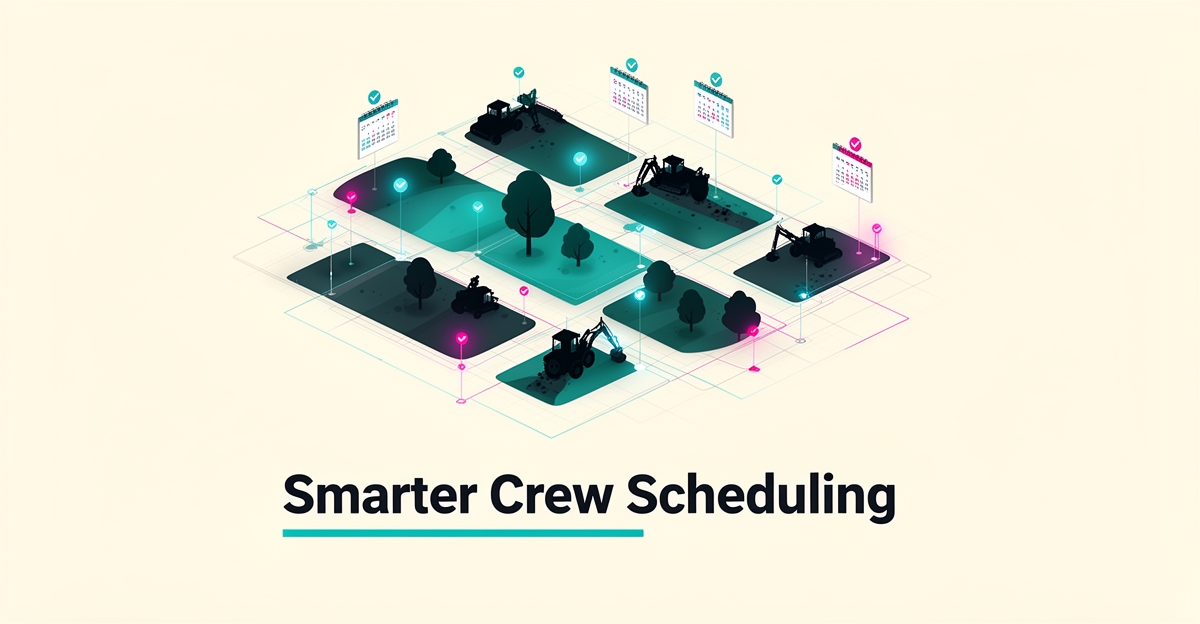
AI-Powered Job Scheduling: How Land Clearing Firms Can Optimize Crew Allocation
Key Facts
- Manual dispatch forces schedulers to juggle weather, terrain, crew availability, and equipment logistics faster than spreadsheets and phone calls can reconcile
- AI analyzes job volume, weather forecasts, terrain complexity, and crew availability to generate optimal schedules
- Custom AI scheduling systems evolve with operations, replacing reactive dispatch with predictive crew allocation
- AI scheduling systems process large volumes of data continuously to identify opportunities humans would miss
- Real-time adaptation allows AI to reallocate crews quickly when weather delays or equipment issues arise
- AI scheduling reduces idle time by moving crews between sites with minimal gaps and improves on-time performance through weather-aware routing and buffer management
- AIQ Labs has deployed 200+ multi-agent systems and runs four live SaaS products daily, so scheduling logic is production-tested, not theoretical
Hire a team member that works 24/7 — for less than a part-time wage.
AI receptionists, SDRs, dispatchers and 99+ roles. Trained on your business, fully managed.
Not sure where to start? Ask our AI planner
The Scheduling Bottleneck: Why Land Clearing Firms Struggle with Crew Allocation
Land clearing runs on tight margins, and a single bad schedule can ripple across crews, equipment, and client deadlines for days.
Manual crew allocation forces dispatchers to balance unpredictable weather, varying terrain complexity, crew availability, and equipment logistics in real time. Spreadsheets and phone calls cannot reconcile those variables fast enough, so jobs get stacked, crews wait on site, and machines sit idle while the next job is still unreachable.
The pressure shows up in lost productivity. When dispatchers spend their day firefighting, fielding calls, re-sequencing jobs, chasing updates, planning quality collapses and on-time performance erodes. The cognitive load of holding a whole operation's schedule in your head is exactly the kind of burden AI systems are built to remove.
Idle time is the most visible cost. Crews arrive before access is cleared, equipment is dispatched to a site that is still too wet after rain, or a skilled operator is sent to a low-complexity job while a steep, brush-heavy site waits. Each mismatch burns payroll hours without producing billable clearing.
Missed deadlines compound the damage. Clients schedule follow-on grading, seeding, or construction work based on promised completion dates. A delay from poor allocation triggers change orders, penalties, and reputational risk that makes future bids harder to win.
Revenue leakage also hides in the gaps. Manual scheduling tends to overcommit crews to maximize utilization, then under-deliver when terrain takes longer than estimated. The result is overtime, rework, and jobs that slip into the next weather window.
Common pain points that drive these losses include:
- Weather windows shifting mid-week and forcing last-minute re-routing
- Terrain complexity misjudged, causing crews to be under- or over-skilled for the site
- Equipment logistics mismatched to job sequencing and travel distance
- Crew availability changes not reflected in the schedule until the morning of the job
AI can change the decision loop. AI analyzes job volume, weather forecasts, terrain complexity, and crew availability to create optimal scheduling, reducing idle time and improving on-time performance. Systems built for operations learn from completed jobs and adjust future allocations as conditions change.
At AIQ Labs, custom scheduling systems evolve with your operation, replacing reactive dispatch with predictive crew allocation that protects margin and keeps commitments. If dispatch is the workflow costing you the most, an AI Workflow Build rebuilds it around your actual terrain data, equipment, and crews, at a fixed price, in phases.
How AI Analyzes Multiple Variables to Optimize Crew Scheduling
AI-powered job scheduling systems transform how land clearing firms manage crew allocation by simultaneously processing multiple complex variables that humans struggle to track in real time. These systems analyze job volume patterns, weather forecasts, terrain complexity metrics, and crew availability data to generate optimal schedules that minimize idle time and maximize on-time performance. This multi-variable analysis happens continuously, adapting to changing conditions throughout the day.
Scheduling managers carry a heavy cognitive burden: every job change forces a cascade of recalculations across crews, equipment, and travel time. AI scheduling systems remove this load by handling the intricate calculations and trade-offs that would overwhelm a human dispatcher working from memory and a whiteboard. They process large volumes of data continuously to identify scheduling opportunities humans would miss.
AI optimization tools create schedules that balance competing priorities like equipment utilization, crew skill matching, and weather-dependent task sequencing. The system evaluates how terrain complexity affects job duration, cross-references this with real-time weather forecasts, and adjusts crew assignments accordingly. When unexpected weather changes occur, the AI rapidly re-optimizes the schedule while maintaining crew utilization targets.
- Analyzes historical job volume patterns to predict daily workload fluctuations
- Integrates multi-day weather forecasts to schedule weather-sensitive tasks optimally
- Maps terrain complexity data to estimate accurate job completion times
- Tracks real-time crew availability including skills, certifications, and equipment access
- Continuously re-optimizes schedules as new variables emerge throughout the workday
This simultaneous variable analysis enables land clearing firms to achieve scheduling precision that surpasses what a manual process can deliver. AIQ Labs builds custom scheduling systems that learn from operational patterns and evolve as business needs change, ensuring schedules remain optimal even as crew sizes, job types, or geographic service areas expand. The result is reduced idle time, improved on-time performance, and more predictable crew utilization without the mental strain of manual scheduling complexity.
Reducing Idle Time and Improving On-Time Performance with Intelligent Automation
Idle crews and missed windows cost land clearing firms more than equipment, they erode margins, client trust, and crew morale. Intelligent automation changes the planning conversation from reactive firefighting to predictive deployment.
AI scheduling systems automate routine planning tasks by learning your operation's patterns and optimizing schedules around current priorities and availability. Instead of a dispatcher rebuilding the week every time it rains, the system handles the routine work and flags only the decisions that genuinely need a human.
For land clearing, that means systems that analyze job volume, weather forecasts, terrain complexity, and crew availability to create optimal scheduling. The result is less downtime, better resource utilization, and improved project completion rates.
Real-time adaptation is where automation delivers measurable impact. When weather delays hit or equipment issues arise, AI reallocates crews immediately instead of waiting for manual re-planning. Continuous optimization replaces static weekly sheets with dynamic deployment that protects billable hours.
The measurable shifts show up across operations:
- Idle time falls as crews move between sites with minimal gaps
- On-time performance improves with weather-aware routing and buffer management
- Resource utilization rises as terrain complexity and skill sets match the right jobs
- Planning overhead shrinks as routine scheduling is automated
Some firms also add an AI dispatcher alongside the scheduling engine, an always-on AI staff member that handles rescheduling calls, crew notifications, and status updates, typically at a fraction of the cost of another full-time hire.
AIQ Labs builds custom scheduling systems that evolve as operations grow, integrating crew data, equipment status, and site conditions into a single planning engine. With 200+ multi-agent systems deployed and four live SaaS products the company runs daily, the scheduling layer is production-tested, it learns from completed jobs and continuously refines crew deployment rules.
Intelligent automation means fewer last-minute scrambles, more predictable completion dates, and crews spending time clearing land instead of waiting for direction.
Implementing AI Scheduling in Your Land Clearing Operation: A Practical Roadmap
The gap between "we should use AI for scheduling" and actually running your crews on it comes down to a disciplined rollout. Firms that treat implementation as a structured roadmap, not a software purchase, see results in weeks rather than stalling in endless pilots.
Start by auditing your current scheduling workflow. Map how jobs get assigned today: who checks weather, how terrain complexity is estimated, and how crew availability is tracked. The point is to find where idle time and on-time misses actually originate, because AI scheduling works by analyzing job volume, weather forecasts, terrain complexity, and crew availability to create optimal schedules. If those inputs live in someone's head or a whiteboard, that's your first integration point.
Next, identify where AI connects to your existing systems. Most land clearing firms already run a CRM, some form of project management, and dispatch tools, and a well-built AI scheduling system should plug into these environments rather than force a platform migration. Off-the-shelf scheduling assistants can handle basic calendar-level coordination, but they are typically priced per user per month and designed for office knowledge workers, not field crews. Pricing changes frequently, so check current rates directly with vendors before comparing.
The build-versus-buy decision matters here. Off-the-shelf tools are fast to deploy but generic; a custom system built around your specific operation, your equipment, your terrain data, your job types, evolves as you grow. That's the approach AIQ Labs takes with AI Workflow Builds: rebuild the one workflow that costs you the most, at a fixed price, delivered in milestones so you see value at each phase before committing further.
Then start small with a single workflow. Pick one pain point, say, weather-driven rescheduling for one crew, and let the AI prove itself before expanding. A practical sequence looks like this:
- Document your current scheduling process and identify the single biggest bottleneck
- Connect the AI system to one existing tool (your CRM or dispatch board) first
- Run the AI schedule alongside your manual schedule for two to four weeks and compare
- Measure idle time and on-time performance before and after
- Scale to additional crews and workflows only once the ROI is visible
Finally, monitor and adjust. AI scheduling isn't fire-and-forget; performance data should feed back into the system so it improves continuously. Be aware that setup takes real effort, configuration complexity is a genuine challenge with any scheduling system, so budget time for it or work with a partner who handles deployment and ongoing optimization. Firms that follow this phased path, assess, integrate, pilot, measure, scale, turn AI scheduling from an experiment into a durable operational advantage. The fastest way to scope yours is the two-minute Fit Check, followed by a free 30-minute strategy call.
Custom AI Scheduling Systems vs. Generic Tools: What Land Clearing Firms Need to Know
Custom AI scheduling systems offer land clearing firms capabilities that generic tools simply cannot match. Off-the-shelf scheduling assistants are built to manage meetings and focus blocks for office-based knowledge workers, they lack the depth to handle field-specific variables such as terrain complexity, equipment logistics, or multi-crew coordination across remote job sites. They are not designed for optimizing crews navigating uneven topography, variable soil conditions, or weather-sensitive clearing operations.
Generic scheduling assistants also struggle to integrate with the specialized software land clearing firms rely on, such as GIS mapping tools, equipment tracking systems, or environmental compliance platforms. Without this integration, scheduling decisions remain siloed, leading to inefficiencies like crews arriving at sites unprepared for ground conditions or equipment sitting idle due to poor sequencing. In contrast, custom AI systems built for field service operations can ingest real-time terrain data, weather forecasts, and crew certifications to dynamically adjust schedules, reducing idle time and improving on-time performance by aligning labor, machinery, and site readiness.
Moreover, custom AI scheduling systems evolve with a business. As land clearing firms take on larger contracts, expand into new regions, or adopt new equipment, a tailored system can scale its logic and integrations accordingly. AIQ Labs builds these systems to connect with existing workflows, whether syncing with dispatch software, updating crew availability based on job completion, or triggering reorders for fuel and mulch based on projected workload. For firms whose scheduling is one piece of a larger connected operation, an AI Operating System ties scheduling together with estimating, dispatch, and client communication in one layer, built in phases and owned outright.
For land clearing firms aiming to reduce operational friction and gain a competitive edge, investing in a custom AI scheduling system delivers long-term value that generic assistants cannot provide. Unlike subscription-based tools that lock users into limited functionality and ongoing per-seat fees, a custom-built system offers true ownership, continuous improvement, and alignment with industry-specific demands, turning scheduling from an administrative task into a core operational advantage.
Still paying for 10+ subscriptions that don’t talk to each other?
We build custom AI systems you own outright. No vendor lock-in. Full control.
Not sure where to start? Ask our AI planner
Frequently Asked Questions
How does AI scheduling actually reduce idle time for land clearing crews?
Can AI scheduling tools handle unexpected weather changes during the workday?
What specific data does AI use to optimize crew allocation in land clearing operations?
How does AI help with the cognitive load on dispatchers and scheduling managers?
Why should land clearing firms choose a custom AI scheduling system over generic scheduling assistants?
What's a practical first step for implementing AI scheduling in our land clearing business without disrupting current operations?
Turn Scheduling Chaos into Predictable Progress
Land clearing firms lose valuable billable hours when crews wait for access, equipment sits idle, and deadlines slip due to manual scheduling that can't keep up with weather, terrain, and crew availability. AI-powered job scheduling transforms this reactive scramble into a proactive system that analyzes job volume, weather forecasts, terrain complexity, and crew data to optimize allocation in real time. The result is less idle time, better on-time performance, and crews spending more hours clearing land instead of waiting for direction. AIQ Labs builds custom scheduling systems that integrate with your existing tools and evolve as your operation grows, delivered in milestones, owned outright, turning scheduling from a daily headache into a strategic advantage. Start with the two-minute Fit Check, then book a free 30-minute strategy call to identify your biggest bottleneck and map a clear path forward.
Make AI your competitive advantage — not just another tool.
Strategy, implementation and ongoing optimization. One partner, end to end.
Not sure where to start? Ask our AI planner