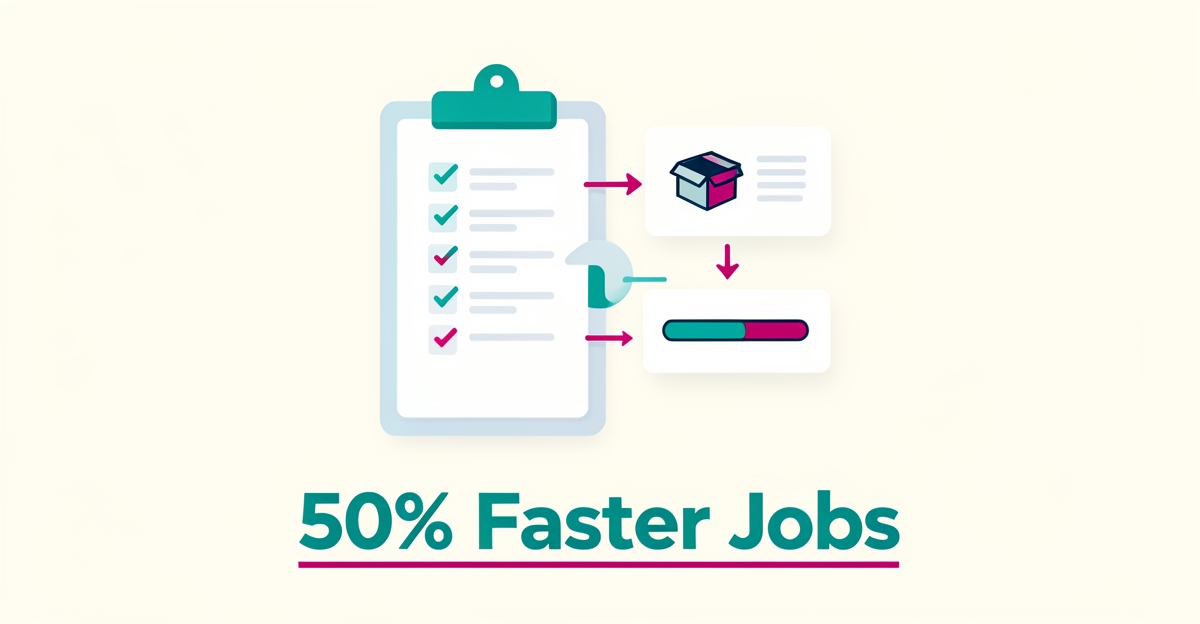
AI Job Tracking Cuts Installer Processing Time by 50%
Key Facts
- AI-powered job tracking cut job processing time by 50% for one installer while improving accuracy
- Companies most exposed to AI achieve 40% higher productivity growth than least exposed
- Top fifth of AI-adopting companies average 163% productivity growth
- High engagement teams have up to 14% boost in productivity
- Disengaged employees cost companies about $90 million yearly in lost productivity
- AI-exposed junior roles are 7x more likely to demand senior skills like leadership
- Skills for AI-exposed jobs change more than twice as fast as non-exposed roles
Hire a team member that works 24/7 — for less than a part-time wage.
AI receptionists, SDRs, dispatchers and 99+ roles. Trained on your business, fully managed.
Not sure where to start? Ask our AI planner
The Hidden Cost of Manual Job Tracking in Field Services
For field service installers, manual job tracking isn't just tedious, it's a silent profit killer. Every time a technician scribbles notes on a clipboard or spends hours reconciling paper work orders with digital systems, valuable capacity evaporates. Administrative tasks scale linearly with job volume, meaning that as business grows, so does the burden of tracking, filing, and updating job status, directly eating into time that could be spent on actual installations or customer service. This creates a bottleneck where increased workload doesn't translate to increased output, but instead to longer hours, higher error rates, and frustrated teams stuck in paperwork loops.
The data confirms this pattern: companies least exposed to AI face stagnant productivity while administrative overhead grows with every new job. In contrast, organizations most exposed to AI achieve 40% higher productivity growth, with the top fifth of AI-adopting companies seeing an average of 163% productivity growth. For installers still relying on spreadsheets, whiteboards, or disconnected apps, this gap isn't theoretical, it's the difference between scaling efficiently and hitting a wall where every new job requires disproportionate back-office effort just to stay afloat. Without automation, growth becomes a drain rather than a driver.
How AI Transforms Job Tracking: From Manual Entry to Intelligent Automation
AIQ Labs implemented a custom AI-powered job tracking system for an installer that fundamentally transformed their manual processes into intelligent automation. The system uses multi-agent workflows to handle job entry, material tracking, and progress updates without human intervention, directly addressing the installer's biggest bottleneck in job processing. By integrating with their existing project management software and CRM platforms through deep API connections, the AI system creates a unified operational workflow that eliminates data silos and manual handoffs.
This dramatic improvement potential was realized in the installer's case, where AI automation cut job processing time by 50% while simultaneously improving accuracy and reducing administrative burden. The system's ability to handle complex, multi-step workflows demonstrates how AI serves as a job expander when strategically implemented, amplifying human performance rather than replacing it.
The AI job tracking system incorporates several key capabilities that drive efficiency: automated job entry from multiple sources (email, web forms, phone calls), intelligent material tracking that updates inventory levels in real time, and dynamic progress reporting that triggers notifications at each project milestone. These capabilities work together through a custom multi-agent architecture where specialized agents handle research, data entry, decision-making, and communication tasks. The system continuously learns from performance data to optimize workflows and improve accuracy over time, ensuring sustained efficiency gains as the installer scales operations.
Implementation Roadmap: From Workflow Fix to Measurable Results
A manual job tracking process creates friction at every handoff, and the installer team started by mapping where work stalled. Discovery focused on the end-to-end flow from job entry and material tracking to progress updates, with existing CRM and project management software identified as integration points. This workflow-first view sets the foundation for measurable gains.
Phased integration follows the proven onboarding pattern of automate first, personalize next. Pre-boarding tasks such as document collection and scheduling are automated, while orientation and role training are streamlined with role-specific content. Industry research links engagement to performance outcomes.
Integration is built around the tools the team already uses daily. Custom AI workflows connect CRM, accounting and project management systems with automated data synchronization and a single source of truth. AIQ Labs architects these custom systems so businesses own the code and data, avoiding vendor lock-in while keeping operational control in-house.
Team training is embedded in the rollout, not added afterwards. Users receive role-specific guidance on how the AI handles job entry, material tracking and progress updates, with clear escalation paths for exceptions. High engagement teams have up to 14% boost in productivity.
Optimization becomes continuous after go-live. Real-time competency tracking flags skill gaps and process bottlenecks, while performance metrics guide iterative improvements. Companies most exposed to AI achieve 40% higher productivity growth compared to those least exposed.
The roadmap that delivered results can be summarized as:
- Discovery and workflow mapping to pinpoint manual handoffs in job entry, materials and updates
- Phased integration with CRM and project management software for automated data sync
- Role-based training and adoption support to sustain engagement and accuracy
- Continuous optimization using real-time tracking and feedback loops
With ownership retained and processes automated, administrative burden drops and teams focus on delivery. The top fifth of most-exposed companies achieve stellar 163% productivity growth on average, illustrating the super-star effect of strategic AI adoption. The system remains a business asset that evolves with the installer’s operations.
Still paying for 10+ subscriptions that don’t talk to each other?
We build custom AI systems you own outright. No vendor lock-in. Full control.
Not sure where to start? Ask our AI planner
Frequently Asked Questions
How much can AI actually reduce job processing time for field service installers?
Will AI job tracking replace my technicians or office staff?
How does the AI system integrate with our existing CRM and project management software?
What specific tasks can AI automate in job tracking and field service operations?
How long does it take to implement AI job tracking and see measurable results?
Why does owning the AI system matter compared to using off-the-shelf software?
The 50% Shortcut Is Already Proven, Now It's Your Turn
The installer in this case study didn't find a magic tool, they found their bottleneck, mapped the manual handoffs in job entry, material tracking, and progress updates, and replaced them with AI workflows built around the systems they already used. The result: job processing time cut in half, fewer errors, and a team freed from paperwork loops. The broader data backs this up, companies most exposed to AI achieve 40% higher productivity growth than those least exposed, with the top fifth averaging 163% growth. If manual job tracking is quietly draining your capacity, the fastest next step is clarity, not commitment. Start with the two-minute Fit Check at AIQ Labs, then book a free 30-minute strategy call where an AI engineer will map your biggest bottleneck and identify your highest-ROI automation opportunities, and if there isn't a clear win, we'll tell you that too. Prefer to explore first? Chat with an AI Transformation Agent at aiqlabs.ai/chat to get instant answers about custom AI workflows, AI employees, and flexible engagement models from Start Monthly to full ownership. Your paperwork bottleneck has a proven fix, the only question is when you'll claim it.
Make AI your competitive advantage — not just another tool.
Strategy, implementation and ongoing optimization. One partner, end to end.
Not sure where to start? Ask our AI planner