AI-Powered Marketing Copy: How Food Trucks Can Automate Their Social Media Ads
Key Facts
- Efficiency is the most commonly cited benefit of AI in marketing, most marketers report it saves them meaningful time, a critical advantage for food truck owners
- AI content creation is now mainstream across the marketing industry as of late 2026, especially for writing and planning
- Agentic AI systems can autonomously plan, test, and optimize ad campaigns based on live performance data
- Consumer comfort with brands using AI has been mixed in recent years, transparency and genuine utility are what drive acceptance
- AI can analyze local event calendars to promote lunch specials near farmers' markets or late-night snacks after concerts
- Most marketers still report they can't achieve desired outcomes with minimal human input, AI works best with a human in the loop
Hire a team member that works 24/7 — for less than a part-time wage.
AI receptionists, SDRs, dispatchers and 99+ roles. Trained on your business, fully managed.
Not sure where to start? Ask our AI planner
The Marketing Bottleneck: Why Food Trucks Struggle with Social Media Ads
For a food truck owner, the workday doesn't end when the last customer is served. The real challenge often begins after the grill cools down: figuring out how to market the business for the next day. This daily pressure to create fresh, engaging social media ads is a significant bottleneck, turning a passion for food into a grind of content creation.
The core of the problem is a simple lack of resources. Unlike larger restaurant chains, most food trucks operate without a dedicated marketing staff. The owner is the chef, the bookkeeper, and the social media manager all at once. This leaves very little time for crafting compelling ad copy, designing visuals, and strategically scheduling posts across multiple platforms.
This is a widely felt pain point. Across the marketing industry, the number one benefit people report from AI is efficiency, most marketers say it saves them real time. For a mobile business where every minute counts, this isn't just a convenience, it's a critical operational advantage.
The challenge is magnified by the nature of the food truck business itself. Success depends on being in the right place at the right time with the right message. An ad that works for a lunch crowd in the financial district won't resonate with a late-night audience near a concert venue. This creates a constant need for unique, localized content.
Key marketing hurdles for food trucks include:
- Constantly updating location and schedule information across all social channels.
- Creating distinct ad copy that appeals to different neighborhood demographics.
- Generating timely promotions based on daily specials, weather, or local events.
- Finding the time to analyze which ads are actually driving foot traffic.
Manually producing this level of dynamic, context-aware content is nearly impossible for a small team. The industry has shifted from generic ads to helpful, in-the-moment suggestions. For a food truck, this means an ad for a cold brew should appear on a hot afternoon, not be scheduled days in advance.
This is where the bottleneck becomes a breaking point. AI content creation is now standard practice across the marketing industry as of late 2026, yet many small business owners are still stuck in a manual cycle. They are tasked with the work of an entire marketing department, a challenge that AI-powered systems are specifically designed to solve by automating the creation of localized, high-converting campaigns.
How AI Enables Hyper-Localized, High-Converting Ad Copy
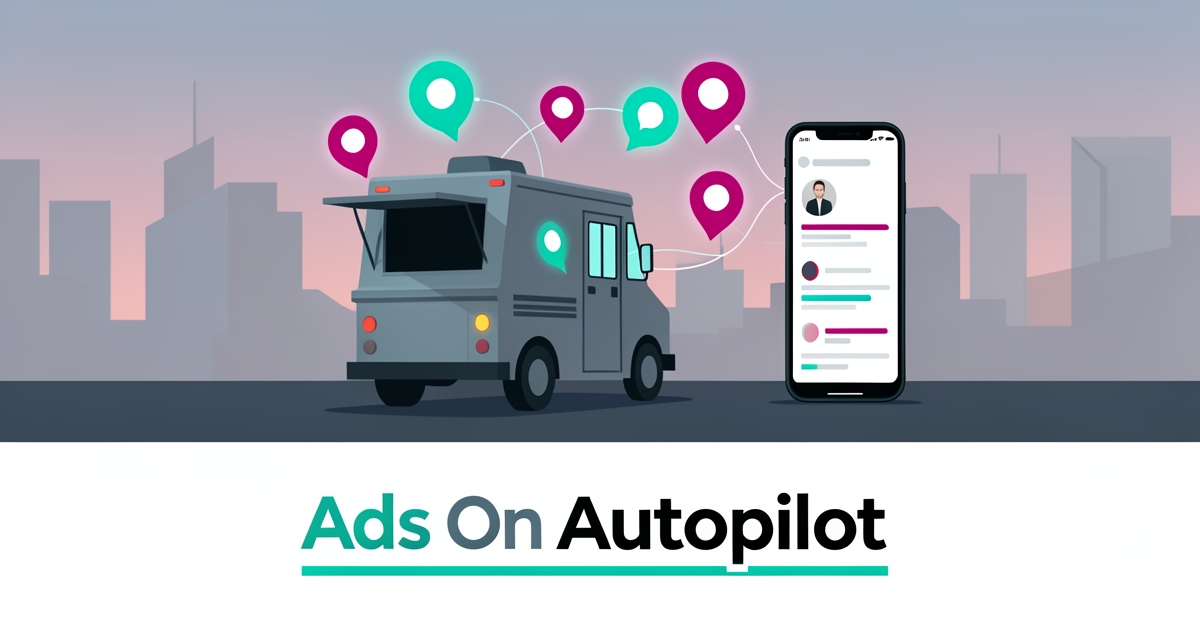
For food trucks, marketing success hinges on being in the right place at the right time with the right message, something static ads simply can't achieve. AI transforms this challenge by generating dynamic, context-aware ad copy that adapts in real time to location, weather, local events, and customer behavior, moving beyond generic promotions to timely, relevant offers. This shift from "Here's an ad" to "Here's help" positions AI as a proactive marketing partner that anticipates needs rather than interrupts them.
Agentic AI takes this further by autonomously planning, testing, and optimizing campaigns based on live data. For small businesses, this typically means higher conversion rates without increasing ad spend, every impression becomes a more efficient use of budget. For food trucks operating on tight margins, that efficiency gap is often the difference between a slow week and a sold-out lunch rush.
- Analyzes local event calendars to promote lunch specials near farmers' markets or late-night snacks after concerts
- Adjusts messaging based on weather, pushing hot drinks on cold days or frozen treats during heatwaves
- Uses neighborhood demographics to tailor offers, like family meals near schools or quick bites for business districts
- Learns from past performance to refine timing, copy, and creative elements for better engagement
By treating AI as a collaborator rather than a tool, food trucks can build campaigns that feel helpful and human, not automated and intrusive. This approach aligns with consumer preferences, consumer comfort with brands using AI has been mixed in recent years, and transparency and utility are what significantly increase acceptance. When AI-generated ads solve real-time problems, like guiding hungry customers to a nearby taco truck during a lunch rush, they stop feeling like ads and start feeling like service. That's the power of hyper-localized, high-converting copy: it doesn't just sell food, it meets people where they are, exactly when they need it.
Practical Steps to Launch AI-Driven Social Media Campaigns for Your Food Truck
Getting started with AI-driven social media campaigns is less about buying tools and more about following a structured path. The good news: you don't need a marketing department to do it. AI content creation is now the industry norm, and efficiency is its most commonly reported benefit, advantages any food truck owner can replicate with the right sequence.
Here's a practical roadmap, adapted from a proven AI marketing implementation framework:
Step 1: Start with content creation. Use AI tools to generate ad copy, images, and short video scripts in minutes. Content writing and content planning are the most common entry points for marketers, so start there. Feed the AI your menu, your voice, and your locations, then generate multiple ad variations for different neighborhoods before lunch service.
Step 2: Segment your audience deeply. Move beyond basic demographics. AI can process purchasing behavior, browsing history, and online interactions to build detailed customer profiles, office workers who order on Tuesdays, festival-goers who spend after 9 p.m. This behavioral segmentation is what separates AI-powered marketing from traditional, one-size-fits-all campaigns.
Step 3: Personalize your offers. Use those profiles to deliver offers that actually convert. A cold drink promo on a hot day near a park, or a late-night snack push near a concert venue, reflects the industry's shift from "Here's an ad" to "Here's help", being useful in the moment rather than just visible.
Step 4: Automate email and social media management. AI tools can handle email copy, send-time optimization, smart segmentation, automated posting schedules, and even comment responses, tasks that eat hours you'd rather spend on the grill.
Step 5: Layer in predictive analytics and ideation. Forecast demand around local events and seasons, then use AI for brainstorming when creative energy runs dry. This is where agentic AI is heading: systems that autonomously plan, adapt, and optimize campaigns in real time, continuously testing creative variations and shifting budget toward what performs.
Two cautions before you scale. First, keep humans in the loop, most marketers say they can't achieve desired outcomes with minimal human input, and many believe AI can't fully replace human creativity. Your brand voice, your recipes, your community relationships still matter most. Second, mind the trust gap: consumer comfort with brands using AI has been uneven in recent years. Be transparent about personalized offers and keep AI-generated content accurate and authentic.
Ownership matters, too. Rather than stacking subscriptions you don't control, consider systems you actually own. That's the philosophy behind [AI Workflow Builds](/workflow-builds), rebuilding the one workflow that costs you the most, at a fixed price, in phases, or a fuller [AI Operating System](/ai-operating-systems) that connects marketing, scheduling, and customer follow-up into one layer you own outright. For hands-off coverage, managed [AI Employees](/ai-employees) can run content and campaign tasks as dedicated digital staff. Whether you build it yourself or partner with specialists, the goal is the same: AI that compounds your advantage instead of renting it back to you.
If you want a clear-eyed read on where to start, take the two-minute Fit Check at aiqlabs.ai/apply and book a free 30-minute strategy call, a working session, not a sales pitch.
Still paying for 10+ subscriptions that don’t talk to each other?
We build custom AI systems you own outright. No vendor lock-in. Full control.
Not sure where to start? Ask our AI planner
Frequently Asked Questions
How can AI help food trucks save time on social media marketing?
Will using AI make my food truck's ads feel impersonal or robotic?
Do I need to be tech-savvy to use AI for my food truck's marketing?
Can AI really improve my food truck's ad performance and sales?
Is it ethical to use AI for personalized food truck ads, and will customers trust it?
What's the first step to start using AI for my food truck's social media ads?
From Daily Grind to Smart Growth: Your Food Truck's AI Advantage
Food trucks thrive on being in the right place at the right time, but manually crafting location-specific, timely social media ads turns that advantage into a daily grind. As we've seen, AI changes that by generating hyper-localized copy that adapts to weather, events, and neighborhood rhythms, turning impressions into real foot traffic without adding to your workload. Efficiency is the payoff marketers report most often, and for food trucks operating on tight margins, that means more sales, not more stress. The path forward is clear: start small, keep your voice in the loop, and let AI handle the repetition. If you're ready to see where AI can unlock real efficiency in your marketing, take the two-minute Fit Check at aiqlabs.ai/apply and book a free 30-minute strategy call, a working session, not a sales pitch.
Make AI your competitive advantage — not just another tool.
Strategy, implementation and ongoing optimization. One partner, end to end.
Not sure where to start? Ask our AI planner