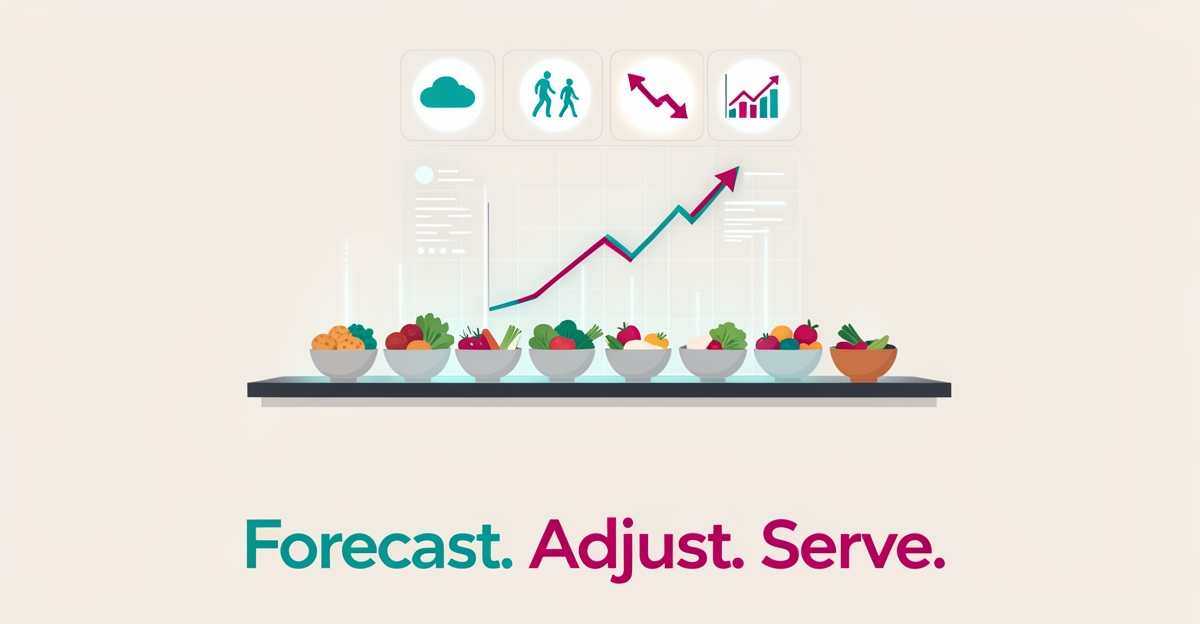
AI-Powered Menu Planning: How Food Halls Can Forecast Demand and Adjust Recipes in Real Time
Key Facts
- AI demand forecasting analyzes foot traffic, weather, and historical sales to predict what will sell, before the day starts.
- Operators using predictive inventory tools typically report meaningful waste reduction, often cited in the range of 20–30% with smarter ordering and portioning.
- AI can dramatically speed up recipe development and menu testing, letting chefs refine new dishes in days instead of months.
- Manual, intuition-based planning tends to produce more overproduction and spoilage than data-driven planning, especially when weather or local events shift traffic.
- Across the food service sector, better demand forecasting is widely viewed as one of the largest untapped levers for cost savings.
- Real-time adjustment means menus, prep volumes, and orders respond to live conditions, not yesterday's assumptions.
Hire a team member that works 24/7 — for less than a part-time wage.
AI receptionists, SDRs, dispatchers and 99+ roles. Trained on your business, fully managed.
Not sure where to start? Ask our AI planner
The Hidden Cost of Guesswork in Food Hall Menu Planning
Food halls operate in a high-pressure environment where menu decisions directly impact profitability and customer experience. Yet many still rely on intuition, past habits, or vendor suggestions to plan their offerings, a method increasingly at odds with real-time demand fluctuations. This guesswork leads to overproduction, spoilage, and missed sales opportunities, especially when foot traffic shifts due to weather, local events, or seasonal trends. Without data-driven insights, vendors struggle to align inventory with actual consumption, resulting in avoidable waste and strained margins.
The food industry has been moving steadily toward AI-assisted planning for exactly this reason: traditional methods cannot keep pace with dynamic consumer behavior. AI-powered systems that analyze foot traffic, weather, and historical sales can forecast demand with enough precision to enable proactive menu and ingredient adjustments. This shift from reactive to anticipatory planning reduces the risk of both stockouts and excess inventory, two costly outcomes of guesswork-driven operations.
The financial toll of inaccurate forecasting is significant. Operators relying on manual planning typically generate substantially more food waste than necessary, and across the sector that adds up to billions in lost value each year. Beyond waste, inefficient planning ties up capital in perishable goods that may never sell, limits menu agility, and frustrates customers when popular items sell out unexpectedly. These inefficiencies compound over time, eroding trust and diminishing the hall's competitive appeal.
- Overproduction due to poor forecasting increases spoilage and disposal costs
- Understocking leads to lost sales and diminished customer satisfaction
- Manual adjustments cannot respond fast enough to real-time variables like rain or events
- Inventory imbalances distort pricing strategies and profit margins
- Lack of data visibility prevents long-term menu optimization
AIQ Labs helps food halls transition from guesswork to precision by building custom AI systems that continuously analyze operational and external data streams. These platforms don't just predict demand, they recommend specific recipe adjustments, portion scaling, and vendor ordering schedules in real time. By grounding decisions in patterns rather than intuition, food halls gain the agility to thrive in unpredictable environments while cutting waste and improving consistency. This kind of system usually starts as a Workflow Build targeting the one planning process that costs you the most.
How AI Transforms Menu Planning with Real-Time Data
Food halls face constant pressure to balance menu variety with inventory efficiency, especially as customer preferences shift with the weather and time of day. Traditional planning methods often rely on static forecasts and gut instinct, leading to overproduction, spoilage, and missed revenue opportunities. AI transforms this process by turning real-time data into actionable insights that keep menus aligned with actual demand.
By analyzing foot traffic patterns, weather forecasts, and historical sales, AI systems can predict demand fluctuations with meaningful precision. For example, a sudden drop in temperature might increase demand for hot soups and stews, while sunny afternoons could drive higher sales of salads and cold beverages. Operators using this data-driven approach typically report waste reductions in the 20–30% range through smarter ingredient ordering and portion planning. AI-assisted recipe development can also move much faster than traditional test kitchens, letting chefs refine new dishes in days rather than months.
These capabilities support continuous menu optimization, where AI suggests adjustments based on live conditions, such as increasing grill capacity during a lunch rush or promoting indoor seating options when rain is forecasted. Instead of reacting to waste after it occurs, food halls can proactively align their offerings with expected demand. This shift not only cuts costs but also improves customer satisfaction by ensuring popular items remain in stock. Predictive analytics is what moves operators from reactive to proactive inventory control.
- Real-time foot traffic analysis to anticipate peak demand periods
- Weather-based adjustments for seasonal menu relevance
- Historical sales trends to identify recurring customer preferences
- Ingredient-level forecasting to minimize overstock and spoilage
- Dynamic recipe scaling to match predicted serving volumes
AIQ Labs builds custom AI systems that integrate these data streams into a unified forecasting engine, enabling food halls to maintain optimal inventory levels while reducing operational waste. Over time, that engine can grow into a broader AI Operating System that connects forecasting, ordering, and reporting across the whole hall. By grounding menu decisions in real-time analytics rather than assumptions, operators gain the agility to adapt quickly, turning variability into a strategic advantage.
From Insight to Action: Implementing AI Menu Planning in Your Food Hall
Implementing AI-powered menu planning begins with establishing a robust data foundation, a critical step that enables the analysis of patterns and trends essential for accurate demand forecasting. Food halls must first collect comprehensive data on foot traffic, weather patterns, and historical sales, which serves as the backbone for AI-driven insights. Even a few months of clean sales data is often enough to start producing useful forecasts.
Once the data infrastructure is in place, the next step involves analyzing this information to identify actionable patterns and trends. AI systems excel at processing large datasets to forecast demand, allowing food halls to adjust their menus and ingredient orders proactively. Industry analyses of AI-driven demand forecasting in food service consistently point to substantial waste reduction and cost savings as the primary payoff.
The implementation phase focuses on integrating real-time optimization into daily operations. This involves setting up systems that can adjust menu offerings dynamically based on current conditions such as weather changes or unexpected fluctuations in foot traffic. AI-assisted recipe development also lets food halls respond quickly to evolving customer preferences and market trends, compressing test cycles that traditionally took months.
To ensure successful adoption, food hall operators should consider the following key steps:
- Start with a pilot program focusing on a single menu category or daypart to test and refine the AI system.
- Invest in staff training to ensure team members understand how to interpret and act on AI-generated insights.
- Establish clear metrics for success, such as waste reduction percentages or improvements in customer satisfaction scores.
- Regularly review and update the AI models to account for seasonal variations and changing consumer behaviors.
AIQ Labs specializes in guiding food halls through this transformation, with fixed-price, phased builds that align with each business's unique needs. You can start small with a single workflow, pay in milestones, and own the system outright when it's done, no ongoing dependency. To see the current engagement models and payment options, visit aiqlabs.ai/pricing.
Still paying for 10+ subscriptions that don’t talk to each other?
We build custom AI systems you own outright. No vendor lock-in. Full control.
Not sure where to start? Ask our AI planner
Frequently Asked Questions
How much can AI-powered menu planning actually reduce food waste in food halls?
Is AI menu planning only for large food halls with big budgets, or can smaller vendors benefit too?
How quickly can AI help develop and test new recipes compared to traditional methods?
What kind of data do I need to start using AI for menu planning in my food hall?
Can AI really adjust menus in real time based on things like weather or sudden crowds?
What's the first step if I want to explore AI for my food hall's menu planning?
Turn Menu Guesswork Into Predictable Profit
Food halls that move from intuition to real-time forecasting stop bleeding margin on overproduction and stockouts. By analyzing foot traffic, weather, and historical sales, AI can anticipate demand shifts, scale recipes dynamically, and align ingredient orders before waste happens, an approach operators consistently link to meaningful waste reduction through smarter planning and portioning. The result is tighter inventory, steadier service, and menus that stay relevant through rain, events, and seasonal swings. The path forward starts with data: capture foot traffic, weather, and sales history, then pilot AI forecasting on one daypart or menu category to prove value fast. Measure waste reduction, sell-through, and customer satisfaction, and expand as confidence grows. If you want to see what a custom, owned system could look like for your hall, start the Fit Check at https://aiqlabs.ai/apply for a free 30-minute strategy call with an AI engineer, a no-obligation working session to map your biggest bottleneck and identify high-ROI automation opportunities. Prefer email? Reach the team at [email protected].
Make AI your competitive advantage — not just another tool.
Strategy, implementation and ongoing optimization. One partner, end to end.
Not sure where to start? Ask our AI planner