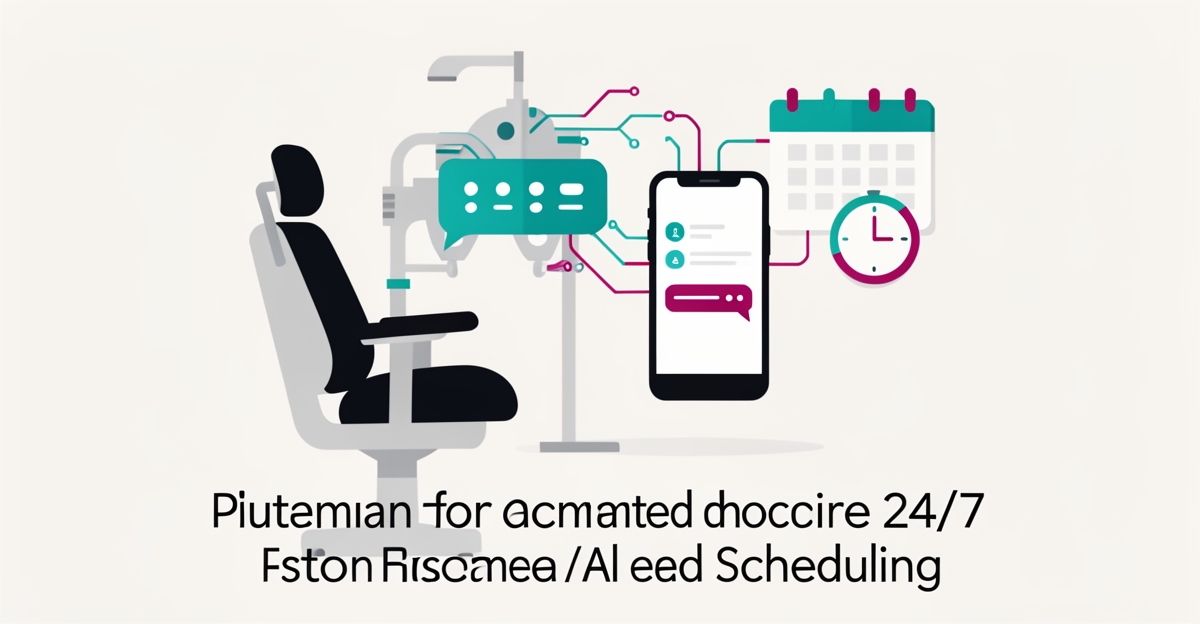
# AI-Powered Patient Communication: The Future of Vision Center Engagement
**Quick Answer:** Many consumers think healthcare is hard to reach, and AI-powered patient communication closes that gap for vision centers. AI receptionists and patient coordinators handle routine inquiries, schedule consults, and deliver instant answers 24/7, freeing staff to focus on complex care. AIQ Labs has deployed 200+ multi-agent systems and runs four live SaaS products daily, so this is production work, not theory.
## Key Facts
- A meaningful share of consumers say the healthcare system feels fundamentally broken, a signal of a deep disconnect between patient expectations and care delivery
- Healthcare leaders widely expect generative AI to reshape patient-facing workflows, with AI budgets typically growing faster than traditional IT spending as of late 2026
- Only a minority of AI pilots, often cited at around 30% in healthcare settings, make it to production, usually due to security, integration, and data-readiness barriers
- AI Employees from AIQ Labs typically cost around 80% less than an equivalent human hire while working 24/7/365
- AIQ Labs has deployed 200+ multi-agent systems and runs 4 live SaaS products daily
## Table of Contents
- [The Patient Engagement Gap in Vision Care](#the-patient-engagement-gap-in-vision-care)
- [How AI Chatbots Transform Vision Center Engagement](#how-ai-chatbots-transform-vision-center-engagement)
- [From Pilot to Production: Making AI Work in Healthcare](#from-pilot-to-production-making-ai-work-in-healthcare)
- [Building Owned AI Employees for Vision Centers](#building-owned-ai-employees-for-vision-centers)
### The Patient Engagement Gap in Vision Care
When a large share of your potential patients feel the healthcare system is broken, the problem isn't just clinical, it's communicational. Consumer research consistently shows a crisis of confidence in how care is delivered, and that disconnect hits vision centers particularly hard.
Patients today expect instant answers about LASIK candidacy, insurance coverage for specialty lenses, and appointment availability, yet many practices still rely on phone lines that go to voicemail after 5 PM and front-desk staff juggling five tasks at once. The gap between expectation and capacity creates friction that drives patients toward competitors or delays care entirely.
The operational strain runs deeper than missed calls. Human clinicians face **limited capacity and burnout risk** while attempting to provide empathetic, personalized care, a challenge that intensifies as patient volumes grow. When your optical technicians spend their day answering the same questions about contact lens fittings and pricing, they're not applying their expertise to complex patient needs.
Several systemic pressures are converging to widen this engagement gap:
- Rising demand for immediate, 24/7 access to vision correction information and booking capabilities
- Staff burnout from repetitive administrative tasks that pull skilled professionals away from clinical work
- Limited after-hours availability when working patients actually have time to research procedures
- Inconsistent communication quality across different staff members and shifts
Patients remain cautiously optimistic about the future, but vision centers can't wait for systemic reform. Industry analysis as of late 2026 indicates that healthcare leaders broadly expect generative AI to be transformative, with AI budgets typically growing faster than traditional IT spending.
This is where **scalable, 24/7 communication** becomes essential rather than optional. AI-powered patient communication tools, like the [AI Employees deployed by AIQ Labs](/ai-employees), handle routine inquiries about vision correction options, schedule consultations, and provide instant responses without adding headcount. By automating these high-volume interactions, vision centers can bridge the engagement gap while protecting their human staff from burnout, ensuring patients receive immediate attention regardless of when they reach out.
### How AI Chatbots Transform Vision Center Engagement
AI-powered chatbots and voice agents are reshaping how vision centers engage with patients by handling routine inquiries, scheduling consultations, and delivering instant answers about vision correction options. These systems reduce wait times and free up clinical staff to focus on more complex patient needs, directly improving both engagement and operational efficiency. AI-driven automation is no longer experimental, it's delivering real-world results in patient-facing workflows across healthcare.
Vision centers implementing AI chatbots see improved patient satisfaction through 24/7 access to information and seamless appointment booking, reducing friction in the patient journey. The technology ensures consistent, accurate responses to common questions about LASIK, cataract surgery, or contact lens options, minimizing misinformation and building trust. Healthcare leadership surveys consistently signal strong confidence in AI's long-term i
AI Employees
Hire a team member that works 24/7 — for less than a part-time wage.
AI receptionists, SDRs, dispatchers and 99+ roles. Trained on your business, fully managed.
See If You’re a Fit — AI Employees from $700/mo
Not sure where to start? Ask our AI planner
mpact on care delivery and patient experience, reinforcing that this shift is widely viewed as essential for modernizing vision care services.
- Handle frequent patient questions about procedures, pricing, and preparation
- Schedule and reschedule consultations without human intervention
- Provide instant, accurate information on vision correction options
- Reduce administrative burden on front desk and clinical teams
- Support compliance through standardized, auditable interactions
AIQ Labs supports vision centers in deploying these capabilities through managed [AI Employees](/ai-employees) trained specifically for patient coordination and support roles, receptionists, intake specialists, schedulers, and 99+ other roles. By integrating chatbots with scheduling systems and patient management platforms, centers create a seamless flow from initial inquiry to appointment confirmation. This approach not only improves efficiency but also aligns with the broader trend toward digitally enabled, decentralized care delivery, where AI plays a central role in empowering clinicians and personalizing patient interactions, making early adoption a strategic advantage for forward-thinking vision centers.
### From Pilot to Production: Making AI Work in Healthcare
The gap between AI promise and AI production is real: only a minority of AI pilots, often cited at around 30% in healthcare settings, make it to production. For vision centers eager to deploy intelligent patient communication tools, understanding why most pilots stall is the first step toward joining the successful minority.
The barriers are predictable. Security concerns top the list, followed by integration challenges, lack of in-house AI expertise, and data readiness issues. These aren't minor technical hiccups, they're structural obstacles that can derail even well-funded initiatives.
**Privacy and security cannot be afterthoughts** in healthcare AI. Patient communication systems handle sensitive health information daily, and any vulnerability creates regulatory exposure and erodes trust. AI chatbots answering questions about vision correction options or scheduling consultations must encrypt data end-to-end and maintain strict access controls from day one.
Bias presents another critical challenge. AI systems trained on incomplete data can deliver inaccurate or skewed responses to patient queries. In vision care, where treatment recommendations vary by age, medical history, and lifestyle factors, chatbots must provide accurate, empathetic responses across diverse patient populations. Poor training data leads to poor outcomes.
Integration complexity kills many pilots before they scale. Connecting AI chatbots to electronic health records, scheduling systems, and practice management software requires deep technical expertise. Without seamless EHR integration, even the most sophisticated AI becomes an isolated tool that creates more work than it eliminates.
**The path forward demands compliance-first design**. This means building AI systems with:
- End-to-end encryption and audit trails for all patient interactions
- Human oversight protocols for complex or sensitive queries
- Regular bias testing and accuracy validation
- Deep integration with existing EHR and practice management systems
- Transparent escalation paths to human staff when needed
The stakes are high because the opportunity is significant. Industry forecasts widely expect providers to reengineer care delivery, decentralize services, and use digital platforms and AI to empower clinicians and personalize care over the coming decade. Vision centers that solve the production challenge now position themselves ahead of this transformation.
AIQ Labs builds AI systems specifically for healthcare environments, with compliance, accuracy, and EHR integration engineered in from the start. Rather than handing vision centers a chatbot template, we deploy trained AI patient coordinators that handle scheduling, answer vision correction questions, and escalate complex cases, while maintaining the security and empathy healthcare demands. With 200+ multi-agent systems deployed, this is work we do every day.
The low production success rate isn't a verdict on AI's potential. It's a signal that production-grade healthcare AI requires specialized expertise most organizations don't have in-house. Vision centers that partner with builders who understand both AI architecture and healthcare compliance can move from pilot to production while competitors remain stuck in testing.
### Building Owned AI Employees for Vision Centers
Vision centers face growing pressure to deliver personalized patient engagement without overextending staff. AI-powered patient communication offers a path forward by automating routine interactions while preserving the human touch where it matters most. For vision centers, this means AI can handle appointment scheduling, answer common questions about vision correction options, and triage patient inquiries, freeing clinical staff to focus on exams and personalized care.
AIQ Labs' approach cen
AI Development
Still paying for 10+ subscriptions that don’t talk to each other?
We build custom AI systems you own outright. No vendor lock-in. Full control.
See If You’re a Fit — AI Employees from $700/mo
Not sure where to start? Ask our AI planner
ters on building owned AI Employees tailored to vision center workflows, such as Patient Coordinator or Intake Specialist roles. Unlike off-the-shelf chatbots, these AI Employees are custom-built and integrated directly with scheduling tools, CRM systems, and communication platforms. This ensures they perform end-to-end tasks, from booking consultations to sending pre-appointment reminders, while maintaining compliance and accuracy. Crucially, vision centers retain full ownership of the system, avoiding vendor lock-in and enabling long-term adaptability as needs evolve.
The investment model aligns with practical SMB realities. Through **Start Monthly**, vision centers can deploy an AI Employee for a fraction of the cost of a part-time hire, typically around 80% less than an equivalent human hire, including build, training, tool integrations, and ongoing optimization. For those seeking phased implementation, **Build in Milestones** allows approval and payment per workflow stage, such as intake automation followed by scheduling, with all progress retained. The **Own It Outright** model delivers full code, agent, and data ownership upon completion, ideal for centers pursuing a complete [AI Operating System](/ai-operating-systems). Full payment details are on the [pricing page](/pricing), no fake prices, no invented case-study numbers. Each approach includes human-in-the-loop governance to ensure critical decisions escalate appropriately, combining 24/7 availability with clinical oversight. This creates a sustainable foundation for AI-powered patient engagement that scales with the vision center's growth.
## Frequently Asked Questions
**Will an AI chatbot actually help my vision center patients or just frustrate them?**
AI chatbots handle routine inquiries about LASIK candidacy, insurance coverage and booking 24/7, reducing wait times and freeing clinical staff for complex care. AIQ Labs has deployed 200+ multi-agent systems, showing tangible value in patient-facing workflows.
**Are patients really demanding 24/7 answers for vision care?**
Yes. Rising demand for immediate, 24/7 access to vision correction information and booking is widening the engagement gap, especially after hours when working patients research procedures. Consumer research consistently shows frustration with how hard it is to reach providers, signaling a disconnect in access and communication.
**Is generative AI actually being adopted in healthcare, or is it just hype?**
Adoption is accelerating. Healthcare leaders widely expect generative AI to be transformative, and AI budgets typically grow faster than traditional IT spending as of late 2026. The shift is increasingly viewed as essential for modernizing vision care services.
**What's the biggest risk if we try a pilot and it fails?**
Only a minority of AI pilots, often cited around 30% in healthcare, make it to production, usually due to security concerns, integration challenges, lack of in-house AI expertise and data readiness issues. Privacy and security must be built in from day one with end-to-end encryption, audit trails and human oversight for sensitive queries.
**Can AI chatbots be trusted with patient data and accurate medical info?**
They can when designed compliance-first. Systems must encrypt data end-to-end, maintain strict access controls, and undergo regular bias testing and accuracy validation. Integration with EHRs and practice management platforms ensures consistent, auditable responses and safe escalation to human staff.
**How soon do we need to act on AI patient communication?**
Industry forecasts widely expect providers to reengineer care delivery and use digital platforms and AI to empower clinicians and personalize care over the coming decade. Vision centers that solve production challenges now position themselves ahead of this transformation rather than waiting for systemic reform.
## Close The Engagement Gap Before It Costs You Patients
Vision centers are caught between rising patient expectations for instant, 24/7 answers and staff stretched thin by repetitive inquiries. AI-powered patient communication closes that gap by handling routine questions about LASIK candidacy, insurance and scheduling, delivering consistent responses around the clock while freeing clinicians to focus on complex care. The challenge isn't the idea of AI, it's production: most healthcare AI pilots stall without compliance-first design, deep EHR integration and human oversight. Centers that solve for privacy, accuracy and ownership now position themselves ahead of the industry-wide shift toward digitally enabled, personalized care. If you're evaluating this, start with one high-volume workflow, [Workflow Builds](/workflow-builds) are a fixed-price way to rebuild the one workflow that costs you the most, map the handoff to human staff, and choose a partner that builds owned AI Employees you control rather than rent. Start the 2-minute Fit Check at [aiqlabs.ai/apply](/apply) for a free 30-minute strategy call to map your biggest bottleneck and see if there's a clear, low-risk win.
AI Transformation Partner
Make AI your competitive advantage — not just another tool.
Strategy, implementation and ongoing optimization. One partner, end to end.
See If You’re a Fit — AI Employees from $700/mo
Not sure where to start? Ask our AI planner