AI-Powered Quality Control: How Bridge Builders Can Automate Inspections Without Hiring More Staff
Key Facts
- Human inspectors typically catch only 70–80% of defects even under optimal conditions, according to visual inspection research
- Automated systems can achieve defect detection accuracy exceeding 99% in controlled studies, though real-world performance varies
- AI inspection systems can reduce manual inspection hours by roughly half in reported industry implementations
- Manual inspection error rates are commonly cited in the 15–40% range of defects missed
- Annual labor cost for a manual inspector can exceed $89,000, per industry cost analyses
- AI can analyze photos and video footage of bridge components to detect defects in real time
- AI won't replace certified inspectors yet; it helps them prioritize and document
Hire a team member that works 24/7 — for less than a part-time wage.
AI receptionists, SDRs, dispatchers and 99+ roles. Trained on your business, fully managed.
Not sure where to start? Ask our AI planner
The Inspection Bottleneck Bridge Teams Can't Staff Their Way Out Of
Bridge owners are being asked to monitor more structures with the same inspector hours, and the math no longer works. Every inspection cycle repeats the same constraints: limited crews, hazardous access, and human variability that caps what can actually be found.
Traditional inspections rely on human eyes, scaffolding, lane closures, and subjective judgment. That approach creates a predictable bottleneck where coverage shrinks as the inventory grows. Teams must choose which structures get attention and which wait, while safety exposure and traffic impacts accumulate with each deployment.
Human visual inspection has a fundamental problem: humans are inconsistent. Even trained inspectors working in optimal conditions typically catch only 70–80% of defects. The gap is not a skill issue; it is a biological and logistical limit under field conditions, fatigue, and difficult access.
The inconsistency translates directly into error rates. Industry analyses commonly cite manual inspection error rates of 15–40% of defects missed, with annual labor cost per inspector that can exceed $89,000. Those costs scale linearly with headcount, yet adding staff does not fix variability or speed.
Safety risk compounds the staffing problem. Inspectors routinely work at heights, under decks, and in active traffic zones. Scaffolding and lane closures add cost, schedule risk, and public disruption, making frequent re-inspections impractical even when condition data is uncertain.
The resource gap shows up as three reinforcing pressures:
- More structures to monitor than inspector hours available, forcing triage and longer intervals
- Inconsistent detection that leaves subtle wear, corrosion, and cracks unnoticed until they worsen
- High cost and safety exposure per inspection that resists scaling with traditional crews
AI can analyze photos and video footage of bridge components to detect defects in real time, shifting the bottleneck from human availability to data capture. Systems in this category of AI business process automation turn imagery into structured, auditable findings that support compliance.
AIQ Labs builds production-ready AI systems that reduce reliance on manual inspection labor while maintaining compliance standards. The intent is not to replace certified judgment but to augment inspection capacity by providing consistent first-pass triage and documentation that inspectors can verify. If inspection workflows are your single biggest cost center, our AI Workflow Builds rebuild that one workflow at a fixed price, in phases.
Without a change in how data is captured and reviewed, bridge teams will continue to staff their way into the same limits: rising labor spend, missed defects, and inspections that are too slow and risky to scale.
How AI Augments Inspectors With Drone Vision and Real-Time Defect Detection
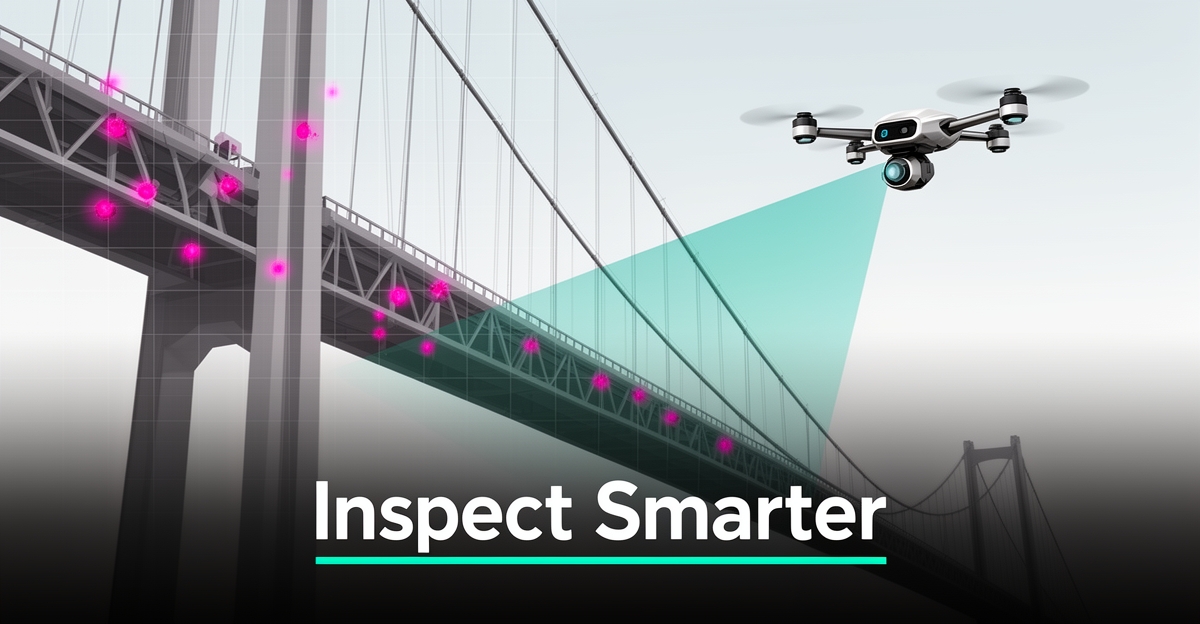
The most dangerous bridge defects hide exactly where human eyes can't easily reach—beneath deck soffits, along cable stays, inside box girders. AI-powered inspection systems are closing that gap by pairing drone-mounted sensors with computer vision models that never blink, never fatigue, and never miss a shift.
The inspection stack starts with data capture. UAVs equipped with high-resolution RGB cameras, LiDAR scanners, and infrared thermal sensors fly repeatable flight paths around a structure, collecting imagery and spatial data from angles that would otherwise require scaffolding, lane closures, or rope-access teams. This combination of drones and advanced sensors serves as the "eyes" of the system, feeding raw visual data into the AI layer for analysis.
That AI layer is where detection happens. Deep learning models trained on labeled defect datasets scan every frame to identify and localize cracks, corrosion, spalling, and deformation. The accuracy ceiling is striking—automated systems have achieved defect detection accuracy exceeding 99% in controlled studies, compared to human inspectors who typically catch only 70–80% of defects even under optimal conditions. Real-world performance varies with lighting, defect type, and training data quality, so treat published figures as benchmarks rather than guarantees. The AI doesn't get tired at hour six of a deck underside survey. It applies the same rigor to image one and image ten thousand.
After detection, the system generates structured outputs automatically. Rather than an inspector handwriting field notes and transcribing them days later, the platform produces:
- Annotated images pinpointing each defect's exact location on the structure
- Quantitative measurements such as crack width, length, and affected area
- Condition ratings and severity classifications for each flagged anomaly
- Formatted inspection reports ready for engineering review and regulatory submission
This is where augmentation—not replacement—becomes the operative principle. AI handles the triage: scanning thousands of images, flagging anomalies, quantifying severity, and assembling documentation. But when a flagged crack could mean load restrictions or emergency repairs, a certified engineer reviews the evidence and makes the final call. As industry analyses put it plainly: AI won't replace certified inspectors yet; it helps them prioritize and document.
The practical impact is significant. Reported implementations show AI inspection systems can cut manual inspection hours by roughly half, freeing experienced engineers to focus on structural assessment rather than data collection. For bridge owners managing dozens or hundreds of structures with limited staff, that shift in how inspector hours get spent changes what's operationally possible.
AIQ Labs builds exactly this kind of production-ready inspection pipeline—custom computer vision systems trained on your structure types, integrated with your asset management workflows, and designed with human-in-the-loop verification at every safety-critical decision point. For owners who want inspection, maintenance, and asset data running on one connected layer, our AI Operating Systems are built in phases and owned outright. The goal isn't to remove engineers from the process. It's to make sure their expertise goes where it matters most.
From Pilot to Production: A Lean Implementation Roadmap for Bridge Owners
Starting small with a single-bridge pilot lets owners validate AI inspection value without disrupting existing workflows or requiring major staff additions. Industry analyses note that human inspectors miss a meaningful share of defects—commonly cited in the 15–40% range—due to fatigue and inconsistency, making automated triage a practical first step toward more reliable assessments. Even trained inspectors typically catch only 70–80% of defects under optimal conditions, highlighting where AI can augment human expertise.
Begin by establishing a repeatable drone flight plan over the selected bridge to ensure consistent data capture across inspections. Collect roughly 200–1,000 labeled images per defect type—such as cracks, spalling, or corrosion—focusing on varied angles, lighting conditions, and clear bounding boxes around each anomaly. This dataset foundation enables training a lightweight detection model whose precision and recall can be measured against known defects, providing an objective baseline for performance evaluation. Industry guidance emphasizes that labeled image volume directly impacts model reliability, especially for complex, variable defects.
Integrate the model's outputs—annotated images with defect locations and severity scores—into existing inspection templates to create hybrid reports where AI flags potential issues for human verification. Define success metrics early, such as reduction in inspection time per bridge or increase in defect detection rate compared to manual baselines, and track them throughout the pilot. Practical implementations show AI systems can reduce manual inspection hours substantially while maintaining compliance through human-in-the-loop validation.
Plan for scale by establishing a quarterly retraining cadence using new field data and documenting operator workflows for model feedback and exception handling. AIQ Labs supports this transition through AI Workflow Builds—fixed-price, phased projects that produce production-ready systems clients own outright, ensuring long-term control over inspection capabilities without vendor lock-in. This lean approach transforms inspection from a reactive, labor-intensive task into a scalable, data-driven process that augments—not replaces—certified inspector judgment.
Still paying for 10+ subscriptions that don’t talk to each other?
We build custom AI systems you own outright. No vendor lock-in. Full control.
Not sure where to start? Ask our AI planner
Frequently Asked Questions
How much can AI-powered inspection systems reduce manual inspection hours for bridge teams?
What percentage of defects do human inspectors typically miss during bridge inspections, even under optimal conditions?
Can AI-powered inspection systems replace certified bridge inspectors?
What accuracy can AI-powered defect detection systems achieve compared to human inspectors?
What is the annual labor cost for manual bridge inspection per inspector, and how does adding staff affect variability?
How do AI inspection systems improve safety during bridge assessments?
Turning Inspection Bottlenecks into Scalable Advantage
Bridge owners face a growing mismatch between inspection demand and inspector capacity, where traditional methods commonly miss 15–40% of defects due to human inconsistency and fatigue, driving up long-term risk and cost. AI-powered systems don't replace certified judgment—they augment it by using drones and computer vision to deliver consistent, auditable defect detection at scale, cutting manual inspection hours substantially while improving accuracy. This shifts the bottleneck from labor availability to data capture, freeing experts to focus on structural assessment rather than data collection. For teams managing aging infrastructure with limited staff, the path forward starts small: run a single-bridge pilot to validate impact, then scale with human-in-the-loop verification. To explore how this approach fits your workflow, take the free two-minute Fit Check to identify your highest-ROI automation opportunity—no obligation, just clarity on where AI can make your inspection process faster, safer, and more reliable.
Make AI your competitive advantage — not just another tool.
Strategy, implementation and ongoing optimization. One partner, end to end.
Not sure where to start? Ask our AI planner