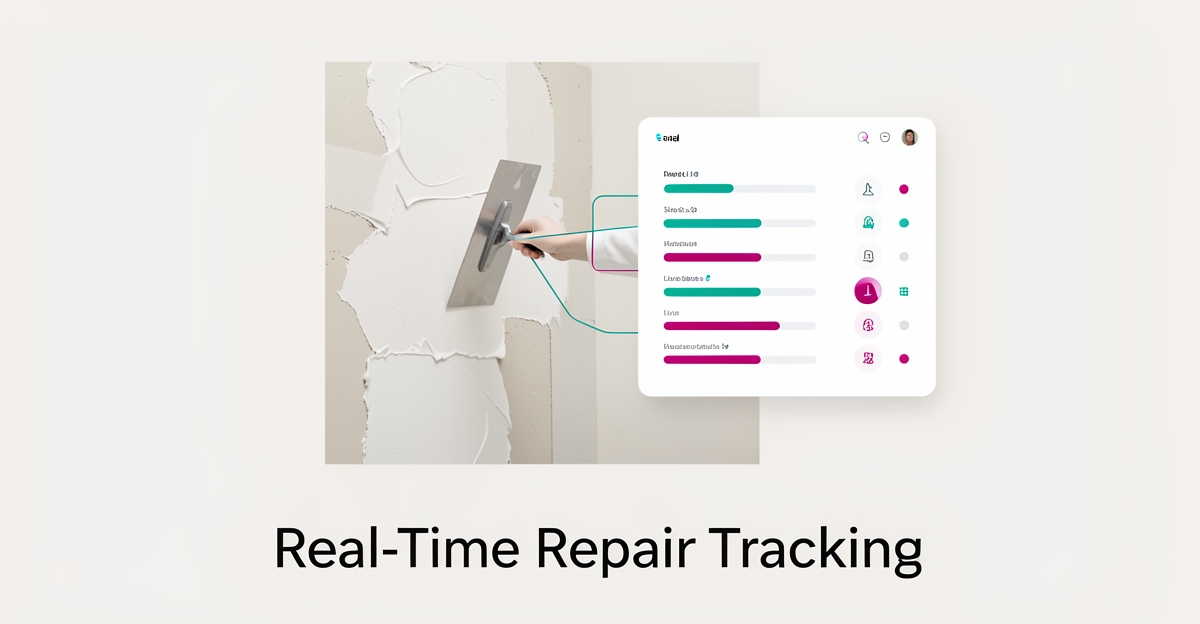
# AI-Powered Repair Tracking: How to Monitor Plaster Restoration Jobs in Real Time
**Quick Answer:** See plaster restoration jobs live with AI-powered tracking. Dashboards surface progress, technician activity and emerging issues as they happen, so small problems stay small.
## Key Facts
n
- Reactive monitoring is one of the most expensive blind spots in restoration work: issues typically surface only after the client notices
- AI-driven monitoring shifts teams from reactive fixes to proactive intervention by catching problems while they're still small
- Real-time dashboards let owners see job progress, technician activity and emerging issues across multiple concurrent jobs at once
- Frontline technician burnout is widely documented; monitoring that removes guesswork gives time back to field teams
- SMBs no longer need enterprise budgets to get enterprise-grade visibility, custom monitoring systems can be built and owned outright
## Table of Contents
1. [The Visibility Gap in Plaster Restoration](#the-visibility-gap-in-plaster-restoration)
2. [How AI Monitoring Transforms Job Progress and Performance](#how-ai-monitoring-transforms-job-progress-and-performance)
3. [Building a Real-Time Plaster Restoration Tracking System](#building-a-real-time-plaster-restoration-tracking-system)
4. [From Data to Decisions: Dashboards, Alerts and Continuous Improvement](#from-data-to-decisions-dashboards-alerts-and-continuous-improvement)
## The Visibility Gap in Plaster Restoration
A plaster restoration job can go sideways in hours, yet most owners don't find out until the client calls to complain. The information gap between what's happening on-site and what's happening in the office is one of the most expensive blind spots in the restoration business.
Traditional monitoring relies on manual check-ins and periodic inspections, which means issues surface late, if they surface at all. By the time a problem is discovered, what should have been a minor correction has often become a costly rework, a missed deadline, or an unhappy client. This reactive approach forces businesses to respond to failures rather than prevent them.
The human cost is just as significant. Frontline field-service work is widely associated with burnout, and technicians juggling unpredictable hours and demanding timelines feel that pressure most. When teams lack the resources and information to resolve problems quickly, it creates headaches for customers and dents technician morale alike.
The consequences of reactive monitoring show up across the industry:
- Delays in detecting quality issues, turning small fixes into expensive rework
- Unplanned failures that disrupt schedules and inflate labor costs
- Technician burnout driven by wasted trips, missing information, and unclear priorities
- Client disputes rooted in incomplete or delayed documentation
The alternative is shifting from reactive to **predictive monitoring**. The principle is simple: continuous data collection and automated analysis catch problems while they're still small. Instead of waiting for a supervisor to drive to a site, owners can see job progress, technician activity, and emerging issues the moment they appear. AI-powered dashboards surface performance trends across multiple concurrent jobs, flagging bottlenecks before they cascade. AI succeeds not by replacing people but by augmenting them, giving teams real-time insights to make faster, better decisions.
For small and medium-sized restoration businesses, closing this visibility gap no longer requires enterprise budgets. AIQ Labs builds custom monitoring systems and dashboards for SMBs in the construction sector, whether as a single [workflow build](/workflow-builds) that fixes the one process costing you the most, or a fuller [AI operating system](/ai-operating-systems) that connects your whole operation. The first step is simply recognizing that **what you can't see, you can't fix**, and that manual check-ins were never designed to keep up with modern restoration workloads.
## How AI Monitoring Transforms Job Progress and Performance
Real-time visibility changes how plaster restoration teams work, turning fragmented job updates into continuous, actionable intelligence. Sensors, AI analytics and dashboards connect the job site to the office, so progress, performance and client sentiment are tracked as they happen.
AI-powered monitoring replaces manual check-ins with continuous real-time data collection via sensors. That shift enables immediate alerts and recommendations instead of delayed responses to issues.
Predictive maintenance moves teams from reactive fixes to proactive intervention. AI analyzes sensor data and uses pattern recognition to spot early signs of wear or trouble, allowing work to be planned before breakdowns occur. For restoration bu
AI Employees
Hire a team member that works 24/7 — for less than a part-time wage.
AI receptionists, SDRs, dispatchers and 99+ roles. Trained on your business, fully managed.
See If You’re a Fit — AI Employees from $700/mo
Not sure where to start? Ask our AI planner
sinesses, that means fewer callbacks and more predictable margins across multiple simultaneous projects.
Dashboards make performance visible to technicians, supervisors and clients. Custom views surface job completion rates, quality scores, resource utilization and client feedback ratings in real time. This **visibility into performance trends** lets managers reallocate crews, reschedule materials and address bottlenecks before they impact satisfaction.
Resource optimization is immediate and data-driven. AI suggests the best technicians, equipment and facilities for each job based on skills, proximity and current workload. The result is improved efficiency, reduced overtime and more predictable arrival and completion times.
Value tends to emerge quickly after a structured deployment, early wins typically include fewer callbacks, better schedule adherence, and more predictable margins. SMBs in construction gain enterprise-grade capabilities without enterprise complexity.
AIQ Labs builds these monitoring tools for SMBs in the construction sector, integrating with existing project management and scheduling systems. Dashboards track job progress, technician performance and client satisfaction in real time, and everything is built to fit your operation rather than force you into a generic platform.
Typical monitoring gains include:
- Predictive alerts for delays, quality issues or material shortages before they escalate
- Live technician activity and skill matching for optimized dispatch
- Client satisfaction tracking tied to completion milestones and feedback
- Continuous feedback loops that refine AI models from real-world outcomes
Teams respond faster, finish cleaner and keep clients informed. That combination of speed, quality and transparency builds trust and repeat work.
## Building a Real-Time Plaster Restoration Tracking System
Building a real-time plaster restoration tracking system starts with defining clear, measurable goals that align with your restoration business's operational priorities. By setting SMART metrics, such as job completion rates, technician response times, and client satisfaction scores, you create a foundation for data-driven decision making.
Next, deploy the necessary monitoring infrastructure at job sites, including environmental sensors, progress-tracking cameras, and IoT devices that capture real-time data on curing conditions, material application, and workflow stages. Integrate this infrastructure with an AI analytics platform capable of processing sensor inputs and visual data to detect anomalies, predict delays, and assess quality outcomes. Connect the system to existing project management tools to ensure seamless data flow and avoid siloed information, enabling supervisors to access unified dashboards that display live job progress, technician activity, and environmental variables.
Configure customized dashboards that highlight key performance indicators such as material usage efficiency, schedule adherence, and quality control results in real time. Establish automated alert systems that trigger when critical thresholds are breached, such as humidity levels outside optimal ranges or delays exceeding predefined tolerances, allowing for immediate intervention. Train technicians and supervisors on interpreting dashboard insights and responding to alerts, ensuring the team can act on AI-generated recommendations without delay. Implement feedback loops by collecting input from field staff and clients after job completion to refine AI models and improve monitoring accuracy over time. Finally, scale the system across additional sites and service lines once pilot results demonstrate consistent improvements in efficiency, quality, and client satisfaction.
AIQ Labs supports SMBs in the construction sector through [workflow builds](/workflow-builds) that rebuild the one workflow costing you the most, at a fixed price, in phases, or a full [AI operating system](/ai-operating-systems) built in milestones and owned outright. Either path gives you a cohesive system designed for long-term scalability and operational clarity.
## From Data to Decisions: Dashboards, Alerts and Continuous Improvement
Collecting data is easy. Turning it into decisions is where restoration businesses win or lose. The final piece of an AI-powered repair tracking system is the layer that transforms raw job-site signals into dashboards your team actually uses, alerts they actually act on, and improvements that compound over time.
**Custom dashboards** consolidate everything into a single view: job completion rates, quality scores, technician utilization, and client satisfaction metrics, all updating in real time. Instead of piecing together status from phone calls and paper notes, owners and supervisors see which plaster restoration jobs
AI Development
Still paying for 10+ subscriptions that don’t talk to each other?
We build custom AI systems you own outright. No vendor lock-in. Full control.
See If You’re a Fit — AI Employees from $700/mo
Not sure where to start? Ask our AI planner
are on track and which are drifting.
Dashboards alone, however, only show you what happened. Automated alerts close the loop by flagging problems the moment thresholds are crossed:
- Delays that push a job past its scheduled completion window
- Quality score dips that suggest rework is needed before the client notices
- Technician bottlenecks where utilization spikes or a crew is stretched thin
- Environmental readings at the job site that fall outside acceptable ranges
This is the difference between reactive and proactive management. The goal is to make the best operational decisions before failure makes the decision for you. Alerts enable intervention while a job is still salvageable, not after the client complaint arrives.
Continuous improvement is the last ingredient. Feedback loops between field teams and the AI system refine alerts, tune quality benchmarks, and sharpen predictions based on real-world outcomes. This matters for technician morale, too: monitoring that removes guesswork gives time back to teams already stretched thin.
For SMBs in the construction sector, how you build this layer matters as much as what it does. AIQ Labs builds custom monitoring and dashboard systems that clients own outright, no vendor lock-in, no platform dependencies, drawing on production experience across 200+ multi-agent systems deployed and 4 live SaaS products the company runs daily. Payment models are straightforward: Start Monthly, Build in Milestones, or Own It Outright, see [pricing](/pricing) for how each works. Restoration businesses can phase the investment: approve each milestone as it ships, and keep everything built if you stop.
If you want to see what a custom dashboard and alert system would look like for your restoration operation, take the two-minute [Fit Check](/apply) and book a free 30-minute strategy call. It's a working session with an AI engineer, and if there isn't a clear win, you'll hear that too.
## Frequently Asked Questions
**How does real-time AI monitoring actually help plaster restoration jobs on site?**
It replaces manual check-ins with continuous sensor and visual data collection so owners see job progress, technician activity, and emerging issues the moment they appear. AI dashboards surface performance trends across concurrent jobs and flag bottlenecks before they cascade, shifting teams from reactive fixes to proactive intervention.
**Won't adding sensors and dashboards just create more work for my technicians?**
The goal is augmentation, not replacement. Monitoring removes guesswork and wasted trips, two of the biggest drivers of frontline burnout in field service work. Teams get real-time insights to make faster decisions with less pressure.
**Is AI monitoring only for large restoration companies?**
No. SMBs can get enterprise-grade visibility with custom systems that integrate with existing project management tools. AIQ Labs builds for SMBs specifically, with payment models (Start Monthly, Build in Milestones, Own It Outright) that let smaller operations phase the investment.
**How quickly can we see value after implementing AI tracking?**
With structured implementation, early wins typically show up within the first few months: fewer callbacks, better schedule adherence, and more predictable margins. A phased build means you approve each milestone as it ships, so value is visible step by step.
**Can AI really predict problems before clients complain?**
Yes, through predictive monitoring. Sensor-based pattern recognition spots anomalies, environmental readings outside curing ranges, schedule drift, quality dips, early enough to intervene while a job is still salvageable, not after a client complaint arrives.
**What kind of alerts will we actually get for plaster restoration?**
Automated alerts trigger when thresholds are breached, such as delays past scheduled completion, quality score dips suggesting rework, technician bottlenecks, or environmental readings outside optimal curing ranges.
## From Guesswork to Real-Time Control
This article has shown how AI-powered repair tracking closes the visibility gap in plaster restoration, turning delayed reactions into proactive decisions. By deploying sensors, AI analytics, and custom dashboards, businesses gain real-time insight into job progress, technician performance, and client satisfaction, preventing small issues from becoming costly rework. For SMBs in construction, this means enterprise-grade monitoring without enterprise complexity, enabling faster responses, optimized dispatch, and stronger client trust. If you're ready to see what real-time tracking could look like for your operation, start with a two-minute [Fit Check](/apply) and book a free 30-minute strategy call to explore your highest-impact opportunities, no obligation, just clarity.
AI Transformation Partner
Make AI your competitive advantage — not just another tool.
Strategy, implementation and ongoing optimization. One partner, end to end.
See If You’re a Fit — AI Employees from $700/mo
Not sure where to start? Ask our AI planner