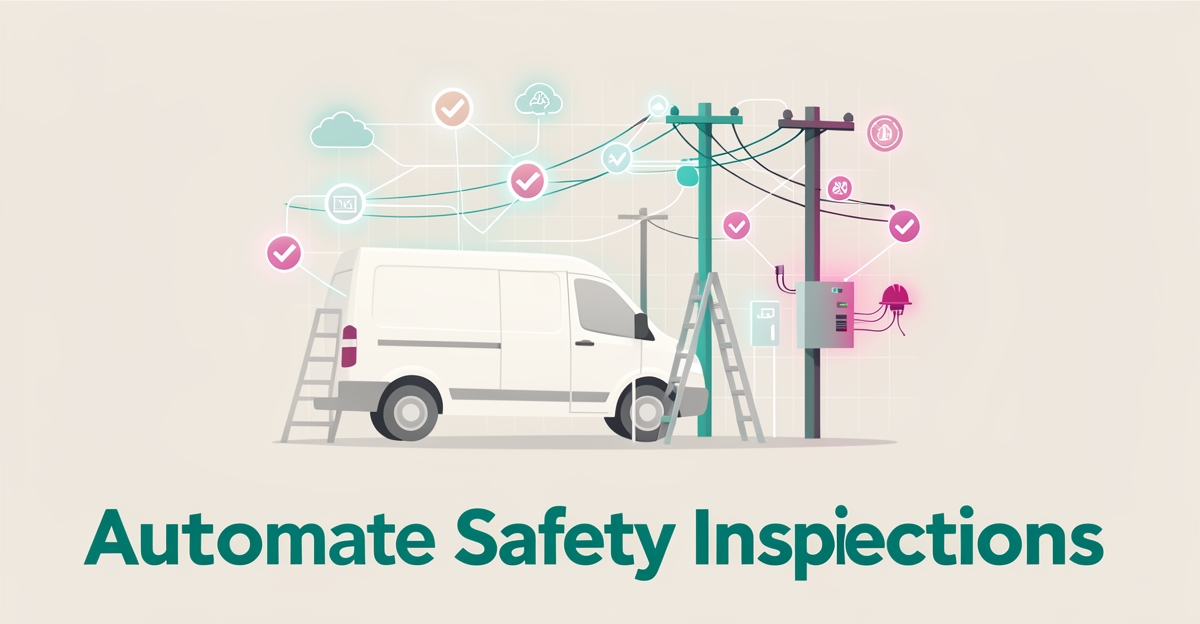
AI-Powered Safety Compliance: How Electricians Can Automate Pre-Work Inspections
Key Facts
- AI agents analyze weather reports, equipment logs, and job site data to flag safety risks before service begins
- Automated compliance systems typically cut manual documentation time dramatically versus paper-based methods
- Proactive hazard identification is widely associated with lower accident rates and improved crew productivity
- AI systems generate timestamped inspection records automatically, creating audit-ready trails for every job
- Industry analysts broadly agree that compliance automation reduces human error in repetitive inspection and documentation tasks
- As of late 2026, electricians increasingly need digital fluency alongside traditional trade skills as connected infrastructure spreads
Hire a team member that works 24/7 — for less than a part-time wage.
AI receptionists, SDRs, dispatchers and 99+ roles. Trained on your business, fully managed.
Not sure where to start? Ask our AI planner
The Hidden Cost of Manual Pre-Work Safety Inspections
Manual pre-work safety inspections for electricians often rely on paper checklists or mental notes, creating significant liability exposure and inefficiency. This approach leaves room for critical oversights, especially when technicians are rushed or fatigued on the job site. Without standardized digital verification, compliance gaps can go unnoticed until an incident occurs, putting both workers and businesses at risk.
Compliance professionals broadly agree that automation removes human error from repetitive inspection and documentation tasks. For electricians, this means eliminating the guesswork in pre-work assessments, such as verifying lockout/tagout procedures, checking PPE availability, or confirming equipment calibration, through systematic, data-driven validation. When inspections depend on human recall or fragmented paperwork, the likelihood of missed hazards increases significantly.
The hidden costs of these inefficiencies extend beyond safety risks to include wasted time, rework, and potential regulatory penalties. Electricians may spend valuable service hours manually documenting inspections that could be automated, delaying job completion and reducing daily capacity. Furthermore, inconsistent inspection records weaken audit readiness and complicate liability defense in the event of an accident.
- Time spent on manual documentation reduces billable hours and delays project timelines
- Inconsistent inspection practices increase vulnerability to OSHA violations and fines
- Human error in checklists can lead to undetected equipment faults or unsafe site conditions
- Lack of real-time data integration prevents proactive risk mitigation based on weather or equipment logs
- Paper-based systems create storage challenges and hinder quick retrieval during audits or investigations
AIQ Labs addresses these challenges through AI Workflow Builds that rebuild the one workflow costing you the most, often pre-work inspection and documentation, at a fixed price and in phases. These systems analyze job site data, weather reports, and equipment logs to flag potential safety risks before service begins, ensuring compliance with local safety codes while reducing the administrative burden on electricians. By transforming pre-work inspections from a reactive, error-prone task into a proactive, automated workflow, businesses can minimize liability exposure and protect their teams more effectively.
How AI Agents Analyze Job Sites, Weather, and Equipment in Real Time
Traditional pre-work inspections rely on clipboard checklists and memory, methods that miss hazards lurking in weather shifts, equipment wear, or last-minute code updates. Multi-agent AI systems flip this model by ingesting site photos, live weather feeds, equipment telemetry, and local code databases before a crew ever pulls onto the property.
Each agent in the swarm specializes: one cross-references real-time wind, precipitation, and temperature data against OSHA thresholds for working at height; another compares equipment diagnostic logs against manufacturer safety bulletins; a third maps the job address to the exact NEC edition and municipal amendments enforced in that jurisdiction. The result is a risk briefing that arrives hours before the first toolbag opens, not a post-incident report.
- Site photos analyzed for clearance violations, trip hazards, and missing signage
- Weather APIs monitored for lightning risk, heat index, and high-wind advisories
- Equipment telemetry scanned for insulation degradation, calibration drift, and fault codes
- Local code databases queried for permit-specific requirements and recent amendments
Proactive hazard identification is widely associated with lower accident rates and improved crew productivity, and compliance automation practitioners consistently report that automated tools outperform manual processes by removing human error from repetitive checks. Industry analysis as of late 2026 also suggests that a large share of electricians will need multi-disciplinary technical fluency in the coming years to operate alongside these intelligent systems.
AIQ Labs builds industry-specific AI agents that orchestrate this exact data fusion, turning fragmented inputs into a single, actionable safety intelligence layer for electrical contractors. The shift moves compliance from reactive paperwork to proactive intelligence, giving crews the situational awareness they need before they step on site.
From Code Compliance to Cybersecurity: The Expanded Safety Scope
The traditional electrician's toolkit is expanding beyond multimeters and wire strippers to include digital fluency and cybersecurity vigilance. As electrical infrastructure becomes increasingly connected through smart grids, IoT devices, and renewable energy integrations, safety compliance now encompasses protecting operational technology (OT) environments from cyber threats. This shift demands that electricians evolve into multi-disciplinary technicians capable of interpreting data streams, securing networked systems, and applying both physical and digital safeguards.
Industry projections generally agree that by the end of the decade, most electricians will need to work as multi-disciplinary technicians, handling the convergence of electrical work with data analysis and cybersecurity responsibilities. This transformation isn't merely additive, it redefines competency requirements for modern electrical work. Electricians must now understand how to interpret data from smart meters, assess vulnerabilities in connected lighting controls, and recognize anomalies in building automation systems that could indicate either equipment failure or intrusion attempts.
AI plays a dual role in this expanded safety scope: enhancing physical hazard detection while strengthening cyber defenses. AI systems can analyze job site data, weather reports, and equipment logs to flag potential safety risks before service begins. Simultaneously, AI-powered cybersecurity tools help identify anomalous network behavior in OT environments, such as unexpected communication patterns between inverters and grid management systems, enabling early intervention against threats that could compromise both safety and service continuity.
- Interpreting real-time data from smart grids and energy management systems
- Applying cybersecurity protocols to protect connected electrical infrastructure
- Using AI to correlate physical equipment status with network activity logs
- Documenting compliance across both safety and cybersecurity domains
This expanded scope creates natural synergies with AIQ Labs' approach to industry-specific AI solutions, where agents are trained not only on electrical codes but also on the digital contexts in which modern electrical systems operate. By integrating safety compliance monitoring with cybersecurity awareness tools, AI helps electricians navigate a work environment where physical safety and digital integrity are inextricably linked, ensuring that pre-work inspections address the full spectrum of risks inherent in today's interconnected infrastructure. As the line between electrical work and IT operations continues to blur, the electrician's role as a guardian of both physical and cyber safety becomes not just valuable, but essential.
Implementing AI Safety Agents Without Disrupting Field Operations
The biggest barrier to adopting AI safety tools isn't the technology, it's the fear of disrupting crews who already have full schedules. A phased rollout solves this by targeting one high-risk workflow first, letting teams see value before expanding to other job types.
Start with panel upgrade inspections, where the stakes are highest and documentation demands are most rigorous. As electrical work converges with data analysis and cybersecurity responsibilities, workflow automation becomes essential for managing increased complexity. By focusing on a single service type, you create a controlled environment to refine the AI's risk-flagging capabilities without overwhelming your dispatch operations.
A managed AI employee model eliminates the need for in-house expertise. Rather than hiring data scientists or training office staff on prompt engineering, electrical contractors can deploy a pre-trained AI dispatcher or safety coordinator, part of AIQ Labs' AI Employees lineup of managed AI staff, that integrates directly with existing dispatch software at roughly 80% less cost than a human hire. This approach mirrors how compliance automation streamlines evidence collection and audit preparation, removing manual pain points while maintaining human oversight for critical decisions.
The integration process typically follows this sequence:
- Connect the AI agent to your current field service management platform via API
- Configure risk parameters based on local electrical codes and your insurance requirements
- Run parallel testing for two weeks, where the AI flags risks but humans verify every alert
- Gradually shift to autonomous pre-work inspections for standard jobs, escalating only complex scenarios
Compliance automation practitioners consistently report that automated tools remove human error and handle repetitive manual tasks more effectively than traditional methods. This efficiency gain matters because pre-work safety analysis requires synthesizing weather reports, equipment logs, and job site data simultaneously, a task that delays morning dispatches when done manually.
AIQ Labs builds these industry-specific AI agents for electricians using a Start Monthly payment model that costs far less than a part-time hire, with build, training, and ongoing optimization included. The system learns your specific service territory and common hazard patterns without requiring your team to write code or manage servers.
As the AI handles routine pre-work inspections, your electricians focus on the complex diagnostic work that requires human judgment. This shift aligns with the broader finding that AI-powered safety compliance reduces accident risk while improving productivity. The technology handles the data synthesis; your team handles the skilled craftsmanship.
Measuring ROI: Reduced Liability, Faster Starts, and Audit-Ready Trails
When an electrician can prove that every inspection step was completed, documented, and timestamped, safety compliance stops being a cost center and starts becoming a business asset. Compliance automation practitioners widely report that AI and cloud compliance tools remove human error, automate manual tasks, and prove more effective and efficient than traditional methods.
The financial case is straightforward. Manual compliance admin, paper checklists, photo filing, evidence collection, audit prep, consumes hours that generate no revenue. Automated systems handle evidence collection and audit preparation as a byproduct of the workflow itself, which is where the substantial cost reduction versus manual compliance administration typically comes from. Instead of paying someone to assemble records after the fact, the records assemble themselves as work happens.
Zero missed steps matters just as much as cost. AI systems that analyze job site data, weather reports, and equipment logs can flag potential safety risks, equipment malfunctions, weather-related hazards, before service begins, and they never skip an item because the schedule ran late. Real-time visibility into control status means deviations get caught and fixed before they become audit findings.
That visibility translates directly into an audit-ready trail:
- Timestamped inspection records for every job, generated automatically
- Documented evidence of code compliance tied to each work order
- Complete logs that satisfy insurer requests and regulatory reviews without scrambling
- Proactive reporting that shows patterns before they become incidents
For insurers and regulators, this changes the conversation. A contractor who can produce a complete, verifiable safety record on demand presents a materially lower liability profile than one relying on memory and manila folders. And the payoff compounds: fewer accidents from AI-flagged risks mean cost savings and improved productivity, creating a feedback loop where better safety data drives better safety outcomes.
This is the approach behind industry-specific AI agents for trades, systems like those AIQ Labs builds for electricians analyze job site conditions against local safety codes and generate the compliance documentation as work proceeds. For contractors ready to go further, AI Operating Systems connect pre-work inspections with dispatch, documentation, and reporting into one operating layer, built in phases and owned outright. The result is safety infrastructure that works like a competitive advantage: faster job starts because pre-work checks complete in minutes, lower insurance exposure because the paper trail is airtight, and the ability to bid on work that requires demonstrated compliance rigor.
One caveat worth keeping in perspective: automation reduces the operational burden, but it doesn't replace judgment. The goal is freeing electricians from tedious documentation so they can focus on the higher-value decisions, the ones that actually keep people safe. When that balance is right, compliance stops being overhead and starts being proof of professionalism.
Still paying for 10+ subscriptions that don’t talk to each other?
We build custom AI systems you own outright. No vendor lock-in. Full control.
Not sure where to start? Ask our AI planner
Frequently Asked Questions
How does AI actually make pre-work safety inspections safer for electricians?
Will AI replace electricians or just add more paperwork?
Do electricians really need to learn cybersecurity and data skills?
Can AI inspections reduce liability and help with audits?
How much time does manual pre-work inspection waste?
What if my crew is worried about disruption from new AI tools?
From Paper Checklists to Proactive Safety Intelligence
Manual pre-work inspections create liability, wasted billable hours, and audit gaps that compound when crews are rushed or paperwork is fragmented. AI-powered agents change that by fusing site photos, live weather feeds, equipment telemetry and local code databases into a pre-arrival risk briefing, while also extending safety scope to the cyber-physical risks of smart grids and connected OT. The result is fewer missed hazards, faster job starts, and timestamped, audit-ready trails that lower insurance exposure and free electricians to focus on skilled diagnostic work rather than documentation. With most electricians expected to need multi-disciplinary technical fluency before the decade ends, building that capability now is a competitive advantage. AIQ Labs builds industry-specific AI agents for electricians that automate these pre-work checks and compliance documentation, whether as managed AI Employees, a fixed-price Workflow Build, or a full AI Operating System, with a Start Monthly option that costs far less than a part-time hire. Take the 2-minute Fit Check at https://aiqlabs.ai/apply, then book a free 30-minute strategy call to map your highest-risk workflow and see a clear, no-obligation plan for proactive safety automation.
Make AI your competitive advantage — not just another tool.
Strategy, implementation and ongoing optimization. One partner, end to end.
Not sure where to start? Ask our AI planner