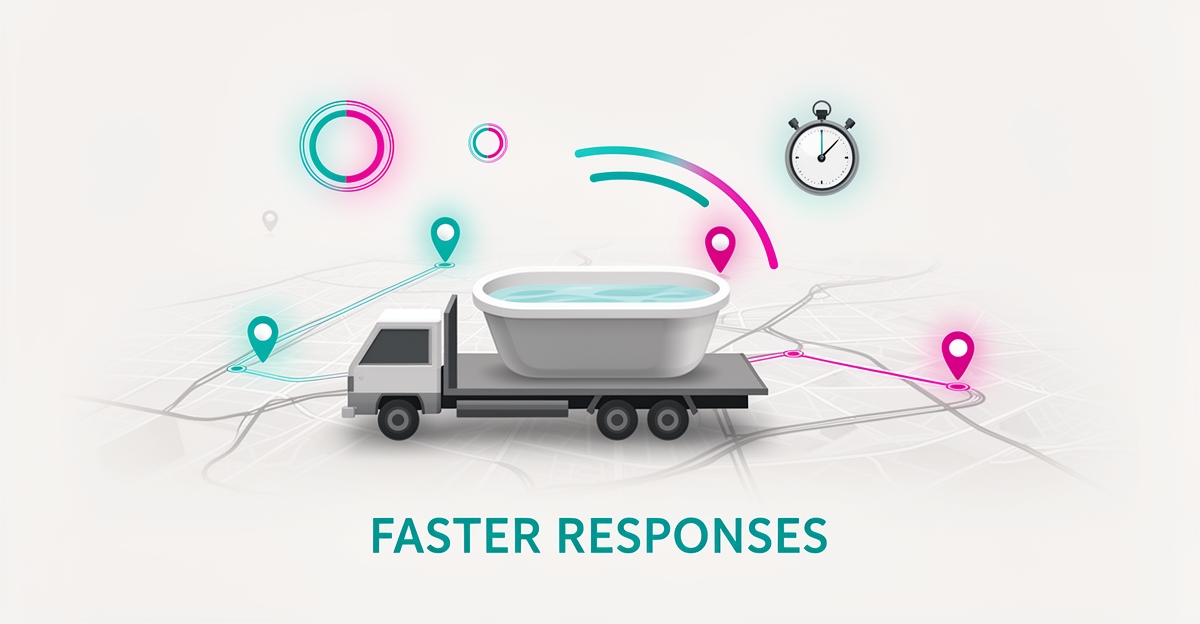
AI-Powered Service Tracking: How Hot Tub Removal Businesses Can Reduce Response Times
Quick Answer: Hot tub removal businesses cut response times with real-time job status monitoring, predictive maintenance, and automated customer updates, turning delays into a competitive edge. Start your Fit Check → https://aiqlabs.ai/apply
Key Facts
- Most customers now expect near-immediate responses to inquiries, a standard set by large service platforms and increasingly applied to local businesses
- AI-powered fleet systems can typically predict vehicle failures weeks in advance, letting you schedule repairs on your terms
- Businesses using AI-driven predictive maintenance commonly report meaningful reductions in downtime, more trucks on the road, more jobs completed per week
- Cloud-based AI solutions process data automatically, largely eliminating the manual-entry errors that plague traditional tracking boards
- AI agents can typically automate a large share of routine customer queries, freeing staff for exceptions and on-site work
- AI-powered tracking solutions commonly show payback within roughly 14–20 months as efficiency gains compound
Hire a team member that works 24/7 — for less than a part-time wage.
AI receptionists, SDRs, dispatchers and 99+ roles. Trained on your business, fully managed.
Not sure where to start? Ask our AI planner
Table of Contents
- Why Slow Response Times Are Costing Hot Tub Removal Businesses Customers
- From Reactive to Proactive: How AI-Powered Tracking Gives You Real-Time Visibility
- Smarter Dispatch and Automated Customer Updates: The Two Levers That Cut Delays
- Implementing AI Service Tracking in Your Hot Tub Removal Operation: A Practical Roadmap
- Getting Started: Owning a Tracking System That Works for Your Business
Why Slow Response Times Are Costing Hot Tub Removal Businesses Customers
Hot tub removal businesses face a critical challenge as customer expectations for fast responses continue to rise. Most customers now expect near-immediate replies to inquiries, so delays in scheduling or crew dispatch quickly erode trust and push customers toward competitors who respond faster. This gap between expectation and reality widens as service volumes grow, putting pressure on traditional manual systems.
Rising inquiry volume means manual scheduling and dispatch processes struggle to keep pace. When response times slow, businesses experience tangible losses: missed booking opportunities as customers seek alternatives, negative reviews that damage online reputation, and increased operational strain from reactive firefighting instead of proactive planning. These delays don't just frustrate customers, they directly impact revenue and long-term brand perception in a competitive local market.
- Lost bookings when customers choose faster-responding competitors
- Negative online reviews citing slow response or poor communication
- Increased technician idle time and inefficient routing
- Higher administrative burden from manual rescheduling and follow-ups
- Reduced capacity to take on new jobs due to scheduling bottlenecks
For hot tub removal businesses relying on spreadsheets, phone calls, or basic scheduling tools, the inability to provide real-time updates or optimize dispatch creates a cycle of delays that gets harder to break as demand grows. AIQ Labs helps service businesses implement AI-powered tracking systems that monitor job status in real time, alert crews to changes, and optimize routing based on location, urgency, and availability, turning response delays into a competitive advantage rather than a liability.
From Reactive to Proactive: How AI-Powered Tracking Gives You Real-Time Visibility
Picture this: a truck breaks down mid-route with a hot tub half-loaded, and you only find out when the customer calls to complain. That's the reactive model most service businesses still run on, and it's exactly what AI-powered tracking eliminates.
Traditional service tracking relies on manual updates and pre-set rule-based alerts. Dispatchers find out about problems after they happen, then scramble. AI-powered systems flip this dynamic by pulling data from sensors, GPS, and vehicle diagnostics into a single real-time view of vehicle locations, technician availability, and job status.
The difference shows up clearly when you compare the two approaches:
- Traditional telematics delivers historical reporting; AI systems provide real-time analysis and predictive insights
- Rule-based alerts fire reactively after a threshold is hit; AI alerts flag problems before they escalate
- Manual dispatch relies on dispatcher judgment; AI algorithms match technician skills, location, and job urgency automatically
- Limited customer updates become automated, personalized notifications about arrival times and delays
The predictive capabilities are where the biggest gains live. Modern AI-powered fleet systems can typically predict vehicle failures weeks in advance, giving you time to act. For a hot tub removal business, that's the difference between scheduling a repair on your terms and losing a full day of jobs to a dead truck.
Downtime drops just as dramatically. Businesses using AI-driven predictive maintenance commonly report substantial reductions in downtime, meaning more trucks on the road and more jobs completed per week. And because these systems process data automatically rather than through manual entry, they largely eliminate the errors that plague manually updated tracking boards.
This shift from reactive to proactive operations compounds across the business. When dispatchers see job status and crew location in real time, they reroute around traffic instead of reacting to late arrivals. When the system predicts a vehicle issue weeks out, maintenance gets scheduled during slow periods instead of peak season. Customers receive proactive updates that manage expectations, and the majority, who now expect fast responses to inquiries, get exactly that.
This is the kind of transformation we build at AIQ Labs: custom AI workflows that integrate GPS data, scheduling software, and dispatch systems into one owned platform, giving service businesses real-time visibility without subscription sprawl. The future of service management is intelligent, proactive, and data-driven, and the businesses that make the shift first will be the ones customers call back.
Smarter Dispatch and Automated Customer Updates: The Two Levers That Cut Delays
Response delays compound fast in hot tub removal, where a missed window can mean a second trip, extra labor, and a frustrated customer. AI changes the dispatch conversation from reactive guessing to real-time optimization.
Smarter dispatch starts with matching the right technician to the right job. AI algorithms analyze technician skills, location, and job urgency to optimize resource allocation and dispatch, ensuring the right crew is assigned to the right job at the right time. That automated optimization replaces manual dispatch where decisions rely on static spreadsheets and phone calls.
The shift from traditional telematics to AI-powered telematics is stark. Traditional systems offer primarily historical reporting and reactive alerts based on pre-set rules, with resource allocation done manually and limited customer updates. AI-powered telematics delivers real-time analysis and predictive insights, proactive AI-driven alerts, automated optimization, and automated personalized updates with high accuracy through automated data processing.
Automated customer updates close the expectation gap. AI-powered systems can automate customer communication, providing updates on service status, estimated arrival times, and potential delays. This proactive communication enhances transparency and manages customer expectations, leading to a more positive experience. With most customers now expecting fast responses to their inquiries, proactive ETAs and delay alerts become a retention lever, not a courtesy.
Data quality underpins both levers. Cloud-based AI solutions maintain high data accuracy through automated processing, compared with the manual-entry errors that plague traditional tracking. That accuracy enables reliable ETAs and confident dispatch decisions.
In practice, the two levers work together:
- Skill and location matching reduces travel time and maximizes efficiency
- Urgency-weighted routing prioritizes time-sensitive removals without overloading crews
- Automated ETAs and delay alerts manage expectations and cut inbound call volume
- Real-time job status visibility lets dispatchers intervene before a delay escalates
AI Agents can also automate a large share of routine inquiries, commonly around 80%, freeing staff to focus on exceptions and on-site execution. If you'd rather hand that entire front-desk function to a managed AI staffer, AIQ Labs' [AI Employees](/ai-employees) cover reception, scheduling, and follow-up at a fraction of the cost of a human hire.
For hot tub removal businesses, this is a workflow automation problem, not a people problem. AIQ Labs builds custom AI workflows that reduce delays and improve overall service quality by monitoring job status in real time, alerting technicians, and optimizing service routing as part of [AI Workflow Builds](/workflow-builds). The result is faster response times, fewer missed appointments, and a service experience that feels intelligent, proactive, and data-driven.
Implementing AI Service Tracking in Your Hot Tub Removal Operation: A Practical Roadmap
Implementing AI service tracking in a hot tub removal operation follows a practical, phased sequence.
Starting with data integration connects your GPS trackers and scheduling software to a unified AI platform, creating the foundation for real-time visibility. This step ensures technician locations, job statuses, and availability feed continuously into the system, eliminating manual updates and data silos. Cloud-based AI solutions maintain high data accuracy when integrated properly, forming the reliable input needed for intelligent decision-making.
System configuration follows, where you define tracking parameters, alert thresholds, and reporting rules tailored to hot tub removal workflows, such as job completion triggers or travel time buffers. This customization ensures the AI focuses on relevant operational signals, like detecting delays before they impact customer appointments. Proper setup minimizes false alerts and maximizes the system's ability to support proactive dispatch decisions based on real-world conditions.
AI model training then uses historical job data to teach the system patterns in service duration, common bottlenecks, and optimal routing, turning past performance into predictive insight. With this foundation, real-time monitoring begins, displaying live technician positions, job progress, and predicted ETAs on a centralized dashboard. Finally, acting on insights means using AI-generated recommendations to reroute crews, adjust schedules, or notify customers of changes instantly. Addressing challenges like integration complexity, data quality, and change management through phased rollouts and staff training ensures smooth adoption. Businesses typically see payback within roughly 14–20 months as efficiency gains compound, and with most customers expecting fast responses to inquiries, timely AI-driven service is a competitive necessity. AIQ Labs supports this journey end to end, from initial data integration to ongoing optimization, ensuring the system evolves with your operation.
Getting Started: Owning a Tracking System That Works for Your Business
Everything you've read in this article points to one question: how do you actually put an AI-powered tracking system to work in a hot tub removal business without a six-month IT project? The answer is a custom-built workflow, deployed in weeks, that you own outright.
The building blocks are straightforward. A dispatch automation layer assigns the right crew to the right job based on location, skills, and urgency, replacing manual dispatch with automated optimization. An AI dispatcher monitors job status in real time, flags potential delays before they escalate, and keeps the schedule moving. Automated customer updates handle the communication side, since most customers now expect fast responses to their inquiries, and AI agents can typically automate around 80% of routine customer queries.
That last point matters more than it sounds. Customer service volume keeps rising with expectations, and a two-person office can't absorb that growth manually. Automated tracking shifts your operation from reactive to proactive, the difference between traditional telematics that report history and AI-driven systems that flag problems before they happen.
The deployment path typically looks like this:
- Connect your existing data sources, scheduling software, GPS, and job records, to the new system.
- Configure tracking parameters, alerts, and reporting around how your crews actually work.
- Let the AI learn from your historical job data so its predictions reflect your business, not a generic template.
- Go live with real-time monitoring, then refine based on what the insights reveal.
One thing to insist on, whichever partner you choose: true ownership of the system. Subscription-based tracking tools lock your data and workflows inside someone else's platform. A custom-built system, the model AIQ Labs uses, transfers full ownership of the code, agents, and data to you, so the workflow becomes a business asset rather than a monthly dependency. With a milestone-based build, you approve and pay per phase and keep everything built along the way. See the [pricing models](/pricing) for how Start Monthly, Build in Milestones, and Own It Outright compare.
The timeline is shorter than most owners expect. A focused workflow build moves from discovery to production deployment in weeks, not quarters, and the ROI case is well established, AI-powered tracking solutions commonly reach payback within 14–20 months as efficiency gains compound.
If you want to see what this would look like for your business specifically, start with the two-minute Fit Check at aiqlabs.ai/apply, followed by a free 30-minute strategy call with an AI engineer. It's a working session, not a sales pitch: you'll map your biggest bottleneck, identify high-ROI automation opportunities, and get real numbers in writing. And if there isn't a clear win for your operation, AIQ Labs will tell you exactly that.
Still paying for 10+ subscriptions that don’t talk to each other?
We build custom AI systems you own outright. No vendor lock-in. Full control.
Not sure where to start? Ask our AI planner
Frequently Asked Questions
How does AI-powered tracking actually reduce response times for hot tub removal businesses?
AI-powered tracking reduces response times by providing real-time visibility into technician locations and job status, enabling proactive dispatch and automated customer updates that manage expectations. This shift from reactive to proactive operations cuts delays by matching the right technician to the right job based on skills, location, and urgency, while AI agents automate a large share of routine customer inquiries, freeing staff to focus on execution. Automated data processing keeps ETAs reliable and decision-making confident.
Is implementing an AI tracking system too complex or expensive for a small hot tub removal business?
Implementation is designed to be practical and phased, starting with data integration from existing GPS, scheduling software, and job records, then configuring alerts and letting the AI learn from historical data specific to your operations. AIQ Labs uses a milestone-based build model where you approve and pay per phase, keeping everything built so far, with deployment typically completed in weeks, not quarters. Payback commonly lands within 14–20 months as efficiency gains compound, making it a viable investment even for smaller operations.
What kind of results can I expect from AI-powered predictive maintenance in my fleet?
AI-powered predictive maintenance can typically flag vehicle failures weeks in advance, allowing you to schedule repairs during slow periods instead of losing jobs to unexpected breakdowns. Businesses using these systems commonly report meaningful downtime reductions, meaning more trucks on the road and more jobs completed per week. This proactive approach turns maintenance from a reactive cost into a planned operational advantage, directly improving fleet reliability and service capacity.
Will customers really notice or care if I use AI to improve my response times?
Yes, most customers now expect fast responses to their inquiries, and delays directly lead to lost bookings, negative reviews, and customers choosing faster-responding competitors. AI-powered systems close this expectation gap by automating personalized ETAs and delay alerts, which enhances transparency and manages the customer experience proactively. With a large share of routine queries automated via AI agents, your team can focus on complex issues while customers receive timely, accurate updates that build trust and loyalty.
How is AI-powered tracking different from traditional telematics or GPS tracking I might already use?
Traditional telematics provides only historical reporting and reactive alerts based on pre-set thresholds, while AI-powered systems deliver real-time analysis, predictive insights, and automated optimization, flagging problems before they escalate and matching technicians to jobs based on skills, location, and urgency. Unlike manual dispatch that relies on spreadsheets and phone calls, AI enables automated, personalized customer updates with high data accuracy through continuous processing. This transforms tracking from a passive log into an active, intelligent dispatch partner.
What if I'm not ready to overhaul my entire system, can I start small with AI tracking?
Absolutely, AIQ Labs' [AI Workflow Builds](/workflow-builds) focus on rebuilding the one workflow that costs you the most, such as dispatch or customer updates, at a fixed price and in phases. This approach lets you prove value in weeks, not months, by addressing your biggest bottleneck, like slow response times or manual scheduling, before scaling to other areas. You can start with a free two-minute Fit Check and a 30-minute strategy call to map your specific opportunity and get real numbers in writing, with no obligation if there isn't a clear win.
Turn Response Delays into Your Competitive Edge
Hot tub removal businesses are losing customers not because of service quality, but because slow response times let faster competitors win the booking. As this article showed, AI-powered tracking transforms reactive dispatch into proactive operations, matching the right technician to the right job, predicting vehicle issues weeks in advance, and automating customer updates that meet today's expectation of fast responses. The result is fewer missed appointments, reduced downtime, and a service experience that feels intelligent and seamless. For owners ready to move beyond spreadsheets and guesswork, the path forward is clear: start with a focused workflow that you own outright and that scales with your business. Take the first step with a two-minute Fit Check at aiqlabs.ai/apply to see where AI can remove your biggest bottleneck, no obligation, just clarity on what's possible for your operation.
Make AI your competitive advantage — not just another tool.
Strategy, implementation and ongoing optimization. One partner, end to end.
Not sure where to start? Ask our AI planner