AI-Powered Student Feedback Loop: How Trade Schools Can Improve Curriculum with Real-Time Insights
Key Facts
- A large majority of executives expect AI to reshape their workforce within a few years, while a minority feel prepared to lead through that change according to leadership research
- AI can collect, analyze, and act on student feedback from hands-on training sessions as shown in feedback loop research
- AI-powered feedback loops help refine curricula and improve student outcomes per educational research
- AI can help bridge the gap between theoretical knowledge and practical skills based on feedback loop studies
- AI automates routine tasks, freeing humans to focus on creative problem-solving and emotional intelligence as noted in leadership research
- AI can help create smoother transitions between care teams, preserving time for face-to-face interactions per healthcare implementation findings
Hire a team member that works 24/7 — for less than a part-time wage.
AI receptionists, SDRs, dispatchers and 99+ roles. Trained on your business, fully managed.
Not sure where to start? Ask our AI planner
The Curriculum Lag Problem in Hands-On Trade Training
Trade schools face a persistent challenge: keeping hands-on training curricula aligned with rapidly evolving industry demands. The gap between theoretical instruction and practical skills often widens because feedback from lab sessions arrives too late to influence current cohorts, leaving students trained on aging techniques. Instructors, already stretched thin managing large classes and equipment logistics, lack the bandwidth to systematically gather, analyze, and act on real-time student input during hands-on exercises.
This delay creates a curriculum lag where schools teach methods that no longer reflect workplace realities. For example, when welding techniques evolve due to new safety standards or electrical codes update on their regular cycle, trade programs may continue using legacy materials simply because feedback cycles operate on semester-end evaluations rather than immediate session insights. Without timely data, instructors cannot adjust demonstrations, refine skill sequences, or address recurring student struggles before bad habits solidify.
Research shows that AI can collect, analyze, and act on student feedback from hands-on training sessions, offering a pathway to close this gap. By capturing micro-feedback during practice, such as tool handling difficulties, confusion over procedural steps, or equipment malfunctions, AI systems transform isolated observations into actionable curriculum intelligence. This enables instructors to pivot mid-lesson, reteach concepts causing widespread confusion, or update skill progressions based on actual student performance patterns rather than anecdotal memory.
- Identifies recurring skill gaps across multiple student workstations in real time
- Flags safety procedure deviations before they become ingrained habits
- Highlights which theoretical concepts students struggle to apply practically
- Tracks time-to-proficiency for specific hands-on tasks
- Recommends micro-adjustments to lesson sequencing based on struggle points
AIQ Labs helps trade schools implement these feedback systems by designing AI tools that integrate directly into training environments, using voice capture during practice sessions, tool station check-ins, or student self-reporting kiosks, to generate immediate, curriculum-relevant insights without adding instructor workload. The technology handles data collection and pattern recognition, freeing educators to focus on what humans do best: providing nuanced guidance, demonstrating complex techniques, and building the confidence that turns trainees into competent tradespeople.
How AI Feedback Loops Capture Real-Time Insights from Training
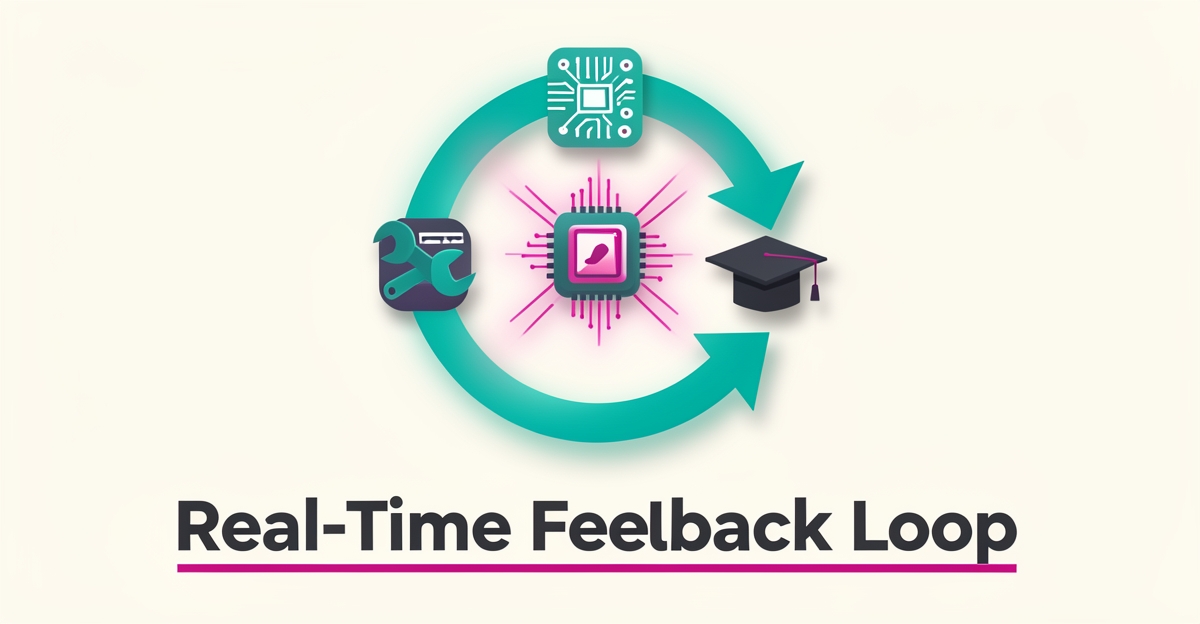
AI-powered feedback loops transform hands-on training into a dynamic source of curriculum intelligence, capturing real-time student insights that directly inform instructional improvements. By collecting feedback during practical exercises, AI systems can analyze patterns in student responses, identify skill gaps, and surface actionable recommendations for instructors. This continuous cycle of input and adaptation ensures training remains aligned with both learning objectives and industry demands.
According to research on AI feedback loops, these systems excel at refining curricula and improving student outcomes by bridging the gap between theoretical knowledge and practical skills. The process begins with defining clear success criteria for each training module, ensuring AI captures relevant data points such as task completion times, error rates, and student self-assessments. Evaluation cycles then build in human oversight, where instructors review AI-generated insights alongside automated analyses to validate findings and prioritize adjustments.
Logging and adapting iterations creates a living curriculum that evolves with each cohort, turning every hands-on session into a data point for improvement. AIQ Labs supports this cycle through AI Workflow Builds and connected operating systems that capture, process, and act on student feedback in real time, delivering recommendations that help instructors refine demonstrations, adjust pacing, or introduce targeted remediation. This approach not only enhances skill acquisition but also strengthens the connection between classroom learning and workplace readiness.
Balancing Automation with Instructor Connection
The most effective trade school programs understand that AI should amplify human connection, not replace it. When instructors spend less time on administrative feedback collection and more time mentoring students through complex problem-solving, everyone wins.
This balance matters more than ever. While most executives expect AI to reshape their workforce within a few years, only a minority feel prepared to lead through the transition, according to leadership research. Trade schools face the same challenge: how do you harness AI's efficiency without losing the human touch that makes vocational education effective?
The answer lies in strategic automation. AI excels at collecting real-time feedback from hands-on training sessions, analyzing patterns across student responses, and flagging curriculum gaps. This frees instructors to focus on what they do best: creative problem-solving, trust-building, and face-to-face coaching that helps students master complex skills.
Think of AI as your administrative assistant, not your replacement. It can handle routine tasks like quiz generation, progress tracking, and initial feedback compilation. Meanwhile, instructors invest their energy in the nuanced work of reading student frustration, adapting teaching approaches mid-lesson, and providing the encouragement that keeps learners motivated through challenging material.
The most successful implementations follow a clear division of labor:
- AI collects and analyzes student feedback from hands-on sessions in real time
- AI generates personalized quizzes and identifies curriculum gaps automatically
- Instructors review AI insights and adjust their teaching strategies accordingly
- Instructors dedicate freed-up time to one-on-one coaching and relationship building
This approach mirrors what's working in other fields. In healthcare, for example, AI helps create smoother transitions between care teams, preserving time for the face-to-face interactions that build trust. Trade schools can apply the same principle: let AI handle data collection and analysis while instructors focus on mentorship.
The risk of over-automation is real. When schools rely too heavily on AI, they lose the emotional intelligence and human connection that help students push through difficult concepts. A welding student struggling with a technique doesn't need another automated quiz, they need an instructor who notices their frustration and adjusts the teaching approach.
AIQ Labs helps trade schools implement feedback systems that respect this balance. The goal isn't to automate teaching; it's to automate the administrative burden so instructors can teach more effectively. When AI handles routine feedback collection and delivers actionable insights, instructors gain hours each week for the high-value interactions that actually improve student outcomes.
The schools getting this right treat AI as a tool for enhancement, not replacement. They use real-time feedback to identify which students need extra support, then deploy their instructors strategically to provide that human guidance. The result is a learning environment where technology and human expertise work in concert, each doing what it does best.
Building Your AI Feedback System with AIQ Labs
Real-time student insight changes how trade schools adapt curriculum between semesters and between shifts. Hands-on training creates immediate feedback moments that traditional surveys miss, and AI makes those moments actionable for instructors.
AI can collect, analyze, and act on student feedback from hands-on training sessions, turning informal comments into structured curriculum signals. Research on feedback loops for AI innovations shows this approach can help refine curricula and improve student outcomes. The system also helps bridge the gap between theoretical knowledge and practical skills that trade programs must close.
Implementation starts with clear success criteria for what feedback matters in a shop floor or lab context. Guidance on building AI feedback systems recommends defining accuracy, safety, and reliability goals before capture begins. Evaluation cycles then review AI outputs with human input from instructors and apprentices, and logging adapts the model from both successes and failures.
AIQ Labs translates this approach for trade schools through three connected entry points. AI Employees handle ongoing feedback monitoring, AI Workflow Builds rebuild the feedback workflow that costs your program the most, and AI Operating Systems connect feedback, scheduling, and reporting into one operating layer the school owns.
Feedback capture starts with the shop floor reality. Systems ingest voice notes after welding exercises, quick tablet taps on tool stations, and instructor observations, then cluster themes by module, instructor, and equipment. This creates a living map of where practical skill transfer stalls.
An AI Employee provides continuous monitoring without adding staff workload. It can triage daily feedback, flag recurring safety concerns, summarize module-level sentiment, and draft instructor briefs before weekly planning. It works around the clock and improves as it learns each cohort's patterns, at a fraction of the cost of a human hire.
The build itself respects human instruction. Analysis on balancing automation and human connection notes AI can automate routine tasks, freeing humans to focus on creative problem-solving and emotional intelligence. In trade education, that means instructors keep coaching while AI handles aggregation.
Leadership readiness is uneven. The same research finds that while most executives expect AI to reshape their workforce within a few years, only a minority feel prepared to lead through the change. Trade schools can move faster with a defined build path.
A practical rollout with AIQ Labs can follow:
- Start Monthly for a single AI Employee that monitors feedback and delivers weekly instructor summaries
- Build in Milestones to develop a department-wide feedback system, approving and paying per phase
- Own It Outright for a full AI operating system the school controls long term
True ownership means the school owns the code, agents, and data when complete, avoiding vendor lock-in. The loop becomes a permanent capability, not a subscription.
Ready to map your biggest curriculum bottleneck? Start the 2-minute Fit Check at aiqlabs.ai/apply, then book a free 30-minute strategy call to identify high-ROI automation opportunities.
Still paying for 10+ subscriptions that don’t talk to each other?
We build custom AI systems you own outright. No vendor lock-in. Full control.
Not sure where to start? Ask our AI planner
Frequently Asked Questions
How does AI-powered feedback actually help trade schools keep their curriculum current with industry changes?
Will using AI in hands-on training replace instructors or reduce the human connection students need?
What specific types of feedback can AI capture during trade school lab sessions?
Is there data showing that executives expect AI to impact their workforce, but feel unprepared to lead that change?
How does AIQ Labs ensure trade schools maintain control over their AI systems without vendor lock-in?
What's a practical first step for a trade school wanting to explore AI feedback systems without a big upfront commitment?
Turning Hands-On Feedback Into Curriculum Intelligence
Trade schools no longer need to choose between maintaining current curriculum and staying aligned with industry demands. AI-powered feedback loops transform hands-on training sessions into continuous sources of curriculum intelligence, capturing real-time insights that traditional semester-end evaluations miss. By automating data collection and analysis, these systems flag skill gaps, safety concerns, and comprehension bottlenecks while freeing instructors to focus on the human mentorship that builds confident, capable tradespeople. The most effective implementations treat AI as an administrative assistant rather than a replacement, using technology to handle routine feedback tasks so educators can invest their expertise where it matters most. AIQ Labs helps trade schools build these feedback systems through AI Employees, AI Workflow Builds, and AI Operating Systems that respect the balance between automation and human connection. Whether you start with a single AI Employee monitoring feedback or build a comprehensive curriculum intelligence system, the goal remains the same: ensuring your training reflects current industry standards. Ready to identify where real-time feedback could strengthen your curriculum? Start the 2-minute Fit Check at aiqlabs.ai/apply, then book a free 30-minute strategy call to map your highest-impact automation opportunity.
Make AI your competitive advantage — not just another tool.
Strategy, implementation and ongoing optimization. One partner, end to end.
Not sure where to start? Ask our AI planner