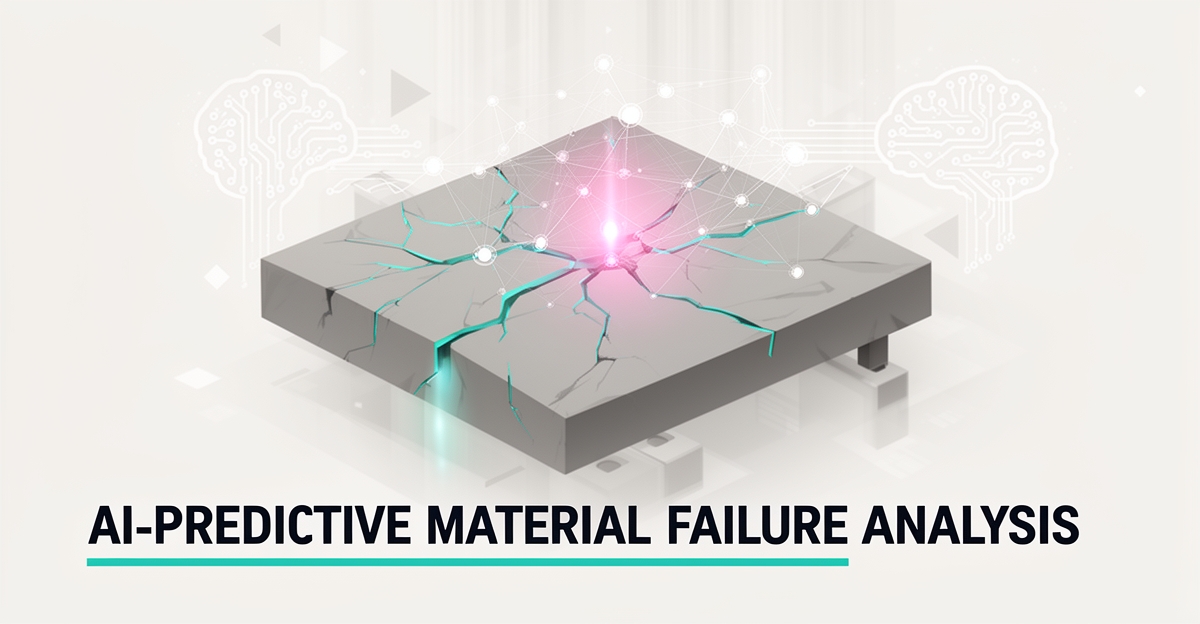
AI-Powered Test Result Analysis: How Labs Can Predict Material Failures
Key Facts
- Unplanned downtime is one of the largest controllable costs in manufacturing—industry analyses commonly cite figures in the hundreds of thousands of dollars per hour.
- Reactive maintenance is widely estimated to cost multiples of planned maintenance, with U.S. Department of Energy–cited analyses putting unnecessary industrial losses in the tens of billions annually.
- Machine learning models can detect equipment failure signatures weeks to months in advance, with published studies reporting high accuracy for well-characterized equipment types.
- Industry research on AI-powered predictive maintenance commonly reports roughly 50% less unplanned downtime and meaningful cost reductions.
- Large software organizations have reported using AI testing to catch a majority of failures before deployment.
- Analysts including McKinsey have documented strong ROI for mature predictive maintenance deployments, typically realized within 12-18 months.
Hire a team member that works 24/7 — for less than a part-time wage.
AI receptionists, SDRs, dispatchers and 99+ roles. Trained on your business, fully managed.
Not sure where to start? Ask our AI planner
The Hidden Cost of Reactive Quality Control
Every hour a lab or manufacturing operation sits idle costs money—and the numbers are significant. Industry analyses of unplanned manufacturing downtime commonly cite costs in the hundreds of thousands of dollars per hour, yet most industrial operations still default to fixing equipment only after it fails.
The economics of reactive quality control are brutal. Emergency repairs typically cost several times more than planned work, and analyses drawing on U.S. Department of Energy estimates attribute tens of billions of dollars in unnecessary industrial losses to reactive maintenance each year. When a material failure surfaces late—in a shipped batch, a failed certification test, or a production line stoppage—the costs cascade through rework, scheduling chaos, and damaged client trust.
Even calendar-based preventive maintenance, the traditional alternative, carries hidden waste. While it reduces catastrophic failures meaningfully compared to reactive approaches, a substantial share of preventive maintenance tasks are performed on perfectly healthy equipment. Labs pay for service nobody needed while still missing the failures that don't follow the schedule.
The burden extends beyond equipment into the testing process itself. QA and testing teams frequently report that the majority of their automation effort goes toward maintaining existing tests rather than finding new problems. That means most quality resources are spent keeping the status quo running—not catching the next material failure before it happens.
Consider what this reactive posture actually costs a materials lab:
- Emergency repairs and rush analysis at a multiple of the cost of planned work
- Downtime exposure that can reach hundreds of thousands of dollars per hour in manufacturing settings
- Quality teams consuming most of their capacity on maintenance instead of detection
- Failures discovered only after they've already impacted projects and clients
The core problem is timing. Traditional testing tells you what has already failed; it cannot tell you what is about to. Yet the data needed to see failure coming already exists—historical test results, sensor readings, and trend data sit in lab systems, largely unanalyzed. Machine learning models trained on this data can detect degradation signatures weeks to months before failure occurs, with published studies reporting strong accuracy for well-characterized equipment types.
This is the gap that AI-powered prediction closes: shifting quality control from documenting failures to anticipating them. Organizations that analyze historical test data with predictive models—like the systems AIQ Labs builds—can flag anomalies while there's still time to act, converting quality data from a record of the past into a forecast of what's coming.
How AI Predicts Material Failures: The Data Pipeline
The journey from raw sensor readings to a timely, actionable alert is not magic; it is a structured, repeatable process. Understanding this four-stage pipeline demystifies how AI moves from abstract data to concrete predictions that save time and money.
The process begins with data collection, where IoT sensors are deployed on machinery to monitor conditions like vibration, temperature, and pressure. The cost of this technology has fallen dramatically, with industrial-grade sensors now available at low per-unit prices. This accessibility makes it feasible to gather the rich, real-time data needed for accurate analysis.
Next, the data moves to the processing stage. Here, a hybrid approach is common. Edge AI chips process data directly on the equipment for instant, latency-sensitive alerts, while cloud-based AI handles the heavy lifting of analyzing historical trends and patterns across an entire fleet of assets.
This processed data then feeds the core of the system: the machine learning models. This is where the system learns to recognize the subtle signatures of degradation that precede a failure. Common models include:
- Random Forest: Known for its robustness and resistance to overfitting, making it a reliable choice for general predictions.
- Gradient Boosting: Often achieves higher accuracy in identifying specific failure cases, though it requires careful tuning.
- Deep Learning: Excels at visual defect detection, analyzing images from inspections to find cracks, pores, or inclusions that the human eye might miss.
Research on material failure prediction with machine learning shows these models can achieve strong accuracy, particularly when synthetic data expands training coverage for rare failure modes. The final stage closes the loop by turning a prediction into an automated action, such as generating a work order in a maintenance system. This ensures that a potential failure identified by the AI is addressed before it can cause costly downtime. This entire pipeline, from sensor to work order, is what enables a predictive maintenance strategy that can substantially reduce unplanned downtime.
Building and integrating such a system requires deep expertise in both data engineering and industrial processes. At AIQ Labs, we build these custom AI solutions with a fixed-price, milestone-based approach—so you know what each phase costs before it starts. If you want to see how this maps to your lab, start with the 2-minute Fit Check.
Proven Results: What AI-Driven Testing Delivers
Labs that move from reactive checks to predictive analysis see measurable gains in uptime, cost control, and quality confidence. AI models trained on historical test data and sensor streams flag anomalies weeks before failure, shifting quality assurance from inspection to prevention.
Industry research on AI-powered predictive maintenance commonly reports roughly 50% less unplanned downtime and meaningfully lower maintenance costs, along with extended equipment lifespan and fewer catastrophic failures. Analysts such as McKinsey have documented strong ROI for mature deployments, typically realized within 12-18 months by moving from calendar-based work to condition-based action.
In software and materials testing, the pattern repeats. Large organizations have reported using AI to catch a majority of failures before deployment, and AI-powered test analytics enables faster test execution through prioritization and quicker defect detection.
Real-world implementation follows a data pipeline that labs can replicate. Historical test results, stress-strain data, and imaging are cleaned and labeled, then fed to models such as Random Forest and Gradient Boosting for failure mode classification. Deep learning handles visual defect detection from images, ultrasonic waves, and X-rays. Synthetic data expands training coverage for rare failure cases.
Documented outcomes from AI-driven testing programs include:
- Substantial reductions in unplanned downtime from predictive maintenance programs
- Fewer catastrophic failures and lower maintenance costs
- Strong ROI for mature deployments, typically realized within 12-18 months
- Earlier failure detection in pre-deployment testing reported by large software organizations
These results matter for labs because predictive analytics and forecasting directly support quality control and client confidence. AIQ Labs has deployed 200+ multi-agent systems, including predictive AI that helps labs analyze historical test data to predict material failure trends and flag anomalies before they impact projects. The approach uses model outputs to generate automated work orders and prescriptive recommendations.
Success requires high-quality data, phased rollouts, and human oversight. False positive rates typically drop significantly after a year of operational tuning, and models reach strong accuracy for well-defined equipment types when trained on 6-12 months of operational data.
Implementing AI Test Analysis: A Phased Approach
Adopting AI for test analysis is not an overnight switch; it is a staged evolution that prioritizes accuracy over speed. By following a structured roadmap, laboratories can integrate predictive capabilities without disrupting current operations.
Begin by identifying high-value targets. Rather than instrumenting every piece of equipment, focus on the assets with the highest historical failure costs. Identifying the 3-5 most expensive failure modes allows for a targeted pilot that proves ROI before scaling. This focused approach prevents resource drain and builds internal confidence.
Once targets are selected, establish a rigorous data baseline. AI models require clean, consistent historical data to learn effectively. Data cleaning and preparation is a critical prerequisite, often requiring dedicated weeks to remove duplicates and standardize formats before algorithms can function reliably. During this phase, collect 3-6 months of operational data to train the model on normal behavior patterns.
Next, validate predictions against known outcomes. Run the AI system in parallel with existing quality assurance processes to compare its forecasts with actual results. This step is crucial for calibrating sensitivity and ensuring the model catches anomalies without generating noise. AI can substantially reduce false positives, but only after a period of supervised tuning and validation.
Scaling too quickly invites operational risk. A phased rollout is essential to avoid false-positive fatigue, where technicians begin to ignore alerts due to excessive noise. Broad deployment in the first year often leads to lower ROI because of this overload. Instead, expand gradually, allowing the model to mature and accuracy to stabilize before full integration.
A practical implementation timeline includes:
- Phase 1: Instrument 3-5 critical assets and collect baseline data for 3 months.
- Phase 2: Activate learning algorithms and begin generating initial anomaly alerts.
- Phase 3: Validate accuracy against historical failures and refine alert thresholds.
- Phase 4: Scale to full operations only after achieving consistent, reliable predictions.
Human oversight remains the final safeguard. AI should augment, not replace, expert judgment. Surveys of QA professionals consistently find that most view AI as a tool that enhances their work rather than replaces it. Maintaining a human-in-the-loop ensures that critical decisions are verified by experienced engineers.
AIQ Labs guides labs through this maturity curve, building predictive systems on solid data foundations—phased, fixed-price, and owned by you at the end. If you'd like to map this roadmap to your own lab, book a free 30-minute strategy call.
Still paying for 10+ subscriptions that don’t talk to each other?
We build custom AI systems you own outright. No vendor lock-in. Full control.
Not sure where to start? Ask our AI planner
Frequently Asked Questions
How much does unplanned downtime actually cost a manufacturing operation?
Can AI really predict material failures before they happen, or is that just marketing hype?
What kind of ROI can we expect from implementing AI-driven predictive testing?
We don't have perfect data—can we still use AI for failure prediction?
Will AI replace our QA engineers and materials scientists?
What does a realistic implementation timeline look like for a materials lab?
From Reactive Testing to Predictive Intelligence
AI-powered test result analysis transforms how labs approach material failure prediction by turning historical data into actionable foresight. Reactive quality control carries heavy costs—unplanned downtime can run into the hundreds of thousands of dollars per hour, emergency repairs cost multiples of planned work, and most QA effort is consumed by test maintenance rather than defect detection. By contrast, AI-driven predictive models trained on 6-12 months of operational data can detect degradation signatures weeks to months before failure, enabling labs to shift from documenting failures to anticipating them. The payoff for mature deployments: substantially less unplanned downtime, lower maintenance costs, and strong ROI typically realized within 12-18 months. Success hinges on high-quality data, phased implementation, and human oversight—starting with high-value assets, validating predictions against known outcomes, and scaling only after predictions stabilize. For labs ready to move beyond reactive testing, AIQ Labs builds these systems in phases at a fixed price, owned outright when complete. Start the 2-minute Fit Check to identify your highest-ROI automation opportunities, or book a free 30-minute strategy call.
Make AI your competitive advantage — not just another tool.
Strategy, implementation and ongoing optimization. One partner, end to end.
Not sure where to start? Ask our AI planner