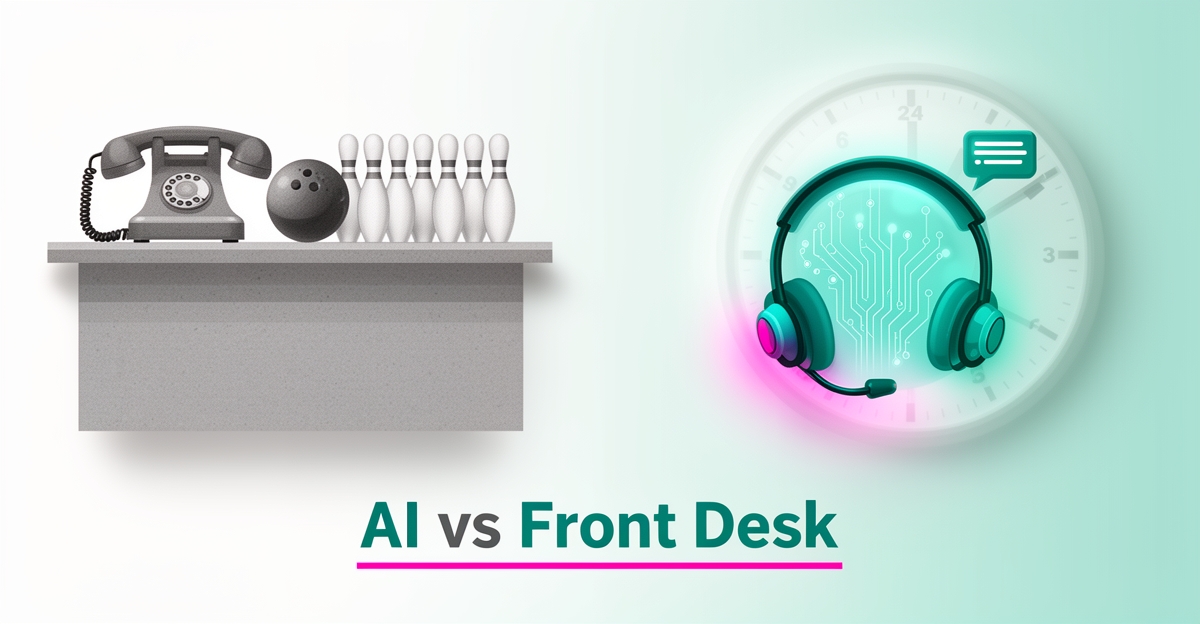
AI Receptionist vs Human Front Desk: A Real-World Comparison for Bowling Alleys
Key Facts
- Industry analyses suggest small businesses miss a majority of incoming calls during business hours, according to receptionist research
- One cost analysis estimates that a handful of missed calls daily can add up to six figures in lost annual revenue, though exact figures vary by business
- A full-time human receptionist can cost roughly $50,000+ per year all-in, industry data indicates, while AIQ Labs' managed AI Employees run at roughly 80% less than a human hire
- A meaningful share of business inquiries — commonly cited around 40% — arrive outside normal operating hours, industry analyses suggest
- Most routine business calls require no empathy or judgment — just fast, accurate answers, call-type analyses find
- Caller surveys indicate most people prefer AI interactions when they deliver faster answers, benchmarking shows
Hire a team member that works 24/7 — for less than a part-time wage.
AI receptionists, SDRs, dispatchers and 99+ roles. Trained on your business, fully managed.
Not sure where to start? Ask our AI planner
The Bowling Alley Front Desk Bottleneck
Picture a Saturday league night: every lane is full, the snack bar has a line, and the phone keeps ringing off the hook. Nobody at the front desk can pick it up — and every unanswered ring is a potential party booking, birthday reservation, or open-play customer walking into a competitor's alley.
The numbers behind this scenario are sobering. According to industry research, small businesses can miss a large share of incoming calls during business hours — and once the doors close, that figure effectively hits 100%. For a bowling alley, the busiest hours are precisely when the front desk is least available to answer the phone.
The timing mismatch runs even deeper. Industry analyses suggest that roughly 40% of business inquiries arrive outside normal operating hours. Parents planning weekend birthday parties, league organizers comparing lane rates, and corporate event coordinators often call in the evening or on Sunday — exactly when a human-only front desk goes silent.
What happens to those missed callers? The picture is grim:
- Research suggests most callers who reach voicemail never call back — they simply move on to the next alley on their list.
- A single missed call can represent hundreds of dollars in lost revenue depending on the inquiry, and a missed party booking sits at the high end of that range.
- With most customers buying from the company that responds first, speed to answer isn't a courtesy — it's the sale.
Multiply those losses across a season and the math becomes stark. One cost analysis estimates that just five missed calls per day can translate into six figures in lost annual revenue — and a busy bowling alley on league nights can easily hit that threshold. Your actual number depends on your party packages and call volume, but the direction is clear.
This is where the front desk becomes a bottleneck rather than a hub. Your staff are juggling shoe rentals, lane assignments, and food orders; the phone is the last thing they can manage. Yet the calls piling up unanswered are overwhelmingly routine — hours, pricing, lane availability, party packages. Call-type analyses indicate that the vast majority of calls don't require empathy or judgment, just fast, accurate answers.
This is exactly the gap AIQ Labs' AI Employees are built for: answering every call 24/7, handling the routine inquiries that dominate inbound volume, and freeing your human staff to focus on the guests standing right in front of them. The result is a front desk that stops leaking revenue during the hours your alley is busiest — and starts capturing it during the hours it isn't.
Cost, Coverage and Performance Head-to-Head
When bowling alley owners weigh the cost of a human front desk against an AI receptionist, the numbers tell a stark story. According to industry research, the all-in annual cost of a single full-time receptionist can reach roughly $52,900 once you factor in salary, benefits, payroll taxes, and training.
By contrast, AIQ Labs' managed AI Employees run at roughly 80% less than a human hire under the Start Monthly model — which includes build, training, tool integrations, monitoring, and ongoing improvements. And that's before you account for the revenue recovered from calls that would otherwise go unanswered.
Availability is where the gap widens further. A human receptionist covers roughly 40 hours per week, while AI receptionists operate 24/7/365 and answer on the first ring. Since industry analyses suggest a large share of business inquiries arrive outside normal hours, that always-on coverage captures opportunities that would otherwise disappear.
Performance metrics reinforce the shift. Industry data suggests AI receptionists resolve a large majority of calls without human intervention, and caller surveys indicate most people prefer AI interactions when they deliver faster answers. For bowling alleys, where most calls involve hours, pricing, lane availability, or party bookings, that resolution rate covers nearly every routine inquiry.
Key differences at a glance:
- Cost: Roughly $52,900 annually for a human vs. about 80% less with a managed AI Employee
- Coverage: 40 hours per week vs. 24/7/365 availability
- Capacity: One call at a time vs. unlimited concurrent calls
- Resolution: Variable by mood and training vs. consistent handling of routine calls
- Caller preference: Most callers prefer AI when it means faster answers
AIQ Labs builds AI receptionists that handle this front-line workload while integrating directly with your booking and scheduling systems. With 200+ multi-agent systems deployed, the result is a front desk that scales with demand, never misses a call, and frees your team to focus on the in-person experience that keeps bowlers coming back.
What AI Handles Best for Alleys and Where Humans Still Win
Bowling alleys live and die by call volume during league sign-ups, weekend parties, and last-minute lane checks. The front desk is the first impression, but it's also a bottleneck that costs revenue after hours and during peak spikes.
AI excels at the high-volume, repetitive work that dominates alley inbound traffic. It answers hours, pricing, lane availability and party bookings instantly, 24/7/365, without hold time. Industry research suggests businesses switching to AI capture significantly more leads due to 24/7 availability alone. Multilingual support is built-in, so one system handles English, Spanish and other languages that would require multiple hires.
Data sync is another clear win. AI receptionists log bookings directly to calendars and CRMs, eliminating manual re-entry and missed notes. The result is faster response times and zero missed calls during evenings and weekends when a large share of inquiries arrive.
Where AI delivers the most value for alleys:
- Hours, pricing and lane availability answered on first ring, 24/7
- Party and league bookings captured and synced to calendar automatically
- Multilingual lead capture for diverse communities
- Unlimited concurrent calls during Friday night rushes
Humans still win on emotional de-escalation and in-person experience. A frustrated league captain or a family with a birthday meltdown needs empathy, tone reading and real-time judgment that AI is still improving on. Analysis of call types finds the vast majority of calls don't need empathy or judgment, which AI handles faster and more consistently. The small remainder benefits from a human.
In-person greeting remains uniquely human. Smiling guests at the door, reading body language, and negotiating complex group packages with custom add-ons are strengths no voice agent replicates. The hybrid model reflects this reality: AI handles the front line, humans manage escalations and the physical welcome.
Caller perception supports the mix. Recent benchmarking suggests most callers preferred AI when it delivered faster response times and helpful answers, and a large majority couldn't distinguish AI from human for standard interactions. For an alley, that means routine inquiries get answered instantly while staff stay free for high-value interactions like upselling food, resolving lane issues, and creating a welcoming atmosphere guests remember.
Hybrid Model Implementation for Bowling Alleys
Bowling alleys live and die on peak-time availability, and missed calls during league nights or weekend parties cost real bookings. A hybrid front desk keeps the human warmth on the floor while an AI receptionist handles the constant stream of routine inquiries that would otherwise tie up staff.
The coverage gap is well documented. Industry analysis suggests small businesses miss a large share of incoming phone calls during business hours, and after hours that number effectively reaches 100% (see receptionist comparison research). Because a meaningful share of business inquiries arrive outside normal hours according to cost and performance analyses, an AI-first line captures demand that a single human desk simply cannot.
A practical rollout for alleys starts with defining what the AI owns and what stays human. AI handles after-hours and overflow coverage, instant booking integration, and high-volume FAQs like hours, pricing, lane availability, and party bookings. Staff stay on the floor for upsells, in-person greetings, and complex problem solving. This mirrors the hybrid model recommended across service businesses, where AI handles the bulk of routine calls with a part-time human for escalations per front desk comparison guides.
Implementation follows a phased, low-risk path:
- Map the call types: log two weeks of inbound questions to identify the routine majority and the minority that need human judgment.
- Deploy AI for after-hours and overflow first, with instant booking integration to the alley's reservation system and calendar.
- Set clear escalation rules for complaints, custom events, or emotional situations, routing those to the on-site team.
- Train floor staff to focus on high-value interactions, upsells, and in-person service while the AI logs every inquiry.
The impact is measurable. Businesses switching to AI receptionists capture significantly more leads due to 24/7 availability alone per lead capture data, and most callers prefer AI interactions when they result in faster response times and helpful answers per caller preference research. With AI handling the bulk of routine calls consistently per performance benchmarks, and most calls not needing empathy or judgment per virtual receptionist analysis, most alley inquiries are a perfect fit.
AIQ Labs supports this approach with a Start Monthly AI Employee model that costs roughly 80% less than a human hire and includes build, training, tool integrations, monitoring, and improvements. You can scale up through milestone-based workflow builds or eventually own your system outright — no vendor lock-in — letting alleys scale coverage during league spikes and weekend rushes while keeping humans where they add the most value.
Still paying for 10+ subscriptions that don’t talk to each other?
We build custom AI systems you own outright. No vendor lock-in. Full control.
Not sure where to start? Ask our AI planner
Frequently Asked Questions
How much can a bowling alley actually save by switching to an AI receptionist?
Will callers be turned off if they realize they're talking to AI?
What happens to party bookings and inquiries that come in after we close?
Can an AI receptionist handle multiple calls at once during league nights?
What kinds of calls should still go to a human at the front desk?
How does an AI receptionist actually book parties and sync with our calendar?
The Last Frame: Rolling Your Front Desk Into the Future
The comparison is clear: while human front desk staff excel at in-person warmth and complex problem-solving, they can't match the 24/7 availability, unlimited capacity, and cost efficiency of an AI receptionist. With a large share of calls missed during business hours and a meaningful share of inquiries arriving after closing time, the traditional model leaves revenue on the table — especially during your busiest league nights and weekend rushes. The hybrid approach offers the best of both worlds: AI handles the routine inquiries that dominate your call volume, while your team focuses on the in-person experience that keeps bowlers coming back. Ready to stop missing calls and start capturing every booking opportunity? Take the two-minute Fit Check to see if an AI receptionist makes sense for your alley, or book a free strategy call to map out your front desk transformation.
Make AI your competitive advantage — not just another tool.
Strategy, implementation and ongoing optimization. One partner, end to end.
Not sure where to start? Ask our AI planner