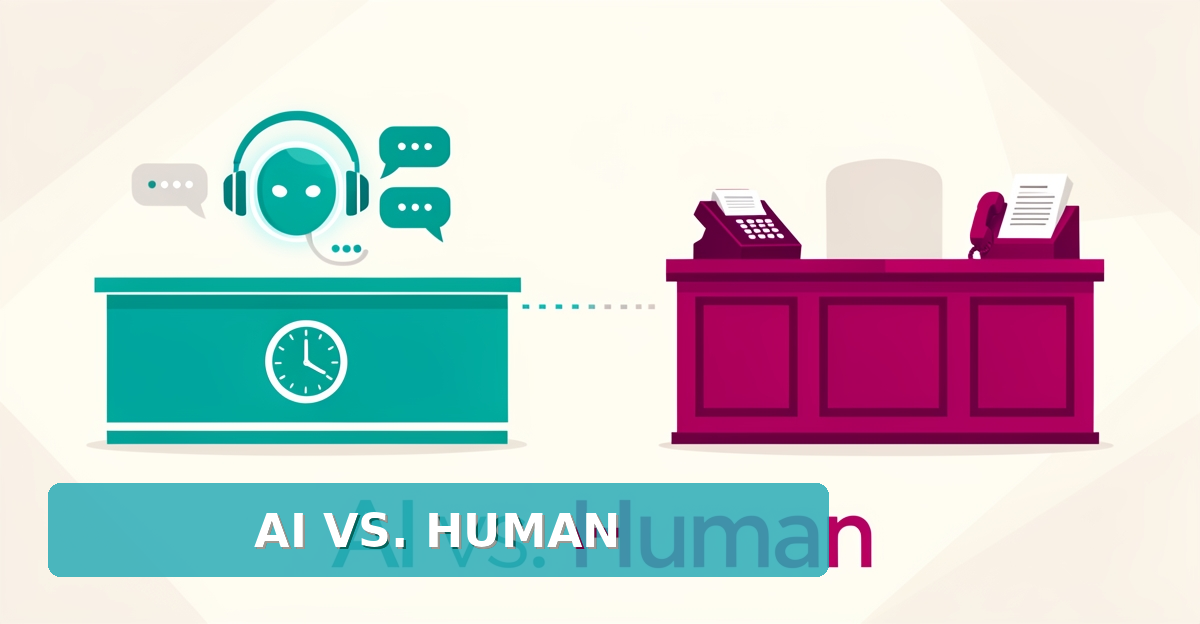
AI Receptionist vs. Human Front Desk: Which Is Better for Real Estate Licensing Schools?
Key Facts
- A meaningful share of prospective student inquiries typically arrive after regular business hours, when human desks are closed
- Call management is a common pain point for small businesses, especially during peak enrollment periods
- AI receptionists can typically automate the majority of routine inquiries, schedules, requirements, tuition, and booking
- Managed AI receptionists usually cost a fraction of a full-time front desk hire
- Hybrid deployments let AI handle volume while humans handle judgment-heavy conversations
Hire a team member that works 24/7 — for less than a part-time wage.
AI receptionists, SDRs, dispatchers and 99+ roles. Trained on your business, fully managed.
Not sure where to start? Ask our AI planner
The Hidden Cost of Missed Calls and Limited Hours in Real Estate Education
Real estate licensing schools face a critical operational gap: a large share of prospective student inquiries arrive outside regular business hours. That means traditional front desks miss a meaningful portion of potential enrollments simply because staff aren't available when students are researching options, often evenings and weekends, when working adults explore career changes.
The cost of these missed connections compounds when call management breaks down during peak periods, leading to voicemail overload and delayed responses that frustrate prospective students. When inquiries go unanswered or delayed, schools lose not just immediate enrollment opportunities but also damage their reputation for responsiveness in a competitive education market.
Beyond missed calls, human front desk staff experience burnout from repetitive tasks like answering routine questions about course schedules, licensing requirements, and tuition costs. These high-volume, low-complexity interactions consume valuable staff time that could be redirected toward personalized student guidance, curriculum development, or instructor support, activities that directly impact educational quality and student success.
AI receptionists eliminate this operational drain by providing 24/7 availability while handling routine inquiries instantly, ensuring no lead goes cold due to timing or staffing limitations. This consistent coverage captures after-hours interest when prospective students are most likely to seek information about career transitions.
- Answering course schedule and requirement questions
- Scheduling consultations and information sessions
- Qualifying leads based on student goals and readiness
- Sending automated reminders and follow-ups
- Routing complex inquiries to appropriate staff
By automating these repetitive functions, schools free up human staff to focus on the nuanced conversations that build trust, discussing career pathways, addressing concerns about exam difficulty, or providing personalized advice about licensing specialties. This strategic division of labor improves both operational efficiency and the quality of student interactions, turning front desk challenges into opportunities for enhanced educational support.
How AI Receptionists Transform Student Engagement and Administrative Efficiency
Real estate licensing schools face constant pressure to balance student support with administrative efficiency. Traditional front desks often struggle with after-hours inquiries and high call volumes during peak enrollment periods. AI receptionists address these challenges by providing 24/7 availability and automating routine tasks, allowing staff to focus on personalized student guidance and curriculum development.
In practice, a well-configured AI receptionist can handle the bulk of routine call volume, course questions, scheduling, tuition and prerequisite FAQs, while typically costing a fraction of a full-time front desk hire. Managed AI receptionist services, like the AI Employees AIQ Labs deploys across 99+ roles, are usually priced well below the loaded cost of an additional staff member, and they don't take vacation or leave calls unanswered at 9 p.m.
The technology integrates with existing CRM systems, calendars, and scheduling tools, creating a unified operational workflow. AI receptionists excel at managing course inquiries, scheduling information sessions, and qualifying leads, even outside regular business hours. For example, they can capture the after-hours inquiries that human staff miss, ensuring no prospective student question goes unanswered.
- Answers routine calls around the clock with zero missed opportunities
- Automates the majority of routine student inquiries
- Frees administrative hours for staff redeployment
- Captures after-hours leads for follow-up
- Integrates with CRM and scheduling systems for seamless workflow
By handling repetitive tasks like appointment scheduling and FAQ responses, AI receptionists free up human staff to provide the empathetic, nuanced support students need when navigating licensing requirements and career decisions. This hybrid approach maintains the personal touch essential in education while leveraging AI for operational scalability and cost efficiency. Schools implementing these systems typically see improved response rates and reduced wait times, directly enhancing the student experience from first inquiry through enrollment.
Why a Hybrid Model Maximizes Student Satisfaction and Staff Productivity
The future of student support in real estate licensing schools isn't about choosing between artificial intelligence and human connection, it's about strategically combining them. As Forbes has observed, the most effective businesses blend automation with authenticity, using AI to handle routine tasks while reserving human expertise for interactions requiring judgment, compassion, and rapport.
In this hybrid model, AI receptionists excel at managing course inquiries, scheduling information sessions, and qualifying leads around the clock. These systems can typically resolve the majority of routine calls automatically, while capturing the inquiries that arrive after business hours. This ensures prospective students receive immediate answers about licensing requirements and course availability, even when your office is closed.
Meanwhile, human staff focus on complex guidance that requires emotional intelligence. They help anxious career-changers navigate licensing pathways, provide personalized academic counseling, and build the relationships that drive enrollment decisions. This division of labor addresses a critical operational challenge: call management is a persistent struggle for many small businesses, often leaving students waiting or sending them to voicemail during peak times.
The productivity gains are substantial. By implementing AI to handle administrative tasks, schools routinely free up significant administrative hours each week. Your admissions team stops playing phone tag and starts having meaningful conversations with serious candidates, while AI manages scheduling, sends reminders, and updates your CRM automatically.
The pattern holds across industries. Well-implemented AI receptionists consistently earn high satisfaction scores when they deliver instant, accurate responses, freeing human advisors to provide the high-touch support that truly requires a personal connection. Students don't resist automation; they resist bad automation.
Key responsibilities in a hybrid model include:
- AI handles: Course inquiries, appointment scheduling, lead qualification, and after-hours FAQ support
- Humans handle: Complex academic advising, emotional support, career counseling, and relationship building
- Shared focus: Seamless handoffs when conversations require escalation from automated systems to personal guidance
AIQ Labs builds these integrated systems for education providers, combining AI receptionist capabilities with strategic human oversight. The technology manages the volume, while your team delivers the value. This approach doesn't just cut costs, it transforms your front desk from a bottleneck into a competitive advantage that serves students better at every touchpoint.
Implementation Roadmap: Deploying an AI Receptionist Aligned with Your School’s Goals
A successful AI receptionist rollout begins with clarity about what you want the system to own, what your human team should keep, and how the two will work together. The strongest deployments treat implementation as an operational redesign, not just a software install.
Start by defining the front-desk jobs that create the most friction. For many real estate licensing schools, that means course inquiries, enrollment questions, appointment booking, and after-hours coverage. That focus matters because missed calls often mean missed revenue, prospective students frequently don't leave voicemail or call back.
Next, configure the agent around your school’s actual admissions workflow. Give it a clear identity, choose the right languages, define inbound or outbound call handling, and build a prompt that reflects your tone, policies, and escalation rules. Then load the knowledge base with the materials students ask for most: course catalogs, licensing requirements, class schedules, tuition details, FAQs, and enrollment policies.
From there, connect the systems that make the receptionist useful instead of just conversational. Sync your CRM, calendar, scheduling tools, and phone workflows so the AI can book consultations, log inquiries, route calls, and capture lead details automatically. Schools benefit most when the AI can answer questions and take action in the same interaction.
Before launch, test the experience the way a real student would. Simulate calls about prerequisites, class availability, payment questions, and licensing deadlines, then review where the AI should solve, schedule, transfer, or escalate. This is also the stage to set guardrails for sensitive conversations, especially when a prospective student needs nuanced guidance that is better handled by a person.
A phased rollout usually works best. Begin with after-hours coverage or overflow calls, measure containment and booking rates, then expand into routine daytime inquiries once the system proves reliable. That hybrid approach reflects the broader market reality: the most effective businesses blend automation with authenticity, using AI to handle routine work while people focus on judgment-heavy conversations.
For schools that want a structured path, AIQ Labs typically approaches this kind of rollout through discovery, integration, training, and ongoing optimization rather than a one-time launch. That model helps align the AI receptionist with enrollment goals, student experience standards, and the systems your team already uses.
The result should feel practical, not experimental: faster response times, fewer missed opportunities, and a front desk that scales without losing the human support students still value.
Still paying for 10+ subscriptions that don’t talk to each other?
We build custom AI systems you own outright. No vendor lock-in. Full control.
Not sure where to start? Ask our AI planner
Frequently Asked Questions
Can an AI receptionist really handle after-hours calls for real estate licensing schools?
Will using an AI receptionist make our school feel less personal to prospective students?
How much time and money can an AI receptionist save our licensing school?
What specific tasks can an AI receptionist handle for our real estate licensing school?
Is it difficult to integrate an AI receptionist with our existing school systems?
Do students actually prefer talking to an AI over a human for enrollment questions?
Turn Your Front Desk Into a 24/7 Enrollment Engine
For real estate licensing schools, the choice isn’t AI versus human, it’s how to combine them so no prospective student is lost to voicemail. The pattern is clear: a large share of inquiries arrive after hours, routine questions drain staff time, and a hybrid model that automates the repetitive work while preserving human guidance for career counseling and complex advising delivers both efficiency and trust. AI receptionists handle course FAQs, scheduling, lead qualification and after-hours coverage at scale, freeing your team for the nuanced conversations that drive enrollment decisions. That strategic division of labor turns a common bottleneck into a competitive advantage. If you’re evaluating where automation fits your admissions workflow, start with a focused assessment of your highest-friction front-desk jobs and how they hand off to your staff. Take the 2-minute Fit Check at /apply for a free 30-minute strategy call with AIQ Labs to map your biggest bottleneck and identify high-ROI automation opportunities, or explore our managed AI receptionists on the AI Employees page. Well-implemented hybrids are proving the model across industries, and education is no exception.
Make AI your competitive advantage — not just another tool.
Strategy, implementation and ongoing optimization. One partner, end to end.
Not sure where to start? Ask our AI planner