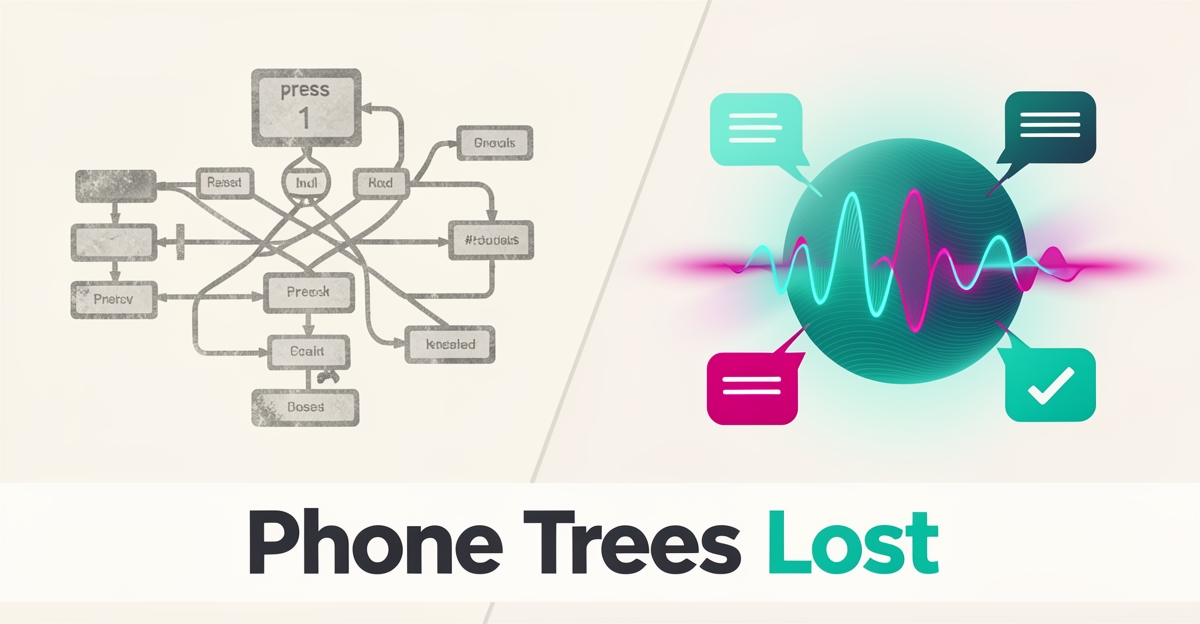
AI Voice Agents vs IVR: Why Phone Trees Lost in 2026
Key Facts
- IVR was designed in the 1990s to route and deflect calls — never to resolve them, according to Bland AI.
- 83% of customers would avoid a company entirely after a poor IVR experience, per industry surveys.
- Poor IVR experiences cost an estimated $262 per customer annually in abandoned calls and lost revenue, according to Ultravox research.
- AI voice agents contain 60–80% of calls without a human versus just 15–25% for IVR, according to CETRAI analysis.
- AI handles calls at roughly $0.08 per minute versus $7.16 for human-handled calls, per CloudTalk statistics.
- Voice AI deployments reach breakeven in 3–6 months compared to 12–18 months for IVR, according to recent studies.
- Televero Health boosted monthly revenue by $204,000 after replacing IVR with AI voice agents, per RingCentral's case study.
Hire a team member that works 24/7 — for less than a part-time wage.
AI receptionists, SDRs, dispatchers and 99+ roles. Trained on your business, fully managed.
Not sure where to start? Ask our AI planner
The Phone Tree Problem: Routing Was Never Resolving
Here's the uncomfortable truth about your phone system: it was never designed to help anyone. Interactive voice response emerged in the 1990s with a narrow mandate — route calls to departments and deflect them away from human agents. It was built to sort, not solve, and three decades later it's still doing exactly that.
The framing that defines 2026 is simple: IVR routes calls; AI voice agents resolve them. A fixed decision tree can only ever service the first intent it recognizes. Everything else becomes a maze of menus, transfers, and dead ends — and customers have noticed.
The frustration economics are brutal. Surveys show 75% of customers report frustration with IVR systems, and 83% say they would avoid a company entirely after a poor IVR experience. That's not annoyance — that's revenue walking out the door.
The downstream costs compound quietly:
- Poor IVR experiences cost an estimated $262 per customer annually in abandoned interactions and lost revenue
- Customers who hit IVR friction are roughly three times more likely to switch providers
- Callers typically abandon after just four or five menu options
- In healthcare settings, IVR patient abandonment rates reach 30–40%
Here's the trap most businesses don't see: IVR looks cheap on the invoice, but the true cost hides in abandoned calls and menu dead ends. As one analysis puts it, the dead end — not the routing mistake itself — is what drives abandonment. The same callers eventually reach an agent, but three menus deeper and angrier. The gap between what callers expect and what legacy systems deliver is exactly where customers quietly leave.
That's the problem AIQ Labs sees across the small and mid-sized businesses we work with: the phone system isn't failing loudly. It's bleeding — one abandoned call, one churned customer, one missed booking at a time. And in 2026, when AI voice agents can answer, understand, and actually resolve a call end-to-end, there's no longer a good reason to keep paying that hidden tax.
What Changed in 2026: AI Agents That Resolve, Not Route
By 2026, AI voice agents had redefined the economics and experience of business phone systems, rendering traditional IVR obsolete. The shift wasn’t just technological—it was a fundamental reimagining of how calls are handled. While IVR was designed in the 1990s to route and deflect, AI agents resolve, completing tasks end-to-end without human intervention. This transformation was driven by stark performance gaps: AI voice agents contain 60–80% of calls compared to IVR’s 15–25%, with first-call resolution rates doubling to 75–85% versus 40–50% for IVR .
The efficiency gains are equally striking. Average handle time plummeted from 11 minutes to just 2 minutes, while cost per call dropped to $0.08/min from $7.16 for human-handled interactions . These improvements aren’t theoretical—Televero Health saw a $204K monthly revenue boost after replacing IVR with AI, while Medical Data Systems automated $280K/month in collections through conversational agents .
The market reflects this shift. The AI voice agent sector, valued at $2.54B in 2025, grew at 39% CAGR, with deployments surging 10x year-over-year . Enterprises adopted a hybrid model: AI answers first, humans escalate, ensuring 24/7 availability without full automation. This approach aligns with AIQ Labs’ AI Employees, which handle high-volume tasks like scheduling and billing while integrating seamlessly with human workflows .
Key advantages include:
- 60–80% containment rates vs. IVR’s 15–25%
- 75–85% first-call resolution vs. 40–50% for IVR
- Handle time cut from 11 to 2 minutes
- $0.08/min vs. $7.16 per call economics
- 39% CAGR in a $2.54B market
For businesses, the math is clear: AI voice agents aren’t just faster or cheaper—they’re fundamentally more effective at retaining customers and reducing friction. As AIQ Labs’ clients demonstrate, the transition from IVR to AI isn’t just about technology—it’s about delivering the service customers expect in an era where 83% would avoid a company after a poor IVR experience .
The Honest Math: Containment Beats Sticker Price (and Vendor Hype)
When considering the financial implications of AI voice agents versus traditional IVR systems, it’s crucial to look beyond the initial sticker price. The economic viability of a solution hinges on containment rates — the percentage of calls resolved without human intervention. High containment rates are the lifeblood of cost-effective customer service, and this is where AI voice agents shine.
According to industry research, AI voice agents contain 60–80% of calls without a human, compared to just 15–25% for IVR systems. This containment is not just a matter of efficiency; it's a direct financial benefit. Each contained call avoids the cost of human intervention, which can be as high as $7.16 per call. In contrast, AI voice agents operate at roughly $0.08 per minute, drastically reducing operational expenses.
The economic case for AI voice agents becomes even more compelling when considering the payback period. Recent studies show that AI voice deployments typically reach breakeven in 3–6 months, compared to 12–18 months for IVR implementations. This rapid return on investment is a game-changer, allowing businesses to see tangible benefits much sooner.
However, it's essential to temper vendor claims with a dose of reality. While vendors may promise containment rates of up to 80%, real-world results can vary. For instance, one real-world customer reported a deflection rate of only 37.5%. This gap between test performance and real-world results underscores the importance of robust evaluation infrastructure and rigorous testing.
A successful AI deployment, such as those led by AIQ Labs, requires a complete approach:
- **Comprehensive Testing:** Ensure your AI agents are rigorously tested in pre-production conditions to simulate real-world scenarios accurately.
- **Production Observability:** Implement monitoring and feedback loops to continuously improve the AI system based on real-world performance data.
- **Feedback Loop:** Create a seamless cycle between pre-production testing and production performance to adapt and refine the AI agents over time.
- **Evaluation Infrastructure:** Invest in the necessary tools and processes to evaluate AI performance accurately, ensuring that your agents meet or exceed containment goals.
- **Realistic Goals:** Set achievable targets based on real-world data, not just vendor promises, to ensure sustainable and measurable success.
For businesses considering AI voice agents, the emphasis should be on containment over upfront costs. With a clear understanding of real-world performance and a commitment to continuous improvement, AI voice agents can deliver significant economic benefits. AIQ Labs, with its comprehensive AI solutions and focus on true ownership and long-term success, is well-positioned to help businesses navigate this transition. Whether you're looking to deploy an AI Receptionist or an AI Employee, the key is to focus on what truly matters: resolving customer issues efficiently and cost-effectively.
The 2026 Playbook: Hybrid Deployment, Not Rip-and-Replace
The winners in 2026 didn't rip out their phone systems — they layered intelligence on top of them. The dominant deployment pattern is AI answers first, humans escalate, with enterprises layering AI agents onto existing telephony for specific high-volume call types before expanding further (Bland AI).
The critical detail is what happens at handoff. When escalation is needed, the AI passes along caller identity, classified intent, actions already attempted, and the full transcript — so the human picks up mid-conversation instead of restarting it (CETRAI). Scalable systems treat human agents as a first-class part of the system, prioritizing handoff quality over full autonomy (Coval.ai). The customer never repeats themselves.
This is augmentation, not replacement — and the data backs it up. Only 20% of service leaders have cut headcount due to AI, while 55% kept staffing stable at higher volumes. Meanwhile, 71% of customers say it's important for a human to validate AI output, and Gartner projects that half of organizations that cut service staff will rehire for similar functions by 2027. Full automation isn't just risky — it's statistically likely to be reversed.
Where should you start? Pick one high-volume, narrow use case and prove it:
- After-hours coverage — capture the calls your competitors miss overnight
- Appointment scheduling and booking confirmation
- Intake and lead qualification for a single service line
The results validate the narrow-first approach. Keller Interiors reduced average wait times by 87% and captured all after-hours leads (RingCentral). Medical Data Systems handles 100% of inbound calls with a 30% human transfer rate while collecting $280,000 monthly through automated conversations (Retell AI). Voice AI deployments also reach breakeven in 3–6 months versus 12–18 months for IVR implementations — faster proof, faster expansion.
This is exactly the model behind AIQ Labs' AI Receptionist: one defined role, deployed via the Start Monthly plan, handling calls end-to-end with human escalation built in. Start with one role, prove containment on your highest-volume call type, then expand into adjacent workflows. The businesses winning the phone channel in 2026 didn't bet everything on day one — they proved one use case, kept their humans in the loop, and scaled from evidence.
Your Next Call Could Be the Test: What to Do This Week
Your next call could be the test of whether your business is ready for 2026’s AI-driven phone handling. Start by auditing your current system: check your call abandonment rate (average 25–30% for IVR), after-hours coverage gaps, and how many callers hit dead ends. According to industry research, 75% of customers are frustrated by IVR, and 83% would avoid a company after a poor experience.
Identify the single highest-volume call type—scheduling, billing, or support—and prioritize automating it. AI voice agents resolve 60–80% of calls without human intervention, compared to 15–25% for IVR (source). This reduces costs: AI handles calls at ~$0.08/min versus $7.16 for human agents (source).
Beware "conversational IVR" vendors whose demos still walk a decision tree. True AI agents adapt to callers, not the other way around. (source) warns that fixed grammars fail to address evolving customer needs.
Take action this week:
- Run a 30-day audit of your call flow, focusing on friction points
- Pinpoint one high-volume call type with the clearest ROI for automation
- Schedule a free strategy call with AIQ Labs to assess your fit
AIQ Labs’ Fit Check reveals whether your business can achieve a 3–6 month breakeven with AI voice agents, avoiding the 12–18 months typical for IVR (source). Real numbers, no fake price anchors—just a clear path to reduce abandonment, lower costs, and keep customers from fleeing after a bad IVR experience.
Still paying for 10+ subscriptions that don’t talk to each other?
We build custom AI systems you own outright. No vendor lock-in. Full control.
Not sure where to start? Ask our AI planner
Frequently Asked Questions
How do AI voice agents improve customer satisfaction compared to traditional IVR systems?
What are the cost savings of switching to AI voice agents over IVR?
Can AI voice agents handle complex tasks without human intervention?
How quickly can businesses see a return on investment with AI voice agents?
Are AI voice agents reliable, or do they often fail to understand customers?
What's the best way to start implementing AI voice agents without overhauling my phone system?
The Phone Tree's Last Voicemail: Your Move in 2026
The verdict from 2026 is clear: IVR was built to route, AI voice agents are built to resolve — and the numbers settled the argument. With 60–80% call containment versus IVR's 15–25%, handle times cut from 11 minutes to 2, and breakeven arriving in 3–6 months instead of 12–18, the economics no longer favor the phone tree (source). But the winning playbook isn't rip-and-replace — it's AI answers first, humans escalate, starting with one high-volume call type like scheduling, billing, or after-hours coverage. That's exactly how we approach it at AIQ Labs: start with one AI Employee in a defined role on a monthly plan, prove containment on real calls, then expand from evidence — never hype. Your next step is simple: audit your abandonment rate, pick your highest-volume call type, and take the two-minute Fit Check at aiqlabs.ai/apply. It leads to a free 30-minute strategy call with an AI engineer — real numbers, no fake price anchors, and an honest answer either way. While you're deciding, a competitor's AI is answering their phone.
Make AI your competitive advantage — not just another tool.
Strategy, implementation and ongoing optimization. One partner, end to end.
Not sure where to start? Ask our AI planner