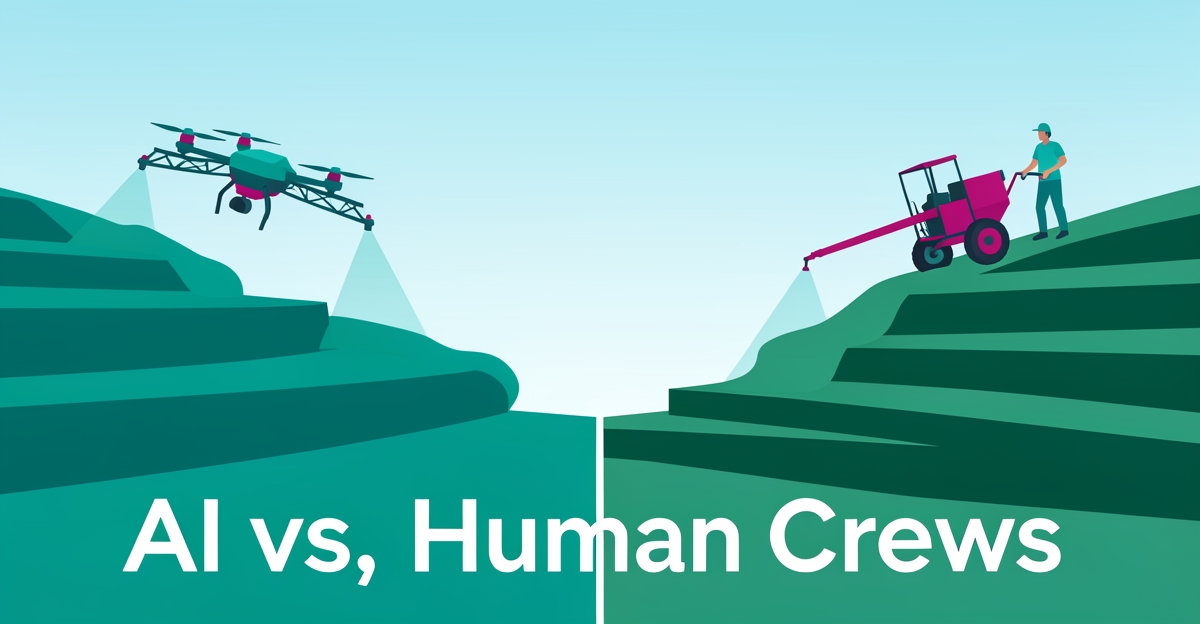
AI vs. Human Crews: Which Is Better for Hydroseeding in Remote Areas?
Key Facts
- Autonomous agricultural drones typically achieve precision within roughly 2 meters for applications like hydroseeding, per agricultural drone research.
- Small altitude deviations can shift spray spread by meters on the ground, precision is a systems problem, not just a hardware problem.
- AI-driven hydroseeding systems can operate across multiple remote sites simultaneously without adding personnel, unlike human crews that require duplicated logistics.
- AIQ Labs has deployed 200+ multi-agent systems and runs 4 live SaaS products daily, implementation experience, not just technology access, determines outcomes.
- AI Employees typically cost around 80% less than a comparable human hire while providing 24/7/365 availability.
Hire a team member that works 24/7 — for less than a part-time wage.
AI receptionists, SDRs, dispatchers and 99+ roles. Trained on your business, fully managed.
Not sure where to start? Ask our AI planner
The Remote Work Challenge: Why Traditional Hydroseeding Struggles in Isolated Terrain
A hydroseeding project 200 kilometers from the nearest supply depot doesn't fail because of seed quality or slurry mix, it fails because of logistics. When terrain is isolated, every hour of delay, every fatigued operator, and every inconsistent spray pass compounds into cost overruns and patchy germination.
Traditional hydroseeding crews face a cascade of logistical barriers in remote terrain. Equipment transport alone can consume days, and once on site, crews must contend with terrain variations, weather windows, and limited resupply options. Across industries, the pattern is the same: the hard part isn't access to the capability, it's executing it reliably in difficult conditions. That's why implementation expertise, not technology itself, has become the primary barrier to scaling AI in field operations.
Human performance adds another variable. Fatigue degrades consistency over long shifts, meaning application rates that were precise at 8 a.m. drift by mid-afternoon. This variability matters in hydroseeding, where uneven coverage directly affects germination outcomes. Agricultural drone research illustrates the stakes: even a small altitude deviation can shift spray spread by meters on the ground, which is why precision at scale is increasingly treated as a systems problem rather than a hardware problem.
The scalability gap is perhaps the most limiting factor. Human crews require transportation, accommodation, and coordination for each deployment, and expanding to multiple remote sites means duplicating all of that overhead. AI-driven systems, by contrast, can be deployed across multiple locations simultaneously without adding personnel. The same research shows autonomous agricultural systems can cover vast fields faster than tractors or planes while maintaining precision within roughly 2 meters for critical applications.
Key operational barriers for human crews in isolated terrain include:
- Transportation delays that push projects past optimal seeding windows
- Crew fatigue leading to inconsistent application rates across a site
- Limited scalability, since each additional remote deployment multiplies logistics costs
- Difficulty attracting and retaining skilled operators willing to work in remote locations
None of this means human crews are obsolete, their adaptability in unpredictable conditions remains a genuine strength. But it does mean the traditional model has structural limits that become expensive exactly where hydroseeding work is hardest. The question for operators is no longer whether alternatives exist, but how to determine the right mix of human oversight and automated application for their specific terrain and workflow. That's the kind of trade-off a workflow build is designed to resolve, rebuilding the one workflow that costs the most, with geography, cost structure, and operational needs weighed before committing capital to either approach.
How AI-Driven Systems Are Transforming Precision Field Operations in Agriculture and Beyond
AI-driven systems are redefining precision in field operations by combining adaptive intelligence with real-time environmental responsiveness. These technologies go beyond simple automation, enabling autonomous decision-making that adjusts to terrain, weather, and operational variables without human intervention. In agriculture and remote terrain applications, this level of precision ensures consistent results where human variability once introduced risk.
Per recent drone research, AI-equipped drones can achieve application accuracy within roughly 2 meters, critical for hydroseeding where seed distribution patterns directly impact germination success. This precision is enabled by dynamic flight path planning that continuously recalculates routes based on field geometry, wind drift, and elevation changes. Unlike static waypoint missions, adaptive systems optimize coverage in real time, reducing overlap and missed zones.
Terrain-following algorithms maintain constant altitude above ground level, compensating for slopes, ridges, and depressions that would otherwise cause uneven application. Payload release logic adjusts timing based on real-time groundspeed and crosswind data, ensuring seeds are deposited at the optimal point along the flight path. When missions are interrupted, fail-safe recovery protocols allow drones to resume from the exact point of interruption, preserving coverage integrity, a capability proven in large-scale agricultural operations spanning hundreds of acres.
These capabilities are not theoretical; they are being validated through real-world deployments where scalability and consistency matter most. AI systems can operate across multiple remote sites simultaneously without additional personnel, eliminating the logistical burden of transporting and housing crews. The broader lesson from enterprise AI adoption is that implementation expertise, integrating AI with field hardware, environmental sensors, and existing workflows, is as vital as the technology itself for achieving reliable outcomes in disconnected environments. It's the same principle behind AIQ Labs' AI Operating Systems: one connected operating layer, built in phases, owned outright.
While human crews bring irreplaceable judgment in unpredictable scenarios, AI-driven systems excel in standardized, repeatable tasks like hydroseeding, where consistency, scalability, and operational uptime determine success. The most effective approach leverages both: AI handles precision execution and data collection, while humans oversee strategy, exception management, and adaptive planning, creating a resilient, high-performance operation model suited to the demands of remote terrain work.
The Hybrid Advantage: When to Use AI, When to Rely on Humans, and How AIQ Labs Helps Decide
In remote hydroseeding projects, the choice between AI and human crews isn't about picking one over the other, it's about matching each to the task at hand. Human crews excel when terrain shifts unexpectedly or weather demands real-time judgment, bringing adaptability that rigid systems can't replicate. Meanwhile, AI-driven systems deliver consistent seed application rates and coverage patterns, especially when operating across large, standardized plots where meter-level precision can directly impact germination success.
This hybrid approach leverages the strengths of both: AI handles routine flight path planning, payload release timing, and terrain following, tasks that benefit from automation's repeatability, while human operators oversee operations, manage exceptions like equipment failure or regulatory hurdles, and make strategic calls when conditions deviate from the norm. Such a model reduces fatigue-related variability in crews while ensuring that critical decisions remain in experienced hands. AIQ Labs supports this balance through its free 30-minute strategy call, which evaluates your geography, workflow complexity, and infrastructure to determine the optimal mix of automation and human oversight for sustainable, scalable outcomes in challenging environments.
Still paying for 10+ subscriptions that don’t talk to each other?
We build custom AI systems you own outright. No vendor lock-in. Full control.
Not sure where to start? Ask our AI planner
Frequently Asked Questions
Can AI-driven drones really be precise enough for hydroseeding in remote terrain?
What makes traditional hydroseeding crews struggle in isolated areas?
Are AI systems faster and more scalable than human crews for remote work?
Does switching to AI mean I have to get rid of my crews?
Why is implementation expertise so important for AI in field operations?
How do autonomous drones maintain consistent coverage when missions get interrupted?
Finding Your Path Forward: AI, Humans, and the Right Mix for Remote Hydroseeding
Remote hydroseeding success hinges not on choosing AI or humans, but on strategically combining their strengths: AI delivers consistent, scalable precision for standardized application, critical where fatigue and logistics undermine human crews, while human oversight remains essential for unpredictable terrain and real-time judgment. This hybrid model directly addresses the core barriers of transportation delays, inconsistent coverage, and scalability limits that inflate costs in isolated operations. For operators weighing this balance, the next step is an objective assessment of their specific geography, workflow, and cost structure to determine where automation adds the most value without overcommitting resources. AIQ Labs' strategy call is designed precisely for this evaluation, helping businesses map high-ROI opportunities and build a sustainable, tailored approach. To explore how this applies to your operation, start with the free two-minute Fit Check at aiqlabs.ai/apply and a free 30-minute strategy call to identify your clearest path forward, no obligation, just clarity.
Make AI your competitive advantage — not just another tool.
Strategy, implementation and ongoing optimization. One partner, end to end.
Not sure where to start? Ask our AI planner