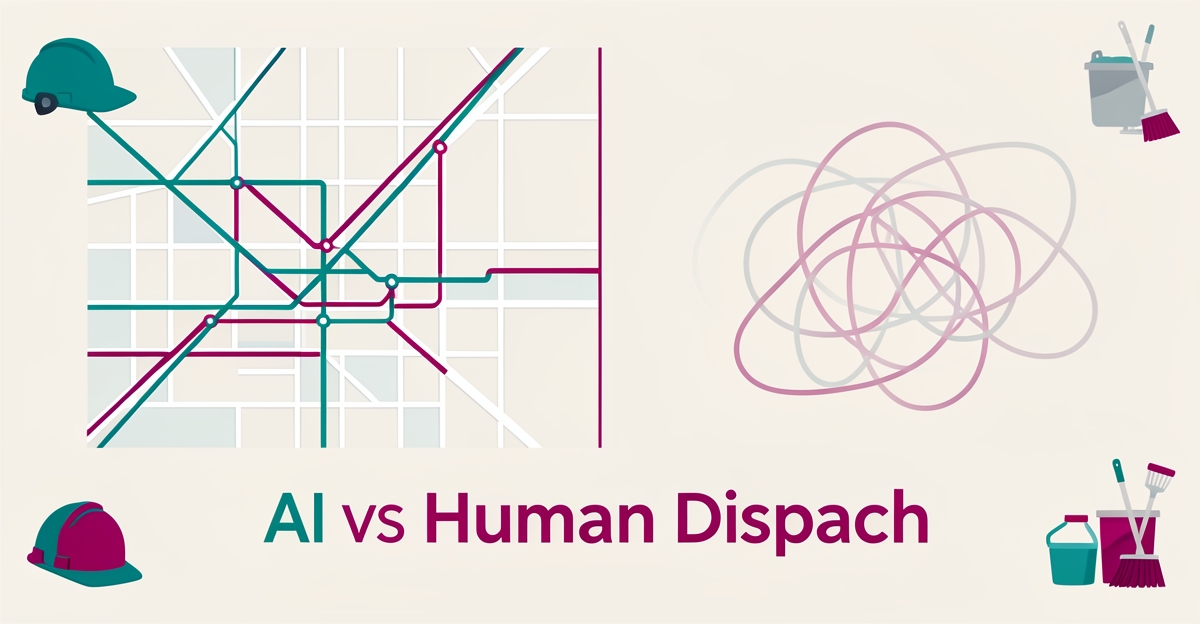
AI vs. Human Dispatch: Which Is Better for Post-Construction Cleaning Companies?
Key Facts
- AI-powered route optimization typically reduces miles driven by 20-35% compared to manual dispatch, per dispatch industry reports
- Skill-based AI dispatch is associated with 25-30% fewer failed stops in fleet operations research
- First-attempt success rates commonly improve 15-20% when AI matches crews to site requirements automatically
- Manual dispatch typically caps out around 10-15 drivers or crews per dispatcher, per industry benchmarks
- An AI dispatcher typically costs around 80% less than a human hire while running 24/7
Hire a team member that works 24/7 — for less than a part-time wage.
AI receptionists, SDRs, dispatchers and 99+ roles. Trained on your business, fully managed.
Not sure where to start? Ask our AI planner
The Dispatch Bottleneck Costing Post-Construction Cleaning Companies Money
Post-construction cleaning companies often hit a hard operational ceiling when manual dispatchers try to manage punch-list crews, change orders, and last-minute site swaps. Juggling check-in calls, manual updates, and error-prone scheduling creates a bottleneck that limits effective oversight to roughly 10-15 drivers or crews per dispatcher, per industry benchmarks. This constraint forces growing companies to either overload dispatchers, leading to missed turnovers and failed site visits, or hire additional staff, driving up back-office overhead with every new contract.
Reactive dispatch doesn't just slow operations; it directly erodes profitability. Missed turnovers delay project handovers, failed site visits trigger penalties or rework, and the constant firefighting consumes time that could be spent on proactive planning or client communication. As contracts scale, the inefficiencies compound: more sites mean more variables, and manual systems struggle to adapt without proportional increases in dispatch labor. The result is a cycle where growth increases cost without improving service reliability.
AIQ Labs helps post-construction cleaning companies break this cycle by moving from reactive, human-limited dispatch to intelligent, scalable automation. An AI dispatcher optimizes crew routing in real time, handles dynamic site changes, and reduces manual coordination, so companies can operate past the 10-15 crew ceiling with greater consistency. Industry reports on AI dispatch point to meaningful reductions in failed stops and improved first-attempt success when crews are matched to site requirements automatically, directly addressing the pain points of missed turnovers and site revisits in post-construction work. Route optimization also typically cuts mileage substantially, lowering fuel and vehicle wear costs while ensuring crews spend more time cleaning and less time navigating between sites.
Unlike human dispatchers who rely on intuition and are prone to fatigue or oversight during peak demand, AI systems deliver consistent optimization every time, eliminating the variability that leads to scheduling errors and miscommunication. They also provide real-time visibility into crew locations and automated ETA updates, reducing the need for constant check-in calls. While human judgment remains valuable for exceptional circumstances, AI excels at handling routine dispatch complexity at scale, freeing skilled staff to focus on client relationships, quality control, and exception management rather than administrative juggling.
For companies ready to move beyond the limits of manual dispatch, AIQ Labs offers a phased implementation approach tailored to post-construction cleaning workflows. Starting with a targeted workflow build, such as automating dispatch for punch-list crews, businesses can validate results quickly before scaling to full department automation or a complete AI operating system. This approach ensures measurable improvements in efficiency, cost control, and scalability without disrupting ongoing operations. To explore how AI can resolve your dispatch bottleneck, start with the two-minute Fit Check and a free 30-minute strategy call to map your biggest operational challenge.
What AI Dispatch Actually Delivers: The Numbers
The numbers tell a story that spreadsheets and whiteboards simply cannot match. When post-construction cleaning crews move between punch-list sites across a metro area, every wasted mile and missed window compounds into real margin erosion.
Dispatch industry reports consistently show that AI-powered routing cuts miles driven, often in the 20-35% range, by optimizing routes across distance, traffic, and crew capacity simultaneously. For a company running five crews across twenty active job sites, that translates to thousands of dollars in fuel and vehicle wear each month. The same systems are associated with 15-20% better first-attempt success rates because the right technician with the right equipment arrives at the right time.
- Typically 25-30% fewer failed stops when crews are matched to site requirements automatically
- 40-60% less dispatcher time spent on manual crew matching and phone tag
- Real-time ETA updates pushed to general contractors without a single check-in call
- Consistent optimization every schedule, no "good days" and "bad days" depending on who's at the desk
- Scalability from 5 to 500+ crews without proportional back-office cost increases
The practical ceiling for human dispatch sits at roughly 10-15 drivers per dispatcher, per industry benchmarks. AI dispatch removes that constraint entirely, handling fleets of any size while freeing experienced staff to handle the exceptions that actually require judgment, weather delays, client escalations, scope changes on active sites. AIQ Labs helps cleaning companies implement this transition through phased builds that prioritize the highest-ROI workflows first, ensuring the technology serves the operation rather than the other way around.
Where Human Dispatchers Still Win
AI dispatch delivers measurable gains in efficiency and scalability, but human dispatchers remain irreplaceable when the unexpected happens. A crew no-show mid-turnover or a general contractor shifting the final clean date requires more than algorithmic rerouting, it demands real-time problem-solving, empathy, and the kind of judgment that comes from years on the job. Human dispatchers excel here, using intuition to reassess priorities, calm frustrated stakeholders, and keep projects moving when rigid systems hit their limits.
Beyond crisis management, human dispatchers build the relationships that sustain post-construction businesses. Regular check-ins with foremen and property managers foster trust that reduces friction during tight turnarounds and encourages repeat work. These connections aren't just nice to have, they directly impact service quality and client retention, especially in markets where reputation drives referrals. Human dispatchers provide exceptional judgment in complex situations, making decisions that require intuition and experience no AI can yet replicate.
This isn't an argument against AI, it's a call to redeploy human talent where it creates the most value. When AI handles routine coordination like scheduling and driver matching, your best people can focus on the nuanced work that prevents costly delays and strengthens client partnerships. The real question isn't AI versus human; it's whether your skilled dispatchers should spend their day on repetitive tasks that machines can do faster and more consistently. By letting AI manage the predictable, you free your team to master the unpredictable.
The Hybrid Model: AI Handles the Routine, Humans Handle the Exceptions
The most effective dispatch strategy for post-construction cleaning companies isn't choosing between AI and human teams, it's combining their strengths. AI dispatch monitors every active job in real time, flags anomalies before they become delays, and surfaces only true exceptions to a human dispatcher who can act rather than react. This proactive model transforms dispatch from a reactive cost center into a precision operation that prevents issues before they impact schedules or customer satisfaction.
The economics of this hybrid approach are compelling for growing service businesses. Savings come from reduced fuel consumption, fewer failed stops, and optimized crew utilization, all while maintaining the human touch for complex situations that require judgment and relationship-building. Because an AI dispatcher typically costs around 80% less than a human hire, the payback on a well-scoped pilot is usually measured in months, not years.
An AI Employee serving as a dispatcher handles booking calls, scheduling, and crew coordination 24/7 at a fraction of the cost of a human hire. This allows human dispatchers to focus on exceptions where their experience adds real value, such as weather-related delays, client-specific access challenges, or equipment substitutions. The system continuously learns from these human interventions, improving its ability to handle similar situations autonomously over time.
- Real-time GPS tracking and automated ETA updates provide constant visibility into crew locations and job progress
- AI-driven route optimization typically reduces mileage by 20-35%, directly lowering fuel costs and vehicle wear
- Skill-based matching ensures the right crew with the right equipment is assigned to each job, cutting failed stops
- First-attempt success rates commonly improve 15-20% when AI handles routine assignments while humans manage exceptions
- Dispatcher time spent on manual driver matching decreases by 40-60%, freeing capacity for higher-value activities
This hybrid model scales efficiently, AI dispatch can manage fleets from 5 to 500+ crews without proportional increases in back-office costs, while human dispatchers remain effective for the nuanced decisions that machines cannot replicate. For post-construction cleaning companies facing variable job complexities and tight client deadlines, this approach delivers both operational efficiency and service quality. AIQ Labs helps businesses implement this balanced strategy through phased implementation plans that preserve human expertise while leveraging automation for routine tasks.
How to Implement AI Dispatch Without Disrupting Your Operation
Disrupting the dispatch desk on day one is the fastest way to lose driver trust and bookings. A phased rollout lets you prove value on one high-friction workflow first, then expand once the team sees it work.
Start with the workflow that creates the most daily pain, typically booking calls or crew scheduling. Post-construction cleaning companies often begin by letting an AI dispatcher handle inbound bookings and initial crew matching while a human dispatcher retains final approval. This limits risk and builds confidence.
Data quality determines whether the system delivers savings or errors. AI dispatch considers distance, traffic, time windows and capacity simultaneously, which is why fleets using AI-powered dispatch typically report 20-35% fewer miles driven. Clean job addresses, service windows, crew certifications and equipment availability must be accurate before automation is trusted.
Train dispatchers to work alongside the system, not against it. Human dispatchers excel at complex situations, relationship building and exceptional judgment. The model that works best is AI handles repetitive matching and real-time visibility, humans handle exceptions. AI dispatch commonly eliminates 40-60% of the manual overhead tied to driver matching, freeing your best people for the calls that need intuition.
Monitor performance before scaling. Track first-attempt success, failed stops and dispatcher time per job. Operations using skill-based AI dispatch commonly report 25-30% fewer failed stops and 15-20% improved first-attempt success rates. Manual dispatch typically caps at 10-15 drivers per dispatcher, while AI dispatch handles 5 to 500+ drivers without proportional back-office growth.
A practical implementation roadmap follows this sequence:
- Pilot one workflow with a Start Monthly AI Dispatcher, e.g., after-hours booking or daily crew scheduling
- Audit and clean core data, then integrate CRM, scheduling and job management tools
- Run human-in-the-loop for 2-4 weeks, measuring failed stops, mileage and dispatcher hours
- Scale to full dispatch support with milestone-based builds, or Own It Outright for full ownership
AIQ Labs applies this phased approach through three payment models, Start Monthly, Build in Milestones, and Own It Outright, so teams can pause or adjust anytime. See pricing for how each model works. The goal is start small, prove ROI, then scale without operational disruption.
Map your biggest dispatch bottleneck in a free strategy call to design a pilot that fits your current crews and tools. Start with the two-minute Fit Check, then book your free 30-minute call.
Still paying for 10+ subscriptions that don’t talk to each other?
We build custom AI systems you own outright. No vendor lock-in. Full control.
Not sure where to start? Ask our AI planner
Frequently Asked Questions
How many crews can one human dispatcher realistically handle before things start slipping?
Will AI dispatch actually save us money on fuel and mileage?
Does AI dispatch reduce failed stops and missed turnovers?
How much dispatcher time can we free up with AI?
What's the ROI timeline for switching to AI dispatch?
Do we have to replace our dispatchers if we use AI?
Turning Dispatch from a Bottleneck into Your Competitive Edge
The dispatch bottleneck isn't just an operational hiccup, it's a profit leak that scales with every new contract. AI-powered dispatch removes the 10-15 crew ceiling, typically cuts mileage by 20-35%, reduces failed stops, and improves first-attempt success rates, all while freeing skilled staff to focus on client relationships and exception handling. The real advantage comes not from replacing humans, but from augmenting them: letting AI manage the predictable so your team can master the unpredictable. For post-construction cleaning companies ready to scale without inflating back-office costs, the path forward is clear, start small, prove ROI, then expand. Map your biggest dispatch bottleneck in a free strategy call to design a pilot that fits your current crews and tools.
Make AI your competitive advantage — not just another tool.
Strategy, implementation and ongoing optimization. One partner, end to end.
Not sure where to start? Ask our AI planner