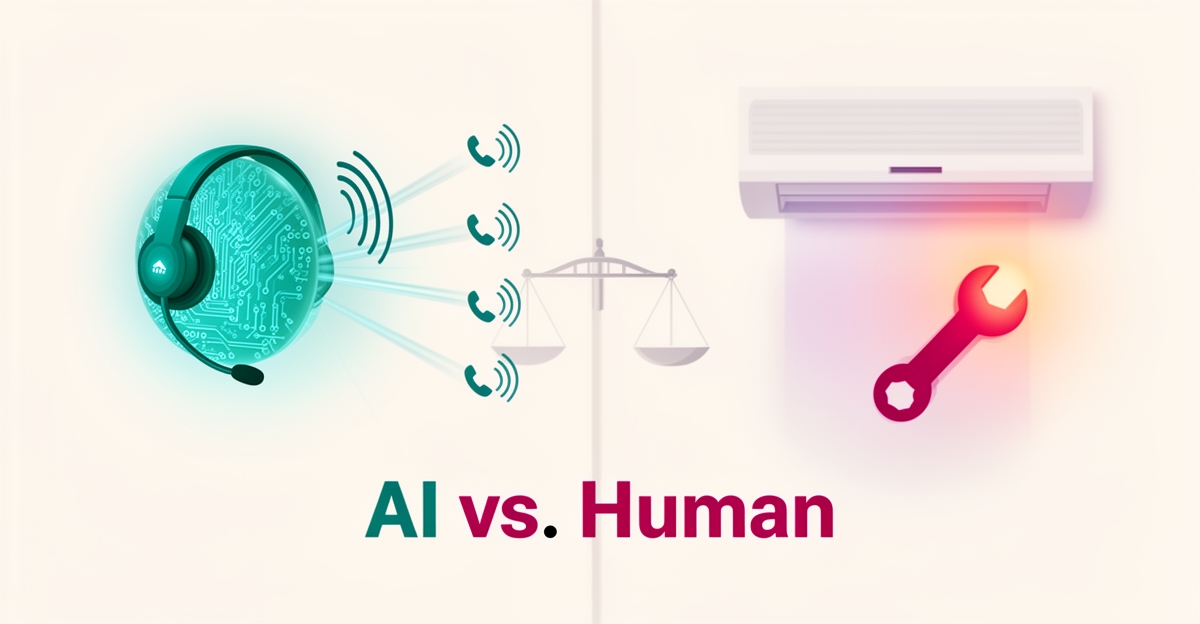
AI vs. Human Dispatchers: Can Machines Handle the Call for AC Service?
Key Facts
- AI dispatchers can handle thousands of inquiries simultaneously without performance drop-offs according to Kustomer research.
- AI voice agents can speak 60+ languages including English, Spanish, German, French and Italian based on CloudTalk data.
- AI dispatchers can reduce Average Handling Time and post-call handling time by automating tedious tasks as shown by Diabolocom.
- Modern AI agents can understand context, intent and nuance in customer language unlike traditional chatbots per Kustomer analysis.
- Human dispatchers excel in empathy, complexity and connection making them essential for high-stakes moments according to Kustomer.
- AI dispatchers improve customer satisfaction by reducing waiting time and increasing response accuracy per Diabolocom findings.
Hire a team member that works 24/7 — for less than a part-time wage.
AI receptionists, SDRs, dispatchers and 99+ roles. Trained on your business, fully managed.
Not sure where to start? Ask our AI planner
The Growing Pressure on HVAC Dispatchers to Handle Volume and Accuracy
When the summer heatwave hits and every air conditioner in the city seems to fail at once, the pressure on HVAC dispatchers becomes immense. This surge in demand exposes the operational limits of relying solely on a human team, leading to missed calls, frustrated customers, and lost revenue.
Human dispatchers, for all their skill, have a finite capacity. They can only handle one call at a time, and during peak seasons, the volume of service requests can quickly become overwhelming. This often leads to long hold times and rushed conversations, where critical details about a customer's issue can be missed.
In contrast, an AI dispatcher can manage thousands of inquiries simultaneously without any drop in performance. According to industry analysis, this capability allows businesses to answer every call instantly, ensuring no customer is left waiting. This continuous availability matters most for after-hours emergencies or seasonal spikes.
The challenge isn't just about volume; it's also about accuracy. A tired or rushed human dispatcher can easily make mistakes when scheduling appointments or recording service details. These small errors can lead to significant problems, such as sending a technician to the wrong address or without the right parts.
AI systems excel at automating these routine but critical tasks. Research from Diabolocom shows that AI can significantly reduce Average Handling Time (AHT) by automating tedious post-call work. This not only improves efficiency but also ensures that every piece of information is captured accurately, every time.
The core challenges of a human-only dispatch model include:
- Limited Availability: Human teams work set hours, leaving calls unanswered during nights, weekends, and holidays.
- Susceptibility to Fatigue: High call volumes lead to burnout, increasing the likelihood of errors in scheduling and data entry.
- Scalability Issues: It's difficult and expensive to scale a human team up or down to match fluctuating seasonal demand.
- Inconsistent Service: The quality of customer interaction can vary depending on the dispatcher's experience and current workload.
These operational hurdles highlight the growing need for a more resilient and scalable solution. Businesses are now exploring how AI dispatch employees can augment their teams, handling the high-volume, repetitive tasks that often lead to human error. This allows skilled human dispatchers to focus on what they do best: managing complex customer issues that require empathy and critical thinking.
How AI Dispatchers Improve Speed, Accuracy, and Cost Efficiency in AC Service Routing
AI-powered dispatchers are transforming AC service routing by eliminating the delays and errors that slow down human teams. They process thousands of concurrent calls without performance degradation, ensuring no customer waits in a queue during peak demand according to Kustomer. This capability directly reduces Average Handling Time by automating routine verification and routing tasks, cutting post-call work significantly as shown by Diabolocom.
These systems verify service needs with high accuracy by understanding context, intent, and nuance in customer language, far beyond basic keyword matching per Kustomer research. By accurately identifying whether a call requires emergency repair, seasonal maintenance, or a simple filter check, AI dispatchers route technicians to the right job on the first attempt. This precision minimizes repeat visits and unnecessary truck rolls, directly lowering operational costs while improving first-time fix rates.
AI dispatchers also break down language barriers, supporting over 60 languages including English, Spanish, German, French, and Italian based on CloudTalk data. For HVAC companies serving diverse communities, this ensures every customer receives immediate, clear communication regardless of their primary language. The result is faster response times, higher accuracy in service routing, and measurable gains in cost efficiency, all without sacrificing the quality of customer interaction.
AIQ Labs delivers managed AI Employees for dispatcher roles that integrate with scheduling tools, CRM systems, and field service platforms. These AI staff handle high-volume intake, validate service requirements, and optimize technician routing, working 24/7 at a fraction of the cost of a human hire. You can start with a two-minute Fit Check to see how AI dispatching fits your operation, then book a free 30-minute strategy call to map it out.
Why Human Dispatchers Remain Essential for Empathy and Complex Issue Resolution
When a homeowner's AC fails during a heatwave, the voice on the other end of the line carries more weight than any algorithm can simulate. Research from Kustomer confirms that human dispatchers excel in empathy, complexity, and connection, making them essential for high-stakes moments where trust hangs in the balance. These situations demand nuanced judgment that goes beyond scripted responses.
- De-escalating frustrated customers facing uncomfortable or dangerous conditions
- Navigating multi-layered service issues requiring creative problem-solving
- Building long-term trust through personalized, relationship-focused interactions
- Making judgment calls when standard protocols don't fit the situation
Human dispatchers build trust and strengthen customer relationships through personalized interactions, according to Kustomer's analysis. This relational depth proves critical when customers face vulnerable moments, an elderly resident without cooling, a family with infants, or a business losing perishable inventory. An AI dispatcher can verify service needs efficiently, but it cannot genuinely reassure a panicked caller that help is truly coming.
The same research notes that AI dispatchers can handle thousands of inquiries simultaneously without performance drop-offs, creating a natural partnership model. AIQ Labs designs AI employees to absorb routine volume, appointment confirmations, basic scheduling, status updates, so human dispatchers remain available for the complex, emotionally charged calls where their expertise matters most. This division of labor preserves the human touch for moments that define customer loyalty.
The most effective dispatch operations don't choose between technology and humanity. They deploy each where it performs best, ensuring that when a caller's voice cracks with stress, a trained professional answers with both competence and compassion.
A Hybrid Model: Using AI to Handle Routine Tasks So Humans Focus on High-Value Interactions
The debate between AI and human dispatchers is not about choosing a winner; it is about assigning the right tasks to the right resource. By leveraging AI for routine inquiries, businesses can liberate their human talent for high-stakes, complex interactions that drive customer loyalty.
AI dispatchers excel at managing high-volume, repetitive tasks with speed and precision. They can handle thousands of inquiries simultaneously without performance drop-offs, according to industry research. This capability ensures that every call is answered instantly, reducing customer frustration and wait times.
Beyond speed, AI agents bring a level of linguistic versatility that humans cannot match. For instance, AI voice agents can speak over 60 languages, including English, Spanish, German, French, and Italian, as noted by CloudTalk. This allows businesses to serve a diverse customer base without hiring multilingual staff for every shift.
Efficiency gains extend to operational metrics as well. By automating tedious tasks, AI dispatchers can significantly reduce Average Handling Time (AHT) and post-call work, according to Diabolocom. This streamlining allows human agents to focus on resolving issues rather than getting bogged down by administrative overhead.
However, the human touch remains irreplaceable for complex, emotionally charged situations. Human dispatchers excel in empathy, complexity, and connection, making them essential for high-stakes moments, as highlighted by Kustomer. They build trust and strengthen relationships through personalized interactions that AI cannot replicate.
Implementing a hybrid model requires a strategic approach to ensure seamless integration. Businesses should consider the following steps:
- Deploy AI dispatchers to handle routine inquiries and verify service needs.
- Train human agents to manage escalations and complex scheduling.
- Continuously monitor performance to ensure AI and humans work in harmony.
At AIQ Labs, we specialize in this hybrid approach through our AI Employee model. Our AI dispatchers integrate with existing workflows to handle routine calls, allowing human teams to focus on high-value interactions. If your dispatch workflow needs a deeper rebuild, routing logic, scheduling rules, escalation paths, our AI Workflow Builds tackle the one workflow that costs you the most, at a fixed price and in phases. This model not only improves efficiency but also enhances the overall customer experience by ensuring the right resource handles the right task.
Still paying for 10+ subscriptions that don’t talk to each other?
We build custom AI systems you own outright. No vendor lock-in. Full control.
Not sure where to start? Ask our AI planner
Frequently Asked Questions
Can AI dispatchers really handle thousands of calls simultaneously?
How accurate are AI dispatchers compared to human dispatchers?
What languages can AI dispatchers speak?
When should I use a human dispatcher instead of AI?
How do AI and human dispatchers work together in a hybrid model?
How much can AI dispatchers reduce operational costs?
The Smart Path Forward: AI and Humans Working Together in HVAC Dispatch
The future of HVAC dispatch isn't about choosing between AI and human teams, it's about strategically combining both to maximize efficiency, accuracy, and customer satisfaction. AI dispatchers excel at handling high-volume, routine tasks like appointment scheduling and service verification, reducing Average Handling Time and eliminating wait times during peak seasons. Meanwhile, human dispatchers remain indispensable for complex, emotionally charged situations where empathy and judgment are critical. By adopting a hybrid model, businesses can free their skilled staff to focus on high-value interactions while ensuring every call is answered promptly and accurately, 24/7. This balanced approach not only improves operational metrics but also strengthens customer trust and loyalty. To explore how AI dispatching can fit your specific HVAC service needs, start with the two-minute Fit Check at aiqlabs.ai/apply, then book a free 30-minute strategy call to assess your biggest bottlenecks and identify high-ROI automation opportunities, no obligation, just clarity on your path forward.
Make AI your competitive advantage — not just another tool.
Strategy, implementation and ongoing optimization. One partner, end to end.
Not sure where to start? Ask our AI planner