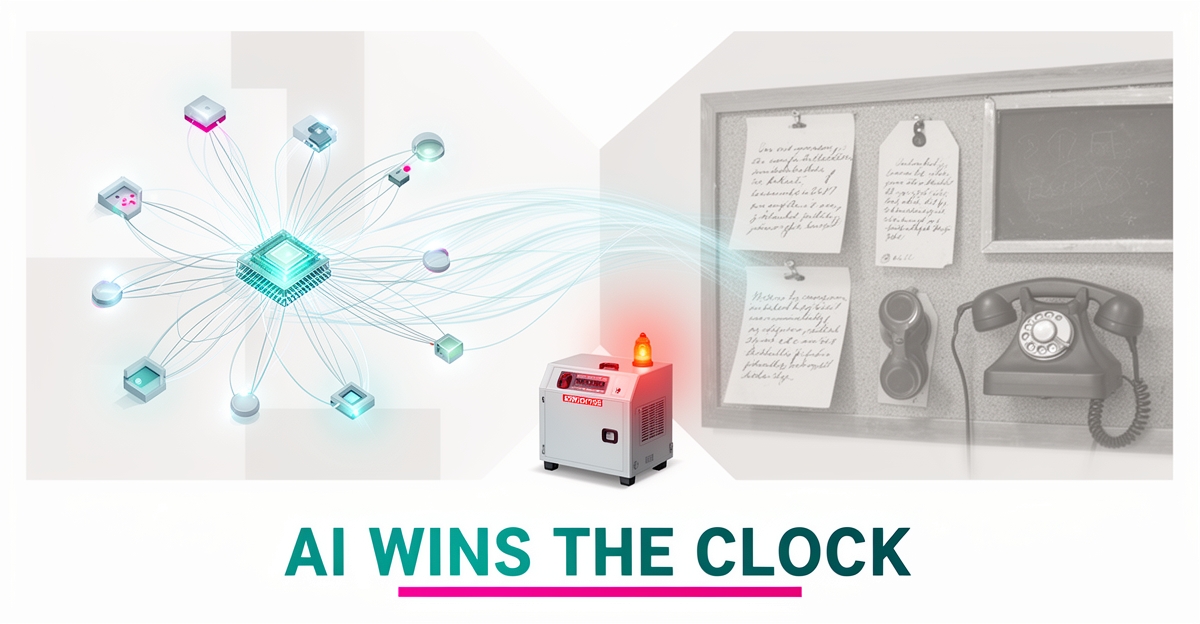
AI vs. Human Dispatchers: Which Is Better for Emergency Generator Response Teams?
Key Facts
- Human dispatcher performance degrades with fatigue, especially during extended outages requiring round-the-clock coordination.
- AI dispatchers process routing data, location, technician availability, parts, urgency, in milliseconds, while human analysis of the same variables takes minutes.
- A managed AI dispatcher typically costs around 80% less than a full-time human dispatcher hire.
- AI dispatchers operate 24/7/365 with no shift changes, sick days, or handoff gaps.
- AIQ Labs has deployed 200+ multi-agent systems and runs 4 live SaaS products daily, the same operational discipline applied to dispatch work.
- AI dispatcher implementation typically runs 60–90 days from workflow assessment to full deployment.
Hire a team member that works 24/7 — for less than a part-time wage.
AI receptionists, SDRs, dispatchers and 99+ roles. Trained on your business, fully managed.
Not sure where to start? Ask our AI planner
The Critical Delay Problem in Emergency Generator Dispatch
During a power outage, every minute of delay in dispatching emergency generator repairs can mean the difference between business continuity and costly downtime. Human dispatchers, while experienced, face inherent limitations that directly impact response times when speed is most critical.
Fatigue impairs human dispatcher performance, especially during extended outages that require round-the-clock coordination. Long shifts degrade cognitive processing speed and decision quality, slower data analysis and delayed calls in exactly the high-pressure scenarios where hesitation costs the most. This fatigue-related slowdown creates bottlenecks when field teams need immediate routing instructions.
Human dispatchers also face natural availability constraints that AI systems eliminate. Unlike AI Employees that operate 24/7/365 without breaks, human teams require shift changes, suffer sick days, and cannot maintain peak performance during overnight emergencies when generator failures often peak. This limitation becomes particularly problematic during widespread grid failures, when demand for dispatch surges precisely when human capacity is lowest.
Data processing speed represents another critical gap in human-led dispatch operations. While experienced dispatchers bring valuable intuition, they cannot match the millisecond-level analysis of AI systems when correlating multiple data points, generator location, technician availability, parts inventory, urgency level, to optimize routing decisions. Slower processing translates directly to longer response times for critical repairs.
- Fatigue degrades human dispatcher judgment during long shifts and extended outages
- Human dispatchers face inherent availability limits including shift changes and sick days
- AI systems process routing data in milliseconds versus minutes for human analysis
These delays aren't merely inconvenient, they have tangible consequences for businesses relying on emergency generator support. When hospitals, data centers, or manufacturing facilities lose power, delayed generator repairs can compromise patient safety, data integrity, or production schedules. AIQ Labs addresses this delay problem through managed AI Employees built for dispatcher roles, combining 24/7 availability with rapid data processing to minimize response times when every second counts.
How AI Dispatchers Outperform Humans in Speed and Accuracy
In emergency generator response scenarios, every second counts, delays can mean extended outages, safety risks, or costly downtime. AI dispatchers eliminate hesitation by instantly analyzing incoming calls, geolocation data, technician availability, and urgency levels to route the nearest qualified team within milliseconds. This real-time coordination reduces response latency far beyond what manual dispatching can achieve, especially during peak demand or off-hours when human teams may be stretched thin.
AI systems process and analyze large volumes of operational data with speed and precision that directly improves decision-making in time-sensitive environments. Unlike human dispatchers who fatigue or hit cognitive overload during high-volume events, AI maintains consistent performance 24/7 without degradation in accuracy or response time. That reliability matters most for generator service teams managing widespread outages after storms or grid failures, where rapid triage determines recovery timelines.
AI dispatchers also reduce human error by taking subjective judgment out of routine routing decisions. Experienced dispatchers bring valuable intuition, but they are inherently limited by cognitive biases, information processing limits, and the inability to simultaneously track dozens of variables like traffic, skill certifications, and parts availability. AI excels here by continuously optimizing routes based on live data feeds, ensuring the right technician with the right parts arrives first. For organizations seeking to strengthen field service operations, AI-driven dispatch through managed AI Employees like those from AIQ Labs provides a scalable, always-on solution that complements human expertise rather than replacing it. This hybrid approach keeps emergency response both fast and adaptable, even as conditions evolve.
24/7 Availability: Eliminating Coverage Gaps in Emergency Response
Power outages don't follow business hours, and emergency generator response teams learn that reality the hard way. When a call comes in at 2 a.m. on a Sunday, the speed of dispatch decides whether equipment runs or production stops. That is where coverage gaps become costly.
AI dispatching tools operate 24/7 without fatigue, reducing the risk of human error. Unlike human teams bound by shifts, breaks and overtime limits, an AI dispatcher maintains continuous availability without performance degradation. The comparison is simple: AI dispatchers offer around-the-clock coverage without fatigue; human dispatchers offer limited availability constrained by shift schedules and burnout.
For generator service, this continuous coverage eliminates the night and weekend delays that traditionally bottleneck response. A system that processes large amounts of data quickly and accurately can triage incoming alerts, verify site details, and route the nearest crew instantly, even when a human dispatcher would be off duty or handing off between shifts.
The operational impact shows up in several ways:
- Immediate night and weekend triage with no handoff lag
- Consistent response protocols across all hours, not just peak shifts
- Reduced missed calls and delayed first-time dispatch during low-staff periods
- Sustained accuracy when call volume spikes outside normal hours
Human dispatchers bring expertise and experience to complex situations, yet they are prone to errors under fatigue and cannot process large amounts of data quickly. Fatigue compounds those limitations during overnight rotations, which is precisely when generator failures are most disruptive.
Within AI business process automation, workflow and task automation is now applied directly to real-time field routing and response coordination. AIQ Labs deploys managed AI Employees, receptionists, SDRs, dispatchers, and 99+ other roles, to handle that coordination end-to-end, working alongside human teams for urgent generator service calls. The result is continuous coverage without coverage gaps, ensuring a technician is mobilized the moment a critical asset goes down, not when the next shift starts.
Implementing AI Dispatchers: From Pilot to Full Integration with AIQ Labs
Deploying AI dispatchers for emergency generator response teams requires a structured approach that balances technological capability with operational reality. The transition from human to AI dispatching begins with a comprehensive assessment of your current dispatch workflows, identifying the bottlenecks where speed and accuracy matter most.
The implementation journey typically starts with a pilot targeting a specific service area or time window. Teams that invest in proper training and process documentation during rollout consistently see fewer operational disruptions, a principle that applies directly to AI dispatcher deployment. A phased approach allows you to validate AI performance against human benchmarks before full-scale rollout.
Integration with existing dispatch tools represents the most critical technical phase. Modern AI dispatchers connect with field service management platforms, GPS tracking systems, and inventory databases through APIs, creating a unified command center. Successful implementation requires real integration expertise, which is why working with a team that has deployed 200+ multi-agent systems matters.
Key implementation steps include:
- Conducting a workflow audit to map every dispatch decision point and data source
- Configuring AI dispatch rules based on technician skills, location, parts availability, and SLA requirements
- Running parallel operations where AI recommendations are validated against human dispatcher decisions
- Training field technicians on AI-generated dispatch protocols and mobile interfaces
- Establishing escalation protocols for complex scenarios requiring human judgment
The financial case for AI dispatchers becomes compelling at scale. While a full-time human dispatcher represents a significant monthly cost in salary and benefits with limited working hours, a managed AI dispatcher from AIQ Labs operates continuously at roughly 80% less than the cost of a human hire. This cost structure enables 24/7 coverage without overtime premiums or fatigue-related errors.
AIQ Labs' Start Monthly model addresses the primary barrier to adoption: upfront investment risk. Rather than committing to large capital expenditures, businesses deploy managed AI dispatchers with setup, training, and ongoing optimization included in a flat monthly plan. As needs grow, the Build in Milestones and Own It Outright options let you scale from a single dispatcher role to a fuller AI Operating System for the whole operation. This approach allows generator service companies to prove ROI in real-world conditions before expanding AI dispatch across their entire business.
The transition period typically spans 60–90 days from initial assessment to full deployment. During this phase, human dispatchers shift focus to exception handling, customer relationship management, and strategic planning, tasks where human expertise adds unique value. The result is a hybrid operation where AI handles routine dispatch decisions while humans manage complex emergencies and maintain client relationships.
Where Speed Meets Reliability: The Future of Emergency Response
The evidence is clear: when every minute counts during a power outage, AI dispatchers deliver the speed, accuracy, and relentless availability that human teams simply cannot sustain, especially during extended crises when fatigue sets in and demand peaks. By eliminating coverage gaps, processing routing data in milliseconds, and operating 24/7 without degradation, AI-powered dispatch ensures critical repairs begin faster, protecting business continuity when it matters most. For organizations ready to test this advantage in their own operations, the path forward starts with clarity. Take the two-minute Fit Check to see where AI can remove bottlenecks in your emergency response workflow, then schedule a free 30-minute strategy call to map your highest-ROI opportunities, no obligation, just a real working session to determine if there's a clear win for your team.
Make AI your competitive advantage — not just another tool.
Strategy, implementation and ongoing optimization. One partner, end to end.
Not sure where to start? Ask our AI planner