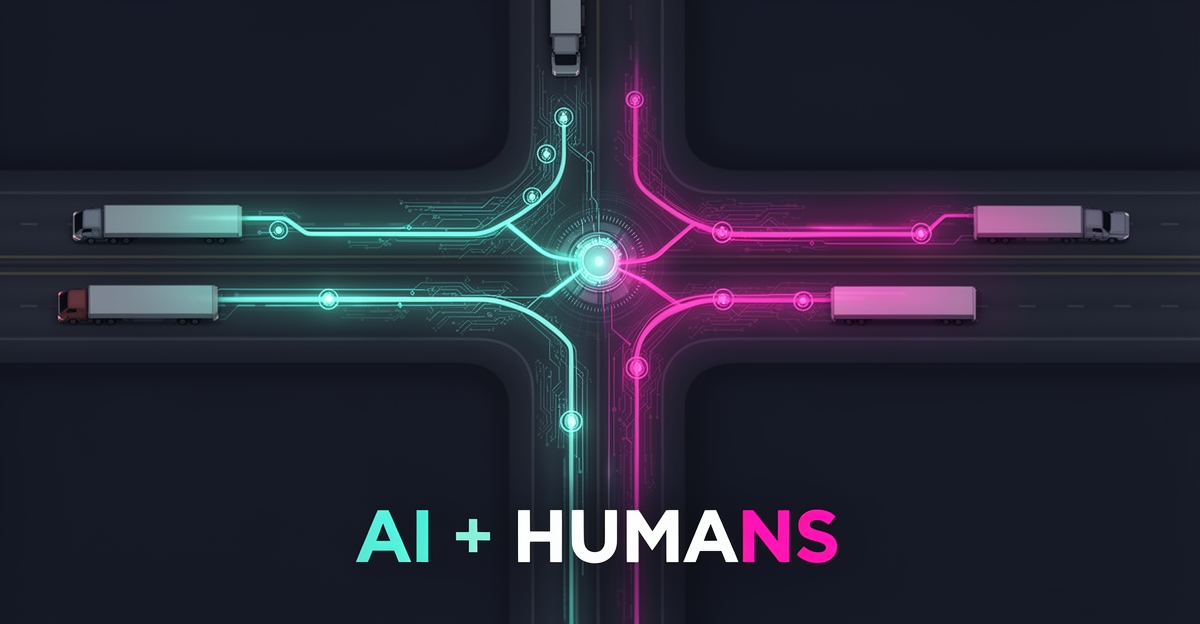
AI vs. Human Dispatchers: Which Is Better for Long Haul Fleet Management?
Key Facts
- AI fleet management typically saves tens of thousands of dollars per year compared to manual dispatch, driven by fewer missed commitments and tighter execution
- Fleets of roughly 20+ vehicles often see AI dispatch pay for itself quickly, since efficiency and availability gains translate directly into cost control
- AI dispatch and route optimization meaningfully reduce total miles driven across the industry by cutting empty miles and improving load matching
- Driver coaching and safety AI have shown meaningful reductions in high-risk driving events in real-world deployments
- Predictive maintenance AI has among the highest real-world adoption in fleet management as of late 2026
- AI dispatchers provide 24/7 availability and load matching optimization while human teams focus on exception handling and relationships
- Hybrid models combining AI dispatchers with human oversight improve efficiency without sacrificing human judgment in long-haul fleet management
Hire a team member that works 24/7 — for less than a part-time wage.
AI receptionists, SDRs, dispatchers and 99+ roles. Trained on your business, fully managed.
Not sure where to start? Ask our AI planner
The Long Haul Dispatch Bottleneck
Manual dispatch breaks down exactly when long-haul operations need it most. The longer the routes and the larger the fleet, the more manual coordination creates costly friction across the network.
Missed deliveries remain a core pain point. Human teams struggle to re-route quickly when traffic, weather, or load changes hit, leading to late arrivals and customer penalties. Industry analyses of AI fleet management consistently point to five-figure annual savings compared to manual dispatch, driven largely by fewer missed commitments and tighter execution.
Inefficient load matching compounds the problem. Dispatchers juggling spreadsheets and phone calls leave empty miles and underutilized capacity on the table. AI dispatchers process a large volume of data in real time to optimize routes and pair loads, which has helped reduce total miles driven across the industry by cutting deadhead time.
Rising labor costs and 24/7 coverage gaps make scalability difficult for fleets of 20+ vehicles. Manual coverage requires shift overlap, overtime, and still leaves overnight decisions delayed. Analyses of AI adoption find that fleets of this size often recover their annual software cost quickly, highlighting how efficiency and availability translate directly to cost control.
The bottleneck shows up in everyday operations:
- Missed deliveries from slow re-routing and poor visibility
- Inefficient load matching that leaves trucks empty or underloaded
- Rising labor costs to maintain 24/7 dispatcher coverage
- Coverage gaps overnight and on weekends when decisions stall
These pressures push operators toward efficiency and scalability as non-negotiable priorities. AI dispatchers offer continuous availability and data-driven load optimization without adding headcount—a shift that fits naturally into modern workflow automation approaches.
Human dispatchers still excel at exception handling and driver relationships, but the routine, high-volume work that drives cost is increasingly automated. AIQ Labs approaches this through managed AI employees, including AI dispatchers that work alongside human teams, providing 24/7 availability and load matching optimization while keeping oversight where it matters.
For long-haul fleets, the bottleneck is no longer just distance. It is the speed and consistency of dispatch decisions at scale.
How AI Dispatchers Outperform Humans on Efficiency and Scale
Long haul fleet management rewards speed, precision, and uptime. AI dispatchers deliver all three at a scale human teams cannot sustain alone.
AI dispatchers process large volumes of real-time data continuously, optimizing routes and load matching without fatigue. Industry research on AI fleet management consistently reports five-figure annual savings compared to manual dispatch, with larger fleets often recovering their software investment within the first months of implementation.
The efficiency gain comes from 24/7 availability and instant system integration. AI dispatchers monitor every asset in real time, automate assignments, and adjust for traffic, weather, and dock delays without manual handoffs. This scalability advantage lets one system support hundreds of trucks while maintaining consistent decision quality.
Route optimization and automated dispatch are where mileage and cost savings compound. Fleet management analyses show AI dispatch and route optimization have measurably reduced total miles driven across the industry. Fewer empty miles mean lower fuel burn, fewer driver hours, and more loads per asset.
Core capabilities that drive the outperformance include:
- Real-time tracking and monitoring for live location, ETA, and exception alerts
- Automated dispatch and routing with dynamic load matching
- Predictive maintenance and analytics to prevent roadside failures
- Driver coaching and safety features that reduce high-risk events
- Integration with existing fleet management systems for unified operations
Predictive maintenance AI has among the highest real-world adoption in fleet management as of late 2026, and driver coaching and safety AI have shown meaningful reductions in high-risk driving events in deployed fleets. These features protect revenue and extend asset life while human dispatchers remain offline.
AIQ Labs applies the same principle through managed AI dispatchers that work alongside human teams, handling routine dispatch, load matching, and status updates 24/7—typically at around 80% less cost than an equivalent human hire. The result is fewer missed deliveries and a cost-effective alternative to expanding headcount.
Human dispatchers still excel at exception handling and relationship building, but for throughput, cost control, and scale, AI dispatchers consistently outperform manual processes.
Where Human Dispatchers Still Win and Hybrid Models Work Best
No matter how sophisticated algorithms become, there are moments in long-haul fleet management when human intuition, empathy, and experience remain irreplaceable. While AI excels at processing vast datasets and optimizing routes at scale, the most resilient operations recognize that dispatch technology works best when it amplifies human judgment rather than attempting to eliminate it entirely.
Human dispatchers maintain distinct advantages in exception handling and relationship management that current AI systems cannot replicate. When a driver faces a family emergency mid-route, or when a high-value client demands last-minute changes that defy algorithmic logic, human dispatchers navigate these nuanced situations with contextual understanding and emotional intelligence. They build trust with drivers over time, understanding individual preferences, safety concerns, and personal circumstances that influence retention and performance.
While AI fleet management delivers substantial annual savings compared to manual dispatch, these systems still struggle with the unpredictability of human relationships and complex exception scenarios. Pure automation often falls short when dealing with the messy, interpersonal realities of long-haul logistics.
Rather than choosing between artificial and human intelligence, forward-thinking fleet operators are implementing hybrid models that leverage the strengths of both. In these arrangements, AI handles routine load matching, real-time tracking, and predictive maintenance alerts—areas where recent fleet management research indicates AI has achieved significant adoption and measurable impact through optimized routing.
Human dispatchers then focus on high-value activities: managing exceptions, coaching drivers through difficult situations, and maintaining the carrier relationships that keep freight moving when standard protocols fail. This division of labor allows AI to process data at scale while humans provide the contextual reasoning that drivers and customers ultimately value.
Transitioning to this hybrid model presents specific challenges that require careful navigation. Fleet operators must address several critical factors to ensure successful adoption:
- Data quality and integration issues that can undermine AI decision-making accuracy
- Driver acceptance and comprehensive training programs to build trust in new systems
- Cybersecurity vulnerabilities that emerge when connecting dispatch systems to broader networks
- Regulatory compliance requirements that vary across jurisdictions and cargo types
These hurdles explain why many organizations benefit from managed AI solutions rather than attempting full in-house automation. AIQ Labs addresses these challenges through managed AI dispatchers that work alongside existing teams, handling routine optimization while human staff focus on exception management and driver relationships. This approach lets fleets capture the efficiency gains of AI without sacrificing the human elements that keep operations resilient.
The most successful long-haul operations recognize that the future belongs not to AI or humans alone, but to intelligent collaboration between algorithmic efficiency and human wisdom. By positioning AI as a tool that handles scale and speed while dispatchers handle nuance and relationships, fleets create systems that are both highly efficient and deeply adaptable to the unpredictable realities of the road.
Implementation Roadmap for AI Dispatch in Long Haul Fleets
Transitioning to an AI dispatcher doesn't require a complete operational overhaul, but it does demand a structured approach. Fleet operators who follow a deliberate implementation path see faster returns and fewer disruptions than those who rush deployment.
Start by evaluating your fleet's size, route complexity, and existing technology stack. Fleets of roughly 20 or more vehicles typically see the fastest payback from AI dispatch. This assessment phase should identify which dispatch functions consume the most staff hours and where missed deliveries or routing inefficiencies create the highest costs.
Choose an AI dispatcher that integrates with your current fleet management systems rather than forcing you to replace them. Look for platforms offering real-time tracking, automated routing, and predictive analytics capabilities. The industry-wide gains from AI dispatch and route optimization only materialize when the system connects properly with your telematics, ELDs, and communication tools.
Implementation succeeds or fails based on driver and dispatcher buy-in. Provide hands-on training that demonstrates how the AI handles routine decisions while flagging exceptions for human judgment. Address concerns directly—drivers often worry about surveillance, while dispatchers fear replacement. Frame the technology as a tool that eliminates repetitive tasks and allows your team to focus on relationship-building and complex problem-solving where humans excel.
Once live, establish clear performance benchmarks and review them weekly during the first quarter. Monitor metrics like on-time delivery rates, empty miles, fuel consumption, and driver satisfaction scores. Adjust routing preferences, load-matching criteria, and escalation protocols based on real-world results. Continuous optimization separates successful deployments from abandoned pilots.
For fleets without in-house AI expertise, a managed approach accelerates this roadmap significantly. AIQ Labs delivers production-ready AI dispatchers through a managed AI employee model that starts monthly and includes training on your specific operations, tool integrations, and ongoing optimization—at roughly 80% less cost than a human hire. For fleets that want to rebuild the full dispatch workflow, Workflow Builds offer a fixed-price, phased approach where you approve each milestone as it ships. And for operators ready to connect dispatch into a broader operating layer, AI Operating Systems are built in phases and owned outright—no vendor lock-in, and the system evolves with your fleet's changing needs. See all payment models on the pricing page.
Still paying for 10+ subscriptions that don’t talk to each other?
We build custom AI systems you own outright. No vendor lock-in. Full control.
Not sure where to start? Ask our AI planner
Frequently Asked Questions
How much can AI dispatchers save long-haul fleets compared to manual dispatch?
How quickly can fleets of 20+ vehicles recover their AI dispatcher costs?
Do AI dispatchers completely replace human dispatchers in long-haul operations?
What efficiency gains have AI dispatchers achieved in the fleet industry?
Which AI-powered features in fleet management have the highest adoption and impact?
What are the main challenges when implementing AI dispatchers in a fleet?
Where Efficiency Meets Experience: The Future of Long Haul Dispatch
The long-haul dispatch bottleneck isn't just about distance—it's about decision speed, consistency, and scale. AI dispatchers deliver measurable gains: fewer missed deliveries, fewer empty miles, and five-figure annual savings through 24/7 optimization and real-time load matching. Yet human dispatchers remain vital for exception handling, driver relationships, and nuanced judgment that algorithms can't replicate. The winning approach isn't AI versus humans—it's intelligent collaboration. By pairing AI's scale and speed with human insight, fleets build resilient operations that adapt to the unpredictability of the road while controlling costs. For fleets ready to move beyond manual bottlenecks, the path forward starts with clarity. Take the 2-minute Fit Check to see where AI can unlock efficiency in your dispatch workflow—without sacrificing the human elements that keep your fleet moving.
Make AI your competitive advantage — not just another tool.
Strategy, implementation and ongoing optimization. One partner, end to end.
Not sure where to start? Ask our AI planner