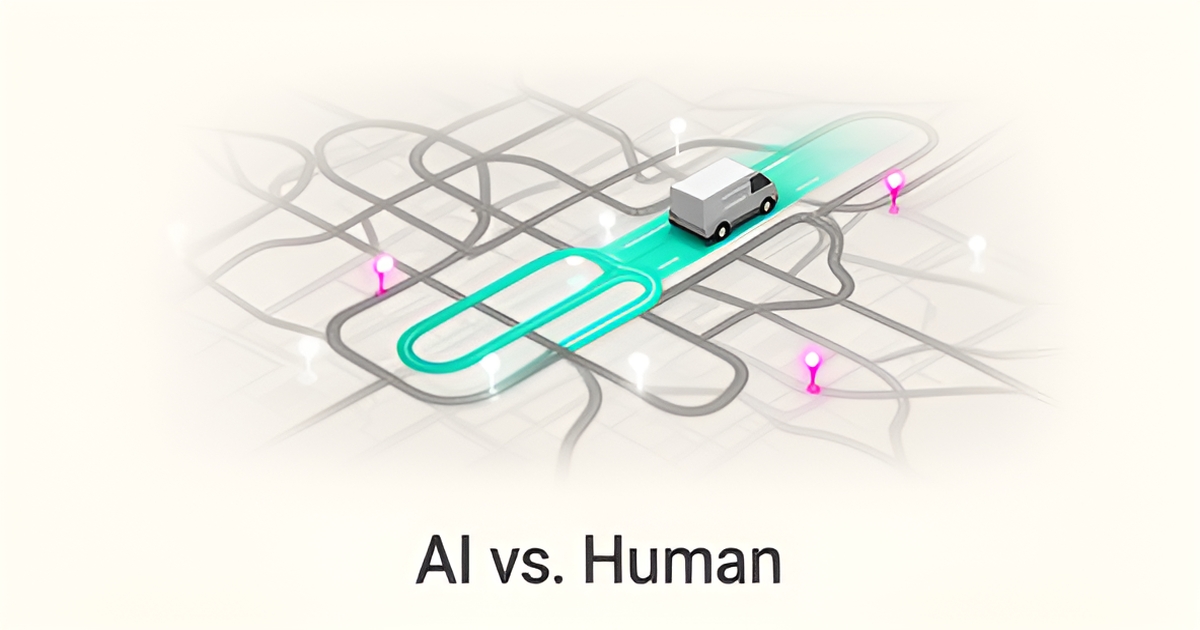
AI vs. Human Dispatchers: Which Is Better for Mobile Windshield Repair Service Operations?
Key Facts
- Manual dispatch wastes thousands of dollars per technician per year in avoidable drive time, according to field service industry analyses
- Five technicians with six jobs each face an astronomically large number of possible scheduling combinations—far beyond real-time human evaluation
- AI dispatching typically reduces drive time by roughly 15% to 30%, per field service research as of late 2026
- Automated notifications commonly reduce “where is my technician?” calls by 60% to 80%
- A five-tech team can lose well over 100 productive hours monthly from inefficient routing, per industry estimates
- Smart gap filling can recover 30% to 50% of previously wasted idle time, per field service research
- Human dispatchers can typically optimize only 3 or 4 variables at once
Hire a team member that works 24/7 — for less than a part-time wage.
AI receptionists, SDRs, dispatchers and 99+ roles. Trained on your business, fully managed.
Not sure where to start? Ask our AI planner
Introduction
Mobile windshield repair lives and dies by windshield time. Every minute a technician spends driving between jobs is a minute not billed, and for many shops that hidden cost quietly erodes margin.
Manual dispatching hits a mathematical wall fast. A small operation with five technicians and six jobs each faces an astronomically large number of possible scheduling combinations—on the order of 10^32—far beyond what a human can evaluate in real time. Humans naturally group by geography and optimize three to four variables at once, while the field changes constantly with traffic, delays and cancellations.
The cost shows up in drive time and idle time. Industry analyses suggest companies relying on manual dispatch can waste on the order of $12,000 per technician per year in avoidable non-productive drive time alone. In a five-tech team, spending 45 minutes driving between jobs instead of an optimized 25 minutes can lose over 130 productive hours per month, translating to $10,000 to $20,000 in unbilled time.
AI dispatching changes the equation by processing millions of permutations instantly. Systems balance hard constraints like certifications with soft constraints like SLAs and workload, typically delivering a 15% to 30% reduction in drive time and recovering 30% to 50% of previously wasted idle time through smart gap filling.
Customer experience improves at the same time. Automated notifications and tighter routing narrow arrival windows from four-hour blocks to one to two hours, and commonly reduce “where is my technician?” calls by 60% to 80%. That frees dispatchers from status chasing and lets them focus on exceptions and service quality.
The best results come from a hybrid model, not wholesale replacement. AI handles high-volume intake, booking modifications, cancellations and real-time re-optimization, while human dispatchers own judgment, escalations and complex coordination. This division of labor scales operations without linearly increasing labor costs.
For mobile repair workflows, the operational levers AI can address include:
- Real-time route sequencing to minimize windshield time
- Predictive job duration based on history, equipment age and technician speed
- Automatic gap filling from a bench of flexible jobs
- 24/7 intake and after-hours triage for emergency calls
AIQ Labs builds these dispatch workflows through AI Workflow Builds—a fixed-price, phased rebuild of the one workflow that costs you the most. The goal is coverage consistency, cost savings and 24/7 availability while maintaining high service quality, with the system owned outright once built.
The shift is from intuition-based scheduling to data-driven dispatch that recaptures revenue, reduces idle time and gives technicians more billable hours in the day.
Key Concepts
In mobile windshield repair operations, dispatching decisions directly impact both operational efficiency and customer satisfaction. Human dispatchers bring valuable judgment and adaptability to complex situations, yet they face fundamental mathematical limits when optimizing schedules with multiple variables. A human dispatcher can typically handle only 3 or 4 variables—such as location, technician skill, and job priority—at once, making real-time optimization impossible beyond a small scale. This constraint becomes critical as job volume grows, where the number of possible scheduling combinations explodes exponentially; for just five technicians with six jobs each, the number of potential sequences is astronomically large, far exceeding human cognitive capacity.
AI dispatching systems overcome this limitation by evaluating millions of routing permutations in seconds, identifying the mathematically optimal sequence to minimize drive time and maximize billable hours. For mobile repair businesses, where "windshield time" represents a significant non-billable cost, this capability translates into measurable financial gains. Companies relying on manual dispatch can waste on the order of $12,000 per technician annually in avoidable drive time alone, while inefficient routing can lead to $10,000 to $20,000 in monthly unbilled time losses for a five-technician team. AI-driven route optimization typically reduces drive time by 15% to 30%, recovering 1 to 2 additional billable hours per technician daily and reclaiming up to 50% of previously wasted idle time through smart gap-filling logic.
Beyond scheduling efficiency, AI enhances customer experience and operational resilience. Automated notifications narrow arrival windows from 4-hour blocks to 1–2 hours, reducing "where is my technician?" calls by 60% to 80% and freeing up dispatcher time for higher-value tasks. AI systems also provide 24/7 availability, enabling instant urgency assessment for after-hours calls and faster emergency dispatch without requiring business owners to stay on call. While AI excels at high-volume, repetitive tasks like booking intake and route recalculations, human dispatchers remain essential for handling exceptions, escalations, and nuanced judgment calls. The most effective model combines both: AI manages the front-end intake and optimization, while humans focus on exceptions and service quality—a synergy that scales operations without linearly increasing labor costs. For businesses seeking to implement such a system, AIQ Labs offers AI dispatch builds as part of its AI Workflow Builds service, with 200+ multi-agent systems deployed and four live SaaS products the company runs daily. To explore how AI dispatching can transform your mobile repair operations, start with the 2-minute Fit Check.
Best Practices
Moving from manual to AI-driven dispatching requires more than just installing software; it demands a strategic approach to data and workflow design. Businesses that successfully implement these systems focus on precision, starting with a clear audit of their current operational bottlenecks.
The first step is identifying where your operation bleeds the most money. Industry analysis suggests that a five-technician team can lose up to $20,000 monthly due to inefficient routing alone. Whether your primary pain point is excessive drive time, high volumes of status calls, or after-hours coverage gaps, pinpointing the specific friction allows you to select the right automation layer.
Data quality forms the foundation of effective AI dispatching. Before deployment, ensure your historical job information—including actual versus estimated completion times, technician certifications, and location-specific variables—is accurate and comprehensive. AI systems rely on this historical data to generate predictive scheduling models that account for variables like technician speed and job complexity.
When configuring your system, establish clear operational parameters:
- Define hard constraints such as required certifications and parts availability
- Set soft constraints including fuel cost minimization and workload balancing
- Create a "bench" of flexible, unscheduled jobs for gap-filling when technicians finish early
- Establish protocols for when the AI should escalate decisions to human dispatchers
Implementing smart gap-filling logic can recover 30% to 50% of previously wasted idle time, according to field service research. This requires maintaining a pool of unscheduled work that the AI can instantly deploy when cancellations or early finishes create schedule gaps.
Customer communication automation delivers immediate returns. Automated notifications reduce "where is my technician?" calls by 60% to 80%, freeing dispatchers from repetitive status updates. Operational data shows this automation typically saves dispatchers one to two hours daily while narrowing arrival windows from four hours to just one or two.
AIQ Labs recommends a hybrid operational model where AI handles high-volume intake and route optimization while human dispatchers manage exceptions and escalations. This division of labor leverages the strengths of both: AI processes millions of routing permutations instantly, while humans apply judgment to complex scenarios requiring emotional intelligence or strategic oversight. If you also need after-hours intake or booking coverage, AI Employees—managed AI receptionists and dispatch staff at roughly 80% less cost than a human hire—can slot in alongside your team.
Finally, establish continuous monitoring protocols. Track metrics like average drive time, billable hours per technician, and customer satisfaction scores. Use these insights to refine your AI's predictive models and adjust operational rules, ensuring your dispatch system evolves alongside your business needs.
Implementation
Implementing AI dispatching in mobile windshield repair operations requires a structured approach that leverages technology while preserving the irreplaceable value of human judgment. The process begins with auditing current pain points—such as excessive drive time, frequent status inquiries, or after-hours call overload—to identify where automation will yield the highest return. Industry research shows that inefficient routing can waste up to $20,000 per month in unbilled drive time for a five-technician team, making this a critical starting point.
Next, businesses must collect and prepare high-quality historical data, including actual versus estimated job durations, technician skill sets, and certification levels, as AI systems rely on this information to generate accurate predictions. Data preparation is essential for enabling predictive scheduling that narrows arrival windows from four-hour blocks to one or two hours, improving both efficiency and customer experience. Once data is ready, organizations should select the appropriate automation layer—whether route optimization for minimizing travel, AI voice assistants for handling booking intake, or gap-filling logic to recover idle time.
Configuring operational constraints is equally vital. Hard constraints like required certifications or specific equipment must be defined alongside soft constraints such as fuel cost reduction or workload balancing. Establishing clear rules ensures the AI respects business priorities while optimizing schedules. Creating a "bench" of flexible jobs—such as callbacks or maintenance tasks—allows the system to instantly fill gaps when a technician finishes early, recovering up to 50% of previously wasted idle time. Automated customer notifications at key milestones further reduce status calls by 60% to 80%, freeing dispatcher capacity for higher-value tasks.
Finally, defining human oversight protocols ensures accountability. Dispatchers should retain the ability to override AI recommendations for exceptions like SLA conflicts or safety concerns, maintaining a hybrid model where AI handles repetitive tasks and humans focus on judgment-driven decisions. Continuous monitoring of metrics like average drive time and billable hours per technician allows for iterative refinement, ensuring the system evolves with operational needs. For businesses seeking expert guidance through this transition, AIQ Labs delivers dispatch automation through AI Workflow Builds—a fixed-price, phased rebuild of your costliest workflow—or, for larger operations, an AI Operating System that connects dispatch with the rest of the business in one layer you own outright.
Start with the 2-minute Fit Check, then book a free 30-minute strategy call.
Conclusion
The evidence clearly shows that AI dispatching transforms mobile windshield repair operations by tackling the core inefficiencies that drain profitability and frustrate customers. For a typical five-technician team, inefficient routing can waste over 130 productive hours per month—equivalent to $10,000 to $20,000 in lost revenue at standard billing rates. AI systems consistently reduce drive time by 15% to 30% and recover 30% to 50% of previously idle time through smart gap-filling logic, directly increasing billable hours without adding staff. Automated customer notifications further cut "where is my technician?" calls by 60% to 80%, freeing dispatchers to focus on complex exceptions while narrowing arrival windows from 4-hour blocks to just 1–2 hours, which boosts booking rates and satisfaction.
For mobile repair businesses ready to act, the path forward starts with auditing current pain points—whether excessive drive time, status call overload, or after-hours disruptions—and collecting accurate historical job data on actual vs. estimated times, technician skills, and job duration patterns. From there, implementing targeted automation layers like route optimization, AI voice assistants for intake, and predictive scheduling with gap-filling capabilities creates immediate impact. Defining clear hard and soft constraints, establishing a bench of flexible jobs for idle time recovery, and setting up automated customer communication triggers are critical next steps. Most importantly, businesses should establish human oversight protocols so AI handles repetitive tasks while dispatchers retain control over exceptions, escalations, and service quality decisions.
AIQ Labs builds custom AI dispatch systems that own these workflows end-to-end, integrating with existing tools like CRMs and scheduling platforms while providing full ownership and ongoing optimization. To explore how this applies to your specific operation, start with the 2-minute Fit Check and then a free strategy call to identify your highest-ROI automation opportunities. This working session maps your biggest bottlenecks and outlines a clear implementation plan—no obligation, just clarity on where AI can deliver measurable gains in efficiency, cost savings, and customer experience for your mobile windshield repair service. Schedule your free 30-minute strategy call to begin.
Still paying for 10+ subscriptions that don’t talk to each other?
We build custom AI systems you own outright. No vendor lock-in. Full control.
Not sure where to start? Ask our AI planner
Frequently Asked Questions
Can a human dispatcher really keep up with mobile windshield repair scheduling?
How much money is windshield time actually costing us?
Will AI actually reduce drive time for my technicians?
Do customers really notice the difference with AI dispatching?
Do we have to replace our dispatchers with AI?
What’s the first step to move from manual to AI dispatching?
Where AI and Human Expertise Meet in Mobile Dispatch
The math is clear: human dispatchers simply can't evaluate the millions of scheduling permutations that impact mobile windshield repair profitability, leading to thousands of dollars wasted per technician annually in avoidable drive time and well over 100 lost productive hours monthly for a five-person team. AI excels at processing these variables instantly, typically cutting drive time by 15% to 30% and recovering up to 50% of idle time through smart gap filling, while automated notifications slash status calls by 60% to 80%. Yet AI doesn't replace human judgment—it amplifies it by handling repetitive intake and optimization so dispatchers can focus on exceptions, escalations, and service quality. For mobile repair businesses ready to move beyond intuition-based scheduling, the path forward starts with auditing current pain points and preparing historical job data on actual vs. estimated times and technician skills. AIQ Labs builds custom AI dispatch systems—through fixed-price, phased AI Workflow Builds—that integrate with your existing workflows and are owned outright, delivering measurable gains in efficiency and customer experience. To explore how this applies to your operation, start with the 2-minute Fit Check and then a free strategy call to identify your highest-ROI automation opportunities—no obligation, just clarity on where AI can recapture revenue and give technicians more billable hours in the day. Schedule your free 30-minute strategy call to begin.
Make AI your competitive advantage — not just another tool.
Strategy, implementation and ongoing optimization. One partner, end to end.
Not sure where to start? Ask our AI planner