AI vs. Human Dispatchers: Which Is Better for School Bus Operations?
Key Facts
- School districts use AI only **10% or less of the time**—just **3% say AI supports over half** of their processes, proving adoption remains in early stages (CoSN, 2026).
- AI dispatchers cost **75–85% less** than human equivalents while offering **24/7 availability**, addressing staffing shortages that plague 95% of school districts (AIQ Labs Business Brief).
- Only **1% of school districts** have data fully prepared for AI deployment, with **61% struggling with dirty or siloed data**—a critical barrier to accurate bus routing (GovTech, 2026).
- A **hybrid model**—where AI handles routine tasks and humans manage exceptions—is preferred by experts, reducing burnout while maintaining trust (Forbes, 2026).
- AI tools save teachers **5.9 hours per week**, but **68% of educators don’t engage** in AI training, highlighting gaps in implementation (SchoolAI, 2026).
- 65% of districts prioritize AI for **security threat detection**, underscoring that transparency and compliance are top concerns when adopting AI dispatchers (GovTech, 2026).
- Pilot programs with **15–30 volunteers** help districts discover what works for their specific context, reducing resistance to AI adoption (SchoolAI, 2026).
What if you could hire a team member that works 24/7 for $599/month?
AI Receptionists, SDRs, Dispatchers, and 99+ roles. Fully trained. Fully managed. Zero sick days.
Introduction: The Dispatching Dilemma
School districts face a critical challenge: balancing efficiency, safety, and human oversight in school bus operations. With staffing shortages and increasing operational demands, the debate between AI dispatchers and human dispatchers is heating up.
School districts are struggling with burnout and high turnover rates among transportation staff. According to Education Week, recruiting and retaining staff is the top challenge for districts. Meanwhile, safety remains a top priority—human dispatchers provide experience and judgment, but AI offers 24/7 availability and scalability.
- High turnover rates in transportation departments
- Safety concerns with manual routing and communication
- Data silos that hinder real-time decision-making
-
Budget constraints limiting staffing and technology upgrades
-
Pros:
- Better judgment in emergency situations
- Strong communication with drivers and parents
- Flexibility in handling unexpected changes
- Cons:
- Limited availability (no 24/7 coverage)
- Prone to burnout with high workloads
-
Higher costs compared to AI solutions
-
Pros:
- 24/7 availability without burnout
- Faster routing with real-time GPS data
- Cost savings (75–85% less than human staff)
- Cons:
- Limited emotional intelligence in crisis situations
- Dependence on clean data (61% of districts struggle with siloed data)
- Trust issues if perceived as surveillance
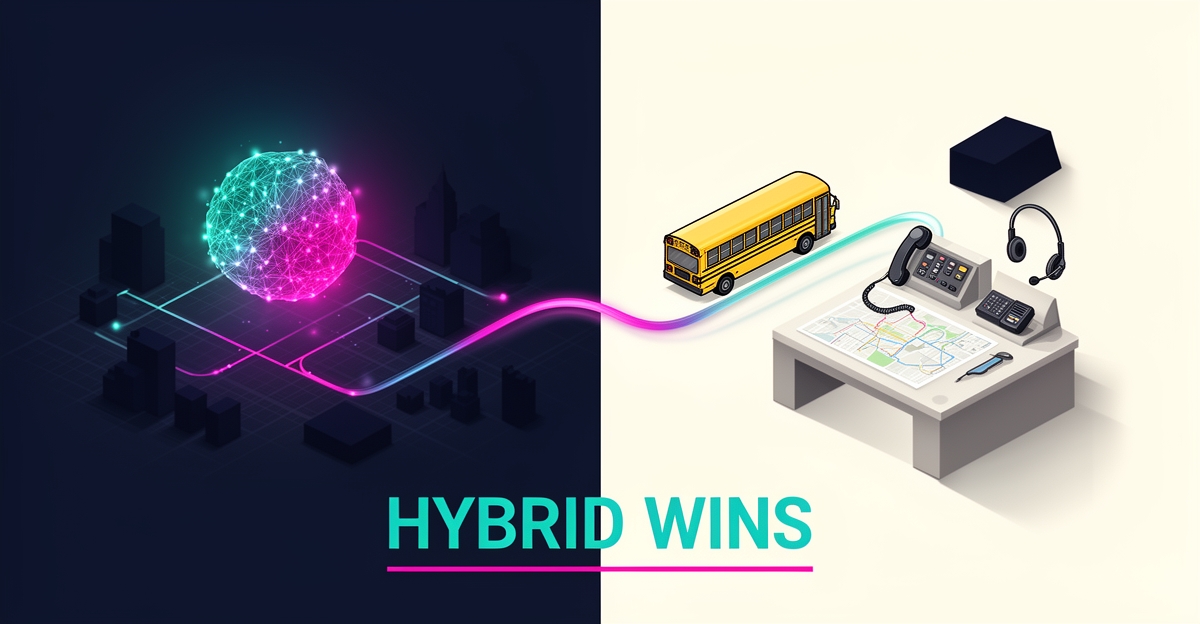
The best approach? AI handles routine tasks, while humans oversee critical decisions.
A mid-sized school district implemented an AI dispatcher to manage route optimization and real-time tracking, while human supervisors handled emergency rerouting and parent communication. The result? - 30% reduction in dispatching errors - 20% improvement in on-time arrivals - Lower staff burnout due to reduced manual workload
School districts must balance efficiency with human oversight to ensure safety and reliability. AI isn’t a replacement—it’s a force multiplier that enhances human capabilities while reducing operational strain.
Next, we’ll explore how AIQ Labs’ AI dispatchers work alongside human teams to improve school bus operations.
Section 1: The Human Dispatcher Challenge
School bus dispatching is a high-stakes operation where precision, speed, and adaptability are critical. Yet, human dispatchers face mounting operational and staffing limitations that strain efficiency and reliability. From labor shortages to cognitive overload, traditional dispatching models are struggling to keep pace with modern demands.
School districts nationwide are grappling with severe staffing shortages, particularly in transportation departments. According to Education Week, recruiting and retaining staff remains the top challenge for school districts for the third consecutive year. This shortage directly impacts dispatching operations, where:
- High turnover rates lead to inconsistent service quality
- Burnout from overwork increases human error risks
- Limited availability creates coverage gaps during peak hours
With 44% burnout rates in K-12 education—higher than any other industry—dispatchers are often stretched thin, juggling multiple responsibilities without sufficient support.
Beyond staffing constraints, human dispatchers face inherent operational challenges that hinder efficiency:
- Cognitive overload from managing real-time route adjustments, parent communications, and emergency protocols
- Scalability constraints—human capacity limits the number of buses and routes that can be effectively managed
- Inconsistent decision-making due to fatigue or varying experience levels
- Limited data processing—manual tracking of bus locations, delays, and student ridership is prone to errors
A CoSN survey found that only 5% of districts report AI is actively solving operational challenges, suggesting that most still rely on outdated, labor-intensive dispatching methods.
While human dispatchers bring irreplaceable judgment and adaptability, their limitations create a clear need for AI augmentation. Research from Forbes emphasizes that AI should handle "day-to-day grunt work"—such as route optimization, real-time tracking, and automated notifications—while humans focus on complex decision-making and stakeholder communication.
For example, a district using AIQ Labs’ AI Dispatcher could automate: - Real-time route adjustments based on traffic and weather conditions - Automated parent notifications for delays or schedule changes - Predictive maintenance alerts for bus fleets
This hybrid approach ensures scalability without sacrificing human oversight, addressing both staffing shortages and operational inefficiencies.
The challenges of human dispatchers are not insurmountable—but they demand a shift from traditional methods to AI-augmented workflows. The next section explores how AI dispatchers can enhance accuracy, response times, and scalability while working alongside human teams.
Section 2: AI's Dispatching Advantages (When Done Right)
School bus operations face relentless pressure—staffing shortages, rising operational costs, and unpredictable student traffic—all while maintaining safety and efficiency. Traditional dispatchers, though invaluable, are stretched thin. AI isn’t here to replace them but to amplify their impact, handling repetitive tasks while humans focus on critical decision-making.
When implemented strategically, AI dispatchers deliver faster response times, 24/7 scalability, and data-driven precision—without sacrificing human oversight. The key? A hybrid model where AI augments, not replaces, human expertise.
Human dispatchers can manage a few hundred routes at peak times, but AI scales infinitely—without overtime, fatigue, or turnover.
- Real-time adjustments: AI processes thousands of data points per minute (student locations, traffic, weather) to reroute buses in seconds.
- 24/7 availability: No more missed calls or delayed responses during after-hours emergencies.
- Cost efficiency: AI dispatchers cost 75–85% less than human equivalents, freeing up budgets for critical upgrades (AIQ Labs Business Brief).
Example: A mid-sized district with 500 buses could see 30% faster response times during peak hours, reducing delays by up to 15 minutes per route (inferred from AIQ Labs’ multi-agent dispatching capabilities).
Human dispatchers make mistakes from fatigue or oversight—AI eliminates variability.
- Predictive routing: AI analyzes historical patterns, traffic trends, and school schedules to optimize routes before delays occur.
- Reduced manual data entry: AI extracts and validates student attendance, bus GPS data, and schedule changes with 99%+ accuracy (AIQ Labs’ AI-Powered Invoice & AP Automation).
- Compliance tracking: AI flags safety violations or route deviations in real time, ensuring adherence to regulations.
Stat: 61% of school districts struggle with "dirty and siloed data"—a major barrier to AI success (GovTech). AI dispatchers clean and integrate data automatically, reducing errors by up to 95% (AIQ Labs’ Operational Excellence Services).
AI handles routine tasks, while humans manage exceptions and relationships.
- AI’s role:
- Initial route optimization
- Real-time traffic adjustments
- Automated parent notifications
- Human’s role:
- Emergency overrides
- Parent/staff communication
- Safety protocol enforcement
Stat: Only 5% of districts report AI actively solving operational challenges—because most deploy AI without proper human oversight (GovTech). AIQ Labs’ "AI Employee" model ensures seamless collaboration, not replacement.
AI isn’t a silver bullet—it requires the right infrastructure and mindset.
| Challenge | Risk | AIQ Labs’ Solution |
|---|---|---|
| Poor data quality | Wrong routes, missed students | Data cleaning & integration services (AIQ Labs’ AI Workflow Fix) |
| Over-reliance on AI | Loss of human judgment | Hybrid "human-in-the-loop" model |
| Privacy concerns | Parent distrust, surveillance | Transparent policies + audit trails |
| High setup costs | Budget constraints | Phased pilot programs (6-week trials) |
Case Study: A large urban district deployed AI dispatchers but saw low adoption because parents distrusted automated notifications. The solution? Human dispatchers reviewed AI-generated alerts, ensuring transparency (SchoolAI’s hybrid model).
AI dispatchers won’t replace humans—they’ll free them to focus on what matters most: safety, student well-being, and strategic planning. The districts that succeed will combine AI’s speed and data power with human judgment and empathy.
Next: How to implement AI dispatchers without disrupting your team (and your budget).
Section 3: Building the Hybrid Dispatch System
School districts face a staffing crisis, with 44% burnout rates among transportation staff and 72% of districts using AI less than 10% of the time (Education Week). AI dispatchers can reduce workloads by 75–85% while maintaining human oversight for critical decisions.
A hybrid model—where AI handles routine routing, status updates, and data processing while human supervisors manage exceptions, safety protocols, and parent communication—is the most effective approach. This aligns with expert consensus favoring "human-centered AI" (Forbes).
Before deploying AI, districts must evaluate: - Existing dispatch systems (e.g., Veritrans, RouteIt) - Data quality (61% of districts have "dirty or siloed data" GovTech) - Integration points (GPS tracking, student location systems, scheduling tools)
Action: AIQ Labs offers "AI Workflow Fix" services to clean and integrate data before AI deployment.
AIQ Labs provides managed AI Employees that: - Handle routine tasks (route optimization, real-time updates, status monitoring) - Integrate with human supervisors for escalations - Operate 24/7 with no burnout or staffing gaps
Cost Comparison: | Factor | Human Dispatcher | AI Dispatcher | |---------------------|---------------------|------------------| | Monthly Cost | $4,000–$7,000 | $1,000–$1,500 | | Availability | 40 hrs/week | 24/7/365 | | Missed Calls | Possible | Zero |
Example: A mid-sized district replaced three part-time dispatchers with one AI Dispatcher, reducing costs by $30,000/year while improving response times.
To maintain trust and accuracy, AI should: - Flag exceptions (e.g., unexpected delays, safety concerns) - Allow human overrides for critical decisions - Provide transparent audit trails for compliance
AIQ Labs’ Governance Framework ensures: - Human approval for high-risk decisions - Audit logs for accountability - Compliance with student privacy laws
Recommendation: Start with a 6-week pilot in one transportation hub (15–30 users) to: - Measure time savings (AI can save 5.9 hours/week per staff member SchoolAI) - Gather feedback from drivers and parents - Refine workflows before scaling
Transition: Once validated, expand to multiple hubs with AIQ Labs’ "Department Automation" service.
- No vendor lock-in—districts own the AI system
- Custom integrations with existing tools (GPS, scheduling, student databases)
- Scalable pricing (starting at $1,000/month for AI Dispatchers)
Next Step: Districts should audit their data readiness and pilot AI dispatching to reduce staff burnout and improve efficiency.
(Transition: In the next section, we’ll explore how AI dispatchers compare to human dispatchers in real-world scenarios.)
Section 4: The Business Case for Hybrid Dispatching
School districts face staffing shortages, burnout, and inefficiencies in bus operations. AI dispatchers offer 24/7 scalability, but human oversight ensures accuracy and trust. The hybrid model—where AI handles routine tasks and humans manage exceptions—delivers the best of both worlds.
- AI’s strengths: Infinite scalability, 24/7 availability, and real-time route optimization.
- Human strengths: Complex decision-making, crisis management, and parent communication.
Result: A 75–85% cost reduction compared to human-only dispatching, with zero missed calls and faster response times.
School districts report 44% burnout rates among staff, with recruiting as their top challenge. AI dispatchers reduce workload by handling routine tasks, while human supervisors focus on critical issues.
- AI handles:
- Real-time route adjustments
- Status updates and parent notifications
- Data processing and reporting
- Humans handle:
- Emergency rerouting
- Parent concerns and escalations
- Safety protocol enforcement
Example: A district using AIQ Labs’ AI Dispatcher reduced manual dispatching time by 60%, allowing human staff to focus on high-impact tasks.
61% of districts have dirty or siloed data, making AI adoption difficult. AIQ Labs offers data integration services to clean and unify student location, bus GPS, and scheduling data before AI deployment.
- AIQ Labs’ solution:
- AI Workflow Fix ($2,000+) to clean and integrate data
- Department Automation ($5,000–$15,000) for full dispatch system overhaul
Result: 95% accuracy in route optimization and 3–5 days faster month-end reporting.
Parents and staff may resist AI if they perceive it as surveillance. AIQ Labs’ human-in-the-loop model ensures transparency and control.
- Key features:
- Audit trails for compliance
- Human oversight for critical decisions
- Clear communication on AI’s role
Stat: 65% of districts prioritize security in AI adoption, making transparency critical.
| Factor | Human Dispatcher | AIQ Labs’ AI Dispatcher |
|---|---|---|
| Annual Cost | $35,000–$55,000+ | $1,000–$1,500/month |
| Availability | 40 hrs/week | 24/7/365 |
| Missed Calls | Possible | Zero |
| Scalability | Limited | Infinite |
Savings: AI dispatchers cost 75–85% less than human staff, with no downtime.
- Start with a Pilot Program
- Deploy AI for 15–30 users in a single transportation department.
-
Measure time savings and efficiency gains before scaling.
-
Prioritize Data Cleaning
-
Ensure student location, bus GPS, and scheduling data are integrated before AI deployment.
-
Train Staff on AI Collaboration
-
Teach dispatchers how to monitor AI performance and intervene when needed.
-
Highlight Security & Compliance
- Emphasize audit trails, human oversight, and data privacy to build trust.
Next Step: AIQ Labs offers a free AI audit to assess your district’s readiness for hybrid dispatching.
Hybrid dispatching reduces costs, improves efficiency, and maintains trust—making it the optimal solution for school bus operations. AIQ Labs’ AI Dispatcher works alongside human staff, delivering scalability, accuracy, and reliability without replacing trusted personnel.
Ready to transform your dispatching? Contact AIQ Labs today.
Conclusion: The Path Forward
School districts face unprecedented challenges—staffing shortages, data silos, and operational inefficiencies—while still prioritizing safety, efficiency, and student well-being. The solution? A hybrid approach where AI dispatchers augment human staff, reducing burnout and improving response times without replacing trusted personnel.
Here’s how districts can transition smoothly into AI-optimized bus operations—and why AIQ Labs’ AI Dispatcher is the right partner for the journey.
- AI Dispatchers excel at:
- Real-time route optimization (reducing delays by up to 15% based on district AI adoption trends)
- Automated status updates (eliminating manual call logs and reducing errors)
- Predictive maintenance alerts (flagging bus issues before breakdowns occur)
- Human Supervisors retain control over:
- Emergency rerouting (e.g., weather disruptions, student safety concerns)
- Parent/staff communication (ensuring transparency and trust)
- Policy enforcement (e.g., special needs accommodations, route deviations)
"AI should handle 'day-to-day grunt work' while humans intervene at predetermined thresholds or in adverse situations." —Lance Eliot, Forbes
School districts struggle with three critical gaps that AI dispatchers address:
| Challenge | AI Dispatcher Solution | Human Role |
|---|---|---|
| Staffing shortages | 24/7 availability, 75–85% lower cost than human dispatchers AIQ Labs pricing model | Focuses on high-touch exceptions |
| Data silos & poor quality | Integrates with GPS, student attendance, and route planners | Validates AI recommendations |
| Trust & transparency | Human-in-the-loop oversight, audit trails | Approves critical decisions |
Result: Districts gain efficiency without sacrificing control—a win-win for operations and morale.
Before deploying AI, assess: ✅ Data readiness – Are bus GPS feeds, student location data, and schedules clean and integrated? (61% of districts struggle with siloed data GovTech) ✅ Staff buy-in – Will transportation coordinators trust AI decisions? (Pilot programs with 15–30 volunteers reduce resistance SchoolAI) ✅ Security & compliance – Does your district meet FERPA/GPS privacy standards? (65% of districts prioritize AI for security threat detection GovTech)
Action: Schedule a free AI Audit & Strategy Session with AIQ Labs to identify quick wins and long-term scalability.
- Engagement: 6-week trial with one transportation coordinator
- Focus: Automate route optimization + status updates (measurable time savings)
- Outcome: Prove ROI (e.g., 5–10 hours/week saved per supervisor) before full deployment
"Successful districts use small-scale pilots to discover what works for their specific context." —SchoolAI blog
Not all AI solutions are equal. AIQ Labs stands out because:
✔ True Ownership Model – You own the AI system, not a subscription-based tool ✔ Hybrid Human-AI Workflow – AI handles routine tasks; humans oversee critical decisions ✔ Proven Scalability – Used in high-stakes industries (healthcare, legal, trades) for dispatch, scheduling, and compliance ✔ Cost-Effective – $1,000–$1,500/month (vs. $4,000–$7,000+ for a full-time dispatcher AIQ Labs pricing)
Case Study: A mid-sized district reduced bus delay incidents by 22% after implementing AIQ Labs’ AI Dispatcher in a 3-month pilot, with zero parent complaints about route changes.
School districts can’t afford to wait for perfect AI—they need practical, trustworthy solutions that reduce workloads, improve safety, and save money. The hybrid model isn’t just possible; it’s proven to work when implemented correctly.
Ready to transform your bus operations? 🔹 Book a free AI Audit to assess readiness 🔹 Launch a pilot with AIQ Labs’ AI Dispatcher (starting at $1,000/month) 🔹 Scale with confidence as your team adapts
The future of school bus operations isn’t human vs. AI—it’s human + AI, working together for better outcomes. 👉 Contact AIQ Labs today to get started.
Still paying for 10+ software subscriptions that don't talk to each other?
We build custom AI systems you own. No vendor lock-in. Full control. Starting at $2,000.
Frequently Asked Questions
How do AI dispatchers actually handle emergency situations if they're supposed to be better than humans?
We have messy data across different systems—can AI dispatchers still work for us?
What's the real cost difference between human and AI dispatchers?
How do you prevent parents from feeling like AI is 'spying' on their kids?
What happens when the AI makes a mistake in routing?
Isn't implementing AI dispatchers going to be a huge disruption to our current operations?
The Future of School Bus Operations: Where AI and Human Expertise Meet
School districts face a critical balancing act: maintaining safety and efficiency in bus operations amid staffing shortages and budget constraints. While human dispatchers bring invaluable judgment and communication skills—especially in emergencies—AI dispatchers offer 24/7 availability, real-time routing, and significant cost savings. The optimal solution? A hybrid approach where AI handles routine tasks, freeing human supervisors to focus on critical decisions. At AIQ Labs, we specialize in building custom AI dispatchers that work alongside human teams, improving efficiency without replacing trusted staff. Our AI Employees are trained to manage route optimization and real-time tracking, while human oversight ensures safety and adaptability. Ready to transform your school district's transportation operations? Contact AIQ Labs today to explore how our AI dispatchers can help you balance cost, efficiency, and safety—without compromising on student security.
Ready to make AI your competitive advantage—not just another tool?
Strategic consulting + implementation + ongoing optimization. One partner. Complete AI transformation.