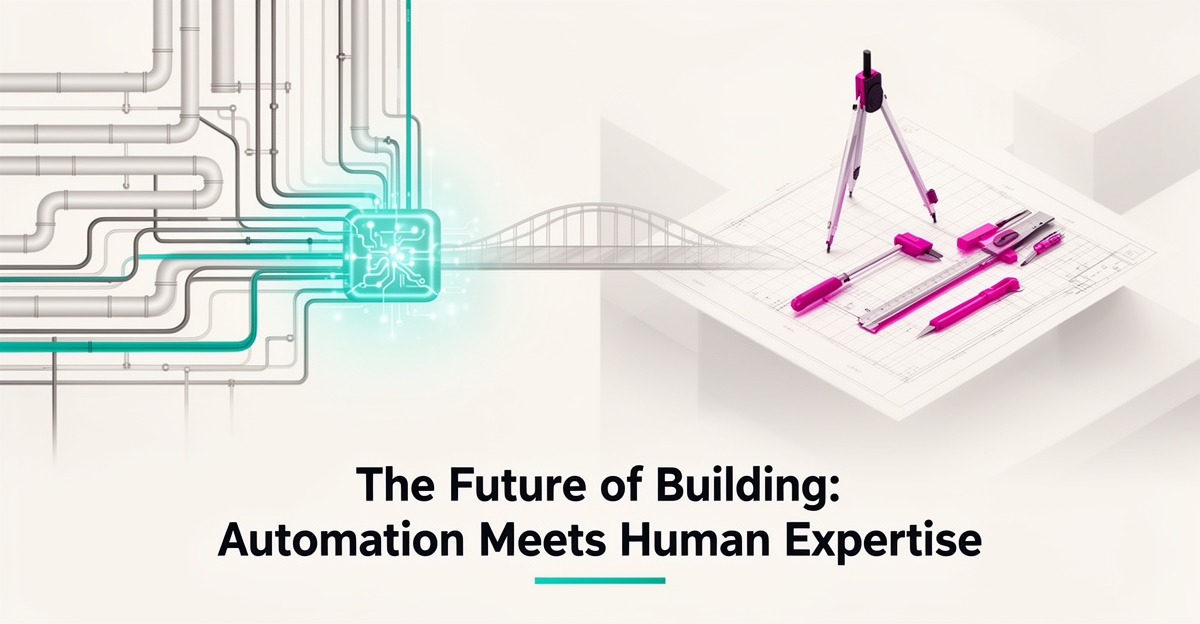
AI vs Human Engineers: When Should MEP Firms Automate Design Tasks Instead of Hiring More Staff?
Key Facts
- Industry research suggests engineers spend only a small fraction of their week—often cited around 16%—on rewarding, innovative work according to engineering research
- AI-first teams are widely reported to deliver projects several times faster than traditional teams industry analysis shows
- Manual data entry typically carries a 1-5% error rate, while AI-assisted processes can hold errors under 1% comparative data reveals
- AI-first teams are reported to operate at substantially lower cost than traditional engineering teams cost analysis confirms
- Tasks happening more than 50 times monthly with predictable patterns typically achieve AI payback within 3-6 months automation research shows
- Workflow automation has delivered strong multi-year ROI in enterprise studies, with one widely cited figure of 248% over three years Forrester research documents
- AI-first teams often run with 1-2 senior engineers while AI handles the bulk of implementation work operating model data reveals
Hire a team member that works 24/7 — for less than a part-time wage.
AI receptionists, SDRs, dispatchers and 99+ roles. Trained on your business, fully managed.
Not sure where to start? Ask our AI planner
The MEP Staffing Trap: Why Hiring More Engineers Isn't Scaling
MEP firms face a growing staffing paradox: hiring more engineers to meet project demand often fails to scale profitability. Despite rising headcount, firms see diminishing returns as engineers spend only a small fraction of their week—industry research often cites around 16%—on rewarding, innovative work, meaning the bulk of their time is consumed by routine tasks that don't leverage their expertise. This misalignment creates a hidden cost: skilled professionals are paid premium rates to perform work that could be systematized, while critical design innovation gets squeezed into fragmented hours.
The scaling trap becomes evident when firms attempt to grow revenue through linear headcount increases. Each new engineer brings not just salary but benefits, onboarding, and management overhead—yet their productive output on high-value design work remains constrained by the same inefficient workflows. Manual processes compound this inefficiency, with data-heavy tasks like drawing revisions or specification updates typically carrying error rates of 1-5%. These errors trigger costly rework cycles, delay approvals, and erode client trust—all while consuming billable hours that could be redirected toward complex problem-solving or client engagement.
AIQ Labs helps MEP firms break this cycle by identifying where automation displaces low-value labor without sacrificing quality. For repetitive tasks such as generating standard duct layouts, calculating pressure drops, or formatting submittal packages, AI-assisted processes can reduce error rates to under 1% and cut processing time from minutes to seconds. Unlike human-led workflows that scale linearly with headcount, AI systems handle volume increases with minimal incremental cost—turning what was once a staffing bottleneck into a scalable capacity advantage. The result isn't fewer engineers, but engineers spending more time on the work that truly drives innovation and firm differentiation. To map these opportunities in your specific workflows, start the 2-minute Fit Check to see where AI delivers the highest ROI—then schedule a free 30-minute strategy call to build a tailored automation roadmap.
Where AI Beats Humans on Cost, Speed and Accuracy in MEP Design
MEP firms hit a ceiling when repetitive design work consumes senior engineers. Automation shifts that work to systems built for speed and consistency, freeing people for judgment-heavy decisions.
For high-volume, rule-based workflows, AI delivers measurable gains in cost, speed and accuracy. AI-first teams are reported to deliver projects at substantially lower cost than traditional teams—often cited around 60% lower—while shipping several times faster. That velocity compounds in design cycles where simulations and documentation repeat across projects.
The financial case is reinforced by enterprise automation data. A Forrester Total Economic Impact study documents a 248% three-year ROI for workflow automation platforms, with over half of businesses seeing full ROI within 12 months. Intelligent automation is reported to achieve 50-70% cost reductions versus 20-30% for basic automation.
Error reduction is equally stark. Manual data entry typically carries a 1-5% error rate for data-heavy tasks, while AI-assisted processes can hold error rates under 1% for structured, repetitive work. Workflow automation can reduce errors by up to 75% in repetitive administrative work.
AI's home turf in MEP design is clear:
- Repetitive design and documentation, including drawing reformatting, rendering from prompts, and auto-generation of specifications
- Simulation and analysis, where machine learning can compress CFD and FEA runs from hours to minutes for faster iteration
- Data entry and processing for takeoffs, submittals, invoices and bid packages
- High-volume bid and proposal tasks, with AI pulling credentials and formatting to client requirements
These tasks share a pattern: they happen more than 50 times per month and follow a predictable pattern. When that threshold is met, AI typically pays for itself within 3 to 6 months. The payback accelerates because setup costs are offset by near-flat scaling costs versus linear headcount.
This is where ROI modeling matters. AIQ Labs helps firms model real-world scenarios to determine where AI delivers the best return—repetitive design tasks, standard configurations, or high-volume projects—through AI Workflow Builds that rebuild the one workflow costing you the most, at a fixed price and in phases. The comparison is not theoretical; it is labor cost, time-to-market and error rate mapped to specific workflows.
Cost, speed and accuracy converge when automation handles the heavy lifting. Engineers reclaim time for architecture, client relationships and complex problem-solving, while the firm scales output without proportional hiring.
Where Human Engineers Stay Essential and AI Falls Short
Despite AI's growing capabilities, human engineers remain essential for tasks that demand nuanced judgment, empathy, and creative problem-solving. Research suggests engineers spend only a small fraction of their week on rewarding, innovative work, indicating that much of their value lies in areas AI cannot replicate—such as interpreting ambiguous schematics, navigating first-of-kind system challenges, and making strategic architecture decisions that require contextual understanding beyond pattern matching. While AI excels at repetitive tasks, it struggles with genuine novelty and situations where interpretation depends on subtle, unspoken factors.
Human expertise is particularly vital in client-facing scenarios where empathy and relationship-building directly impact project outcomes. Tasks involving sensitive negotiations, trust-based communication, or understanding unspoken client needs are best handled by people, as replacing a high-value relationship manager with automated systems introduces significant revenue risk. AI lacks the capacity for genuine emotional intelligence or the ability to adapt communication style based on real-time social cues—limitations that become critical in complex stakeholder environments common in MEP projects.
Strategic design decisions also remain firmly in the human domain. High-level system architecture, trade-off analysis between competing priorities, and innovative solutions for unprecedented technical challenges rely on experiential knowledge and creative reasoning that AI cannot originate. Although AI can support these processes by simulating alternatives or flagging inconsistencies, the final judgment must come from experienced engineers who understand the broader implications of design choices. This is why the most effective approach positions AI as an assistive tool—handling data-heavy, repetitive work like documentation generation or simulation runs—while humans focus on interpretation, innovation, and relationship management. AIQ Labs helps firms model this balance to ensure automation enhances rather than replaces human expertise where it matters most.
The Hybrid Assist Model: How MEP Firms Automate Without Losing Talent
The most effective path forward for MEP firms isn't choosing between AI and human engineers—it's strategically combining both. Industry analysis suggests AI-first teams can operate with just 1-2 senior engineers handling architecture, edge cases, and quality assurance while AI agent teams manage the bulk of implementation work. This hybrid approach allows firms to scale output without proportional headcount growth, with some firms reportedly handling significantly more bids annually using the same team size. By starting with assist-first pilots—where AI drafts designs or proposals for human refinement—firms build confidence and ease cultural transitions. Teams commonly report saving meaningful percentages of time previously spent on manual processes, and error rates for repetitive tasks can drop from 1-5% to under 1% with AI assistance.
AIQ Labs supports this model through a phased approach: Start Monthly for low-risk pilots, Build in Milestones for a defined workflow rebuild, or Own It Outright for a full AI Operating System that connects your firm's workflows in one layer you own outright. Industry analysis suggests this structure can reduce communication overhead from 30-40% to 10-15% of total project time. Firms leveraging this approach typically see project velocity increase several-fold and costs drop substantially compared to traditional workflows, all while retaining senior talent for high-value judgment work. Further validation shows that tasks occurring over 50 times monthly with predictable patterns typically achieve AI payback within 3-6 months, making the assist model both practical and profitable. This balanced strategy turns automation into a talent multiplier rather than a replacement, positioning firms to capture more work without sacrificing engineering expertise.
For MEP leaders ready to explore this model, the first step is identifying where AI handles the heavy lifting so engineers can focus on what only humans can do: innovative design, client relationships, and solving the unexpected. To map your firm's highest-impact automation opportunities, start with the 2-minute Fit Check, then book a free 30-minute strategy call to assess readiness and model real-world ROI.
Still paying for 10+ subscriptions that don’t talk to each other?
We build custom AI systems you own outright. No vendor lock-in. Full control.
Not sure where to start? Ask our AI planner
Frequently Asked Questions
What percentage of an engineer's week is actually spent on innovative, rewarding work?
How much can AI reduce error rates in repetitive data-heavy tasks compared to manual processes?
What is the typical payback period for automating tasks that happen more than 50 times per month?
Can AI replace human engineers in tasks requiring empathy or complex judgment?
How much faster can AI-first teams deliver projects compared to traditional teams?
What is the Hybrid Assist Model and how does it help MEP firms scale without hiring more staff?
Beyond the Binary: How MEP Firms Can Amplify Human Expertise with AI
The evidence is clear: MEP firms face a scaling paradox where hiring more engineers doesn't translate to proportional value, as most of their time is spent on routine tasks that don't leverage their expertise. AI excels at handling these repetitive, high-volume workflows—cutting error rates from 1-5% to under 1%, accelerating simulations from hours to minutes, and reducing processing time from minutes to seconds. But human engineers remain irreplaceable for nuanced judgment, client relationships, and innovative problem-solving. The winning strategy isn't choosing between AI and people—it's combining them. By automating the heavy lifting, firms free their engineers to focus on the work that drives differentiation and innovation. This hybrid approach scales output without proportional headcount growth, turning automation into a talent multiplier. To see where this balance delivers the highest ROI in your workflows, start with the 2-minute Fit Check, then book a free 30-minute strategy call to model real-world opportunities and build a tailored roadmap.
Make AI your competitive advantage — not just another tool.
Strategy, implementation and ongoing optimization. One partner, end to end.
Not sure where to start? Ask our AI planner