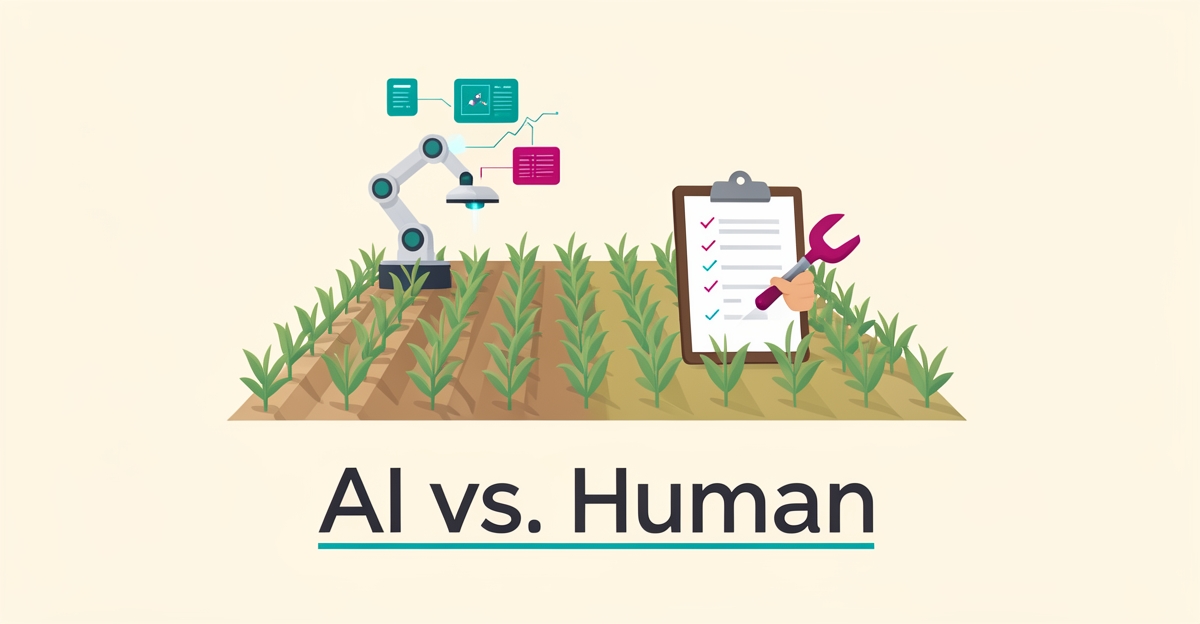
AI vs. Human Harvest Supervisors: Which Is Better for Small Farms?
Key Facts
- AI Employees cost roughly 80% less than an equivalent human hire, with no benefits, overtime, or sick days
- AIQ Labs has deployed 200+ multi-agent systems and runs 4 live SaaS products daily
- AI supervision applies standardized grading criteria consistently across every shift, reducing variability from fatigue and subjective judgment
- One AI Employee can monitor multiple fields simultaneously — something a single human supervisor cannot do
- AIQ Labs offers three entry points: AI Employees, AI Workflow Builds, and AI Operating Systems, each with clear payment models
Hire a team member that works 24/7 — for less than a part-time wage.
AI receptionists, SDRs, dispatchers and 99+ roles. Trained on your business, fully managed.
Not sure where to start? Ask our AI planner
The Supervision Gap: Why Small Farms Struggle with Harvest Oversight
Small farms face a critical bottleneck during harvest season: skilled human supervisors are either too costly to hire consistently or simply unavailable when needed most. This creates a structural vulnerability where inadequate oversight leads to preventable yield losses, inconsistent quality decisions, and operational bottlenecks that erode profitability just when margins are thinnest.
Labor shortages in rural areas exacerbate the problem, with many small farms unable to attract or retain experienced harvest supervisors willing to work peak-season hours. When supervisors are stretched thin or absent, critical decisions about ripeness, sorting, and field prioritization fall to less experienced workers, increasing variability in yield quality. Skilled-labor availability is a widely cited barrier across industries adopting automation as of late 2026, and agriculture is no exception.
The need for extended coverage during peak harvest windows further strains limited human resources. Crops don't adhere to 9-to-5 schedules, and delays in supervision can mean the difference between marketable produce and field losses. AIQ Labs addresses this gap by deploying AI Employees that provide continuous field monitoring without fatigue, shift changes, or absenteeism—ensuring consistent oversight exactly when it matters most.
Human inconsistency in yield assessments introduces another layer of risk. Even experienced supervisors apply subjective judgment to complex variables like moisture content, pest damage, and maturity indicators, leading to divergent decisions across shifts or individuals. This variability undermines batch uniformity and complicates downstream processing. In contrast, AI systems apply standardized criteria in real time, using sensor-driven inputs rather than gut feel.
Together, these factors create a supervision gap that traditional hiring models cannot bridge. Small farms need oversight that is both affordable and relentlessly consistent—qualities increasingly delivered through purpose-built AI solutions designed for agricultural field operations.
What AI Supervision Actually Does in the Field
AI supervision works by combining sensor input, real-time decision loops, and automated coordination. The same principles that guide autonomous machinery in other resource industries translate directly to small farm harvest quality, crew coordination, and equipment uptime.
Sensor fusion is the foundation. Cameras, load sensors, moisture readings, and GPS combine to give the system a continuous picture of field conditions. On a farm, that becomes sensor-driven harvest quality grading, where size, ripeness, and damage are assessed as crops move rather than after the fact.
Real-time decision loops replace delayed radio checks. Instead of waiting for a supervisor to drive between fields, an AI system can shift pickers, bins, and equipment before bottlenecks form—dynamic coordination that keeps crews utilized and harvest moving.
Predictive maintenance is another direct benefit. AI systems can monitor equipment signals and flag issues before they become mid-harvest breakdowns. For small farms, that means fewer costly interruptions during the narrow window when every hour counts.
The operational pattern is consistent:
- Standardized grading reduces missed grades and over-harvest
- Optimized routing and equipment coordination cut wasted fuel and time
- Automated safety checks and predictive alerts reduce incidents and unplanned downtime
AIQ Labs applies this logic to agriculture through AI Employees tailored to farm size and operational needs, offering 24/7 oversight at a fraction of human labor costs. The comparison is not AI versus people, it is consistent, always-on decision support versus variable human coverage.
Small farms gain scalability without adding headcount, consistency across shifts, and faster decisions when weather windows close.
Cost, Consistency, Scalability: The Four-Factor Comparison Framework
Choosing between an AI or human harvest supervisor is not about replacing people; it is about matching your farm's resources to the right kind of oversight. Small farms operate on razor-thin margins, and a single misstep during harvest can wipe out a season's profit.
The first factor is cost. A human supervisor typically commands a salary in the tens of thousands of dollars annually, plus benefits, taxes, and overtime that can add another 25–35% to the total. In contrast, an AI Employee from AIQ Labs works for a flat monthly rate—roughly 80% less than a human hire—with no benefits, no overtime, and no sick days.
Consistency is the second factor. Human supervisors are subject to fatigue, mood, and turnover, which leads to uneven decisions across shifts and seasons. AI systems deliver the same data-driven judgment around the clock, applying standardized criteria every time.
The third factor is scalability. A human supervisor can only be in one place at a time, limiting oversight to a single field or crop. An AI Employee can monitor multiple fields simultaneously, processing sensor data from each location and flagging issues in real time. This is especially valuable for small farms that grow diverse crops across scattered plots.
The fourth factor is decision speed. When weather shifts or equipment malfunctions mid-harvest, every minute counts. AI systems process real-time data and adjust plans instantly, while human supervisors may need to consult with others or wait for daylight.
Here is a quick comparison of the four factors:
- Cost: Human supervisor costs a full salary plus 25–35% in benefits and overtime; an AI Employee costs a flat monthly rate at roughly 80% less.
- Consistency: AI applies the same criteria every shift; humans vary with fatigue and turnover.
- Scalability: One AI can oversee multiple fields; one human cannot.
- Decision speed: AI reacts in seconds; humans may take minutes or hours.
AIQ Labs' AI Employee model is designed for exactly this kind of operational oversight. Each AI Employee is trained on your farm's unique processes, integrates with your existing tools, and works around the clock without breaks. The result is a supervisor that never sleeps, never misses a detail, and scales with your operation.
For small farms weighing these four factors, the math is clear: AI supervision offers a more affordable, consistent, and scalable solution than traditional human oversight. The question is not whether AI can do the job, but whether your farm can afford to wait.
Implementation Path: From Single-Field Pilot to Full Harvest Automation
Starting with a single-field pilot lets small farms validate AI supervision without betting the entire harvest on unproven technology. The most practical entry point is an AI Dispatcher or Field Manager role that plugs into existing telematics, GPS guidance, and crew communication apps already running on the equipment.
- Connect the AI supervisor to equipment telematics and moisture sensors for real-time field conditions
- Integrate with crew messaging apps so instructions flow through familiar channels
- Run the first harvest cycle in human-supervised mode with AI providing recommendations only
- Gradually shift to AI-supervised operation with human-in-the-loop checkpoints for critical decisions
The Start Monthly payment model keeps risk low: a flat monthly cost covers the build, training on your specific operation, tool integrations, and ongoing optimization—with the ability to pause or adjust anytime. As confidence builds, farms can move to a Workflow Build to rebuild the one workflow that costs them most, or eventually a full AI Operating System that connects the whole operation in phases. AIQ Labs uses this same phased methodology—starting with a single AI Employee in a defined role like Dispatcher or Field Manager, proving value in one workflow, then scaling across the operation as confidence builds.
Still paying for 10+ subscriptions that don’t talk to each other?
We build custom AI systems you own outright. No vendor lock-in. Full control.
Not sure where to start? Ask our AI planner
Frequently Asked Questions
Can AI really supervise harvest when human supervisors are hard to find?
Is AI supervision more consistent than a human supervisor?
How much faster or more productive is AI oversight in practice?
Will AI supervision make harvest safer and reduce downtime?
Is AI supervision affordable for a small farm compared to hiring?
How do farms actually start with AI supervision without risking the whole harvest?
The Harvest Window Won't Wait — Neither Should Your Oversight
Small farms lose margin every season to the supervision gap — missed ripeness calls, inconsistent grading, and equipment downtime that human crews can't cover around the clock. AI supervision closes that gap with standardized, sensor-driven decisions that never fatigue and never turn over. AIQ Labs delivers this capability through AI Employees — purpose-built roles like Field Manager and Dispatcher that integrate with your existing telematics and crew apps, work 24/7 without overtime or absenteeism, and cost roughly 80% less than a human hire. With 200+ multi-agent systems deployed and 4 live SaaS products the company runs daily, the track record is real. Start with a single-field pilot, validate the results, then scale across your operation. The 2-minute Fit Check leads to a free 30-minute strategy call — no obligation, just clarity on where AI oversight pays for itself fastest. Begin at https://aiqlabs.ai/apply.
Make AI your competitive advantage — not just another tool.
Strategy, implementation and ongoing optimization. One partner, end to end.
Not sure where to start? Ask our AI planner