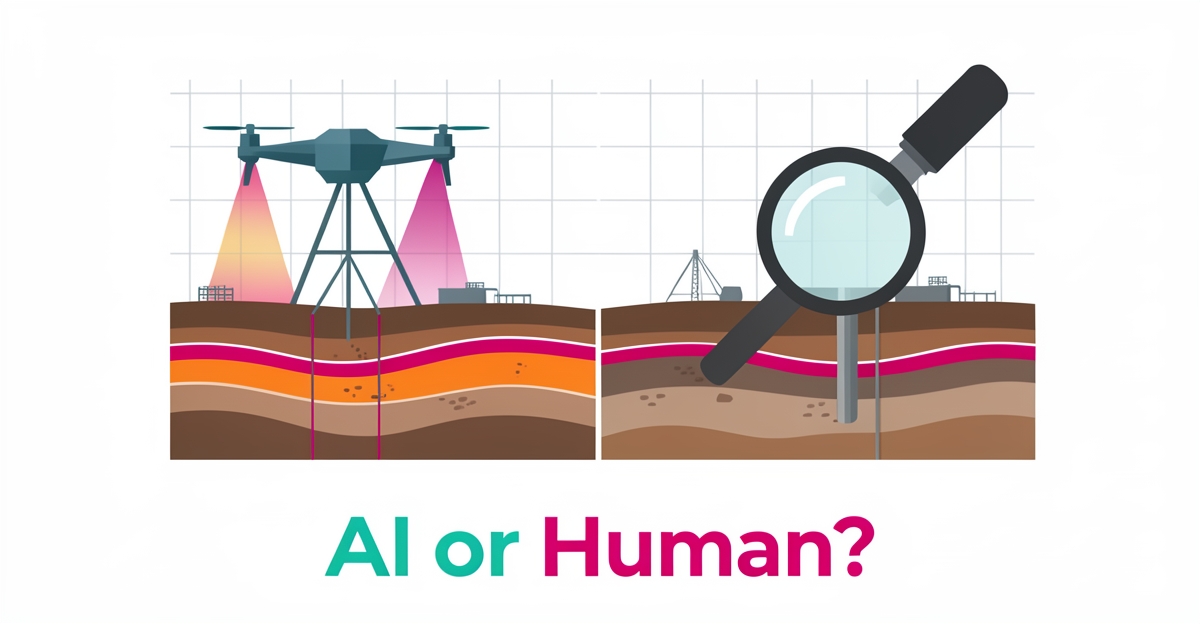
AI vs. Human Inspections: Which Is Better for Geothermal Site Readiness?
Key Facts
- The built environment is widely cited as one of the largest contributors to global emissions, which puts pressure on energy and construction projects to work leaner
- AI-powered tools can typically evaluate dozens of geothermal sites in hours, compared to days or weeks for human-led assessments
- AI-driven pre-screening lowers overall assessment costs by minimizing wasted effort on unsuitable sites
- Human inspectors are essential for evaluating complex geological formations that AI might overlook
- AI systems require large volumes of high-quality data to function effectively in geothermal assessments
- A hybrid AI-human approach can meaningfully cut preliminary assessment timelines while maintaining accuracy
- AI-powered planning tools analyze past project data and external factors to produce faster, better-informed schedules and budgets
Hire a team member that works 24/7 — for less than a part-time wage.
AI receptionists, SDRs, dispatchers and 99+ roles. Trained on your business, fully managed.
Not sure where to start? Ask our AI planner
The High Cost of Manual Geothermal Site Assessments
The manual assessment of geothermal sites presents significant operational and financial hurdles for developers seeking to advance renewable energy projects. Traditional inspections require extensive travel to remote locations, consuming substantial time and resources while delaying critical project timelines. Evaluating multiple potential sites efficiently remains a persistent challenge, as each location demands individual on-site visits for soil analysis, topography evaluation, and climate data collection. These bottlenecks are compounded by growing pressure on construction and energy projects to reduce both costs and emissions, the built environment is consistently cited as one of the largest contributors to global emissions, so every wasted site visit carries a cost in both dollars and carbon.
Manual processes create compounding inefficiencies that strain budgets and extend development cycles. Teams must coordinate logistics, secure access permissions, and deploy specialized personnel across vast geographic areas, often repeating similar assessments for marginally different sites. This approach not only increases fuel consumption and labor expenses but also limits the number of viable locations that can be realistically evaluated within feasible timeframes. As geothermal developers face mounting pressure to accelerate project timelines while minimizing environmental impact, the inability to rapidly screen and prioritize sites becomes a critical bottleneck in the pursuit of scalable clean energy solutions.
- Extensive travel requirements increase operational costs and carbon footprint
- Lengthy timelines delay project feasibility studies and investment decisions
- Inability to efficiently evaluate multiple sites limits strategic site selection
- Manual processes hinder scalability in competitive renewable energy markets
AIQ Labs addresses these challenges through AI workflow builds that rebuild the assessment workflow that costs you the most, analyzing soil reports, topography, and climate data to pre-screen geothermal locations, reducing the need for repetitive on-site visits while improving early-stage feasibility insights. By leveraging regional performance data, these tools enable developers to focus human expertise on the most promising candidates. This shift not only cuts unnecessary field expenditures but also supports faster, more sustainable decision-making in the race to deploy clean energy assets at scale.
How AI-Powered Pre-Screening Transforms Site Evaluation
AI-powered pre-screening is transforming how geothermal sites are evaluated by rapidly processing diverse datasets before any physical visit occurs. This approach allows teams to assess soil composition, topographical features, and historical climate patterns at scale, identifying viable locations far earlier in the planning cycle. By automating initial data synthesis, organizations avoid unnecessary field trips to sites with low geothermal potential, conserving both time and budget.
AI systems can analyze large volumes of civil engineering data, including soil reports and topography, to optimize site evaluations and reduce reliance on manual inspections. This capability is particularly valuable in geothermal projects, where subsurface conditions dictate feasibility. AI models trained on regional performance metrics can detect anomalies such as poor thermal conductivity or unstable strata long before drilling begins.
The speed advantage is substantial: while human-led assessments may take days or weeks per site, AI-powered tools can typically evaluate dozens of locations in hours. This acceleration enables faster decision-making during the exploratory phase, especially when managing large portfolios of candidate sites. Teams can prioritize high-potential locations for deeper investigation, ensuring that expert human inspectors focus only on the most promising prospects.
Cost savings compound these efficiency gains. Eliminating redundant on-site visits reduces travel, labor, and equipment expenses, particularly in remote or hard-to-access regions. AI-driven pre-screening lowers overall assessment costs by minimizing wasted effort on unsuitable sites. These savings can be redirected toward advanced testing or community engagement efforts that directly impact project success.
- Processes soil, topography, and climate data in parallel
- Identifies thermal risks and geological inconsistencies early
- Reduces need for preliminary field surveys
- Scales evaluation across hundreds of potential sites
- Flags environmental constraints before permitting
AIQ Labs supports this workflow through fixed-price, phased workflow builds that integrate regional geothermal performance data into pre-screening models, enabling smarter, faster site readiness evaluations without replacing essential human expertise. By combining algorithmic precision with field-seasoned judgment, geothermal teams can move from speculation to confident investment with fewer surprises underground.
Where Human Expertise Still Matters in Geothermal Assessments
Even the most sophisticated AI can't replicate the judgment of a seasoned geologist standing on a site, interpreting subtle geological cues that data alone might miss. While AI-powered systems excel at processing soil reports, topography, and climate data to pre-screen locations, human expertise remains irreplaceable for nuanced assessments.
Complex geological formations present a prime example. When subsurface conditions involve irregular rock strata, fault lines, or unexpected mineral compositions, human inspectors draw on years of field experience to interpret anomalies that algorithms might flag incorrectly or overlook entirely. Human inspections remain essential for evaluating these intricate geological scenarios, as AI systems lack the contextual depth to navigate ambiguity.
Environmental impact evaluation similarly demands human judgment. Assessing how a geothermal installation might affect local ecosystems, water tables, or protected habitats requires understanding regulatory frameworks, community concerns, and ecological interdependencies, factors that resist simple quantification. While AI delivers speed and cost efficiency, it offers limited context compared to human inspectors.
The accuracy of any AI system hinges entirely on data quality. AI-powered planning tools analyze historical project data and external factors, but experts consistently note that these systems require large volumes of high-quality data to function effectively. Feed an AI incomplete soil samples or outdated climate records, and it will generate confident but flawed recommendations, potentially leading to costly drilling mistakes or site failures.
Human oversight serves as the critical safeguard against these blind spots. Key scenarios where inspectors prove indispensable include:
- Interpreting ambiguous geological survey results that fall outside training data patterns
- Assessing site-specific environmental sensitivities requiring regulatory knowledge
- Validating AI-flagged risks through on-ground verification and contextual analysis
- Making judgment calls when data conflicts or gaps emerge during assessment
AIQ Labs recognizes this balance, building AI systems trained on regional geothermal performance data that augment rather than replace human expertise. The most effective approach integrates AI's analytical power with human contextual knowledge, ensuring that human oversight prevents costly oversights while technology handles the heavy data lifting.
The Hybrid Approach: Combining AI Speed with Human Judgment
The future of geothermal site readiness doesn't lie in choosing between AI and human expertise, it lies in combining them strategically. By leveraging AI for rapid data analysis and reserving human judgment for nuanced evaluations, developers can achieve both speed and precision without compromising on safety or feasibility. This hybrid model addresses the core limitations of each approach while amplifying their strengths.
A practical implementation begins with comprehensive data collection, integrating soil reports, topographical surveys, and historical climate datasets into a unified platform. AI systems then process this information at scale, identifying patterns and flagging sites with elevated risk factors, such as unstable substrates or unfavorable thermal gradients, in a fraction of the time required for manual review. AI-powered analysis can significantly reduce the need for preliminary on-site visits by rapidly processing large volumes of geospatial and geological data.
Once AI completes its initial screening, human inspectors focus their efforts exclusively on the flagged sites, those requiring expert interpretation of complex geological formations or subtle environmental indicators. This targeted approach ensures that skilled professionals spend their time where it matters most, applying contextual knowledge that AI alone cannot replicate. Human inspectors bring critical expertise in assessing subsurface conditions and environmental stewardship considerations, which remain essential for responsible geothermal development.
The final step involves synthesizing AI-generated risk scores with inspector notes into a cohesive readiness assessment. This integrated view enables developers to make confident go/no-go decisions, balancing computational efficiency with seasoned judgment. For organizations pursuing this method, partnering with a provider experienced in AI data enrichment ensures that models are trained on region-specific geothermal performance data, improving relevance and reducing false positives.
By structuring workflows this way, geothermal teams can meaningfully cut preliminary assessment timelines, often by half or more, while maintaining or improving diagnostic accuracy, a dual advantage that directly supports faster project initiation and lower exploratory costs. As the technology matures through 2026 and beyond, this balanced approach will likely become the standard for sustainable, data-informed site evaluation in renewable energy development.
Implementing AI-Driven Site Readiness for Your Geothermal Projects
Geothermal site readiness assessments are evolving rapidly as companies seek faster, more accurate ways to evaluate potential locations. AI-powered systems now analyze soil reports, topography, and climate data to pre-screen sites, reducing the need for frequent on-site visits while improving feasibility assessments. This shift allows geothermal teams to focus field efforts on the most promising locations, saving time and resources.
AI is also changing how energy and construction teams track, measure, and reduce carbon emissions while improving material efficiency, goals that align directly with the sustainability mandates of geothermal projects. AI-powered planning tools similarly analyze past project data, labor productivity rates, and external factors like weather and supply chain risks to create better schedules and budgets, a capability directly transferable to geothermal site evaluation.
To implement AI-driven site readiness, geothermal companies need a structured data infrastructure that integrates historical soil reports, topographical surveys, climate patterns, and regional geothermal performance metrics. AIQ Labs builds custom systems trained on this regional data to ensure models reflect local geological nuances, improving prediction accuracy for subsurface conditions and long-term site viability. These systems integrate with existing workflows, allowing teams to retain familiar tools while gaining AI-enhanced insights, and because builds are delivered in fixed-price phases, you only commit to the next step when the last one has proven itself.
Evaluating AI solutions requires verifying that models are trained on high-quality, region-specific geothermal performance data, not generic datasets. The system should demonstrate measurable improvements in screening speed and risk identification, such as early detection of unsuitable soil permeability or seismic risks. AIQ Labs develops production-ready AI agents that continuously learn from new field data, ensuring models stay accurate as project conditions evolve.
- Centralize soil, topography, and climate data from surveys, sensors, and public sources
- Train AI models on regional geothermal performance history for localized accuracy
- Integrate AI outputs into existing project management and GIS platforms
- Maintain human oversight for complex geological validation and environmental review
- Continuously retrain models with new field data to improve long-term reliability
For companies ready to modernize their site assessment process, AIQ Labs offers a clear path forward. Start with the 2-minute Fit Check, then book a free 30-minute strategy call to explore how custom AI systems can transform your geothermal site readiness workflow, no obligation, just a real working session with an AI engineer to identify high-ROI opportunities. You can reach the team directly at [email protected].
Still paying for 10+ subscriptions that don’t talk to each other?
We build custom AI systems you own outright. No vendor lock-in. Full control.
Not sure where to start? Ask our AI planner
Frequently Asked Questions
Is AI actually faster than human inspectors for geothermal site assessments?
How much does AI cost compared to traditional geothermal site inspections?
Can AI replace human geologists when evaluating complex geothermal sites?
What kind of data does AI need to accurately assess geothermal site readiness?
How do I combine AI and human inspections for geothermal projects?
What are the biggest risks of using AI for geothermal site selection?
Building Smarter Geothermal Assessments: Where AI and Human Insight Meet
The future of geothermal site readiness isn't about choosing between AI and human expertise, it's about combining them strategically. AI excels at rapidly processing soil, topography, and climate data to pre-screen hundreds of sites, cutting assessment timelines and costs while flagging risks early. Human inspectors remain essential for interpreting complex geological formations, validating AI findings, and assessing environmental impacts where contextual judgment is irreplaceable. By integrating AI-powered pre-screening with targeted human evaluation, geothermal teams can make faster, more confident decisions without compromising accuracy or safety. This hybrid approach directly supports business goals of reducing operational waste, accelerating project timelines, and focusing expert resources where they deliver the most value. For geothermal developers ready to modernize their site assessment workflow, AIQ Labs offers a clear path forward through custom AI systems trained on regional performance data. Start with the 2-minute Fit Check, then book a free 30-minute strategy call to explore how this balanced approach can transform your readiness assessments, no obligation, just a real working session to identify high-ROI opportunities.
Make AI your competitive advantage — not just another tool.
Strategy, implementation and ongoing optimization. One partner, end to end.
Not sure where to start? Ask our AI planner