AI vs. Human Site Inspectors: Which Is Better for Small Contractors?
Key Facts
- Industry analyses report AI safety tools can reduce on-site incidents by up to 50% according to recent research
- AI-driven inspection systems are typically credited with cost reductions in the 40-60% range while improving data consistency across projects according to recent research
- 50% of frontline employees report burnout, while 66% say they lack sufficient time to complete work according to Microsoft research
- Up to 30% of critical decision logic resides as tacit knowledge rather than documented processes according to industry analysis
- AI inspection systems provide 24/7 monitoring, unlike human inspectors limited by working hours and physical presence according to recent research
- Demand for forward-deployed engineers grew sharply over the past year according to industry analysis
Hire a team member that works 24/7 — for less than a part-time wage.
AI receptionists, SDRs, dispatchers and 99+ roles. Trained on your business, fully managed.
Not sure where to start? Ask our AI planner
The Small Contractor's Inspection Dilemma: Cost, Coverage, and Consistency
Small contractors face a growing challenge: maintaining consistent, high-quality site inspections across multiple projects while operating with tight budgets and limited staff. Traditional human inspections, though valuable for contextual judgment, strain resources when juggling several job sites, leading to gaps in coverage and inconsistent reporting. This tension between thorough oversight and operational feasibility has pushed many to explore AI-driven alternatives that promise greater efficiency without sacrificing safety or quality.
AI-powered site inspection tools are changing how contractors manage risk and compliance, offering 24/7 monitoring through computer vision, sensors, and predictive analytics. According to industry analysis, these systems are typically credited with reducing inspection costs by 40-60% while significantly improving data consistency across geographically dispersed projects. For small contractors overseeing multiple small builds, this means reliable oversight without the expense of deploying additional human inspectors to every location.
Beyond cost savings, AI enhances safety by enabling proactive hazard detection rather than reactive responses. Systems equipped with computer vision can identify missing PPE, detect equipment nearing restricted zones, and monitor for heat stress, delivering real-time alerts that prevent incidents before they occur. Industry analyses report AI tools reducing on-site incidents by up to 50% as of late 2026, shifting safety management from periodic checks to continuous oversight. This capability is especially critical for contractors who cannot afford to station inspectors at every site around the clock.
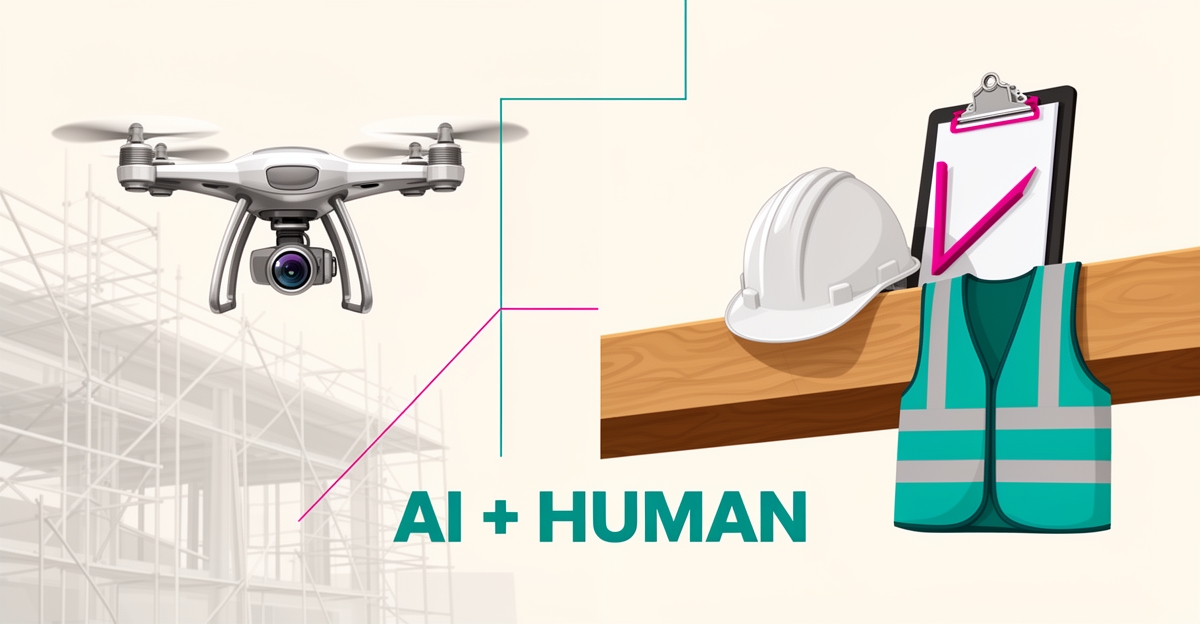
However, AI does not eliminate the need for human expertise. Instead, it augments it by handling repetitive monitoring tasks and surfacing trends, allowing supervisors and safety managers to focus on interpretation, decision-making, and OSHA compliance. The most effective implementations combine AI's scalability and consistency with human contextual judgment, creating a collaborative model where technology handles surveillance and people drive action. For small contractors navigating limited personnel and dispersed projects, this balance offers a practical path to maintaining quality without overextending their teams.
The AI Advantage: Cost Reduction with 24/7 Monitoring
The numbers tell a compelling story. According to industry research, AI-driven inspection systems are typically credited with cost reductions in the 40-60% range while simultaneously improving data consistency, a combination that fundamentally changes the economics of site oversight for small contractors.
Unlike human inspectors constrained by working hours and physical presence, AI systems provide continuous monitoring across every project simultaneously. Computer vision cameras, wearables, and equipment sensors work around the clock, transforming raw jobsite data into actionable safety alerts. This shift from periodic spot checks to 24/7 surveillance means hazards get identified in real time, not discovered during tomorrow's walkthrough.
The operational benefits extend beyond simple cost savings. These systems deliver tangible safety improvements through specific applications already proving themselves on active sites:
- PPE detection systems that instantly identify workers missing hard hats or safety gear
- Fall prevention monitoring at leading edges and elevated work zones
- Equipment collision avoidance that tracks machinery proximity in real time
- Heat stress monitoring that protects workers during extreme conditions
The impact is measurable. Recent industry data reports these AI tools reducing incidents on active construction sites by up to 50%. Consider a practical example: an AI camera system monitoring a tower crane's "no-go" zone near power lines. The system continuously tracks the crane's hook position and automatically alerts both the lift supervisor and operator the moment it enters restricted airspace, complete with time-stamped documentation.
For contractors juggling multiple small projects across different regions, this consistency proves invaluable. Human inspectors bring expertise but also variability, different judgment calls, fatigue factors, and scheduling constraints. AI systems apply identical standards across every site, every shift, every day. They don't get tired during the third site visit or rush through inspections to make the next appointment.
The technology also addresses a critical resource constraint facing the construction industry. Microsoft research reveals that 50% of frontline employees report burnout, while 66% say they lack sufficient time to complete their work. AI monitoring systems alleviate this pressure by handling routine surveillance tasks, allowing human safety managers to focus on interpretation, decision-making, and OSHA compliance rather than constant physical presence.
This represents a fundamental shift from reactive to proactive safety management. Traditional inspection models identify problems after they occur or during scheduled reviews. AI systems surface risks as they develop, enabling intervention before incidents happen. The data consistency and continuous oversight create a safety net that scales effortlessly, one system can monitor five sites as easily as one.
For small contractors operating on thin margins, the math becomes straightforward. Typical cost reductions of 40-60% combined with 24/7 monitoring capabilities and documented incident reductions create a compelling business case. The technology doesn't eliminate the need for human judgment, it amplifies human expertise by ensuring nothing gets missed between site visits.
Where Human Inspectors Still Win: Context, Judgment, and Complex Decision-Making
Human inspectors bring irreplaceable value when it comes to interpreting the full picture of a construction site, especially when safety decisions hinge on subtle, context-rich cues that AI systems may overlook. While AI excels at detecting missing hard hats or equipment proximity, it struggles to judge whether a worker's fatigue, a sudden weather shift, or an unconventional but safe workaround requires intervention. This contextual judgment, rooted in years of on-site experience, allows human inspectors to distinguish between genuine hazards and acceptable variations in work methods, a nuance that remains beyond current AI capabilities.
Their strength also lies in complex decision-making that blends technical knowledge with interpersonal awareness. For example, a human inspector might notice tension between subcontractors, recognize signs of heat stress not yet triggering sensor alerts, or adapt safety protocols based on crew morale and communication patterns, factors embedded in tacit knowledge that, as research suggests, can comprise up to 30% of critical decision logic in field operations. These insights aren't captured in data streams but emerge from presence, observation, and relationship-building with crews over time.
Ultimately, the most effective site inspection strategy doesn't choose between AI and humans but leverages both: AI provides consistent, 24/7 monitoring and early hazard detection, while human inspectors deliver the judgment, adaptability, and leadership needed to turn alerts into meaningful action. For small contractors managing multiple projects, this hybrid approach ensures both operational efficiency and the deep contextual understanding that only experienced professionals can provide. To explore how AI can augment your inspection workflow without replacing critical human expertise, take AIQ Labs' 2-minute Fit Check and then book a free 30-minute strategy call to map your highest-impact automation opportunities.
Implementation Roadmap: How Small Contractors Can Deploy AI Inspection Systems
Most AI implementations fail not because the technology underperforms, but because the rollout ignores the human side of the equation. For small contractors, a structured deployment plan turns a promising tool into a durable operational advantage.
Start with leadership communication. According to construction safety research, successful adoption depends on clear messaging that AI data will be used for improvement rather than punishment. Your crew needs to hear this directly from ownership before the first camera goes up.
Next, build worker trust through privacy safeguards and transparency. Define exactly what data the system collects, who can access it, and how long it's retained. When workers understand that monitoring protects them rather than surveils them, resistance drops considerably.
Then integrate AI into your existing safety infrastructure rather than running it as a parallel system. The same industry analysis shows AI works best when layered into toolbox talks, site-specific safety plans, and OSHA compliance workflows, with humans interpreting context and making final decisions.
A phased deployment keeps risk low and learning high:
- Pilot on one site with a single use case like PPE detection or no-go zone monitoring
- Deliver hands-on training so crews know how to interpret and respond to alerts
- Measure results against your baseline incident and inspection costs
- Expand to additional sites only after the pilot proves consistent value
The payoff justifies the discipline. Industry analyses report AI inspection systems reducing incidents by up to 50% on active sites while typically cutting inspection costs by 40-60%, a significant edge for contractors juggling multiple small projects across regions.
AIQ Labs structures deployments exactly this way: milestone-based workflow builds where you approve each phase, keep everything built so far, and scale only when the numbers justify it. Whether you start with a single workflow fix or a broader operating system for your business, the goal stays the same, AI your team trusts and actually uses.
Still paying for 10+ subscriptions that don’t talk to each other?
We build custom AI systems you own outright. No vendor lock-in. Full control.
Not sure where to start? Ask our AI planner
Frequently Asked Questions
Can AI really reduce inspection costs for small contractors?
How does AI improve safety on construction sites compared to human inspectors?
Will AI replace human safety inspectors on small contractor job sites?
What specific safety hazards can AI detection systems identify on construction sites?
How can small contractors successfully implement AI inspection systems without worker resistance?
The Smartest Inspection Strategy Isn't Either/Or
The debate between AI and human site inspectors misses the point for small contractors. The real advantage lies in combining AI's 24/7 monitoring and cost efficiency with human expertise in context and judgment. AI systems excel at continuous surveillance, detecting missing PPE, tracking equipment zones, and identifying heat stress risks, while industry analyses report incident reductions of up to 50% and typical inspection cost savings in the 40-60% range. Human inspectors bring irreplaceable value in interpreting complex situations, reading crew dynamics, and making nuanced safety decisions that sensors can't capture. For contractors managing multiple projects on tight budgets, this hybrid approach delivers consistent oversight without overextending your team. The path forward starts with a single pilot: choose one high-impact use case, build worker trust through transparent communication, and measure results against your baseline. Ready to explore how AI can strengthen your inspection workflow without replacing the expertise that keeps your sites safe? Take AIQ Labs' 2-minute Fit Check, then book a free 30-minute strategy call to map your highest-impact opportunities.
Make AI your competitive advantage — not just another tool.
Strategy, implementation and ongoing optimization. One partner, end to end.
Not sure where to start? Ask our AI planner