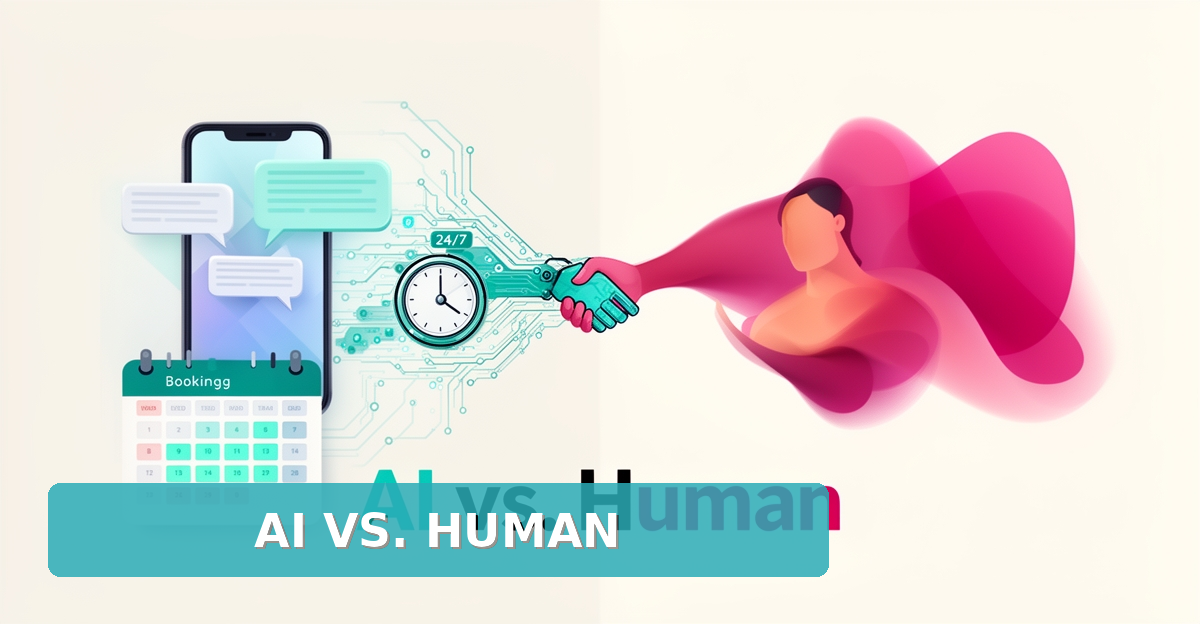
AI vs. Human Staff: Which Is Better for Managing Rental Inquiries and Bookings?
Key Facts
- AI Employees typically cost around 80% less than a comparable human hire, with no salaries, benefits, or overtime
- AI Employees operate 24/7/365, capturing every inquiry even outside business hours
- AI handles initial inquiry triage, FAQ responses, and calendar checks while humans focus on negotiation and relationship building
- A meaningful share of critical decision logic in most organizations lives as tacit knowledge, requiring human oversight
- Companies that redesign workflows around AI — not just add a chatbot — tend to see the strongest results
Hire a team member that works 24/7 — for less than a part-time wage.
AI receptionists, SDRs, dispatchers and 99+ roles. Trained on your business, fully managed.
Not sure where to start? Ask our AI planner
The Cost and Scalability Gap in Rental Inquiry Management
Managing rental inquiries and bookings with human-only staff creates significant operational strain for small and medium-sized businesses. Labor costs, limited availability, and the inability to scale during peak demand periods strain resources and impact customer experience. Human staff typically work 40 hours per week, leading to missed inquiries outside business hours and increased labor expenses during seasonal spikes. AI Employees, by contrast, operate 24/7/365 without sick days, vacations, or overtime costs, ensuring every inquiry is captured immediately.
A managed AI Employee typically costs around 80% less than a comparable human hire, eliminating the need for salaries, benefits, recruiting, and training expenses. This cost efficiency allows SMBs to reallocate budget toward growth initiatives while maintaining consistent inquiry response rates. Unlike human teams that require proportional hiring to handle volume increases, AI systems scale instantly to manage thousands of simultaneous interactions without additional labor costs.
The scalability gap becomes critical during high-demand periods such as holiday seasons or local events, where inquiry volumes can surge unpredictably. Human-only teams face bottlenecks, delayed responses, and lost bookings due to capacity limits. AI handles the initial inquiry volume — answering FAQs, checking availability, and scheduling viewings — while human staff focus on complex negotiations, relationship building, and high-touch bookings. This hybrid approach maximizes both efficiency and service quality.
AIQ Labs helps businesses implement this balance by deploying AI Employees for front-end inquiry management and retaining human experts for strategic customer interactions. The result is a responsive, cost-effective system that scales with demand without sacrificing the human elements essential for trust and long-term client relationships. By automating repetitive tasks, SMBs reduce operational overhead and free their teams to focus on activities that drive revenue and loyalty. This model transforms rental inquiry management from a cost center into a scalable, customer-centric operation.
Why a Hybrid AI-Human Model Outperforms Either Approach Alone
Rental teams are caught between rising inquiry volume and the cost of keeping humans on call 24/7. A hybrid AI-human model resolves that tension by assigning each channel to the agent that performs best.
AI excels at the first mile of the customer journey. It can screen initial inquiries, answer FAQs, and extract booking data instantly and without fatigue, operating 24/7 while human teams sleep. As of late 2026, the strongest results consistently come from high-volume, repetitive use cases. The result is faster response times, consistent information, and a scalable front door that does not add headcount.
Humans remain essential for the last mile. Empathy, persuasion, originality, creativity and human connection are capabilities that AI still cannot replicate reliably. In rentals that means negotiating a complex multi-unit hold, de-escalating a distressed guest, or building long-term trust with a property owner — moments where judgment and rapport matter more than speed.
The performance gap between approaches shows up clearly in practice. Businesses that simply add a chatbot on top of unchanged workflows typically see modest gains. Those that redesign roles and processes around AI — letting it own triage and data work while humans own judgment calls — tend to outperform. Simply adding a chatbot is not enough; workflows and roles must be redesigned around it.
A practical hybrid design for rentals looks like this:
- AI handles initial inquiry triage, FAQ responses, and calendar availability checks 24/7
- AI extracts and normalizes data from forms, emails and calls for human review
- Human agents step in for negotiation, exceptions, refunds, and relationship building
- Human-in-the-loop controls audit AI decisions for compliance and quality
This split mirrors how staffing is evolving more broadly across customer-facing operations: the shift is toward augmentation, not replacement. AI takes the repetitive volume; people take the moments that decide whether a guest books or an owner renews.
The model also protects institutional knowledge. In many organizations, a meaningful share of critical decision logic resides as tacit knowledge rather than documented processes, meaning humans must remain in the loop for exceptions and edge cases. AI reduces administrative overload so staff can focus on data-driven, people-first strategies rather than repetitive screening.
AIQ Labs helps businesses design this hybrid model — using AI for initial inquiries and human staff for complex events — to maximize service quality and reduce operational costs. The outcome is a rental operation that scales with demand without sacrificing the human touch that closes bookings and retains owners.
Implementing AIQ Labs' Hybrid Model for Rental Operations
Moving from theory to practice requires a structured approach that respects your current operational reality. AIQ Labs guides rental businesses through a phased implementation, ensuring you build capabilities without disrupting existing guest relationships.
The first phase is a candid assessment of how inquiries are handled today. AIQ Labs begins with a Discovery Workshop to map your current inquiry handling, identifying whether you are still piloting basic tools or ready to scale integrated workflows. From there, most businesses start with a Workflow Build — rebuilding the one workflow that costs the most, at a fixed price, in phases.
Once the baseline is established, the focus shifts to deploying AI Employees for initial inquiry handling. These are not simple chatbots but managed AI staff — receptionists, dispatchers, and similar roles across 99+ use cases — that answer routine questions about availability, pricing, and amenities 24/7. For rental businesses, this means AI handles the "first mile" — screening inquiries and scheduling viewings — while your human team focuses on high-value interactions that require empathy and complex negotiation.
The implementation follows a precise sequence to minimize disruption:
- Assess current inquiry volume and identify repetitive questions suitable for automation
- Deploy AI Employees for 24/7 initial response and standard booking workflows
- Retain human staff for complex event bookings and distressed guest situations
- Establish human-in-the-loop protocols for all financial transactions and exceptions
- Train staff on AI collaboration — most teams adjust within days, not weeks
Critical to this model is maintaining human oversight for nuanced decisions. A meaningful share of critical decision logic in most organizations resides as tacit knowledge — unwritten expertise that AI cannot replicate. Your team retains control over complex bookings, special requests, and relationship management, while the AI handles volume and data extraction.
For rental businesses that want inquiry handling, booking management, and owner communications connected in one place, an AI Operating System provides a single operating layer built in phases and owned outright. You can review pricing options — Start Monthly, Build in Milestones, or Own It Outright — before committing to anything.
Ready to map your hybrid staffing strategy? Start the Fit Check — a two-minute assessment that leads to a free 30-minute strategy call with an AI engineer. We will identify your highest-ROI automation opportunities and determine if an AI Employee pilot makes sense for your inquiry volume. If there is not a clear win, we will tell you that too.
Still paying for 10+ subscriptions that don’t talk to each other?
We build custom AI systems you own outright. No vendor lock-in. Full control.
Not sure where to start? Ask our AI planner
Frequently Asked Questions
How much can a small business save by using AI Employees instead of hiring human staff for rental inquiries?
Can AI handle all types of rental inquiries, or do I still need human staff for some situations?
What does a hybrid AI-human model look like in practice for rental businesses?
Is there evidence that companies using AI in customer-facing roles perform better financially?
How long does it typically take for staff to adjust to working with AI Employees in a rental business?
What share of critical business decisions still requires human oversight?
Build a Rental Operation That Scales Without Losing the Human Touch
The choice between AI and human staff for rental inquiries is not either/or. AI wins on the first mile — 24/7 triage, instant FAQ answers, availability checks and data extraction at roughly 80% less cost than a comparable human hire — while humans remain essential for the last mile of empathy, negotiation and complex relationship building. Businesses that move beyond pilots to integrated hybrid workflows consistently see stronger results, because they redesign roles around AI rather than simply adding a chatbot. For SMBs, that means automating repetitive volume to free your team for the human capabilities that close bookings and retain owners, with human-in-the-loop controls protecting compliance and tacit knowledge. AIQ Labs helps rental businesses design this balance with managed AI Employees for front-end inquiry management and human experts for strategic interactions. Map your current setup and high-ROI automation opportunities with the Fit Check for a free 30-minute strategy call with an AI engineer — we'll identify a clear win or tell you honestly if there isn't one.
Make AI your competitive advantage — not just another tool.
Strategy, implementation and ongoing optimization. One partner, end to end.
Not sure where to start? Ask our AI planner