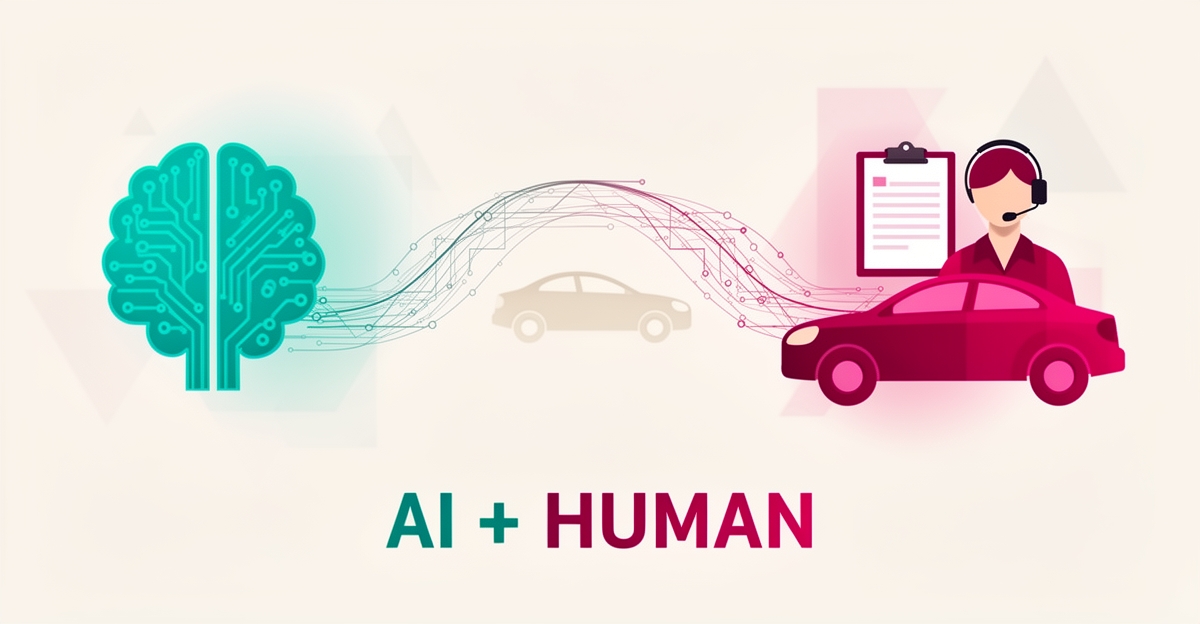
AI vs. Human Staff: Which Is Better for Managing Service Requests in an Auto Body Shop?
Key Facts
- AI adoption in auto repair has grown steadily, with a meaningful share of shops now using AI for intake, diagnostics, and scheduling according to industry research.
- AI-powered diagnostic tools typically improve assessment consistency by reducing human misdiagnosis and repeat checks per industry data.
- Shops using AI for routine tasks commonly report faster job completion and lower administrative overhead from market analysis.
- Clearer estimates and proactive updates are consistently linked to higher customer satisfaction in AI-assisted service flows according to the same research.
- The AI in auto repair market is projected to grow substantially through 2030 according to projections.
- AIQ Labs has deployed 200+ multi-agent systems and runs 4 live SaaS products daily—this is operational experience, not theory.
Hire a team member that works 24/7 — for less than a part-time wage.
AI receptionists, SDRs, dispatchers and 99+ roles. Trained on your business, fully managed.
Not sure where to start? Ask our AI planner
The Service Request Bottleneck in Auto Body Shops
Auto body shops face mounting pressure to handle service requests quickly and accurately, especially during peak hours. When relying solely on human staff, bottlenecks emerge that slow throughput, increase errors, and strain resources. Limited scalability during busy periods means customers wait longer for initial assessments, while inconsistent first-contact quality leads to misdiagnosis and rework. These delays not only frustrate customers but also drive up labor costs as shops struggle to keep pace with demand.
Human-only service request handling creates variability in how issues are identified and communicated, directly impacting diagnostic accuracy. Industry research on AI in auto repair shows that AI-assisted diagnostics typically reduce misdiagnosis by applying consistent pattern recognition to every assessment, highlighting the gap between unaided human judgment and data-driven precision. Without AI support, technicians often spend excess time on initial assessments, reducing the hours available for actual repairs. This inefficiency contributes to longer job completion times and higher operational costs, particularly when shops cannot scale staff quickly enough to match fluctuating workloads.
The financial strain of maintaining adequate human coverage intensifies during peak seasons. Labor expenses, including salaries, benefits, and training, represent a significant portion of shop overhead. AI-assisted intake and diagnostics typically lower repair costs by reducing misdiagnosis and minimizing wasted labor on incorrect assessments. Shops that fail to optimize their intake process risk losing revenue not only through inefficiency but also through diminished customer trust when estimates are inaccurate or delayed.
- Inconsistent first-contact quality leads to misdiagnosis and rework
- Limited scalability during peak hours increases customer wait times
- High labor costs reduce flexibility to adjust staffing with demand
- Variability in service request handling lowers overall throughput
Overcoming these bottlenecks requires more than just adding staff—it demands a smarter approach to managing the flow of service requests. By integrating AI Employees to handle routine intake, triage, and preliminary assessments, auto body shops can free human advisors to focus on complex cases and customer relationship building. This hybrid model improves consistency, reduces pressure on teams during busy periods, and creates a more predictable workflow from first contact to final repair. The result is a service request process that scales with demand, minimizes errors, and supports both operational efficiency and customer satisfaction.
What Research Shows About AI and Human Performance
Service requests are the first test of an auto body shop's efficiency, and the data shows AI is changing how that test is scored.
AI adoption in auto repair has grown steadily as shops look for ways to automate intake and diagnostics. Industry research shows shops using AI are not just experimenting—they are measuring gains in speed, cost, and accuracy across their service request flow.
Diagnostic accuracy is the clearest win. AI-assisted diagnostic tools typically reduce misdiagnosis by applying consistent pattern recognition to every vehicle assessment. Industry data attributes the lift to reduced human error and fewer repeat checks, freeing technicians to focus on complex repairs rather than re-verifying routine findings.
Efficiency gains follow accuracy. Shops using AI for routine tasks commonly report faster job completion times. Market analysis links the acceleration to optimized workflows, reduced technician downtime, and automated routine tasks in the service request flow.
Cost and satisfaction move together. By reducing misdiagnosis and wasted labor, AI-assisted processes typically lower repair costs for customers. The same research links AI-personalized service recommendations to higher customer satisfaction, as customers receive clearer estimates and proactive updates.
Human staff still provide strengths AI cannot replicate alone:
- Empathy and nuanced problem-solving for complex or emotional service requests
- Judgment in edge cases where data is incomplete or damage is non-standard
- Relationship building that drives repeat business and referrals
- Final validation and quality control on repairs
The comparison highlights a practical split. AI excels at scale, speed and consistency for routine intake, triage and diagnostics. Humans excel at complex diagnosis, customer reassurance and exception handling.
This is why a hybrid approach works best for service request handling, with AI employees managing routine requests while humans focus on complex cases. The model preserves throughput and team well-being while keeping the human touch where it matters most.
The Hybrid Model: AI for Routine, Humans for Complex
Auto body shops are rethinking how they manage service requests to balance speed, accuracy, and team well-being. With managed AI Employees—receptionists, dispatchers, schedulers, and 99+ other roles—shops can handle routine intake, triage, scheduling, and status updates 24/7, freeing technicians to focus on complex repairs and customer relationships. This model directly supports throughput gains without replacing staff, and typically runs at a fraction of the cost of a comparable human hire.
Industry research shows AI-assisted diagnostics reduce misdiagnosis, allowing technicians to spend less time on repeat checks and more on skilled work. Shops using AI for service request handling commonly report faster job completion, driven by optimized workflows and reduced technician downtime. Lower repair costs follow, partly due to fewer errors and more efficient parts usage.
- AI Employees manage initial customer contact, estimate requests, and appointment scheduling without fatigue or missed calls
- Human technicians focus on complex diagnostics, repair quality, and building customer trust
- The hybrid model reduces repetitive administrative work that contributes to staff burnout
- 24/7 AI availability ensures no service request goes unanswered, improving first-response times
- Teams report higher job satisfaction when AI handles routine tasks, enabling focus on higher-value work
By integrating AI Employees for routine service requests, auto body shops maintain human expertise where it matters most—while gaining measurable improvements in efficiency, cost control, and team morale. Ready to explore how this model fits your shop? Start the Fit Check at https://aiqlabs.ai/apply to assess your current workflows and identify high-ROI automation opportunities, then schedule a free 30-minute strategy call at https://aiqlabs.ai/book to map your path forward.
Implementation Roadmap for Auto Body Shops
Implementing AI for service requests works best through a phased, practical roadmap designed for real-world adoption. Start with AI-powered intake and diagnostic support to capture customer details and preliminary vehicle assessments, reducing manual entry errors and speeding up initial triage. According to industry research, AI-assisted diagnostics typically improve assessment consistency, directly supporting faster and more reliable service initiation.
Integrate the AI system with existing shop management tools such as scheduling, invoicing, and parts ordering platforms to create a seamless workflow. This enables automated updates, reduces duplicate data entry, and allows technicians to focus on repairs rather than administrative tasks. Train staff on human-in-the-loop escalation protocols so complex or ambiguous cases are smoothly transferred to experienced team members, maintaining service quality while leveraging AI for routine handling. If one workflow costs your shop the most—say, estimate intake or parts coordination—a targeted Workflow Build can rebuild it at a fixed price, phased in stages.
Measure success using key metrics like diagnostic accuracy, cycle time, and customer satisfaction. AI-assisted processes typically lower repair costs and speed up job completion. These gains compound when AI handles repetitive requests, freeing humans for high-value interactions that build trust and loyalty. Shops that want everything connected—intake, scheduling, estimating, parts, and customer updates in one layer—can move toward a full AI Operating System, built in phases and owned outright.
Choose a payment model that aligns with your shop's readiness and growth stage: Start Monthly for a low-risk entry with an AI Employee handling intake and diagnostics; Build in Milestones to phase in workflow integrations over time; or Own It Outright for full control of a custom AI operating system. Each approach includes build, training, tool integrations, monitoring, and ongoing improvements—ensuring the system evolves with your shop's needs.
By following this roadmap, auto body shops can achieve measurable efficiency gains without disrupting team dynamics or customer relationships. The goal isn't to replace human expertise but to augment it—letting AI manage the predictable so your staff can excel at what they do best: delivering expert, empathetic repairs that keep customers coming back.
Still paying for 10+ subscriptions that don’t talk to each other?
We build custom AI systems you own outright. No vendor lock-in. Full control.
Not sure where to start? Ask our AI planner
Frequently Asked Questions
How much can AI improve diagnostic accuracy in auto body shops?
Will using AI in my auto body shop reduce repair costs for customers?
Can AI help speed up job completion times in my shop?
What happens to my human staff if I add AI for service requests?
Is AI reliable enough to handle customer service requests 24/7 without errors?
How do I know if AI is right for my auto body shop's current workflow?
Where AI Meets Expertise in Auto Body Service
The picture is clear: auto body shops face real pressure from inconsistent service requests, rising labor costs, and scalability limits during peak times. AI-assisted diagnostics typically improve assessment consistency, while shops using AI commonly report faster job completion and lower repair costs—directly addressing the bottlenecks that slow throughput and frustrate customers. Yet the human touch remains irreplaceable for complex diagnostics, empathy, and building lasting relationships. The winning approach isn't choosing between AI and staff—it's combining them strategically. By letting AI handle routine intake, triage, and updates, shops free their teams to focus on skilled work and customer trust. This hybrid model creates a more predictable workflow, reduces burnout, and scales with demand without sacrificing quality. If you're ready to see how this balance works in your shop, start with the free two-minute Fit Check to assess your current workflow and uncover high-ROI automation opportunities. From there, schedule a no-obligation 30-minute strategy call to map your path forward—because the goal isn't just faster service, it's smarter, sustainable growth that keeps both your team and your customers coming back.
Make AI your competitive advantage — not just another tool.
Strategy, implementation and ongoing optimization. One partner, end to end.
Not sure where to start? Ask our AI planner