AI vs. Human Staffing: Which Is Better for 24/7 Biohazard Response Teams?
Key Facts
- AI employees handle intake and triage at machine scale, thousands of simultaneous alerts, where human capacity is a fraction of that
- AIQ Labs' managed AI staff typically run at roughly 80% less cost than an equivalent human hire
- Human fatigue on extended shifts is a well-documented driver of error in safety-critical work; AI systems don't fatigue
- AI performance degrades when context shifts mid-task, which is why human verification stays in the loop
- Data inaccuracy remains one of the most-cited concerns in AI adoption surveys, human oversight is the standard mitigation
- AIQ Labs has deployed 200+ multi-agent systems and runs 4 live SaaS products daily
Hire a team member that works 24/7 — for less than a part-time wage.
AI receptionists, SDRs, dispatchers and 99+ roles. Trained on your business, fully managed.
Not sure where to start? Ask our AI planner
The Critical Limitations of Pure Staffing Models in Biohazard Response
Relying on a single staffing model in 24/7 biohazard response creates dangerous blind spots. Human-only teams break under sustained pressure, while AI-only systems miss the nuance that keeps people safe.
Human teams face hard physiological limits. Extended shifts drive fatigue, which increases error rates when protocols must be followed precisely. Coverage also collapses outside business hours, leaving gaps in monitoring and triage, and in biohazard work, a gap is a liability.
Pure AI staffing introduces a different set of risks. AI can ingest and triage enormous volumes of reports in a day, far beyond human capacity, yet it struggles when context shifts. Research on large language models has repeatedly shown that performance degrades when instructions or conditions change mid-task. That drop matters when contamination patterns evolve hour by hour.
AI systems also lack genuine situational awareness. They don't know the goal behind a question or the stakes behind a decision, and they won't grasp unspoken constraints like politics or customer trust. In biohazard work, that means an AI can confidently push the wrong recommendation from incomplete field data, and the mistake scales instantly.
Data concerns compound the problem. Surveys of AI adopters consistently rank data inaccuracy and results errors among the top concerns. Without human verification, biased or thin inputs lead to flawed containment decisions.
Pure staffing models fail because they ignore complementary strengths:
- Humans fatigue, need breaks, and cannot sustain 24/7 coverage without degraded judgment
- AI cannot replicate empathy, moral reasoning, or creative problem-solving for novel exposures
- AI lacks accountability and can miss context that changes the right action
- Human-only teams cannot match AI speed and consistency in routine monitoring and triage
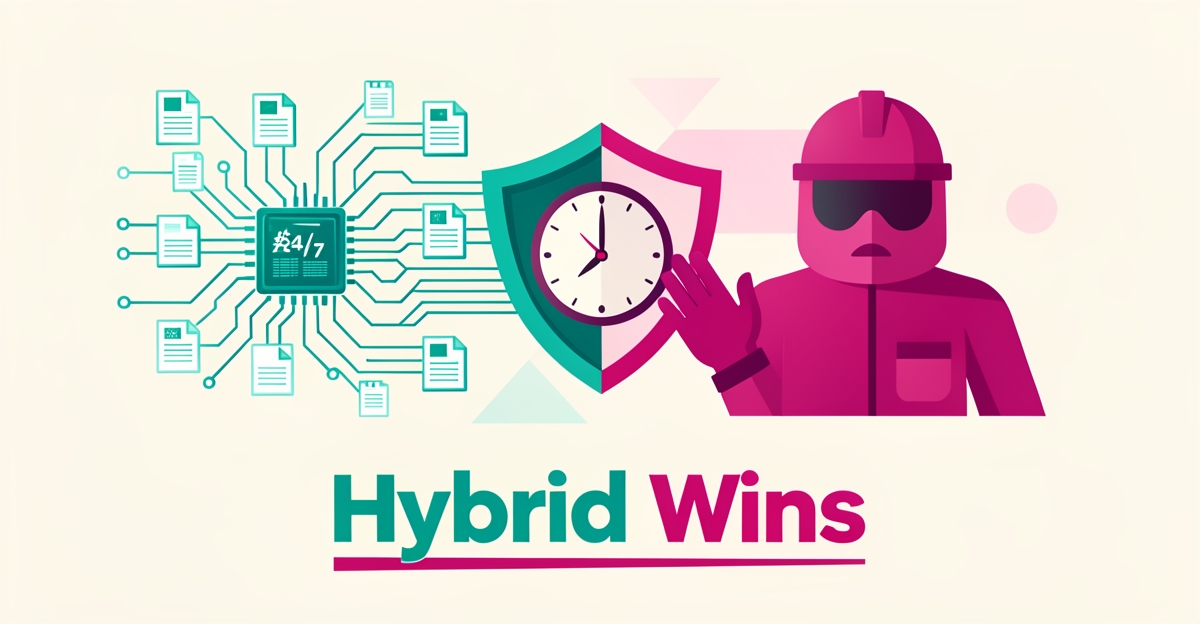
The evidence points to a hybrid design. AI handles initial triage, data analysis, pattern recognition, and routine monitoring while humans make critical on-site decisions and manage complex scenarios. AI brings momentum, and humans bring meaning.
AIQ Labs applies this principle through a hybrid model using [AI employees](/ai-employees) for triage and human experts for on-site decisions, ensuring safety without sacrificing speed. The approach aligns with how effective teams operate: humans define goals and constraints, AI produces a first pass, and humans verify and refine.
Why a Hybrid AI-Human Model Optimizes Safety and Speed
Biohazard response cannot afford the trade-off between speed and judgment. The most resilient teams pair machine-scale processing with human accountability, letting each handle what it does best under pressure.
AI employees excel at the relentless, data-heavy front end of a response. They turn environmental readings, contamination logs and spread models into actionable triage in seconds, at volumes no human team can match. That 24/7 availability eliminates fatigue-driven gaps and delivers consistent triage and pattern recognition across shifts.
Human experts remain essential where stakes, ambiguity and people intersect. Humans bring moral reasoning, situational empathy and on-site judgment that models cannot replicate. AI adoption is widespread across enterprises precisely because it accelerates routine work, but the same experience shows its limits when context shifts and values matter.
A hybrid model operationalizes this division of labor. AI handles first-pass assessment and continuous monitoring, while humans validate, decide and communicate. This loop preserves safety without sacrificing speed.
In practice, the hybrid workflow looks like:
- AI triage and data analysis: ingest sensor feeds, reports and alerts, flag anomalies and draft initial risk summaries
- Human decision and oversight: verify AI flags, authorize containment actions and adapt protocols to real-world conditions
- Collaborative escalation: AI routes complex or high-risk cases to human experts with full context and audit trails
This structure mirrors how AIQ Labs designs response teams, using managed AI employees for triage and human experts for on-site decisions. AI employees work 24/7/365 without interruption, while specialists provide the accountability and empathy required for life-safety calls.
Cost and scalability reinforce the case. AIQ Labs' managed AI staff typically run at roughly 80% less cost than an equivalent human hire, freeing budget for senior responders and specialized equipment. The model also scales instantly, supporting thousands of simultaneous alerts without slowing response.
The result is a system where speed and judgment reinforce each other. AI compresses time to first insight; humans ensure that insight is applied responsibly. For 24/7 biohazard response, that balance is not optional, it is the standard for safety.
Implementing AIQ Labs' Hybrid Model: From Audit to Scale
Knowing where to start is often the hardest part of adopting AI in a high-stakes operation like biohazard response. The good news: the path from pilot to production follows a repeatable sequence that any team can execute.
The first step is a workflow audit. Identify repetitive, high-volume tasks, initial call triage, intake documentation, routine monitoring, that follow clear rules and could benefit from automation. Then calculate your current costs, including salary, benefits, and overhead, so you have a real baseline to measure against. AIQ Labs' [Workflow Builds](/workflow-builds) are designed around exactly this: rebuild the one workflow that costs you the most, at a fixed price, in phases, so you see results before you scale.
Next, start small. Pilot a single AI employee in one function, typically triage, where speed and consistency matter most and clear protocols exist. AI's advantage here is real: it processes intake at machine scale, around the clock, without fatigue. That's exactly what a 24/7 response operation needs at the intake layer.
Once the pilot is live, measure relentlessly:
- Response time from first contact to triage completion
- Cost savings against your pre-pilot baseline
- Escalation accuracy, how often AI routes cases correctly to humans
- Customer satisfaction on AI-handled interactions
If the numbers hold, scale incrementally rather than all at once. Add AI coverage to adjacent workflows, dispatch coordination, scheduling, follow-up documentation, while keeping humans in the loop for everything that requires judgment. The AI-first, human-second model works because AI handles first-line interactions and routing while humans own complex cases that demand emotional intelligence and ethical judgment.
Guardrails are non-negotiable at this stage. Data inaccuracy and results errors remain among the most-cited concerns in AI adoption surveys, valid worries when a mistake scales its damage across every decision it touches. Effective implementations include monitoring, defined escalation paths, and human accountability for AI outputs.
This is the framework AIQ Labs follows with its hybrid model: AI employees for triage and routine monitoring, human experts for on-site decisions. For teams whose operations outgrow a single workflow, [AI Operating Systems](/ai-operating-systems) connect everything into one operating layer, built in phases and owned outright. Teams that audit, pilot, measure, and scale with proper oversight will get there first, and with fewer missteps.
Still paying for 10+ subscriptions that don’t talk to each other?
We build custom AI systems you own outright. No vendor lock-in. Full control.
Not sure where to start? Ask our AI planner
Frequently Asked Questions
Why can't we just use AI for 24/7 biohazard response instead of hiring human teams?
What are the real risks of relying only on human staff for round-the-clock biohazard monitoring?
How does a hybrid AI-human model actually work in practice for biohazard response?
Is the cost savings of AI employees real, or just marketing hype?
What happens when the AI makes a mistake in a high-stakes biohazard situation?
How do we get started without disrupting our current response operations?
Where AI Momentum Meets Human Meaning
The evidence is clear: neither pure human staffing nor pure AI staffing can meet the relentless demands of 24/7 biohazard response alone. Human teams fatigue and create dangerous blind spots during extended shifts, while AI systems, despite their machine-scale processing, lack the empathy, moral reasoning, and contextual judgment required for life-or-death decisions on the ground. The path forward isn't choosing between speed and judgment, it's designing a hybrid model where AI handles initial triage, data analysis, and routine monitoring, freeing human experts to focus on complex scenarios, on-site decisions, and the empathy that keeps people safe. AIQ Labs implements this exact approach, using managed AI employees for triage and human specialists for critical response, ensuring safety without sacrificing speed or scalability. If you're ready to explore how this model could strengthen your own high-stakes operations, start with a free [Fit Check](/apply) to identify your biggest automation opportunity, no obligation, just clarity on where AI can create real value for your team.
Make AI your competitive advantage — not just another tool.
Strategy, implementation and ongoing optimization. One partner, end to end.
Not sure where to start? Ask our AI planner