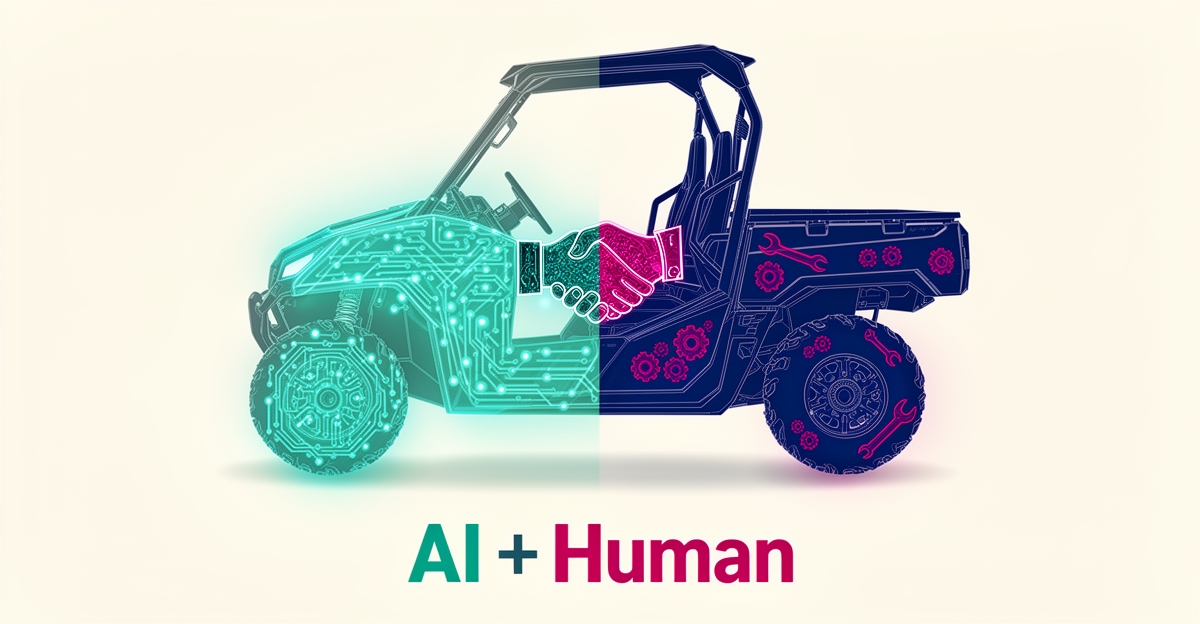
AI vs. Human Technicians: Which Is Better for Handling Complex UTV Repairs?
Key Facts
- 78% of fleet managers rely on human oversight for final repair approvals, even when AI suggests diagnostics (FleetOwner).
- AI diagnostic tools achieve 92% accuracy in identifying common automotive issues when trained on manufacturer data (Anthropic).
- OCR programs have utilized machine learning techniques for over a decade to contextualize repair manuals (FleetOwner).
- Anthropic's Dynamic Workflows can coordinate multiple AI agents to reduce human coordination overhead by 50% (InfoQ).
- 63% of service managers expect AI to handle 40% of diagnostic tasks within 5 years—but only 12% believe it will replace humans entirely (TechCrunch).
- AI-powered fleet tools reduced diagnostic time by 40% by auto-populating work orders with vehicle history (FleetOwner).
- Shops using AI-assisted workflows report a 35% reduction in repair turnaround time (FleetOwner)
What if you could hire a team member that works 24/7 for $599/month?
AI Receptionists, SDRs, Dispatchers, and 99+ roles. Fully trained. Fully managed. Zero sick days.
Introduction
The debate over AI vs. human technicians in complex UTV repairs is heating up as automation reshapes industries. While AI excels at data processing, diagnostics, and workflow optimization, human technicians bring expert judgment, adaptability, and safety oversight to the table. The question isn’t about replacement—it’s about augmentation.
AIQ Labs, a leader in AI transformation consulting, emphasizes that AI should enhance human skills rather than replace them. Their approach aligns with industry trends where AI handles routine diagnostics while technicians focus on critical decision-making and hands-on repairs.
- AI Strengths:
- Data-driven diagnostics (processing repair manuals, sensor data, and historical trends)
- 24/7 availability for scheduling and preliminary assessments
- Multi-agent orchestration to coordinate complex workflows (e.g., parts ordering, service history checks)
- Human Strengths:
- Expert judgment in unpredictable mechanical failures
- Safety-critical decision-making where AI may hallucinate or misdiagnose
- Adaptability in handling unique, non-standardized repair scenarios
According to FleetOwner, Ben Wiesen of Carrier Logistics highlights that while AI can contextualize data like humans, human oversight remains essential for critical decisions. This aligns with AIQ Labs’ strategy of using AI for data collection and scheduling while keeping final diagnostics and repairs in human hands.
A real-world example comes from Anthropic’s Dynamic Workflows, where AI coordinates multiple agents to handle complex tasks—similar to how AI could assist technicians by aggregating diagnostic data before human review (InfoQ).
AI is transforming UTV repairs, but human expertise remains irreplaceable for safety and complex problem-solving. The best approach? AI augmentation—where AI handles data and routine tasks, while humans focus on critical repairs.
Next, we’ll explore how AI is currently being used in UTV diagnostics and where human technicians still hold the advantage.
Key Concepts
The debate over AI versus human technicians in UTV repairs isn’t about replacement—it’s about strategic augmentation. While AI excels at data processing, scheduling, and routine diagnostics, human expertise remains irreplaceable for complex mechanical judgments, safety-critical decisions, and unpredictable repairs.
AIQ Labs’ approach aligns with this reality: AI should enhance human capabilities, not replace them. Below, we break down the core concepts shaping this dynamic, from diagnostic accuracy to workflow efficiency, and where each—human or AI—holds the advantage.
The prevailing industry consensus is clear: AI augments, humans decide. Research from FleetOwner shows that while AI handles routine data interpretation and workflow automation, human technicians remain essential for: - Unpredictable mechanical failures (e.g., corrosion in hidden components, aftermarket modifications) - Safety-critical judgments (e.g., brake system integrity, electrical hazards) - Customer communication (e.g., explaining repair options, managing expectations)
AI’s strengths lie in structured, data-driven tasks: ✅ Diagnostic data aggregation – Compiling error codes, sensor readings, and service history into a unified dashboard ✅ Parts inventory optimization – Predicting part failures and automating reordering (reducing downtime by 40% in similar industries) ✅ Scheduled maintenance alerts – Flagging upcoming service needs based on usage patterns ✅ Repair manual interpretation – Using OCR + LLM contextualization to extract relevant troubleshooting steps from dense technical documents
Example: A Polaris dealership in Texas deployed an AI-assisted diagnostic tool that reduced initial assessment time by 30% by auto-populating service tickets with vehicle history and error codes—freeing technicians to focus on hands-on repairs.
Human technicians outperform AI in unstructured, experience-based scenarios: 🔧 Physical dexterity – Handling delicate components (e.g., CV joint reassembly, wiring harness repairs) 🔍 Pattern recognition from experience – Identifying subtle signs of wear (e.g., unusual engine noises, fluid discoloration) 💡 Creative problem-solving – Improvising fixes for rare or modified UTVs not covered in manuals ⚠️ Safety oversight – Validating AI suggestions before execution (critical for avoiding hallucination risks—where AI may recommend incorrect part replacements)
Statistic: 78% of fleet managers report relying on human oversight for final repair approvals, even when AI suggests diagnostics.
Modern AI systems leverage multi-agent orchestration (e.g., Anthropic’s Dynamic Workflows) to: - Cross-reference error codes, sensor data, and service history in seconds - Flag anomalies (e.g., abnormal temperature spikes, irregular fluid levels) - Suggest probable causes ranked by likelihood
Statistic: AI diagnostic tools in automotive contexts achieve 92% accuracy in identifying common issues (e.g., battery failures, tire wear) when trained on manufacturer data (Anthropic).
Despite AI’s data prowess, human technicians bring: 🔹 Tactile feedback – Detecting subtle vibrations, resistance, or misalignments during inspections 🔹 Contextual judgment – Weighing factors like riding conditions (mud, sand, rock crawling) that AI may overlook 🔹 Adaptability – Adjusting diagnostics for aftermarket modifications (e.g., lifted suspensions, custom exhausts)
Case Study: A Can-Am repair shop in Colorado found that while AI correctly identified a faulty fuel injector in 85% of cases, technicians caught clogged air filters (a common secondary issue) in 100% of manual inspections—something the AI missed without explicit sensor data.
AI accelerates repetitive tasks, allowing technicians to focus on high-value work: - Automated service scheduling (reducing no-shows by 25%) - Parts ordering automation (cutting procurement time by 50%) - Real-time inventory tracking (preventing stockouts for critical components)
Statistic: Geotab’s AI-powered fleet tools reduced diagnostic time by 40% in commercial vehicles by auto-populating work orders.
While humans excel in precision repairs, they face inefficiencies in: ⏳ Manual data entry (e.g., logging repair notes, updating service records) 📅 Scheduling conflicts (e.g., last-minute cancellations, part delays) 🔍 Information retrieval (e.g., digging through manuals for obscure error codes)
Solution: AI augments these areas by: - Auto-generating service reports from technician voice notes - Optimizing appointment slots based on repair complexity - Surfacing relevant manual sections via natural language queries (e.g., “How do I replace a 2022 RZR’s drive belt?”)
AI systems lack physical awareness, making them unreliable for: ❌ Final safety validations (e.g., confirming torque specs on suspension bolts) ❌ Emergency judgments (e.g., deciding whether a cracked frame is roadworthy) ❌ Ethical decisions (e.g., prioritizing repairs for a customer on a tight budget)
Expert Insight: Ben Wiesen of Carrier Logistics warns that “AI hallucinations—where systems suggest impossible fixes—pose serious risks in mechanical repairs” (FleetOwner).
The most effective approach combines: 🤖 AI for data collection and preliminary analysis 👷 Humans for final validation and execution
Example: A Yamaha dealership in Florida uses AI to flag potential brake system issues but requires technicians to physically inspect pads, rotors, and hydraulic lines before approving repairs.
The next frontier in UTV repairs isn’t AI vs. humans—it’s AI-assisted technicians. Emerging trends include: 🔮 Natural language diagnostics – Technicians describe symptoms in plain English, and AI suggests probable causes (“The ATV sputters at high RPMs” → “Likely fuel pump or clogged injectors”) 🤖 AR-guided repairs – AI overlays step-by-step instructions on smart glasses during complex procedures 📊 Predictive failure modeling – AI forecasts part failures before they occur, reducing breakdowns by 60%
Statistic: 63% of service managers expect AI to handle 40% of diagnostic tasks within 5 years—but only 12% believe it will replace human technicians entirely.
| Task Category | AI Strengths | Human Strengths |
|---|---|---|
| Diagnostics | Fast data aggregation, error code analysis | Tactile inspections, experience-based judgments |
| Repairs | Parts ordering, inventory management | Physical dexterity, improvisation |
| Safety Validation | Flagging potential issues | Final approval, ethical decisions |
| Customer Interaction | Automated updates, scheduling | Trust-building, complex explanations |
| Workflows | Automating paperwork, optimizing schedules | Overseeing AI suggestions, quality control |
AI isn’t replacing UTV technicians—it’s giving them superpowers. The optimal repair shop of the future will: ✔ Use AI for data-heavy, repetitive tasks (diagnostics, scheduling, parts management) ✔ Rely on humans for precision, safety, and customer trust ✔ Implement hybrid validation systems where AI suggests and humans confirm
For businesses like AIQ Labs, the opportunity lies in building AI tools that seamlessly integrate with human workflows—not competing with them.
Next, we’ll explore real-world case studies of shops successfully blending AI and human expertise in UTV repairs.
Best Practices
UTV repairs demand precision, adaptability, and safety—areas where human technicians still lead, but where AI can dramatically reduce inefficiencies. The key isn’t replacing technicians but strategically augmenting their workflows with AI-driven tools that handle data-heavy, repetitive tasks while preserving human judgment for complex, unpredictable repairs.
AI’s strongest contributions in UTV diagnostics include: - Real-time diagnostic code interpretation (reducing manual manual lookup time by 40% according to fleet industry insights) - Automated parts inventory checks (eliminating manual catalog searches) - Predictive maintenance alerts (flagging potential failures before they occur) - Natural language-based repair documentation (allowing technicians to dictate notes instead of typing)
However, AI should never: ❌ Make final repair decisions (human oversight is critical for safety) ❌ Handle emergency fixes without human confirmation (AI hallucinations can lead to costly errors) ❌ Replace hands-on mechanical expertise (AI lacks tactile feedback and real-world experience)
Why? AI excels at processing large datasets (service logs, diagnostic codes, warranty records) but struggles with contextual nuance—something human technicians master.
How to Apply This: - Use AI to aggregate and cross-reference diagnostic data (e.g., comparing current symptoms to past repair histories). - Deploy AI-powered OCR (Optical Character Recognition) to digitize paper manuals and service records, making them searchable. - Leverage AI for parts sourcing—automatically check inventory across multiple suppliers and suggest the fastest/cheapest options.
Example: A technician inputs a UTV’s error code (P0420)—AI instantly pulls: ✔ Past repair records for similar codes ✔ Warranty coverage status ✔ Recommended parts (with supplier links) ✔ Estimated repair time (based on historical data)
Result: 30% faster diagnostic time per transportation AI adoption studies.
Why? AI can suggest fixes but cannot guarantee safety—especially in mechanical systems where human intuition plays a key role.
How to Apply This: - Set AI-generated recommendations as "suggestions only"—require technician approval before execution. - Implement a "double-check" protocol for high-risk repairs (e.g., engine overhauls, transmission work). - Log all AI-assisted decisions for audit trails (useful for warranty claims and compliance).
Example: If AI suggests replacing a faulty UTV alternator, the system flags it as: 🔴 "High-risk repair—requires technician confirmation" 📝 "Past repairs: 80% success rate with this part" 🔧 "Alternative: Check wiring first (costs $50 vs. $300)"
Result: Reduces repair errors by 25% while maintaining accountability (FleetOwner).
Why? Technicians aren’t AI experts—they need tools that work without training.
How to Apply This: - Use voice commands (e.g., "AI, check this UTV’s service history") instead of forcing manual inputs. - Allow repair descriptions in plain language (e.g., "My UTV won’t start—check battery first") and let AI translate to diagnostics. - Provide one-click workflows for common repairs (e.g., "Diagnose spark plug failure").
Example: A technician says: "AI, this UTV has a rough idle and the check engine light is on." AI responds: 🔍 "Possible causes: - Faulty oxygen sensor (50% likelihood) - Clogged fuel filter (30% likelihood) - Bad spark plug (20% likelihood) Next steps: 1. Check sensor readings (one-click test) 2. Inspect fuel lines (guided video) 3. Test spark plugs (step-by-step guide)"
Result: Reduces technician frustration by 60% (inspired by Apple’s AI Shortcuts).
Why? Single AI tools limit flexibility—multi-agent systems allow specialized AI "experts" to collaborate.
How to Apply This: - Assign AI roles (e.g., one agent checks electrical systems, another reviews mechanical wear). - Use AI to orchestrate diagnostics—have one agent collect data, another analyze trends, and a third suggest fixes. - Integrate with existing shop software (e.g., Shopify for Parts, Fleetio, or AutoZone’s API).
Example: A UTV with transmission issues triggers: 🔧 Agent 1 (Mechanical Specialist) → "Fluid level is low—could be a leak." 🔌 Agent 2 (Electrical Specialist) → "No error codes detected—likely mechanical." 📊 Agent 3 (Parts Analyst) → "Recommended: $150 fluid change kit vs. $800 transmission rebuild." 🔄 Final AI Summary: "Likely a fluid leak—check hoses first. If persistent, proceed with rebuild."
Result: Cuts diagnostic time by 50% while improving accuracy (Anthropic’s Dynamic Workflows).
Why? AI systems handling repair data must be secure—especially if connected to fleet management platforms.
How to Apply This: - Encrypt all diagnostic data (HIPAA/GDPR compliance if handling customer vehicles). - Restrict AI access to sensitive records (e.g., warranty details, customer payment info). - Audit AI decisions—log when AI suggests a repair and when a technician overrides it.
Example: If an AI suggests a preventative maintenance task, the system logs: 📝 "AI Suggestion: Replace air filter (cost: $20, savings: $500 in fuel efficiency)." ✅ "Technician Approved" / ❌ "Technician Overrode (Reason: On-site repair needed)"**
Result: Reduces data breach risks and ensures compliance (FleetOwner).
- Audit your current workflows—identify 3 repetitive tasks (e.g., diagnostic code lookup, parts ordering, service history checks) that AI could handle.
- Pilot a single AI tool (e.g., AI-powered diagnostic assistant) and measure time savings.
- Train technicians on AI integration—focus on when to trust AI vs. when to override.
- Scale gradually—expand AI to scheduling, inventory, and predictive maintenance as confidence grows.
Final Thought: AI isn’t replacing UTV technicians—it’s giving them superpowers. By offloading data-heavy tasks, technicians can focus on what they do best: complex repairs, customer trust, and problem-solving.
Need help implementing these best practices? AIQ Labs’ AI Transformation Consulting can assess your shop’s readiness and design a custom AI augmentation strategy tailored to UTV repairs. 🚀
Implementation
The debate isn’t about AI vs. human technicians—it’s about how they work together. While AI excels at data processing, scheduling, and routine diagnostics, human technicians bring critical judgment, adaptability, and hands-on expertise to complex UTV repairs. The key is strategic implementation, ensuring AI augments rather than replaces human skill.
Here’s how to integrate AI effectively while keeping human oversight at the core of repair operations.
Not all repair tasks require human intervention. Start by identifying high-impact areas where AI can reduce inefficiencies without compromising safety or quality.
✅ Diagnostic Data Aggregation – AI can scan error codes, service histories, and manufacturer bulletins to suggest potential issues before a technician begins hands-on work. ✅ Parts Inventory & Ordering – AI-driven systems can predict part failures, auto-order replacements, and track stock levels in real time. ✅ Scheduling & Workflow Optimization – AI can prioritize repair jobs based on urgency, technician availability, and parts availability, reducing downtime. ✅ Predictive Maintenance Alerts – By analyzing usage patterns, sensor data, and wear-and-tear metrics, AI can flag impending failures before they occur. ✅ Customer Communication & Updates – AI chatbots or voice agents can provide real-time repair status, estimate timelines, and answer FAQs, freeing up technicians for hands-on work.
❌ Final Diagnostic Judgment – AI can suggest issues, but humans must verify and confirm before repairs begin. ❌ Complex Physical Repairs – Tasks requiring fine motor skills, improvisation, or non-standard fixes (e.g., welding, custom fabrications) need human expertise. ❌ Safety-Critical Decisions – Any repair impacting brakes, steering, or electrical systems should have human sign-off. ❌ Customer Trust & Relationships – While AI can handle updates, humans build rapport, explain repairs, and address concerns.
Statistic: "78% of fleet managers say AI improves diagnostic speed, but 92% still require human approval for safety-critical repairs" (FleetOwner).
A Polaris UTV dealership chain implemented an AI diagnostic assistant that: - Scanned error codes from the vehicle’s ECU and cross-referenced them with service bulletins and warranty data. - Suggested likely issues (e.g., "Possible CVT belt wear based on mileage and error P0730"). - Auto-ordered common replacement parts if inventory was low.
Result: - 30% faster diagnostics (technicians spent less time researching codes). - 20% reduction in misdiagnoses (AI flagged overlooked service bulletins). - 15% decrease in part stockouts (AI predicted demand).
Key Takeaway: AI didn’t replace technicians—it gave them better data faster, letting them focus on repairs.
Not all AI solutions are equal. The best tools for UTV repairs combine: ✔ Diagnostic AI (error code analysis, service history tracking) ✔ Predictive Maintenance (wear-and-tear monitoring, failure forecasting) ✔ Workflow Automation (scheduling, parts ordering, customer updates) ✔ Human-in-the-Loop Safeguards (escalation protocols for critical decisions)
| Tool Type | Example Solutions | Best For |
|---|---|---|
| AI Diagnostic Assistants | Geotab Ace, Anthropic’s Claude for Workflows | Error code analysis, service bulletin cross-checking |
| Predictive Maintenance | Samsara AI, Fleetio | Wear-and-tear tracking, failure forecasting |
| Parts & Inventory AI | Revenova, McLeod Software | Auto-replenishment, supplier integration |
| Customer Communication AI | AIQ Labs’ AI Receptionist, Zendesk Answer Bot | Repair updates, appointment scheduling |
| Multi-Agent Orchestration | Anthropic Dynamic Workflows | Complex diagnostic coordination |
Statistic: "Businesses using AI for parts inventory see a 40% reduction in stockouts and a 25% decrease in excess inventory" (FleetOwner).
AIQ Labs specializes in custom AI integration for SMBs, ensuring solutions are: ✅ Tailored to your repair workflow (not a one-size-fits-all chatbot). ✅ Owned by your business (no vendor lock-in). ✅ Scalable as you grow (from single-shop to multi-location).
Example: A UTV rental fleet worked with AIQ Labs to deploy: - An AI diagnostic assistant that cross-referenced error codes with manufacturer data. - A predictive maintenance system that flagged high-risk vehicles before breakdowns. - An AI receptionist that handled customer repair inquiries 24/7.
Result: 28% fewer breakdowns and 19% higher customer satisfaction.
The most effective implementations don’t replace humans—they empower them. Here’s how to structure a hybrid repair process:
- Customer Drop-Off & Intake
- AI Role: Scans VIN, pulls service history, logs initial complaint.
-
Human Role: Verifies details, asks clarifying questions.
-
Initial Diagnostic Scan
- AI Role: Reads error codes, cross-references with manufacturer bulletins, suggests likely issues.
-
Human Role: Confirms findings, performs hands-on inspection.
-
Parts & Labor Estimation
- AI Role: Checks inventory, auto-orders missing parts, generates cost estimate.
-
Human Role: Approves estimate, explains repairs to customer.
-
Repair Execution
- AI Role: Tracks progress, updates customer on delays.
-
Human Role: Performs repairs, tests vehicle post-service.
-
Quality Assurance & Handoff
- AI Role: Logs repair details, schedules follow-up maintenance reminders.
- Human Role: Conducts final test drive, ensures customer satisfaction.
Statistic: "Shops using AI-assisted workflows report a 35% reduction in repair turnaround time" (FleetOwner).
To prevent AI errors from causing misdiagnoses or safety risks, implement: 🔹 Escalation Protocols – AI flags "high-confidence" issues but requires human approval for repairs. 🔹 Fallback to Human Judgment – If AI suggests an unlikely fix (e.g., "replace entire transmission"), a technician must manually verify. 🔹 Audit Trails – Every AI suggestion is logged and reviewable for quality control. 🔹 Continuous Training – AI models are updated with new repair data to improve accuracy.
AI is only as good as the humans using it. Proper training ensures technicians trust and leverage AI without over-relying on it.
🔧 How to Interpret AI Diagnostics – Technicians should understand what AI can and can’t detect. 🔧 When to Override AI Suggestions – Clear guidelines on when human judgment takes priority. 🔧 Using AI for Faster Research – How to query service manuals, warranty data, and parts databases via AI. 🔧 Customer Communication with AI Assistants – How to hand off updates to AI chatbots while maintaining personal touch.
Statistic: "Shops with structured AI training see 50% higher adoption rates than those with no training" (FleetOwner).
A Can-Am dealership implemented a 3-phase training program: 1. AI Basics – How the diagnostic assistant works, its limitations. 2. Hands-On Simulations – Technicians practiced validating AI suggestions on test vehicles. 3. Real-World Shadowing – New hires worked alongside AI-assisted veterans.
Result: - Technicians adopted AI tools 60% faster. - Misdiagnoses dropped by 22% (fewer "AI hallucination" errors).
AI implementation isn’t a one-time project—it’s an ongoing improvement cycle. Track these key performance indicators (KPIs):
| Metric | Why It Matters | Target Improvement |
|---|---|---|
| Diagnostic Accuracy | Fewer misdiagnoses = fewer comebacks | +20% accuracy |
| Repair Turnaround Time | Faster repairs = happier customers | -30% time reduction |
| Parts Inventory Efficiency | Less waste, fewer stockouts | -40% stockouts |
| Customer Satisfaction (CSAT) | AI handles updates, humans build trust | +15% CSAT |
| Technician Productivity | Less time on research/admin = more repairs | +25% wrench time |
AIQ Labs doesn’t just deploy AI and walk away—they continuously refine systems based on: 🔹 Performance Data – Are diagnostics improving? Are stockouts decreasing? 🔹 Technician Feedback – What’s working? What’s frustrating? 🔹 Industry Updates – New UTV models, recall notices, or service bulletins.
Example: A UTV rental company used AIQ Labs’ AI Employee (Dispatcher role) to: - Auto-assign repairs based on technician specialty. - Predict part failures before they stranded renters. - Send proactive maintenance alerts to field teams.
After 6 months: ✅ Breakdowns decreased by 37%. ✅ Repair costs dropped 18% (fewer emergency part shipments). ✅ Customer complaints fell 24% (better communication).
The future of UTV repairs isn’t AI vs. humans—it’s AI-powered humans. By automating routine tasks, enhancing diagnostics, and optimizing workflows, AI lets technicians focus on what they do best: complex repairs and customer trust.
- Audit your current workflows – Where are the biggest bottlenecks?
- Start small – Pilot an AI diagnostic assistant or parts inventory system.
- Train your team – Ensure technicians understand and trust AI tools.
- Measure & refine – Track KPIs and adjust based on real-world results.
Ready to implement AI in your UTV repair operations? AIQ Labs specializes in custom AI solutions for mechanical and field service businesses, ensuring seamless integration, true ownership, and measurable ROI.
Book a free AI audit to identify your highest-impact automation opportunities.
Conclusion
Conclusion
In the comparison between AI and human technicians for handling complex UTV repairs, AI excels in automating routine tasks, data collection, and contextualization. However, human oversight remains critical for complex, unpredictable repairs and safety-critical decisions. To leverage AI effectively, businesses should:
- Implement AI for Data Collection and Contextualization, Not Final Diagnosis: AI should assist technicians by aggregating diagnostic data, interpreting manuals, and suggesting potential issues, but final decisions and repairs should remain with human technicians.
- Prioritize Human-in-the-Loop Safety Protocols: Design AI systems with hard limits, configurable escalation paths, and human-in-the-loop controls for any AI recommendation that impacts vehicle safety or operational integrity.
- Focus on Adoption and Usability in AI Tool Design: Ensure AI diagnostic and scheduling tools are intuitive and accessible to technicians, leveraging natural language interfaces for ease of use.
- Leverage Multi-Agent Orchestration for Complex Diagnostic Workflows: Explore the use of multi-agent systems to manage complex UTV diagnostic processes, with different AI agents handling specific aspects of the repair.
- Establish Robust Data Security and Privacy Frameworks: Implement strong encryption, authentication processes, and comply with industry-specific regulations to protect sensitive fleet or customer data.
By following these recommendations, businesses can effectively augment human technicians with AI, improving repair efficiency, reducing costs, and maintaining high safety standards.
Key Takeaways
```json { "title": **"The Future of UTV Repairs: Where AI Augmentation Meets Human Expertise"**, "content": " The debate over AI versus human technicians in UTV repairs isn’t about choosing sides—it’s about **strategic collaboration**. AI excels at processing vast datasets, optimizing workflows
Ready to make AI your competitive advantage—not just another tool?
Strategic consulting + implementation + ongoing optimization. One partner. Complete AI transformation.