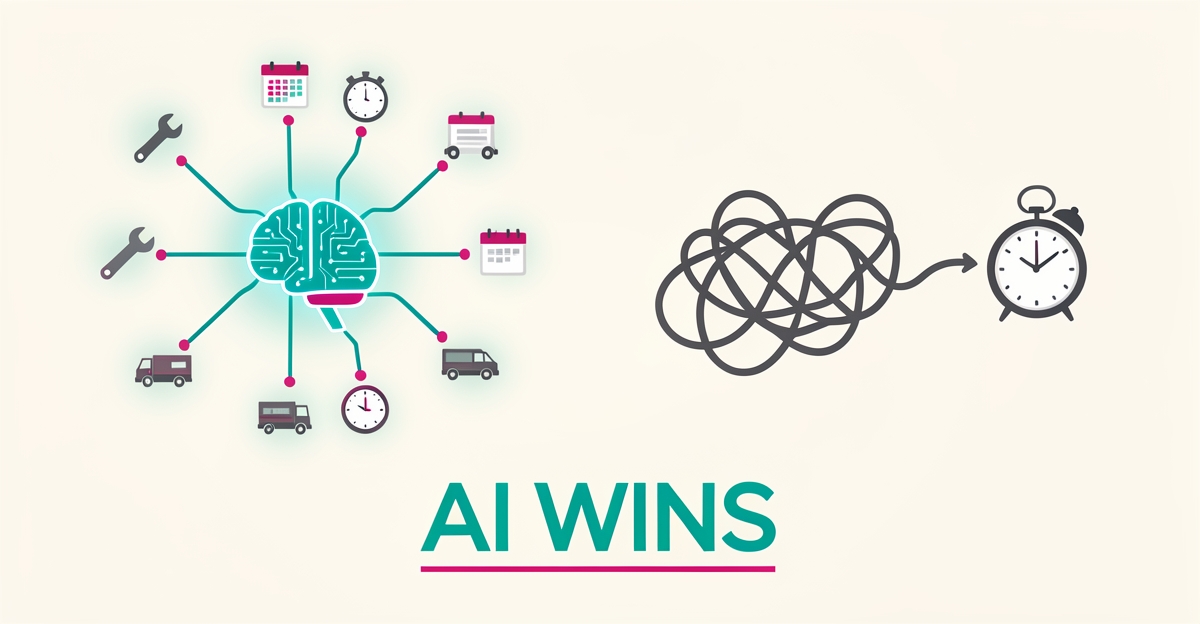
AI vs. Human Technicians: Which Is Better for Managing Repair Scheduling?
Key Facts
- Traditional maintenance scheduling often averages around 48-hour response times for non-emergency repairs according to industry analysis
- AI-driven predictive maintenance has been credited with maintenance cost reductions of up to 40% in widely cited industry research according to maintenance software analysis
- AI-powered scheduling has been associated with production downtime reductions of roughly 30% according to industry reporting
- AI-driven maintenance scheduling has been linked to downtime reductions of up to 50% in some deployments according to industry findings
- AI-powered scheduling is frequently reported to improve resource utilization by 30–40% according to maintenance software research
- Industry data suggests AI scheduling can improve maintenance labor productivity by around 31% according to industry analysis
- AI-driven predictive maintenance has been associated with roughly 20% fewer unplanned outages according to automation research
Hire a team member that works 24/7 — for less than a part-time wage.
AI receptionists, SDRs, dispatchers and 99+ roles. Trained on your business, fully managed.
Not sure where to start? Ask our AI planner
The Hidden Cost of Human-Led Scheduling in High-Volume Repair Operations
In high-volume repair operations, human-led scheduling struggles to keep pace with demand spikes and complex routing needs, leading to costly inefficiencies. Manual systems often result in delayed responses, with traditional maintenance scheduling averaging around 48-hour response times for non-emergency repairs and short windows for emergencies, according to industry analysis. These delays directly increase equipment downtime and reduce technician productivity, especially when unexpected failures occur or workloads fluctuate unpredictably.
The limitations of human-driven scheduling become even more pronounced under pressure, where error rates rise and scalability hits a hard ceiling. Without real-time data integration or predictive capabilities, dispatchers rely on static schedules and reactive adjustments, which can lead to inefficient routing, overlapping assignments, or missed service windows. Industry research suggests AI-powered scheduling can reduce production downtime by roughly 30% and improve resource utilization by 30–40%, highlighting the performance gap when human operators manage complex repair logistics without automation support.
- Increased labor costs from overtime and idle time due to poor schedule alignment
- Higher rates of repeat visits caused by incorrect parts allocation or misdiagnosed issues
- Lost revenue opportunities when technicians are unavailable during peak demand periods
- Inconsistent customer communication leading to lower satisfaction and retention
- Difficulty scaling operations without proportional increases in supervisory staff
These hidden costs accumulate quickly in field service environments, eroding profitability and limiting growth potential. AIQ Labs addresses these challenges through AI Workflow Builds that rebuild the scheduling process that costs you the most—optimizing technician routing, balancing workloads dynamically, and adapting to changing conditions in real time, turning scheduling from a liability into a strategic advantage.
How AI-Driven Scheduling Outperforms Humans in Predictive Optimization and Real-Time Adaptation
AI-powered scheduling transforms repair operations by anticipating failures before they occur and dynamically adjusting to changing conditions in real time. Unlike human technicians who rely on fixed schedules and reactive responses, AI systems analyze continuous streams of equipment data to predict maintenance needs with precision, significantly reducing unplanned downtime and optimizing resource allocation.
Widely cited industry research suggests predictive maintenance driven by AI can decrease maintenance costs by up to 40% and reduce downtime by as much as 50% in some deployments. These systems have been associated with maintenance labor productivity gains of roughly 31% through intelligent task prioritization, and they eliminate the inefficiencies of manual scheduling that often result in delayed responses and overlapping work orders.
- Real-time data analysis enables AI to adjust schedules instantly when equipment shows early failure signs
- Predictive failure modeling anticipates issues before they cause breakdowns, extending asset life
- Dynamic route optimization minimizes travel time between jobs, increasing technician utilization
- Continuous learning from historical data improves prediction accuracy over time
- Scalable automation handles volume spikes without additional hiring or overtime costs
AIQ Labs builds these capabilities into custom dispatch and scheduling systems for field service businesses, with 200+ multi-agent systems deployed and four live SaaS products the company runs daily. By replacing guesswork with data-driven foresight, AI-driven scheduling ensures repairs happen when and where they're needed most—maximizing uptime while minimizing waste. This level of predictive optimization and real-time adaptation is difficult for human-led processes to match at scale, especially as repair volumes grow and equipment complexity increases.
From Pilot to Performance: Implementing AI Scheduling in Phases
Starting small with targeted workflow builds or AI Employees like dispatchers lets businesses test AI scheduling benefits without overhauling entire operations. This phased approach reduces risk while building confidence in the technology's ability to handle volume spikes and optimize technician routes. AIQ Labs offers three entry points, each with a payment model that matches your commitment level: Start Monthly, Build in Milestones, or Own It Outright.
The first entry point, AI Workflow Builds, focuses on rebuilding the one workflow that costs the most—like repair scheduling—at a fixed price, delivered in phases. A workflow build targets a single critical process, eliminating manual bottlenecks and creating a single source of truth. When you build in milestones, you see working results at each phase before committing further, and you own the system outright with no vendor lock-in.
The second entry point is AI Employees—managed AI staff that perform real job tasks like dispatching, appointment setting, or lead qualification, across 99+ roles. An AI Dispatcher works around the clock, integrates with your scheduling software and CRMs, and continuously learns from performance data. Compared to a human hire in an equivalent role, an AI Employee typically costs around 80% less while providing 24/7 availability. Starting monthly keeps the risk low, so you can prove the concept before scaling.
The third entry point, AI Operating Systems, connects scheduling, dispatch, customer communication, and reporting into one operating layer—built in phases and owned outright. This is the path for businesses that want scheduling improvements to compound across the whole operation rather than live in a single tool. To explore which entry point fits your repair operation, start with the 2-minute Fit Check, then book a free 30-minute strategy call to map your biggest bottleneck and identify high-ROI opportunities. You can reach the team any time at [email protected].
Still paying for 10+ subscriptions that don’t talk to each other?
We build custom AI systems you own outright. No vendor lock-in. Full control.
Not sure where to start? Ask our AI planner
Frequently Asked Questions
How much downtime can AI-powered scheduling actually reduce compared to human-led scheduling?
Is AI scheduling really more cost-effective than hiring additional human technicians for dispatching?
What specific inefficiencies does human-led scheduling cause in high-volume repair operations?
Can AI scheduling adapt to real-time changes like sudden equipment failures or workload spikes?
Will my team resist switching to AI scheduling, and how can we manage that change effectively?
Do I need to replace my existing CRM or work order system to use AI scheduling?
Turn Scheduling Chaos into a Competitive Advantage
The pattern is clear: human-led scheduling in high-volume repair operations creates hidden costs through delayed responses, inefficient routing, and scalability limits that erode profitability. AI-driven scheduling turns this liability into a strategic advantage by predicting failures, optimizing routes in real time, and adapting dynamically to workload changes—with industry research pointing to downtime reductions of up to 50% and utilization gains of 30–40%. AIQ Labs helps field service businesses make this shift through three entry points—AI Workflow Builds, AI Employees like dispatchers, and full AI Operating Systems—with payment models that match your commitment: Start Monthly, Build in Milestones, or Own It Outright. If you're ready to eliminate scheduling bottlenecks, take the 2-minute Fit Check and book a free 30-minute strategy call to map your biggest repair scheduling challenge.
Make AI your competitive advantage — not just another tool.
Strategy, implementation and ongoing optimization. One partner, end to end.
Not sure where to start? Ask our AI planner