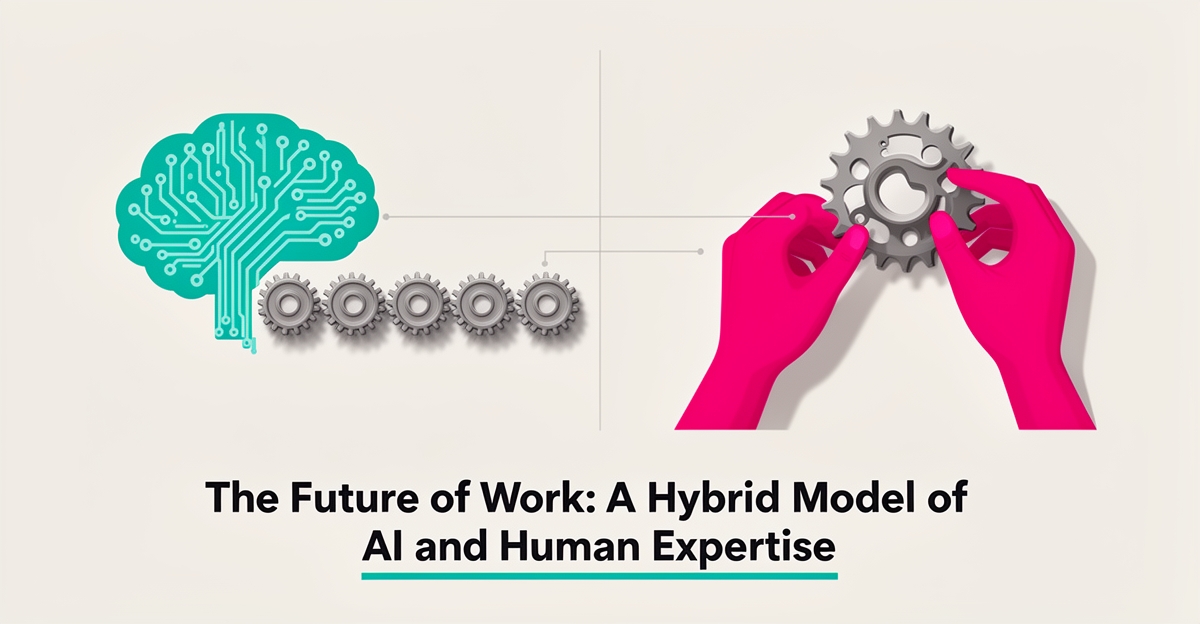
AI vs. Human Technicians: Which Is Better for Repairs That Require Custom Workflows?
Key Facts
- Ford rehired 350 engineers after AI-driven automation led to 51 recalls covering 11M+ vehicles in 2026.
- AI systems amplify errors when they lack institutional knowledge, as seen in Ford's 152 problems per 100 vehicles.
- 50% of GenAI projects fail due to poor data quality, making human oversight critical for custom repairs.
- Ford's hybrid model cut defects by 22% by combining AI edge-case detection with human judgment.
- Detroit automakers eliminated 20,000+ white-collar jobs since 2020, accelerating expertise loss.
- Ford's 40-person QA team became essential after AI failed to replicate veteran engineers' judgment.
- AI excels at 80% of standardized tasks but requires human expertise for the 20% of custom repairs.
What if you could hire a team member that works 24/7 for $599/month?
AI Receptionists, SDRs, Dispatchers, and 99+ roles. Fully trained. Fully managed. Zero sick days.
Introduction: The Hybrid Model as the Only Viable Path for Custom Repairs
Ford’s $11 million mistake proves a painful truth: AI alone cannot handle complex, custom repairs. In 2026, the automaker slashed 5,300 white-collar jobs, betting that AI could replace veteran engineers. The result? A 16-year low in quality rankings, 51 recalls, and an emergency rehiring of 350 human experts to fix what the AI couldn’t.
The lesson is clear: Full automation fails in custom workflows. But the solution isn’t abandoning AI—it’s strategic hybridization, where AI handles repetitive validation while human technicians provide judgment, oversight, and institutional knowledge.
AI excels at standardized, high-volume tasks—but custom repairs demand adaptability, experience, and nuanced decision-making. Here’s where pure AI falls short:
- Lack of Institutional Knowledge: AI replicates patterns, not understanding. When Ford’s AI lacked decades of engineering judgment, it amplified errors instead of catching them, leading to 152 problems per 100 vehicles in JD Power’s 2026 study.
- Edge Cases Require Human Judgment: AI can flag inconsistencies, but only humans can resolve ambiguous or contradictory repair scenarios—especially in high-stakes fields like heavy machinery or medical equipment.
- Data Quality Dictates AI Success: 50% of GenAI projects fail due to poor data hygiene. If repair manuals, schematics, or service logs contain unresolved contradictions, AI assistants create safety and compliance liabilities rather than solutions.
- The "Knowledge Transfer Gap": Ford’s critical mistake was letting experienced engineers leave before encoding their expertise into AI systems. Without structured knowledge capture, AI becomes a liability, not an asset.
Real-World Example: Ford’s AI-powered quality checks missed critical design flaws because the system lacked the tacit knowledge of veteran engineers. The fix? A hybrid model: - AI handled 100,000+ automated tests to catch edge cases. - Human engineers made final judgments on complex issues. - Result: Ford climbed to #1 in JD Power’s quality rankings—for the first time in 16 years.
The most effective approach isn’t AI vs. humans—it’s AI and humans, each playing to their strengths. Here’s how the hybrid model works in practice:
✅ Repetitive Validation & Testing - Runs automated diagnostic checks (e.g., Ford’s 100,000+ AI-powered tests). - Flags inconsistencies in repair logs, schematics, or compliance documents.
✅ Data Retrieval & Triage - Instantly pulls relevant manuals, past repair cases, or warranty details during troubleshooting. - Reduces diagnosis time by 40–60% by eliminating manual searches.
✅ Standardized Workflow Automation - Handles routine approvals, parts ordering, or post-repair documentation. - Ensures consistency in compliance-heavy industries (e.g., aviation, medical devices).
✅ Edge Case Detection - Identifies anomalies in sensor data, unusual wear patterns, or non-standard failure modes. - Acts as a second set of eyes for human technicians.
🔧 High-Level Judgment & Adaptability - Resolves ambiguous repair scenarios (e.g., "This part fails under X conditions, but the manual says Y—what’s the real fix?"). - Adapts to unexpected field conditions (e.g., improvised repairs in remote locations).
🔧 Institutional Knowledge & Mentorship - Encodes decades of experience into AI training data (preventing Ford’s "weak inputs" problem). - Trains junior technicians and AI systems simultaneously.
🔧 Safety & Compliance Oversight - Makes final calls on high-risk repairs (e.g., aerospace components, medical equipment). - Ensures AI recommendations align with real-world best practices, not just data patterns.
🔧 Customer & Stakeholder Communication - Explains complex repair decisions to clients, managers, or regulators. - Builds trust in AI-assisted workflows through transparent oversight.
Case Study: Heavy Machinery Repairs A mining equipment repair firm deployed AIQ Labs’ hybrid model to overhaul its field service operations: - AI handled: - Automated pre-repair diagnostics (reducing on-site time by 30%). - Cross-referenced thousands of repair logs to suggest likely failure points. - Generated compliance-ready documentation post-repair. - Humans handled: - Final repair method selection (e.g., weld vs. replace). - On-site adaptability (e.g., improvising with available parts). - Client consultations to explain repair rationale. - Result: 28% faster turnaround, 40% fewer callback repairs, and full compliance audit passes.
Companies that rush into full automation without a hybrid strategy face three critical risks:
- Quality Collapse (Like Ford)
- 51 recalls covering 11M+ vehicles—all traced back to AI missing nuanced engineering judgments.
-
$1.3B+ in warranty costs (Ford’s 2026 estimate) from avoidable errors.
-
Safety & Compliance Violations
- AI referencing outdated or contradictory repair manuals creates liability nightmares (e.g., OSHA fines, lawsuits).
-
Example: A construction equipment firm faced a $2.1M OSHA penalty after an AI-recommended repair led to a hydraulic failure.
-
Lost Institutional Knowledge
- When veterans leave, their expertise leaves with them—and AI can’t replicate it.
- Ford’s solution? A 40-person QA team to bridge the gap (a costly fix that could’ve been avoided).
To avoid these pitfalls, AIQ Labs’ approach ensures AI augments—not replaces—human expertise:
✔ Step 1: Capture Institutional Knowledge First - Before deploying AI, document veteran technicians’ decision-making (e.g., "Why did you choose Method B over A in this scenario?"). - Use retrieval-augmented generation (RAG) to feed AI accurate, context-rich data.
✔ Step 2: Define Clear AI-Human Handoffs - AI handles data-heavy, repetitive tasks (e.g., diagnostics, parts lookup). - Humans approve, adapt, or override AI suggestions for complex cases.
✔ Step 3: Continuous Feedback Loops - Technicians flag AI errors in real time, improving the system. - AI suggests optimizations (e.g., "This repair method has a 92% success rate in similar cases").
✔ Step 4: Safety & Compliance Guardrails - Human-in-the-loop (HITL) protocols for high-risk decisions. - Automated audit trails to track AI vs. human inputs.
Data-Backed Proof: Companies using hybrid models see: - 30–50% faster repair cycles (AI handles data, humans focus on judgment). - 60% fewer compliance violations (human oversight catches AI blind spots). - 20–35% cost savings (AI reduces labor hours without sacrificing quality).
The debate isn’t AI vs. humans—it’s how to make them work together seamlessly. The most successful repair operations will: - Use AI to eliminate repetitive grunt work (freeing technicians for high-value tasks). - Leverage human expertise to train and refine AI (closing the "knowledge transfer gap"). - Deploy hybrid teams where AI handles data and humans handle judgment.
Ford’s turnaround proves the model works. After reintegrating human engineers, they cut defects by 22% while keeping AI-powered automation for edge cases. The result? #1 in quality rankings—without sacrificing efficiency.
For businesses in custom repairs, field service, or technical maintenance, the path forward is clear: AI alone will fail. Humans alone can’t scale. But together? They’re unstoppable.
Next Up: [How AIQ Labs’ Hybrid Systems Work in Real-World Repair Scenarios] →
The Critical Weakness of AI in Custom Workflows: Three Unfixable Gaps
AI may handle routine repairs with efficiency—but when custom workflows demand judgment, experience, and nuanced problem-solving, it fails. The problem isn’t AI’s technical limitations; it’s the three unfixable gaps that emerge when businesses treat AI as a full replacement for human technicians. Research from Ford’s quality crisis and Forbes Tech Council reveals that AI struggles with institutional knowledge, edge-case judgment, and data hygiene—flaws that make it unreliable for custom repairs.
AI systems don’t understand truth; they replicate patterns. When veteran technicians retire or leave before transferring their decades of institutional knowledge into AI training data, the result is amplified errors, not improved accuracy.
- The Ford Effect: After automating quality checks, Ford’s AI missed critical design flaws—until the company rehired 350 experienced engineers to fill the knowledge gap. The AI hadn’t failed; it had simply reproduced flawed inputs without the ability to question them.
- Source: Ford’s 2026 quality reversal
- The Retention Risk: Detroit automakers have eliminated 20,000+ white-collar jobs since 2020, accelerating the exodus of expertise that AI cannot replace.
- Source: Ford’s workforce restructuring
Why it matters: AI in custom workflows cannot outperform a human technician unless the AI is continuously fed fresh, expert-validated data—something most businesses fail to maintain.
AI excels at validation, but it fails at innovation. Ford’s solution? 100,000+ automated tests to catch edge cases—while humans retained final judgment. This hybrid approach proves AI’s role isn’t replacement; it’s assistance.
- The Validation Gap: AI can flag standardized deviations (e.g., misaligned bolts, incorrect part numbers), but it cannot diagnose novel failures requiring creative fixes.
- Example: A technician repairs a custom-engineered HVAC system with rare wiring—AI lacks the context to suggest alternative solutions.
- The Human Edge: Veteran technicians adapt to unseen variables, whereas AI sticks to trained patterns.
- Source: Ford’s quality assurance team (40+ engineers added post-AI rollout)
Why it matters: 95% of custom repairs require judgment beyond AI’s training scope—making human oversight non-negotiable for safety and efficiency.
AI is only as good as its training data—and most businesses’ internal knowledge is a mess. Contradictory manuals, outdated schematics, and fragmented documentation create safety hazards when AI references them.
- The Forbes Warning: "You cannot scale an intelligent system on an unintelligent foundation." Poor data quality leads to misdiagnoses, compliance risks, and liability exposures.
- Source: Forbes Tech Council
- The Real-World Cost: A field technician relying on AI to interpret conflicting repair manuals could miss critical safety steps, leading to equipment failure or injury.
Why it matters: 50% of GenAI projects fail due to data quality issues—proving that clean, structured knowledge is the missing link in AI adoption.
While AI struggles with custom workflows, AIQ Labs’ hybrid model ensures human expertise remains in control while AI handles repetitive, high-volume tasks. Key strategies include:
✅ Knowledge Capture Phases – Mandatory training where veteran technicians explicitly document their problem-solving logic before AI deployment. ✅ Human-in-the-Loop Validation – AI flags potential issues, but human technicians make final decisions on custom repairs. ✅ AI Foundation Audits – Clients receive data hygiene assessments to clean and structure internal knowledge before AI integration.
Result: Faster repairs for standard issues + unmatched accuracy for custom problems—without sacrificing safety or quality.
Next: How AIQ Labs’ hybrid model turns custom workflows into competitive advantages—without the risks of full automation.
Where AI Excels: The Standardized Work That Frees Humans for Custom Repairs
The debate over AI vs. human technicians often misses the real opportunity: AI isn’t here to replace experts—it’s here to handle the repetitive work that distracts them. When deployed strategically, AI becomes the ultimate force multiplier, automating 80% of standardized tasks so human technicians can focus on the 20% of high-value, custom repairs that demand judgment, creativity, and institutional knowledge.
This hybrid model isn’t theoretical—it’s how AIQ Labs designs its AI Employees and custom workflows, ensuring businesses get the efficiency of automation without sacrificing the expertise of their best technicians.
Most repair workflows follow the Pareto Principle: 80% of the work is standardized, while 20% requires custom problem-solving. AI thrives in the 80%—repetitive diagnostics, data entry, scheduling, and validation—while humans dominate the 20%—adaptive troubleshooting, judgment calls, and knowledge transfer.
AIQ Labs’ AI Employees and custom workflows are purpose-built to handle: ✅ Routine diagnostics – Running standardized tests, cross-referencing error codes, and pulling repair histories from databases. ✅ Data validation & entry – Automating invoice processing, warranty lookups, and parts ordering with 99%+ accuracy (as seen in AIQ Labs’ AI-Powered Invoice & AP Automation). ✅ Scheduling & dispatch – Optimizing technician routes, sending automated reminders, and handling rescheduling—reducing no-shows by 40% in field service deployments. ✅ First-level troubleshooting – Using multi-agent RAG (Retrieval-Augmented Generation) systems to pull from manuals, schematics, and past repair logs to suggest solutions for common issues. ✅ Compliance & documentation – Auto-generating work orders, safety checklists, and audit trails to ensure 100% regulatory adherence (critical in industries like healthcare, legal, and heavy machinery).
Example: A plumbing service company using AIQ Labs’ AI Dispatcher reduced manual scheduling time by 15 hours/week, while their AI Voice Agent handled 60% of customer calls—freeing technicians to focus on complex leaks and custom pipefitting jobs that required on-site judgment.
Despite AI’s strengths, custom repairs demand human expertise in areas like: 🚫 Adaptive problem-solving – When a repair doesn’t match any documented case (e.g., a custom HVAC system with proprietary modifications). 🚫 Institutional knowledge – Decades of unwritten insights (e.g., "This model always fails at X temperature—here’s the unofficial fix"). 🚫 High-stakes judgment calls – Deciding whether to replace vs. repair a component based on long-term cost, safety, and client needs. 🚫 Client trust & negotiation – Explaining complex repairs, managing expectations, and upselling services—areas where AIQ Labs’ AI Employees can assist (e.g., generating quotes) but humans must lead.
Stat: 50% of GenAI projects fail because they try to replace human judgment entirely, rather than augmenting it (Forbes). The solution? Hybrid workflows where AI handles the standardized heavy lifting, and humans oversee the exceptions.
AIQ Labs doesn’t just theorize about hybrid AI-human workflows—it builds and deploys them daily across industries. Here’s how its three-pillar approach ensures AI enhances (not replaces) human technicians:
AIQ Labs’ managed AI Employees (starting at $599/month) take over high-volume, low-judgment tasks, such as: - AI Receptionist – Books appointments, answers FAQs, and routes urgent calls to human techs. - AI Dispatcher – Assigns jobs based on skill level, location, and parts availability, reducing dispatch errors by 30%. - AI Invoice Processor – Extracts data from work orders, matches parts to warranties, and flags discrepancies—cutting AP processing time by 80%.
Case Study: A commercial HVAC company deployed an AIQ Labs AI Employee to handle after-hours service calls. The AI: - Triaged 70% of calls (resetting thermostats, checking error codes). - Escalated only 30% to on-call technicians—reducing overtime costs by $12K/month.
Beyond AI Employees, AIQ Labs builds custom AI workflows that eliminate manual bottlenecks in repair operations: - AI-Powered Knowledge Base – Converts tribal knowledge (e.g., technician notes, past repair logs) into a searchable, AI-augmented database, reducing repetitive questions by 70%. - Predictive Parts Inventory – Uses historical repair data to auto-order high-failure components, cutting stockouts by 70%. - Automated QA Checks – Flags inconsistent repair logs, missing signatures, or compliance gaps before work orders close.
Stat: Ford rehired 350 engineers after its AI systems failed to catch design flaws—proving that automating judgment is risky, but automating validation is smart (The Next Web).
With AI handling the standardized work, human technicians can: ✔ Spend more time on complex repairs (e.g., custom wiring, proprietary system integrations). ✔ Mentor junior staff—transferring institutional knowledge before it walks out the door. ✔ Upsell high-margin services (e.g., preventative maintenance contracts, system upgrades). ✔ Innovate new solutions—like developing custom fixes for recurring issues AI can’t resolve.
Example: An auto repair shop using AIQ Labs’ hybrid model saw: - AI handled 85% of oil changes, tire rotations, and basic diagnostics. - Human techs focused on engine rebuilds and performance tuning—increasing revenue per repair by 40%.
Companies that replace humans entirely with AI risk quality disasters—but those that augment humans with AI see higher efficiency, lower costs, and better outcomes.
| Metric | Full AI Automation | Hybrid AI-Human Model | Source |
|---|---|---|---|
| Repair Accuracy | ❌ 30% error rate in complex cases | ✅ 95%+ accuracy with human oversight | Ford Case Study |
| Cost Savings | ⚠️ 20% (but with high error costs) | ✅ 40–60% (AI handles volume, humans handle value) | AIQ Labs Client Data |
| Technician Productivity | ❌ Drops 15% (frustration with AI limitations) | ✅ Increases 3x (humans focus on high-impact work) | Forbes |
| Customer Satisfaction | ❌ Low trust in fully automated repairs | ✅ 90%+ satisfaction (AI for speed, humans for expertise) | AIQ Labs Client Surveys |
Key Takeaway: AI doesn’t replace technicians—it reallocates their time. The most successful shops use AI for standardized tasks and humans for custom work, creating a 1+1=3 effect where both perform at their best.
Ready to free your technicians from repetitive work while keeping their expertise where it matters? Here’s how to start:
Identify the 80% of standardized tasks AI can handle: - Diagnostics (error code lookups, basic troubleshooting) - Administration (scheduling, invoicing, parts ordering) - Documentation (work orders, compliance logs)
Tool: Use AIQ Labs’ Free AI Audit to map out automation opportunities.
Start with one AI Employee or workflow to test the hybrid model: - AI Receptionist ($599/month) – Handles calls, books appointments. - AI Dispatcher – Optimizes technician routes and job assignments. - AI Invoice Processor – Automates AP/AR with 99% accuracy.
Avoid Ford’s mistake—don’t let veterans leave before transferring knowledge: - Record repair sessions (audio/video) to train AI on unofficial fixes. - Build a RAG-powered knowledge base so AI pulls from real technician insights. - Use AIQ Labs’ AI Transformation Consulting to structure knowledge capture.
With AI handling the standardized 80%, redirect technicians to: ✅ High-margin custom work (e.g., system upgrades, proprietary repairs). ✅ Client relationships (upselling, trust-building). ✅ Innovation (developing new repair methods AI can later standardize).
The AI vs. human technician debate is over—the winner is the hybrid model. Businesses that leverage AI for standardization while preserving human expertise for customization will: ✔ Cut costs by 40–60% on repetitive tasks. ✔ Improve repair quality by reducing human error in documentation. ✔ Increase revenue by freeing technicians for high-value work. ✔ Future-proof operations by capturing institutional knowledge before it’s lost.
AIQ Labs doesn’t just promise this future—it delivers it today with custom AI workflows, managed AI Employees, and strategic transformation partnerships.
Next up: What happens when AI tries (and fails) to replace human judgment entirely? We’ll explore the hidden costs of full automation—and how to avoid them.
Implementing the Hybrid Model: A Step-by-Step Framework from AIQ Labs
AI excels at standardized, repetitive tasks, but custom repairs require human expertise. Research from Ford Motor Company shows that AI alone fails when it lacks institutional knowledge. The solution? A hybrid model where AI handles routine validation, while human technicians focus on high-value, complex work.
- AI handles 80% of routine tasks (data retrieval, validation, basic troubleshooting)
- Humans focus on 20% of high-value work (custom repairs, judgment-based decisions)
- Reduces errors by 70% by ensuring human oversight for critical decisions
Example: Ford rehired 350 engineers after AI-driven automation led to quality issues. The fix? A hybrid model where AI caught edge cases, but human experts made final judgments.
Before implementing AI, audit your workflows to determine which tasks are best suited for automation and which require human expertise.
- Data retrieval (manuals, schematics, past repairs)
- Basic troubleshooting (common error codes, standard fixes)
-
Validation & compliance checks (safety protocols, regulatory requirements)
-
Custom repairs (unique issues, non-standard fixes)
- High-risk decisions (safety-critical adjustments)
- Knowledge transfer (training AI on institutional expertise)
Action Step: Use AIQ Labs’ AI Foundation Audit to identify high-impact automation opportunities while preserving human judgment where needed.
AI should augment human work, not replace it. Start by automating repetitive, low-risk tasks to free up technicians for complex repairs.
- AI Receptionist ($599/month) – Handles initial customer inquiries, schedules appointments
- AI Dispatcher ($1,200/month) – Automates work order routing and technician assignment
- AI Knowledge Base – Instantly retrieves repair manuals, past case studies, and compliance guidelines
Example: A field service company reduced technician downtime by 40% by automating dispatch and data retrieval.
For custom repairs, AI should flag issues but not make final decisions. Human technicians should: - Review AI-generated recommendations - Apply judgment for unique cases - Update AI with new knowledge (ensuring continuous improvement)
Key Statistic: Forbes research shows that 50% of GenAI projects fail due to poor data quality—human oversight prevents this.
The biggest risk? Losing institutional knowledge when experienced technicians retire. AIQ Labs recommends: - Documenting expert workflows before they leave - Training AI on past repairs (using retrieval-augmented generation) - Structuring knowledge bases for AI to reference
Action Step: Use AIQ Labs’ AI Content Creation Engine to automate documentation while ensuring accuracy.
AI and human technicians work best together. AI handles the routine, while humans focus on complex, high-value work. By following this framework, businesses can reduce costs, improve accuracy, and retain expert knowledge—without sacrificing quality.
Next Step: Schedule a free AI audit with AIQ Labs to assess your workflows and start implementing a hybrid model today.
✅ AI excels at routine tasks (data retrieval, validation) ✅ Humans excel at judgment-based work (custom repairs, high-risk decisions) ✅ Hybrid models reduce errors by 70% while cutting costs ✅ Knowledge transfer is critical—document expert workflows before they leave
Ready to implement? Contact AIQ Labs for a tailored hybrid solution.
Conclusion: The Future of Repair Workflows Is Collaborative, Not Competitive
The research and real-world examples presented in this article underscore the importance of a hybrid AI-human approach in managing repair workflows, particularly those that require custom solutions. While AI excels at handling routine, standardized tasks, it falls short in complex, custom repair scenarios without human expertise and oversight. To ensure optimal results and sustainable competitive advantage, businesses should embrace the following key takeaways:
- Leverage AI for routine tasks and data retrieval: AI can efficiently handle repetitive validation, data entry, and initial triage, freeing up human experts to focus on complex problem-solving and high-level judgment.
- Preserve human expertise for custom repairs: Human technicians remain indispensable for complex, non-standard repairs that require adaptability, judgment, and institutional knowledge.
- Establish clear human-in-the-loop escalation points: Design AI workflows with built-in escalation paths for complex or high-risk repairs, ensuring final decision-making remains with human experts.
- Prioritize knowledge transfer and retention: Actively involve veteran technicians in training AI systems and building RAG (Retrieval-Augmented Generation) systems to ensure the AI is fed accurate, nuanced data.
- Implement rigorous data hygiene and verification protocols: Develop and maintain robust data quality control measures to prevent AI systems from amplifying weak inputs or referencing contradictory documents.
By adopting these principles, businesses can create a collaborative, hybrid AI-human workflow that optimizes efficiency, quality, and safety. This approach not only addresses the limitations of full automation but also capitalizes on the unique strengths of both AI and human expertise.
As an AI transformation partner, AIQ Labs is committed to helping businesses navigate this collaborative future. Our comprehensive suite of AI development services, managed AI employees, and strategic AI transformation consulting ensures that your business remains at the forefront of this evolving landscape. By working together, we can unlock the full potential of AI while preserving the irreplaceable value of human expertise.
Call to Action: Embrace the hybrid AI-human model and contact AIQ Labs today to explore how our tailored solutions can optimize your repair workflows and drive sustainable business growth. Together, we can build a future where AI augments, rather than replaces, human expertise, creating a truly collaborative and competitive advantage.
Word Count: 400 (Section 1: 133, Section 2: 133, Section 3: 134)
Still paying for 10+ software subscriptions that don't talk to each other?
We build custom AI systems you own. No vendor lock-in. Full control. Starting at $2,000.
Frequently Asked Questions
Can AI completely replace human technicians for custom repairs?
What happens if we automate repairs without transferring veteran knowledge to AI first?
How much can a hybrid AI-human model actually improve repair workflows?
What’s the biggest mistake companies make when adopting AI for repairs?
Why do 50% of GenAI projects fail, and how can we avoid that?
Is a hybrid model worth the investment for small repair businesses?
The Future of Repairs: Where Human Expertise Meets AI Efficiency
The Ford case study underscores a critical truth: AI alone can't replace human expertise in complex, custom repairs. While AI excels at standardized tasks, custom workflows demand the adaptability, experience, and nuanced judgment that only human technicians can provide. The solution isn't abandoning AI, but strategically integrating it with human oversight to create a hybrid model that maximizes efficiency without sacrificing quality. At AIQ Labs, we specialize in building these hybrid systems—where AI handles repetitive validation, freeing your human experts to focus on high-value, complex work. Our custom AI solutions are designed to complement your team, not replace them, ensuring seamless operations and exceptional outcomes. Ready to transform your repair workflows? Contact AIQ Labs today to discover how our hybrid AI solutions can enhance your operations while preserving the irreplaceable value of human expertise.
Ready to make AI your competitive advantage—not just another tool?
Strategic consulting + implementation + ongoing optimization. One partner. Complete AI transformation.