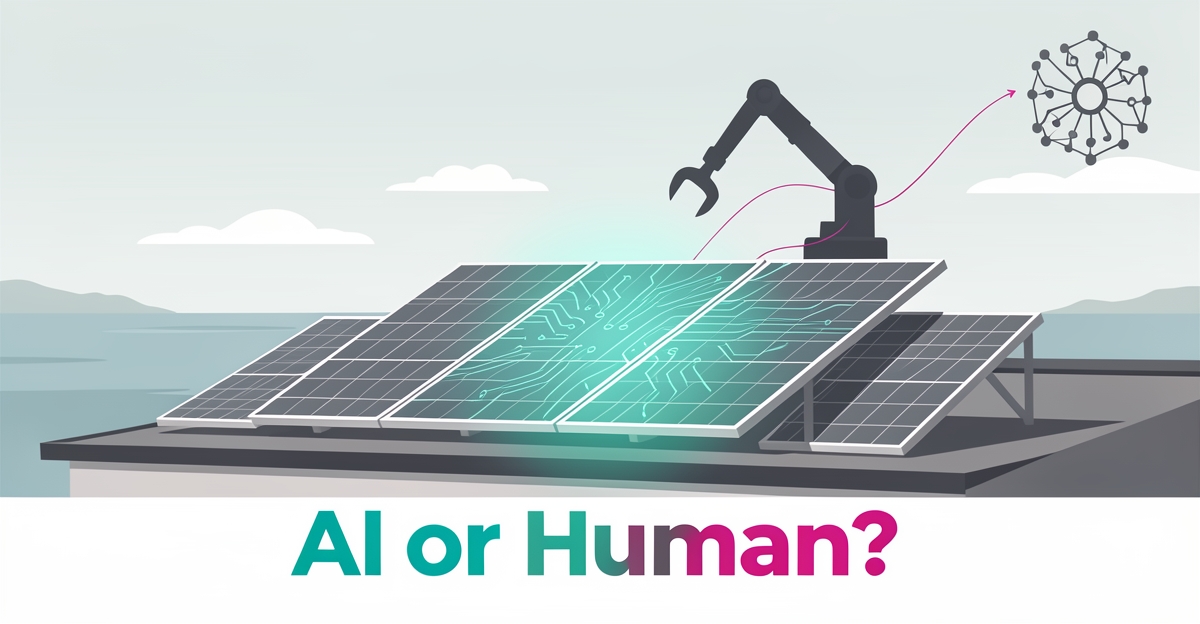
AI vs. Human Technicians: Which Is Better for Solar Panel Cleaning in Halifax?
Key Facts
- The global solar panel cleaning market was estimated at roughly USD 1.2 billion as of 2025, with continued growth projected through 2035 according to industry analysis.
- AI-powered cleaning systems typically reduce water usage by around 35% through condition-based scheduling per industry data.
- A majority of cleaning firms now use digital tools for route planning, scheduling, and customer engagement according to market analysis.
- Battery-driven robotic cleaners are increasingly deployed for routine daily maintenance across varied installations.
- Human technicians remain essential for complex installations requiring safety judgment and adaptive problem-solving as noted by industry leaders.
- Hybrid models combining AI routine cleaning with human expertise for complex work are emerging as the practical standard reflecting market evolution.
Hire a team member that works 24/7 — for less than a part-time wage.
AI receptionists, SDRs, dispatchers and 99+ roles. Trained on your business, fully managed.
Not sure where to start? Ask our AI planner
The Rising Demand for Solar Panel Cleaning in Halifax’s Growing Renewable Sector
Halifax is riding a wave of solar adoption that is changing maintenance expectations across the region. As installations multiply, keeping panels at peak output is becoming a core operational priority rather than an occasional chore.
The global solar panel cleaning market was estimated at roughly USD 1.2 billion as of 2025, with industry projections pointing to steady growth through 2035. That expansion reflects rising demand for solar energy and the need for efficient, cost-effective cleaning methods.
Soiling directly erodes performance, which drives owners to seek more consistent maintenance. AI-powered cleaning systems can reduce water usage by roughly 35% by cleaning only when needed, a benefit that matters as operators balance performance with resource use.
Digital adoption is already reshaping service delivery. A majority of cleaning firms now use digital tools for route planning, scheduling, and customer engagement, signalling a market moving toward IoT-integrated service platforms and real-time monitoring.
Automation is entering the field in practical forms. Battery-driven robotic cleaners are being deployed for routine daily maintenance across varied settings, demonstrating how recurring cleaning can be handled with minimal manual intervention.
For businesses evaluating options, the rising demand creates a clear decision point between scale and service. Hybrid models are emerging as a practical response, where routine tasks are automated and human expertise is reserved for complex, high-value work.
Key drivers shaping Halifax’s demand include:
- Expanding solar capacity increasing the total surface area requiring regular maintenance
- Market growth pushing operators toward scalable, repeatable cleaning processes
- Digital transformation enabling IoT-integrated scheduling and monitoring across fleets
- Water and labor efficiency pressures favoring systems that clean only when needed
This is the context where AI strategy becomes operational. AIQ Labs helps businesses build hybrid models where AI handles routine tasks while humans focus on complex jobs and client trust-building, aligning with how the industry is evolving.
The combination of market growth, digital adoption, and automation readiness sets the stage for comparing AI technicians versus human staff on cost, efficiency, and scalability.
How AI-Powered Cleaning Systems Improve Efficiency and Reduce Operational Costs
AI-powered cleaning systems are transforming solar maintenance by optimizing every pass and eliminating guesswork. By integrating IoT sensors with machine learning, these systems clean panels only when soiling levels threaten performance, cutting unnecessary cycles and conserving resources. This targeted approach not only preserves panel efficiency but also extends the lifespan of cleaning equipment through reduced wear. Industry research indicates AI-driven systems can reduce water usage by roughly 35% through condition-based cleaning schedules, a significant advantage in water-conscious regions like Halifax.
These autonomous solutions deliver measurable gains in operational efficiency that manual methods struggle to match. Robotic cleaners operate consistently without fatigue, maintaining optimal cleaning patterns across large arrays while adapting to real-time weather and soiling data. Unlike human crews limited by shift schedules and variability in technique, AI systems ensure uniform coverage and performance tracking across every panel. Market analysis shows that IoT-integrated platforms are now widely used for smarter routing and scheduling, enabling predictive maintenance that prevents energy loss before it occurs.
Scalability is where AI systems create lasting cost advantages over labor-dependent models. Once deployed, robotic fleets can expand to cover additional installations with minimal incremental cost, primarily software licensing and occasional hardware checks. This contrasts sharply with manual cleaning, where scaling means hiring, training, and managing more staff, increasing payroll, benefits, and supervision overhead. For Halifax-based solar operators, this translates to a lower long-term cost per kilowatt-hour maintained, especially as system sizes grow. AIQ Labs' workflow builds support this shift by rebuilding the highest-cost operational workflow first, so AI handles routine cleaning cycles while human technicians focus on complex inspections, customer engagement, and trust-building, turning operational efficiency into stronger client relationships.
Why Human Technicians Remain Essential for Complex Jobs and Customer Trust in Halifax
In Halifax’s community-driven energy market, trust is built on site visits, local knowledge, and the reassurance of a skilled person on the roof. Automation handles routine soiling, but complex arrays still demand human judgment.
Human technicians remain essential for complex and high-value installations where safety, precision, and adaptability matter. According to industry leaders, human technicians still play a crucial role in the cleaning process, particularly in complex and high-value installations. They navigate roof angles, shading, fragile mounting, and custom configurations that robotic systems cannot safely assess.
Expertise and attention to detail separate a clean panel from a protected asset. Solar Survey AI notes human technicians can provide a level of expertise and attention to detail that AI-powered systems may not be able to match. That judgment prevents damage, identifies early faults, and ensures cleaning methods suit the specific glass, coating, and environmental exposure common across Nova Scotia homes and businesses.
Customer trust in Halifax is personal and relationship-based. The same industry insight highlights that human technicians can also provide a level of customer service and support that is essential for building trust and loyalty with customers. Face-to-face walkthroughs, clear reporting, and responsive service reinforce confidence in a market where referrals drive growth.
The broader market context reinforces why this balance matters. The global solar panel cleaning market was estimated at roughly USD 1.2 billion as of 2025, with industry research projecting steady growth through 2035. A majority of cleaning firms now use digital tools for route planning, scheduling, and customer engagement, showing how digital and human capabilities are converging.
A hybrid model reflects this reality. AIQ Labs helps businesses build hybrid models where AI handles routine tasks while humans focus on complex jobs and client trust-building. That approach aligns with how the sector is evolving, where market analysis shows AI-powered cleaning systems can reduce water usage by roughly 35% by cleaning only when needed, while humans manage exceptions.
Human technicians continue to deliver value where automation stops:
- Complex roof and array assessments requiring on-site safety judgment
- High-value commercial and residential systems needing meticulous, personalized care
- Direct customer interaction, education, and relationship building that drives retention in Halifax
- Troubleshooting soiling patterns, equipment issues, and site-specific constraints
In practice, the most resilient cleaning operations pair scalable automation with skilled technicians who own the complex work and the customer relationship.
Building a Hybrid Model: How AIQ Labs Helps Halifax Businesses Combine AI and Human Strengths
AIQ Labs helps Halifax solar service providers build a practical hybrid model where AI handles routine cleaning tasks and human technicians focus on complex jobs and client relationships. This approach draws on AIQ Labs’ three entry points: AI Employees for managed AI staff that run scheduling, dispatch, and customer follow-up; Workflow Builds to rebuild the one workflow that costs the most, at a fixed price and in phases; and AI Operating Systems that connect everything into one operating layer you own outright. By combining the strengths of both AI and people, businesses can maximize efficiency, reduce operational strain, and maintain high service quality across growing customer bases.
Research shows that AI-powered cleaning systems can reduce water usage by roughly 35% by cleaning only when needed, directly lowering operational costs and environmental impact according to industry analysis. At the same time, human technicians remain essential for complex and high-value installations where attention to detail and adaptive problem-solving are critical as noted by industry leaders. This division of labor allows AI to manage repetitive, scheduled cleanings while humans address edge cases, system inspections, and customer consultations.
- AI Employees handle routine cleaning schedules, monitoring, and basic maintenance coordination
- Human technicians focus on complex repairs, system diagnostics, and client engagement
- Shared oversight ensures quality control and continuous improvement
- Real-time data from AI systems informs predictive maintenance and service planning
- Flexible scaling allows businesses to adjust AI and human resources based on seasonal demand
The hybrid model also supports better customer trust and long-term retention. While AI delivers consistent, data-driven performance, human technicians provide the personal interaction and expert guidance that build confidence in solar investments highlighting the irreplaceable role of human touch. AIQ Labs enables this balance through managed AI Employees that integrate with scheduling, CRM, and monitoring tools, with flexible payment models, start monthly, build in milestones, or own it outright, so technology aligns with business goals without locking you in. This integrated approach helps Halifax providers scale sustainably without sacrificing service quality or increasing overhead.
Still paying for 10+ subscriptions that don’t talk to each other?
We build custom AI systems you own outright. No vendor lock-in. Full control.
Not sure where to start? Ask our AI planner
Frequently Asked Questions
Is AI cleaning actually cheaper than hiring human technicians in Halifax?
How much water can AI-powered solar panel cleaning really save?
Can robots handle all solar panel cleaning jobs, or do I still need people?
Will AI replace human technicians completely?
Is the solar panel cleaning market growing enough to justify investing now?
Are Halifax cleaning firms already using digital and IoT tools?
Where Automation Meets Expertise: The Smart Path Forward for Solar Care
As Halifax’s solar sector expands, the choice isn’t between AI and human technicians, it’s about combining their strengths. AI-powered systems deliver efficiency, scalability, and meaningful water savings by cleaning only when needed, while human expertise remains vital for complex installations, safety judgments, and building the trust that drives local referrals. A hybrid model lets automation handle routine cycles so skilled technicians can focus on high-value work and client relationships, turning operational efficiency into long-term retention. For solar service providers ready to scale without sacrificing quality, the next step is assessing where AI can relieve repetitive tasks and where human insight adds irreplaceable value. Start with AIQ Labs’ 2-minute Fit Check at aiqlabs.ai/apply, then book a free 30-minute strategy call to map your biggest automation opportunities, no obligation, just clarity on where AI fits best.
Make AI your competitive advantage — not just another tool.
Strategy, implementation and ongoing optimization. One partner, end to end.
Not sure where to start? Ask our AI planner