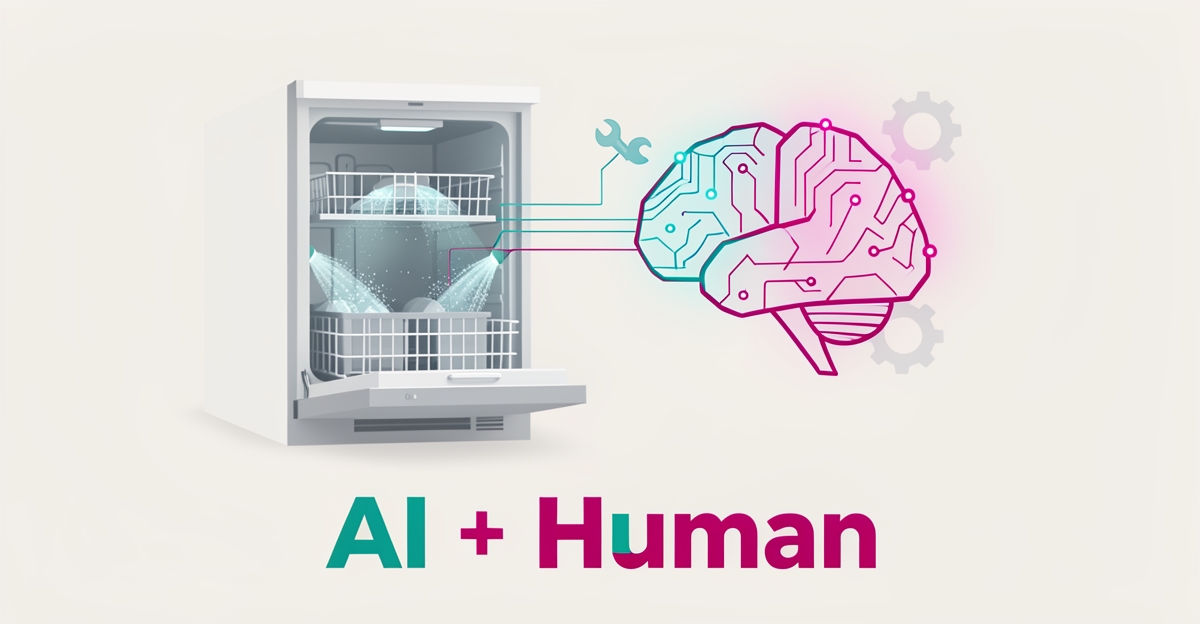
AI vs. Human Technicians: Which Is More Efficient for Emergency Dishwasher Repairs?
Key Facts
- AI can typically automate the majority of repetitive data and decision-making tasks in repair workflows, triage, error-code analysis, parts lookup and dispatch.
- As of late 2026, AI adoption is broad: most companies now use AI in at least one business function.
- Managed AI employees in dispatcher and coordinator roles typically cost around 80% less than a human hire while working 24/7.
- The physical repair itself is where AI cannot go, unpredictable emergency repairs demand human dexterity and judgment.
- Human technicians remain irreplaceable for physical repairs requiring manual dexterity, improvisation, and judgment under incomplete information.
- AI-powered predictive maintenance can detect early-warning patterns like pump degradation before catastrophic failures disrupt service.
- Speed without accuracy is a liability in emergency repair, and accuracy without speed is a revenue loss.
Hire a team member that works 24/7 — for less than a part-time wage.
AI receptionists, SDRs, dispatchers and 99+ roles. Trained on your business, fully managed.
Not sure where to start? Ask our AI planner
The Emergency Repair Crisis: Why Speed and Accuracy Collide
A commercial dishwasher failure in food retail is not an inconvenience, it is an immediate threat to service, revenue and health code compliance. Every hour of downtime risks lost sales, discarded product and inspections that can shut a location down.
The pressure creates a core tension for operators. AI promises efficiency gains, and as IBM defines it, AI is technology that enables machines to simulate human learning, problem solving and decision-making, exactly the pattern-recognition work that dominates the early stages of a repair. Most companies now use AI in at least one business function, and the value of AI investments continues to grow.
That automation potential collides with the realities of emergency repair. AI-powered diagnostics can analyze error codes, sensor data and historical performance to provide initial assessments and surface repair manuals or parts information. For routine guidance, speed is achievable.
Emergency dishwasher repairs demand more than pattern matching. The variability of issues, from simple clogs to complex motor failures or control system malfunctions, requires nuanced understanding of mechanical, electrical and plumbing systems. Human technicians bring contextual understanding of the specific environment, usage history and contributing factors that AI cannot fully grasp.
Physical execution remains a decisive gap. Repairs require dexterity, fine motor skills and precise adjustments to components. Adaptability and improvisation are critical when unexpected issues arise mid-repair, and judgment based on experience is needed when information is ambiguous or incomplete.
The business problem is balancing rapid diagnostics with reliable execution. Operators need a repair model that reduces response time and cost per repair without sacrificing customer satisfaction when health and revenue are on the line.
Key capabilities that remain human-led in emergency scenarios include:
- Contextual understanding of site-specific conditions and usage history
- Manual dexterity and physical manipulation of components
- Adaptability and improvisation for novel or unexpected failures
- Judgment and decision-making under incomplete information
AI's strongest contribution is not hands-on repair, it is accelerating the information layer before a technician arrives. Predictive maintenance strategies leveraging AI can analyze historical data to identify failure patterns and reduce the likelihood of emergency events in the first place.
This is where a comparative analysis of response time, cost per repair and customer satisfaction becomes essential. AIQ Labs helps operators design a hybrid model that uses AI for diagnostics and dispatch while reserving human expertise for contextual judgment and physical execution, whether that starts with a single AI workflow build or a full AI operating system. Speed without accuracy is a liability in emergency repair, and accuracy without speed is a revenue loss.
Where AI Wins: Diagnostics, Data, and Predictive Prevention
When a dishwasher fails during peak service hours, every minute counts, AI excels in the critical first moments of emergency response. By instantly analyzing error codes and cross-referencing them with historical datasets, AI systems can pinpoint likely failure points in seconds rather than the minutes or hours a technician might spend consulting manuals or recalling past cases. This rapid diagnostics capability allows for immediate triage, determining whether an issue requires urgent on-site intervention or can be resolved remotely with guided steps. The bulk of repetitive data and decision-making work in a repair workflow, intake, code lookup, parts identification, scheduling, typically falls well within what modern AI handles reliably.
Beyond raw speed, AI leverages continuous sensor data streams to detect subtle patterns invisible to the human eye, such as gradual pump degradation, intermittent valve leaks, or voltage fluctuations in control boards, that often precede catastrophic failures. By recognizing these early-warning signatures across many similar units, AI enables predictive prevention, alerting service teams to replace worn components during scheduled maintenance windows rather than waiting for a disruptive breakdown. This shift from reactive to proactive service not only reduces emergency call volumes but also extends appliance lifespan and improves operational continuity for businesses reliant on constant dishwasher availability.
AI also functions as an intelligent force multiplier by providing technicians with instant, context-aware access to repair knowledge. When connected to centralized parts databases and manufacturer service bulletins, AI can recommend the exact replacement part, highlight common failure modes for specific models, and even suggest optimal repair sequences based on real-time field data from other technicians. This eliminates time-consuming searches through physical manuals or fragmented digital resources, ensuring that when a human technician arrives on-site, they are armed with precise, actionable intelligence. These capabilities demonstrate how AI enhances, not replaces, human expertise by handling the data-intensive elements of repair workflows, allowing skilled technicians to focus on complex diagnostics and hands-on resolution where their judgment and dexterity remain indispensable.
Where Humans Remain Irreplaceable: Adaptability, Dexterity, and Judgment
When a commercial dishwasher fails during service, the cost is measured in minutes, not just parts. That pressure exposes where AI assistance ends and human mastery begins.
Emergency repairs demand more than error-code matching. Human technicians bring contextual understanding that AI cannot replicate, especially when diagnostics contradict what is visible on site. Technicians can consider the specific environment, usage history, and potential contributing factors to a malfunction, which AI may not be able to fully grasp. In a kitchen with hard water, heavy grease loads, and irregular maintenance, that history changes the diagnosis.
Physical dexterity remains a decisive gap. Many repairs require manual dexterity, precise adjustments, and physical manipulation of components, tasks that are challenging for robotic systems. Cramped under-counter spaces, brittle plastic clips, and corroded fittings require tactile feedback and fine motor control that current automation lacks. AI can guide, but it cannot reach.
Adaptability and judgment amplify under emergency conditions. Unexpected issues often arise during repairs, requiring technicians to adapt their approach and improvise solutions, a capability that is still developing in AI. Technicians exercise judgment based on experience and intuition to make critical decisions during repairs, especially when faced with ambiguous or incomplete information. That improvisation is irreplaceable when a control board is fried and a replacement will not arrive until morning.
The limitations are not theoretical. AI effectiveness heavily relies on the availability and quality of data. AI algorithms require large, accurate datasets of past repairs, failure patterns, and component performance to learn and make informed predictions. Inconsistent or incomplete data can significantly limit the accuracy and reliability of AI-driven insights.
While AI adoption is broad, most companies now use AI in at least one business function, its role in emergency repair remains assistive. AI can automate the repetitive information work, but the physical repair itself is where emergencies live.
For service leaders evaluating response models, the question is not AI versus humans, but where each adds value. AIQ Labs works with SMBs to map that boundary, assessing whether AI can handle routine or emergency cases more effectively without compromising service quality. A comparative analysis of AI and human-led repair response models shows response time, cost per repair, and customer satisfaction all shift with task complexity.
Human strengths in emergency dishwasher repairs include:
- Contextual synthesis of usage history, environment, and symptoms
- Fine motor dexterity for cramped, delicate component work
- Real-time improvisation when diagnostics contradict physical reality
- Safety-critical judgment with incomplete data
These capabilities are why human technicians remain indispensable for emergency scenarios. AI can accelerate triage and parts lookup, but the final repair still depends on adaptability, hands-on skill, and experienced judgment that only a trained technician provides.
The Hybrid Model: AI Triage + Human Execution for Optimal ROI
AI-powered triage is transforming how emergency dishwasher repair services manage initial intake and coordination. By leveraging AI to handle customer inquiries, filter diagnostic information, and streamline parts logistics, businesses can reduce response delays and free up human technicians for hands-on work. This approach starts by assessing current workflows to identify high-ROI automation targets such as dispatch, diagnostics, and inventory management, exactly the repetitive coordination work AI handles best.
Deploying managed AI employees for these coordination roles delivers measurable efficiency gains while operating 24/7. Unlike human coordinators limited to standard business hours, AI employees provide continuous coverage for intake triage, predictive scheduling, and real-time status updates, critical advantages during emergency scenarios where timing impacts customer satisfaction and operational costs. For field services like appliance repair, this means faster initial response and better resource allocation without sacrificing service quality.
The cost-benefit advantage of this hybrid model is substantial. AI employees in roles such as dispatcher or service coordinator typically cost around 80% less than a human hire, eliminating expenses tied to salaries, benefits, and overtime while maintaining round-the-clock availability. By reserving complex physical repairs and nuanced decision-making for skilled humans, organizations achieve optimal ROI, combining AI's scalability in logistics and diagnostics with human expertise in execution and judgment. This balanced approach ensures emergency repairs remain both efficient and reliable, even under pressure.
Building Your AI-Enhanced Repair Roadmap: From Assessment to Scale
Emergency dishwasher failures demand speed, but speed without judgment creates costly callbacks. An AI-enhanced repair roadmap lets food retail and field services teams keep human expertise where it matters while automating the repetitive work that slows emergency response.
Start with a discovery workshop to map current emergency response bottlenecks. The session surfaces where technicians lose time to dispatch delays, parts lookups, and manual diagnostics. With AI adoption now widespread across business functions, the question shifts from whether to use AI to where it adds real value without eroding service quality.
Pilot an AI dispatcher or diagnostic agent for a single location. A contained pilot tests AI for routine triage, error-code analysis, and first-contact guidance. The repetitive coordination work, intake, scheduling, and initial diagnostics, is typically where AI pays off fastest, while technicians focus on hands-on repair.
Measure response time and first-time-fix rates against the baseline. Clear metrics reveal whether AI-assisted dispatch shortens arrival windows and whether guided diagnostics reduce repeat visits. Data quality determines success; AI effectiveness heavily relies on availability and quality of historical repair, maintenance logs, and equipment performance data.
Scale across departments once the pilot proves stable. Expansion follows the same pattern: map workflow, integrate with existing maintenance management systems, train technicians to use AI tools, and monitor performance. AIQ Labs structures this progression in phases, assessment, roadmap design, and governance, to move teams from pilots to embedded operations, whether through a targeted workflow build or a connected AI operating system built and owned outright.
Data infrastructure readiness is the non-negotiable prerequisite. Inconsistent or incomplete data limits accuracy and reliability of AI-driven insights. A readiness check covers data collection, cleaning, integration points with CRM and dispatch systems, and human-in-the-loop controls for critical decisions.
A practical roadmap looks like this:
- Discovery workshop to map bottlenecks in emergency response and parts access
- Pilot an AI dispatcher or diagnostic agent at one site with defined success metrics
- Measure response time, first-time-fix rates, and technician adoption before scaling
- Validate data infrastructure and integration with legacy maintenance systems
- Scale across locations and departments with governance and change management
Low-risk entry matters. The Start Monthly model lets teams begin with one AI employee for dispatch or intake, with build, training, integrations, monitoring, and improvements included and the ability to pause or adjust anytime. See pricing for the full range of payment models: Start Monthly, Build in Milestones, or Own It Outright.
Ready to test where AI can handle routine emergency cases without compromising service quality? Start the Fit Check at https://aiqlabs.ai/apply for a free 30-minute strategy call to map your biggest bottleneck and identify high-ROI automation opportunities.
Still paying for 10+ subscriptions that don’t talk to each other?
We build custom AI systems you own outright. No vendor lock-in. Full control.
Not sure where to start? Ask our AI planner
Frequently Asked Questions
Can AI actually fix a commercial dishwasher during an emergency?
Where does AI really help in emergency dishwasher repairs?
Why do human technicians still matter for emergency repairs?
Is a hybrid AI plus human model worth it for food retail?
How much is AI being adopted in business right now?
What data do I need before using AI for dishwasher maintenance?
Where Speed Meets Skill: Building a Smarter Repair Strategy
The takeaway: while AI accelerates diagnostics and predictive maintenance, automating the bulk of repetitive data tasks, human technicians remain essential for emergency dishwasher repairs due to their contextual understanding, dexterity, adaptability, and judgment under uncertainty. The most effective approach isn't choosing between AI and humans, but integrating them: using AI for triage, parts lookup, and predictive insights while reserving skilled technicians for complex, hands-on execution. This hybrid model reduces downtime, controls costs, and maintains service quality when health and revenue are on the line. To assess where AI can add real value in your repair workflow without compromising reliability, Start the Fit Check at https://aiqlabs.ai/apply for a free 30-minute strategy call to map your bottlenecks and identify high-ROI automation opportunities.
Make AI your competitive advantage — not just another tool.
Strategy, implementation and ongoing optimization. One partner, end to end.
Not sure where to start? Ask our AI planner