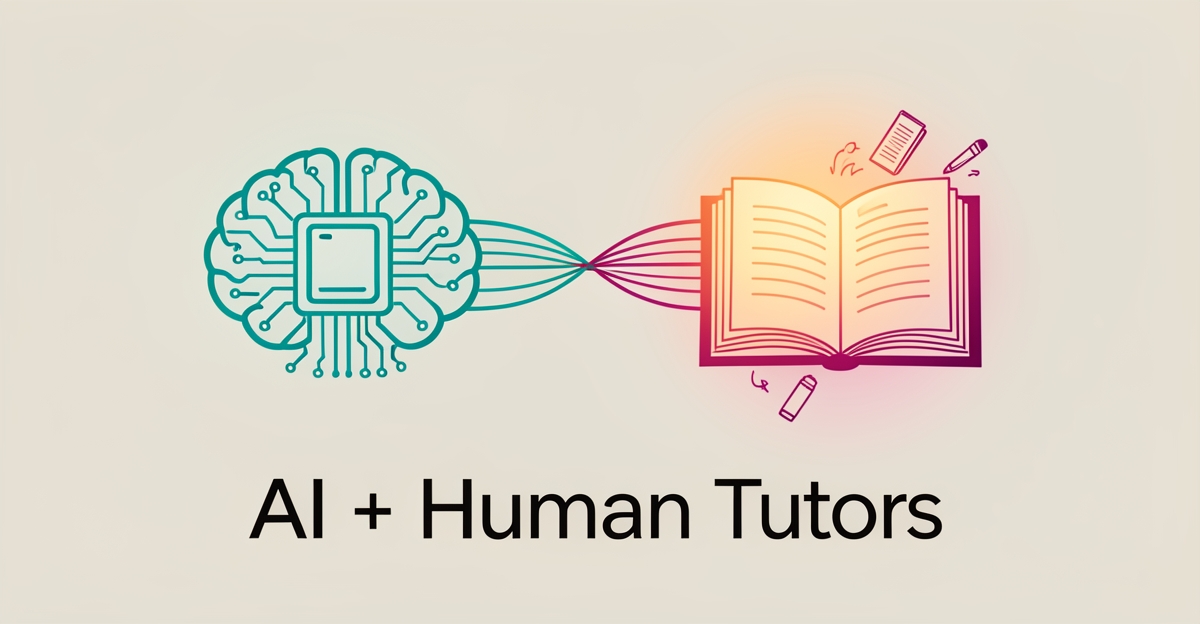
AI vs Human Tutors: Which Is Better for Homeschooling or Private Tutoring Environments?
Key Facts
- Roughly half of teachers report feeling unprepared for AI's impact in education according to Intuit
- 75% of enterprise workers report better speed or quality with AI per Intuit
- 4 in 10 employees say their organization has adopted AI in some form based on Gallup
- AI can process huge volumes of data fast and consistently, but outputs depend on data quality Intuit notes
- Human intelligence fills gaps AI can't, like judgment, empathy, and creativity Intuit confirms
- AI can deliver outcomes at scale, but a mistake scales the damage too Intuit warns
- AI should be used as a tool to support, not replace, teachers and students LinkedIn advises
Hire a team member that works 24/7 — for less than a part-time wage.
AI receptionists, SDRs, dispatchers and 99+ roles. Trained on your business, fully managed.
Not sure where to start? Ask our AI planner
The Homeschool and Private Tutoring Dilemma
The tension between rising educational costs and the growing demand for personalized learning is creating a real dilemma for parents and tutoring businesses alike. As families seek tailored instruction that fits unique learning styles and paces, they often face steep price tags for qualified human tutors. At the same time, many educators feel unprepared to navigate the rapid integration of AI into teaching practices, with roughly half of teachers reporting they feel unprepared for AI's impact in education. This gap highlights not just a training challenge, but a deeper uncertainty about how to balance technological efficiency with the irreplaceable human elements of mentorship.
Parents and tutoring providers are increasingly asking whether AI can deliver the personalization they need without sacrificing the emotional intelligence and critical thinking that only human tutors consistently provide. While AI excels at processing large volumes of data quickly and adapting instruction based on performance metrics, it lacks the capacity for genuine empathy, moral reasoning, or creative problem-solving that emerges from lived experience. Human tutors, by contrast, build trust through real-time emotional responsiveness and can guide students through ambiguous or novel situations where AI may falter due to its reliance on existing patterns. This divide isn't just technical, it's pedagogical, touching on how we define effective learning in an age of intelligent machines.
To address this, forward-thinking models are emerging that treat AI not as a replacement but as a force multiplier for human expertise. AIQ Labs supports this balance by helping tutoring businesses and homeschool cooperatives design hybrid systems where AI handles data-driven tasks like progress tracking, adaptive quiz generation, and content recommendations, freeing human tutors to focus on higher-order skills such as judgment, creativity, and strategic feedback. In this framework, AI becomes a copilot that amplifies human potential rather than attempting to replicate it. The goal isn't to choose between AI and human tutors, but to create learning environments where each plays to its strengths: AI for scale and consistency, humans for connection and insight. This approach acknowledges that while AI can deliver outcomes at scale, a mistake scales the damage too, making human oversight not just beneficial, but essential. Trust, too, remains uneven in AI-human collaboration, with users often swinging between over-reliance and skepticism, underscoring the need for thoughtful design and clear boundaries in educational AI implementation.
What Research Shows: Strengths and Limits of AI vs Human Tutors
The question isn't whether AI tutors can teach, it's whether they can teach your child, in the way your child actually learns. Research comparing artificial and human intelligence reveals a clear division of strengths, and understanding where each excels is the first step toward building an effective tutoring strategy.
According to research from Intuit, AI processes massive volumes of data quickly and consistently, but its outputs are only as reliable as the data and constraints behind them. In practice, this means an AI tutor can drill multiplication tables with a hundred students simultaneously at 2 a.m. without fatigue, but it can also scale a mistake just as efficiently, embedding a misunderstanding across every session it touches.
Human tutors operate differently. They learn from lived experience, context, feedback, and consequences, and they can generalize from just a few examples. Analysis of AI versus human problem-solving notes that human cognition is theory-driven and forward-looking, meaning a skilled tutor anticipates where a student will struggle next, not just where they've already stumbled.
The emotional dimension matters enormously in one-on-one settings. Education experts on LinkedIn emphasize that AI should support, not replace, the human elements of teaching. A homeschooled child experiencing frustration with fractions needs more than correct answers, they need a tutor who reads their hesitation, adjusts tone, and builds the trust that keeps them engaged.
Here's how the two approaches break down across the dimensions that matter most in tutoring:
- Speed and scale: AI runs 24/7 across unlimited tasks; humans bring depth, prioritization, and the judgment to know what matters most in a given moment
- Creativity: AI remixes existing patterns into useful variations, while humans produce original intent and direction grounded in real-world purpose
- Emotional intelligence: AI mirrors tone and social cues without genuine feeling; humans read emotions and build authentic rapport in real time
- Judgment and accountability: AI optimizes for patterns in data with no moral agency; humans weigh fairness, consequences, and responsibility for outcomes
Perhaps the most telling signal: despite decades of development in intelligent tutoring systems, roughly half of teachers still feel unprepared for AI's role in education, as of late 2026. The technology is advancing faster than our frameworks for using it wisely.
This is precisely the gap that hybrid models address. When AIQ Labs designs AI implementation roadmaps for education providers, whether a single rebuilt workflow through AI Workflow Builds or a fuller connected system, the architecture follows the same principle the research supports. AI handles the repetitive, high-volume, rules-driven execution like practice problem generation and progress tracking, while human tutors retain judgment, creativity, and strategic oversight of each student's learning journey.
The evidence doesn't point to a winner. It points to a partnership where each type of intelligence does what it does best, and the student gets the full benefit of both.
The Hybrid Model: AI as Copilot, Human as Pilot
The most effective learning environments leverage AI as a support system rather than a replacement for human expertise. Research confirms that AI should be designed as a copilot, not a pilot, allowing educators to maintain strategic oversight while benefiting from technological efficiency according to LinkedIn. This approach acknowledges that while AI excels at processing large volumes of data quickly and consistently, its reliability depends entirely on the quality of input data and predefined constraints as noted by the Intuit Blog.
AI tutors demonstrate particular strength in handling data-intensive, repetitive tasks that consume significant instructor time. They can efficiently manage practice drills, track individual progress across multiple metrics, and deliver personalized content recommendations at scale, functions that align with AI's core capability of detecting statistical patterns and applying them consistently per the Intuit Blog. This allows human tutors to redirect their energy toward higher-order cognitive and emotional aspects of teaching that machines cannot replicate.
Human educators remain indispensable for nurturing judgment, creativity, motivation, and critical thinking, skills rooted in lived experience and forward-looking reasoning as emphasized in LinkedIn research. Unlike AI, which generates variations by remixing existing patterns, humans produce original intent and direction, combining imagination with purpose and real-world context according to the Intuit Blog. They also build genuine rapport by reading emotional nuances and responding with empathy in real time, a dimension where AI can only mirror social cues without genuine feeling.
This division of labor creates a synergistic model where technology handles execution while humans provide wisdom and guidance. AIQ Labs applies this principle when designing educational technology solutions, ensuring that AI systems enhance rather than diminish the educator's role. By automating routine administrative and instructional tasks, AI frees human tutors to focus on what matters most: inspiring curiosity, fostering resilience, and guiding students through complex conceptual challenges that require authentic understanding rather than pattern recognition. The result is a learning environment that is both efficient and deeply human.
Implementation Roadmap for Homeschoolers and Tutoring Businesses
Building a hybrid tutoring environment starts with a simple principle: let each side do what it does best. Research on balancing AI and human skills in education shows that AI excels at repetitive, high-volume, rules-driven execution, while human tutors should focus on judgment, creativity, and strategic thinking.
Begin by defining clear roles. Assign AI the data-driven tasks: generating practice problems, tracking progress, identifying knowledge gaps, and providing instant feedback on routine exercises. Reserve human tutors for instruction that requires empathy, contextual judgment, and the ability to read a student's emotional state, areas where, as comparisons of AI and human intelligence confirm, people consistently outperform machines.
Next, use AI for routine tasks but maintain independent oversight. This matters more than many realize: educators warn that AI can manipulate human thought and decision-making, so safeguards must protect learner autonomy. Design AI as a copilot, not a pilot, and regularly ask it for the strongest argument against its own recommendations.
Trust calibration is equally critical. Research indicates that people either rely too much on AI or too little, and finding the middle ground requires deliberate structure.
- Define escalation triggers, specify which situations always route to a human tutor
- Audit AI outputs weekly for accuracy and bias
- Set boundaries on AI-generated content before students see it
- Measure outcomes monthly: comprehension gains, engagement levels, and learner confidence
Finally, measure what matters. With 75% of enterprise workers reporting better speed or quality with AI, the temptation is to assume similar gains in tutoring. Track actual student outcomes rather than assuming efficiency translates to learning.
This is the model AIQ Labs helps tutoring businesses build: AI handles data-driven tasks while human tutors deliver personalized instruction. For a tutoring business, that usually starts with rebuilding the one workflow that costs the most, scheduling, progress reporting, or parent communication, through AI Workflow Builds at a fixed price, with the option to grow into a fuller AI Operating System over time. If you are ready to design your hybrid environment, start with the two-minute Fit Check, then book a free 30-minute strategy call to map your implementation roadmap.
Still paying for 10+ subscriptions that don’t talk to each other?
We build custom AI systems you own outright. No vendor lock-in. Full control.
Not sure where to start? Ask our AI planner
Frequently Asked Questions
Can AI replace human tutors for homeschooling?
What are the main advantages of AI tutors over human tutors?
How do human tutors outperform AI in one-on-one settings?
What is a hybrid AI-human tutoring model?
How do I prevent over-reliance on AI in my homeschool or tutoring business?
Is AI tutoring actually effective for student outcomes?
Beyond the Either/Or: Building Smarter Tutoring Together
The evidence is clear: AI and human tutors each bring irreplaceable strengths to homeschooling and private tutoring environments. AI excels at speed, scale, and data-driven tasks like progress tracking and adaptive practice, while human tutors deliver the empathy, judgment, and creativity that foster genuine understanding and engagement. Rather than choosing one over the other, the most effective approach leverages AI as a copilot, handling repetitive execution so human educators can focus on higher-order skills that machines cannot replicate. This hybrid model not only improves learning outcomes but also addresses the unpreparedness many educators feel about AI's role in education, with roughly half of teachers reporting they feel unprepared for AI's impact, according to research from Intuit. For tutoring businesses and homeschool cooperatives ready to build this balanced environment, AIQ Labs offers a clear path forward. Start with the two-minute Fit Check to assess your readiness, then book a free 30-minute strategy call to map your implementation roadmap, no obligation, just clarity on how to combine technological efficiency with human insight for better student outcomes.
Make AI your competitive advantage — not just another tool.
Strategy, implementation and ongoing optimization. One partner, end to end.
Not sure where to start? Ask our AI planner