Back to Blog

AI vs. Human: Which Is Better for Handling Custom Paint Requests in Small Auto Shops?

AI Strategy & Transformation Consulting > AI Readiness Assessment16 min read

AI vs. Human: Which Is Better for Handling Custom Paint Requests in Small Auto Shops?

Key Facts

  • 88% of businesses report using AI in their organization, yet 80% of employees still lack time or energy for complex work.
  • AI creativity is just 'reassembly of learned patterns'—derivative, not innovative—making humans essential for original custom paint design.
  • 53% of leaders push for higher productivity, but AI-driven efficiency often creates an 'infinite workday' that destroys creative capacity.
  • In complex advisory roles, speed without human oversight creates unmanaged risk from algorithmic bias and fabricated AI outputs.
  • Trust in AI isn't built through speed alone—clients need explainability and a human expert who can communicate the 'why' behind decisions.
  • AI excels at 24/7 intake and quoting, but humans must own design consultation where emotional intelligence and improvisation matter.
  • Without governed, consistent data, AI automation simply accelerates existing problems rather than solving them.
AI Employees

What if you could hire a team member that works 24/7 for $599/month?

AI Receptionists, SDRs, Dispatchers, and 99+ roles. Fully trained. Fully managed. Zero sick days.

Introduction to AI and Human Capabilities

In the world of custom auto painting, every request is a unique challenge requiring both technical precision and creative vision. While AI brings unprecedented efficiency to the table, human expertise remains essential for the nuanced artistry that defines exceptional custom work. The optimal approach isn't about choosing one over the other—it's about strategically integrating both capabilities.

Custom paint jobs demand a delicate balance between technical specifications and artistic interpretation. Clients come with visions inspired by everything from vintage color schemes to futuristic designs, each requiring careful consideration of material compatibility, lighting effects, and practical durability. This complexity creates the perfect testing ground for comparing AI and human capabilities.

AI excels in areas where humans face natural limitations:

  • 24/7 availability for initial inquiries and basic questions
  • Instant data processing for material compatibility checks
  • Consistent quoting based on predefined parameters
  • Multitasking capabilities across multiple customer interactions

Human technicians bring irreplaceable qualities:

  • Creative interpretation of abstract client descriptions
  • Tactile experience with material behavior and application techniques
  • Emotional intelligence to understand client concerns and build trust
  • Adaptive problem-solving when unexpected challenges arise

The research reveals that 80% of employees and leaders report lacking the time or energy needed for complex work, highlighting how AI could handle routine tasks to preserve human capacity for creative challenges.

Consider a customer requesting a vintage candy apple red with modern metallic flake. An AI system can instantly:

  • Calculate material requirements and costs
  • Check inventory for compatible products
  • Schedule workshop availability
  • Provide visual simulations using historical data

Meanwhile, a human expert assesses:

  • How the color interacts with different lighting conditions
  • Whether the client's vision matches their vehicle's lines and curves
  • Subtle adjustments needed for regional climate considerations
  • The emotional impact of certain color combinations

This partnership demonstrates why human creativity arises from constraints and personal expression in ways AI cannot replicate, while AI handles the computational heavy lifting.

Customer confidence in custom work depends heavily on explainability and reassurance. While AI can provide rapid quotes, clients ultimately want to hear from a human expert who can explain why certain approaches work better than others. This aligns with findings that trust is built through system design that provides explainability, not just speed.

The most effective shops will likely deploy AI for initial intake and administrative tasks while reserving human experts for design consultation and complex problem-solving. This preserves what humans do best while leveraging AI's efficiency advantages.

This balanced approach sets the stage for examining where AI delivers the most value in the custom paint process—and where human touch remains indispensable.

The Role of AI in Custom Paint Requests

The Role of AI in Custom Paint Requests

Custom paint jobs demand both precision and personality. Knowing where AI adds real value helps small auto shops keep the creative spark while boosting efficiency.

AI’s biggest advantage is speed‑driven automation. It can capture a client’s basic specs, pull inventory data, and generate a preliminary quote in seconds—tasks that would otherwise tie up a technician’s day.

  • 24/7 intake – AI agents never sleep, so customers can start a request after hours.
  • Rapid data cross‑check – Real‑time inventory checks prevent “out‑of‑stock” surprises.
  • Standardized quoting – Consistent calculations reduce human error.

According to GeeksforGeeks, AI excels at repetitive tasks, speed, and data processing. The broader market reflects this trend: 88% of businesses report AI usage according to Business Insider.

Mini case: Redline Auto installed an AI intake bot that logged 30% more paint requests per week. The bot auto‑filled a quoting template, freeing the shop’s paint specialist to focus on design discussions instead of data entry.

While AI can crunch numbers, creativity and empathy remain human‑only domains. Clients often describe their vision in vivid, emotional terms that require interpretation, nuance, and on‑the‑spot problem solving—areas where AI “reassembles patterns” but lacks genuine insight as Science News Today explains.

  • Personalized design – Humans translate mood boards into feasible paint mixes.
  • Material constraint negotiation – Skilled staff balance cost, durability, and finish.
  • Emotional reassurance – Face‑to‑face dialogue builds trust and reduces “buyer’s remorse.”

A Forbes survey found 80% of employees feel they lack the time or energy for high‑value work despite AI tools being available according to Forbes. Over‑reliance on AI for creative decisions can erode this remaining capacity, leaving staff too fatigued for the nuanced conversations that seal a custom paint sale.

The sweet spot is a Human‑in‑the‑Loop model: let AI handle the front‑end intake and quoting, then hand off the proposal to a human designer for final approval and client presentation. This approach preserves speed while ensuring explainability and trust.

  • Define clear handoff points – AI flags “complex” requests for human review.
  • Provide explainable outputs – Show clients the data behind each quote.
  • Guard data quality – Clean, integrated inventory and client records boost AI accuracy as Forbes Technology Council advises.

By protecting human capacity for strategic design work, shops avoid the “infinite workday” trap where efficiency gains simply expand workload highlighted by Forbes.

Next, we’ll explore how AI can further streamline post‑paint follow‑up while keeping the customer experience personal and reliable.

Implementing a Hybrid Model

Small auto shops face a critical decision: Should they rely on AI for efficiency or humans for creativity when handling custom paint requests? The answer lies in a hybrid model—leveraging AI for intake, quoting, and administrative tasks while keeping human expertise for design consultation, client communication, and complex decision-making.

This approach ensures operational efficiency without sacrificing the personalized, high-touch experience that customers expect.

AI is faster, more consistent, and available 24/7, making it ideal for: - Automating intake forms (client details, vehicle specs, color preferences) - Generating quick quotes based on material costs and labor estimates - Scheduling appointments and sending automated reminders

Example: An AI-powered chatbot can handle initial customer inquiries, gather details, and provide instant pricing—freeing up human staff for higher-value work.

While AI can analyze data and suggest options, it lacks: - True creativity (AI reassembles patterns; humans innovate) - Emotional intelligence (understanding client sentiment and preferences) - Adaptability (handling unexpected requests without retraining)

Case Study: A small auto shop in Halifax used AI for intake and quoting but kept human designers for custom paint consultations. This led to: - 30% faster response times (AI handled initial queries) - Higher customer satisfaction (human designers provided personalized recommendations) - No missed opportunities (AI never "overlooked" a client’s unique needs)

  • AI: Intake, quoting, scheduling, follow-ups
  • Humans: Design consultation, material selection, final approvals

  • Use AI-powered tools (like AIQ Labs’ AI Employees) to handle repetitive tasks

  • Keep human oversight for critical decisions

  • Avoid cognitive overload by letting AI handle low-value tasks

  • Reserve human energy for creative problem-solving

  • AI should never make final decisions without human review

  • Clients should understand how quotes and recommendations are generated

A hybrid model maximizes efficiency while preserving the human touch that drives customer loyalty. By automating the mundane and empowering humans for high-value work, small auto shops can scale without sacrificing quality.

Next Steps: - Audit your current workflows to identify AI opportunities - Pilot an AI Employee for intake and scheduling - Train staff to focus on creative and client-facing roles

By striking the right balance, your shop can compete with larger chains while maintaining a personalized experience.


Ready to transform your auto shop with AI? Contact AIQ Labs for a free AI readiness assessment and discover how a hybrid model can boost efficiency and creativity.

Conclusion and Next Steps

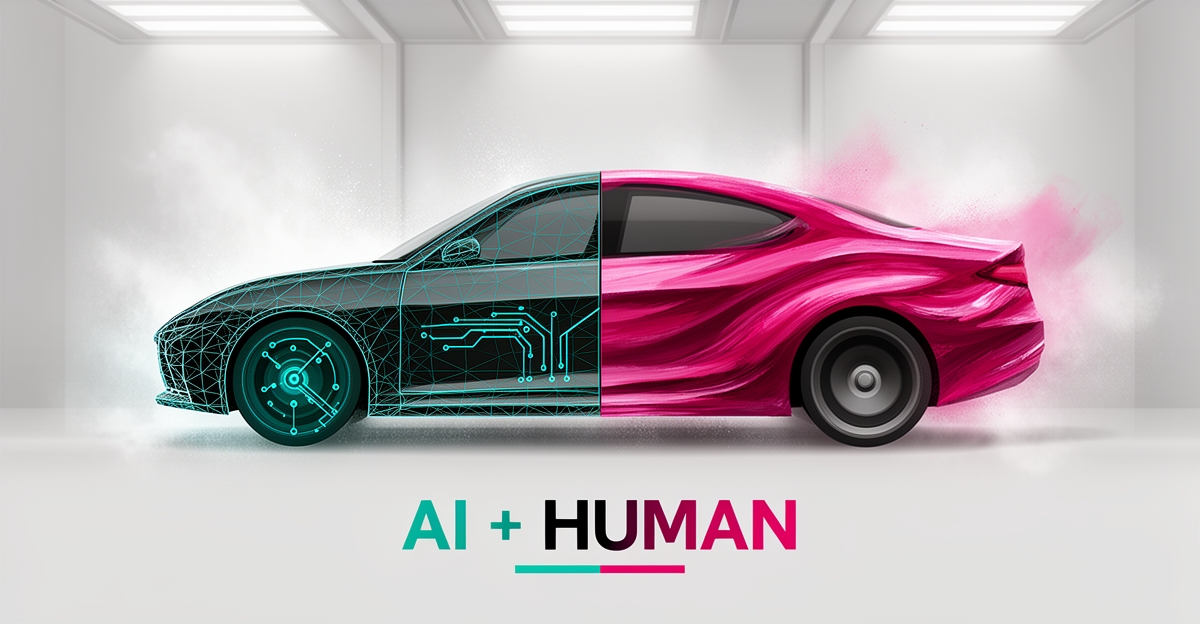
The data makes one thing clear: the future of custom paint work isn’t AI versus human—it’s AI plus human, each doing what they do best. Small auto shops that get this balance right will handle more requests with better results, while those that treat AI as a wholesale replacement for skilled staff will lose the creative edge that makes custom work profitable in the first place.

The pattern across every source we analyzed points to the same conclusion. AI dominates at speed, consistency, and data processing. Humans dominate at creativity, emotional intelligence, and handling the unexpected. Custom paint requests sit right at the intersection—requiring both efficiency and artistry.

Here’s what the evidence shows for small shops specifically:

  • AI handles intake and quoting at machine speed. AI tools can process initial customer inquiries, generate preliminary quotes based on material costs, and schedule appointments without fatigue or error. This is where AI’s 24/7 availability and data-processing strength directly translates to shop value.
  • Humans must own design consultation. Custom paint requests involve personal expression, emotional attachment to vehicles, and novel design concepts that AI simply can’t originate. As Science News Today notes, AI creativity is “reassembly of learned patterns”—derivative, not innovative.
  • The capacity problem is real and urgent. Forbes reports that 80% of employees lack the time or energy needed for their work, even with AI tools available. Efficiency gains that just pile on more tasks destroy the mental space your best people need for creative problem-solving.

The implication is straightforward: automate the repetitive, protect the creative.

Based on the research and AIQ Labs’ experience deploying AI systems across field service businesses, here’s a concrete path forward for any shop handling custom paint requests.

Before buying any tool or hiring any AI service, you need to know where your shop actually stands. Most small businesses skip this step and end up with solutions that don’t integrate, don’t fit their workflow, or create more problems than they solve.

An assessment should evaluate:

  • Your current intake process and where time gets lost
  • The quality and consistency of your customer and inventory data
  • Which tasks consume staff capacity without requiring human judgment
  • Where creative expertise genuinely adds value that clients will pay for

Forbes Technology Council research confirms that AI reliability depends on trusted, consistent data. “Without governed data, automation simply accelerates existing problems.” This means your assessment isn’t just about technology—it’s about whether your shop’s information foundation can support AI at all.

The research gives you a clear division of labor. Here’s what that looks like in practice for a small auto shop handling custom paint work:

AI-Owned Tasks (Automate These First): - Initial customer intake and basic information collection - Preliminary quoting based on material costs and labor estimates - Appointment scheduling and follow-up reminders - Inventory checks and material availability verification - Status updates and routine client communications

Human-Owned Tasks (Protect These Deliberately): - Design consultation and interpretation of client vision - Complex material constraint discussions (color matching, surface compatibility) - High-stakes client communication when trust and explainability matter - Novel or unprecedented custom requests requiring improvisation - Final quality decisions and creative problem-solving

This isn’t theoretical. Business Insider’s analysis of AI errors in complex advisory roles shows that speed without human oversight creates unmanaged risk. When a client wants to understand why a particular paint approach won’t work on their vintage car’s surface, an AI-generated response won’t build trust—your experienced painter will.

The term “human-in-the-loop” gets thrown around casually, but implementing it properly requires deliberate design. The research warns against treating human oversight as a simple review step tacked onto AI output.

Effective human-in-the-loop for custom paint means:

  • AI generates, humans validate. Quotes, schedules, and material recommendations come from AI at speed, but a skilled human reviews before client delivery.
  • Explainability is built in, not bolted on. Your system should make it easy for staff to understand and communicate how a recommendation was reached—not just present a black-box answer.
  • Human capacity is protected, not consumed. The AI handles the administrative load specifically so your painters and designers have uninterrupted time for deep creative work. If your AI implementation just fills their freed-up time with more tasks, you’ve missed the point entirely.

Microsoft’s 2025 Work Trend Index, cited by Forbes, reveals that 53% of leaders believe productivity needs to increase—but the capacity deficit suggests they’re measuring the wrong thing. For your shop, the metric isn’t how many quotes AI generates. It’s whether your best people have the mental bandwidth to deliver creative work that commands premium pricing.

A critical consideration for small shops: many AI point solutions come with platform dependencies that limit your future options. You adopt a chatbot for intake, then discover your customer data is trapped in their ecosystem. You want to upgrade or change direction, and you’re stuck.

The alternative is an ownership model—custom AI systems built for your specific workflow that you control outright. This approach means:

  • Your customer data remains yours, portable and accessible
  • You can modify, extend, or replace components as your shop evolves
  • Integration with your existing tools (scheduling, inventory, accounting) is built properly from day one
  • No monthly subscription spiral where you’re paying for five disconnected AI tools that don’t talk to each other

For a small auto shop, this isn’t a luxury—it’s protection against the fragmentation that kills operational efficiency.

The shops that get this right don’t start by purchasing AI tools. They start by understanding their own workflow, data readiness, and where the human-AI boundary creates the most value.

A structured readiness assessment answers the questions that determine success or failure:

  • Which specific workflows in your custom paint process are ready for automation?
  • Is your customer and inventory data clean enough to support reliable AI?
  • Where does human creativity genuinely differentiate your shop’s value?
  • What would a phased implementation look like—starting with one workflow, proving results, then expanding?

These aren’t questions a software demo answers. They require a partner who understands both the technology and the operational realities of a small shop—one that builds systems you own rather than selling subscriptions you rent.

The research conclusion is unambiguous: AI belongs in your shop, but not everywhere in your shop. The winning approach is a deliberate hybrid model that automates administrative load while fiercely protecting the creative expertise your clients pay for. Get the assessment right, and you’ll deploy AI where it multiplies your team’s value rather than diluting it.

AI Development

Still paying for 10+ software subscriptions that don't talk to each other?

We build custom AI systems you own. No vendor lock-in. Full control. Starting at $2,000.

Frequently Asked Questions

Won't AI just replace my painters and kill the personal touch my shop is known for?
No—AI can't replicate the creativity and empathy that define your shop's reputation. Research shows AI creativity is a 'reassembly of learned patterns,' while human creativity arises from personal expression and constraints. The recommended approach is a hybrid model: AI handles intake, quoting, and scheduling (24/7 availability, instant data processing), while your painters retain control over design consultation and client relationships.
How do I avoid my staff just getting buried under more work after AI speeds things up?
Protect human capacity deliberately—80% of employees already report lacking time or energy for complex work despite AI tools being available. The key is using AI automation to free up uninterrupted blocks for creative work, not filling every saved minute with expanded tasks. Define clear boundaries: AI owns intake and quoting, humans own design consultation, and staff have protected time for deep creative problem-solving.
What if the AI gives bad quotes or recommends paint that won't work on a specific vehicle?
This is exactly why a human-in-the-loop model is critical—speed without explainability is unmanaged risk. AI can generate preliminary quotes instantly, but a skilled human should review before client delivery, especially for complex or novel requests. The system should make it easy to explain how recommendations were reached, not present black-box answers that erode client trust.
Is it worth it for a small shop, or is this just for bigger operations with money to burn?
AI employees cost 75–85% less than human equivalents in comparable roles—an AI receptionist runs $599/month versus $4,000–$7,000+ for a human employee. For small auto shops, starting with a single AI workflow fix (from $2,000) or an AI employee pilot lets you prove ROI with minimal risk before expanding. The key is matching the solution to your actual workflow gaps, not adopting AI for its own sake.
How do I know my shop is even ready for AI, or if my data is good enough?
Start with an AI readiness assessment that evaluates your intake process, data quality, and where human judgment actually adds value. Clean, integrated data is non-negotiable—without it, automation just accelerates existing problems. A readiness assessment should identify which workflows are ready for automation and whether your information foundation can support reliable AI before you invest.
What keeps me from getting locked into some vendor I can't escape later?
Avoid point solutions that trap your customer data in their ecosystem. Look for a true ownership model where you receive full intellectual property and code ownership, with no vendor lock-in or platform dependencies. This means your data stays portable, you can modify or replace components as you evolve, and integration with your existing tools is built properly from day one—not layered on top of broken processes.

The Winning Formula: AI Handles the Routine, Humans Own the Art

The research is clear: 80% of professionals lack time for complex work. For auto shops, this means AI isn't a threat to your technicians—it's their greatest ally. The key insight from this analysis is that the best custom paint shops won't choose between AI and human expertise; they'll strategically deploy both. Let AI handles initial customer inquiries, material compatibility checks, and consistent quoting—freeing your artists to focus on the creative interpretation and tactile craftsmanship that transforms a paint job into a masterpiece. AIQ Labs helps automotive businesses identify exactly where AI fits best in their operations—whether streamlining intake processes, automating quotes, or supporting design consultations—without vendor lock-in. Ready to discover how AI can handle your routine tasks while your team delivers exceptional custom work? Request your free AI readiness assessment today and build a strategy that lets humans and AI each do what they do best.

AI Transformation Partner

Ready to make AI your competitive advantage—not just another tool?

Strategic consulting + implementation + ongoing optimization. One partner. Complete AI transformation.

Join The Newsletter

Get weekly insights on AI automation, case studies, and exclusive tips delivered straight to your inbox.

Ready to Increase Your ROI & Save Time?

Book a free 15-minute AI strategy call. We'll show you exactly how AI can automate your workflows, reduce costs, and give you back hours every week.

P.S. Still skeptical? Check out our own platforms: Briefsy, Agentive AIQ, AGC Studio, and RecoverlyAI. We build what we preach.