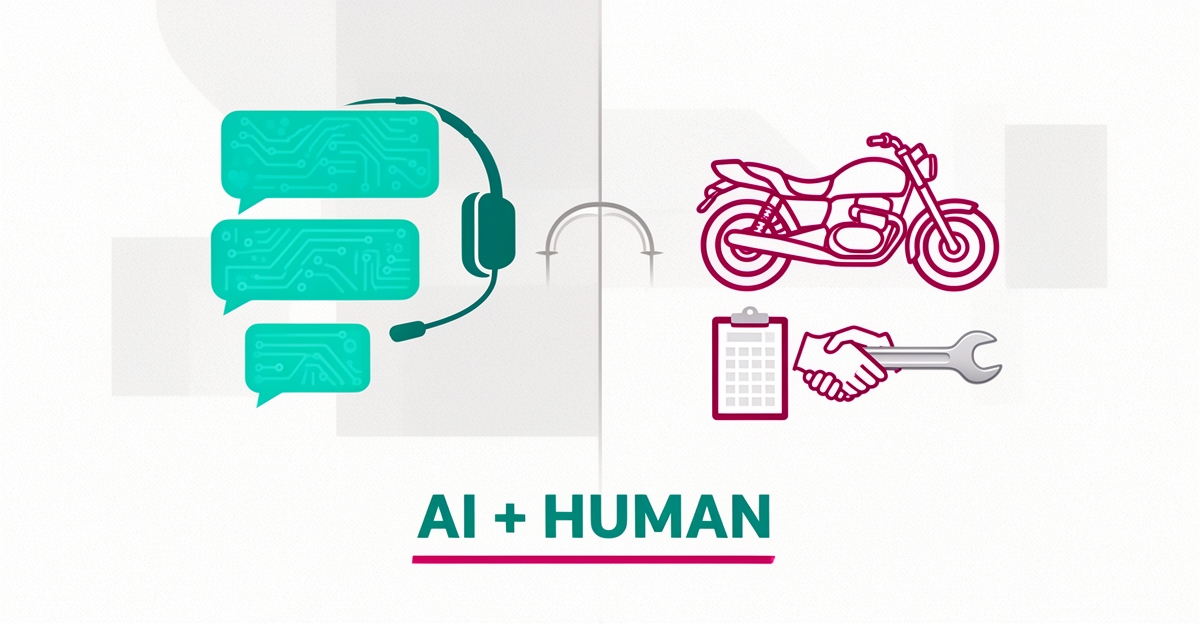
AI vs. Human: Which Is Better for Handling Customer Inquiries in a Motorcycle Body Shop?
Key Facts
- A strong majority of consumers say they prefer human support over AI agents for customer service, and most expect a human option to always be available
- A significant share of customers report that their last AI interaction failed to solve their problem, according to widely cited customer service surveys
- Many consumers say they would cancel a service if they discovered it was solely AI-driven
- Most repair shop owners believe AI can help them save time and increase revenue, according to industry reporting
- Agentic AI deployments have been reported to substantially reduce human agent workload on repetitive tickets
Hire a team member that works 24/7 — for less than a part-time wage.
AI receptionists, SDRs, dispatchers and 99+ roles. Trained on your business, fully managed.
Not sure where to start? Ask our AI planner
The Motorcycle Shop Customer Service Bottleneck
Motorcycle body shops live on trust and turnaround time, yet the phones keep ringing with the same questions after hours and on weekends. Estimates, parts availability, and repair timelines create a constant inquiry load that pulls technicians off the floor and owners into phone tag.
The bottleneck shows up daily. Customers call for a status update while the service writer is with a bike on the lift, voicemails pile up overnight, and repetitive questions about estimates and parts burn hours that should go to repairs. Most repair shop owners believe AI could help them save time and increase revenue, according to industry reporting, but customer appetite for full automation is limited.
Preference for human support remains strong in the motorcycle repair context. Widely cited customer service research finds that a large majority of Americans prefer interacting with a human over an AI agent, and most believe companies should always offer the option to speak with a human. The risk of getting it wrong is real: a significant share of customers say their last AI interaction didn't solve their problem, and many consumers believe human agents are more accurate than AI.
That gap matters for body shops where a misquoted repair time or parts delay can stall a rider's season. When inquiries go unanswered, trust erodes quickly. Shops face:
- Phone tag during peak shop hours and after-hours calls that go to voicemail
- Repetitive estimate and parts questions that repeat for every inquiry
- Delayed callbacks that increase perceived wait times and reduce retention
- Service writers pulled off the floor to answer routine questions
The perception problem compounds the operational one. Survey data suggests many people believe AI is used primarily to save money, not to improve service, and a meaningful share of consumers would cancel a service if they found it was solely AI-driven. In a category built on relationships, that perception is a liability.
This is why many shops are exploring a hybrid model rather than full automation. AI can handle routine inquiries while humans focus on complex repairs and relationships, a balance that aligns with how AIQ Labs builds AI workflows for service businesses. The goal is consistent coverage without sacrificing trust, using automation for the repeatable questions and preserving human touch for estimates, damage assessments, and repair conversations.
Getting the mix right requires clear role mapping, transparent handoffs, and systems that integrate with existing shop tools. Without those guardrails, shops risk trading a phone tag problem for a customer churn problem.
Why Routine Inquiries and Complex Repairs Need Different Hands
A motorcycle body shop lives or dies on two very different kinds of conversations: the quick, repeatable questions that clog the phone, and the high-stakes repair discussions that build trust.
Routine inquiries demand speed and consistency. Complex repairs demand empathy and accuracy. That split is where the AI vs human debate gets practical.
Agentic AI systems handle FAQs, parts availability, service scheduling and basic troubleshooting with 24/7 consistency. Deployments of agentic AI have been reported to substantially reduce human agent workload, freeing staff from repetitive tickets. For shops facing call volume spikes, that efficiency protects revenue without adding headcount.
The cost advantage is real, but consumer perception lags. Customer research consistently shows most Americans prefer interacting with a human over an AI agent, and many consumers believe human agents are more accurate than AI. That gap matters in a body shop where a misread estimate can erode trust.
Accuracy concerns are not theoretical. Survey data finds a significant share of customers say their last AI interaction didn't solve their problem, and most believe companies should always offer the option to speak with a human. When a repair involves damage assessment, insurance claims, or repair timing, customers want judgment, not a script.
The hybrid model maps work to strength. AI owns the repeatable front door, humans own the relationship and the repair.
AI fits routine, high-volume touchpoints:
- Instant answers to hours, pricing tiers, and appointment availability
- Service reminders and scheduling confirmations with calendar integration
- Basic parts lookup and warranty status checks
- Initial intake triage and documentation for later human review
Humans stay essential for trust-building moments:
- Damage assessment explanations and repair options
- Insurance negotiations and cost approvals
- Complex diagnostics and personalized timelines
- Apologies, exceptions, and relationship recovery
AIQ Labs helps shops design that split through AI Workflow Builds, using agentic systems that integrate with existing shop tools while keeping clear escalation paths. The goal is not replacement, it is augmentation.
When AI handles the routine, staff get more time for the conversations that convert a repair into repeat business.
How Agentic AI Changes the Game for Shops
Agentic AI transforms customer service in motorcycle body shops by moving beyond simple information retrieval to active problem-solving. Unlike basic chatbots that only pull from knowledge bases, agentic systems integrate with shop management tools, retain conversation context, and can execute actions like checking parts inventory or scheduling repairs directly. This evolution addresses a key gap: a significant share of customers report their last AI interaction failed to solve their problem, highlighting the limitations of passive approaches. This frustration drives preference for human agents, with most Americans strongly favoring human support.
Successful implementation requires deliberate design choices grounded in proven best practices. Shops should strategically map AI roles to handle routine inquiries—such as appointment questions or parts availability—while reserving human agents for complex estimates, insurance negotiations, or emotionally sensitive conversations. Clear escalation paths ensure seamless handoffs when AI reaches its boundaries, protecting the many consumers who would cancel a service if they discovered it was solely AI-driven. Transparency is non-negotiable; informing customers they're interacting with AI builds trust, especially since most believe companies should always offer human agent access. Perceived accuracy still favors humans, making openness about AI's role critical to maintaining satisfaction.
AIQ Labs supports this hybrid model through AI Employees—managed AI receptionists and intake staff that work with your existing workflows—and through AI Operating Systems for shops that want one connected layer across the whole business. Continuous monitoring tracks not just efficiency gains, but sentiment and repeat contact rates to ensure the technology enhances rather than erodes relationships. Action-oriented AI consistently outperforms passive chatbots in nuanced scenarios. By keeping humans in the loop for judgment calls and continuously refining AI based on real shop data, businesses achieve efficiency without sacrificing the personal touch that defines trusted motorcycle repair experiences. This balanced approach turns AI from a cost-cutting tool into a relationship-enhancing capability.
A Practical Hybrid Model for Motorcycle Body Shops
Motorcycle body shops live on trust, speed, and clear communication. Customer inquiries range from simple hours and pricing questions to complex damage assessments and repair timelines, making a one-size-fits-all approach risky.
A practical hybrid model starts with mapping inquiry types. Routine, high-volume requests such as hours, service menus, parts availability, and status checks are ideal for automation. Complex repairs, insurance negotiations, and damage explanations stay with experienced staff. This strategic role mapping protects the human touch where it matters most.
Research shows the human preference is strong. Most Americans strongly prefer interacting with a human over an AI agent, and most believe companies should always offer the option to speak with a human. At the same time, a significant share of customers say their last AI interaction didn't solve their problem, underscoring why escalation design matters.
For motorcycle shops, the hybrid workflow looks like this:
- Assess inquiry types and volume to separate routine from relationship work
- Map AI to routine tasks like FAQs, appointment booking, and repair status updates
- Design clear escalation paths with transparent handoffs to human technicians
- Ensure transparency by informing customers when they are speaking with AI
- Monitor sentiment not just volume, tracking resolution and repeat contacts
Agentic AI systems that integrate with shop tools, retain context, and have defined action boundaries perform better than basic chatbots. Shops that adopt this approach can reduce repetitive inquiries while keeping staff focused on diagnostics, estimates, and customer relationships.
Implementation follows a practical sequence. First, audit current calls and emails to identify the top 10 repetitive questions. Next, train an AI employee on shop-specific data, service menus, and policies with human-in-the-loop oversight. Then build escalation triggers for keywords like insurance, total loss, or pricing disputes. Finally, monitor metrics beyond efficiency, including customer sentiment and first-contact resolution.
AIQ Labs supports this model with three entry points. An AI Employee—such as a managed AI receptionist—can handle after-hours calls, schedule inspections, and provide status updates 24/7 at a fraction of the cost of a human hire, while humans handle complex repairs and relationship building. An AI Workflow Build rebuilds the one workflow that costs you the most, at a fixed price and in phases. And for shops that want everything connected, an AI Operating System is built in phases and owned outright.
The goal is not replacement. It is augmentation. When AI handles routine inquiries consistently and humans step in for nuance, shops improve response speed without sacrificing trust.
Still paying for 10+ subscriptions that don’t talk to each other?
We build custom AI systems you own outright. No vendor lock-in. Full control.
Not sure where to start? Ask our AI planner
Frequently Asked Questions
Will customers actually accept AI for customer service at a motorcycle body shop?
Is AI just for cost cutting or can it actually improve service?
What kind of inquiries should AI handle vs a human?
How much workload can agentic AI really take off my team?
Are repair shop owners actually adopting AI?
What's the biggest risk if we go full AI?
Keep the Trust, Lose the Phone Tag
Motorcycle body shops win on trust and turnaround, not on who answers the phone first. A full AI handoff backfires: customers still want a human for estimates, damage assessments and insurance talks, and many say their last AI interaction didn't solve their problem. At the same time, routine inquiries about hours, parts availability, scheduling and status updates are burning technician time and creating after-hours voicemail piles. The practical path is a hybrid model where agentic AI covers the repeatable front door 24/7 and humans own the high-stakes conversations that protect retention. Map inquiry types, set clear escalation paths, and keep transparency about when customers are speaking with AI. If you're ready to design that split for your shop, start with the two-minute Fit Check at aiqlabs.ai/apply, then book a free 30-minute strategy call to map your biggest bottleneck and identify high-ROI automation opportunities. With most customers still preferring human support for the conversations that matter, the goal is consistent coverage without sacrificing the relationships that keep riders coming back.
Make AI your competitive advantage — not just another tool.
Strategy, implementation and ongoing optimization. One partner, end to end.
Not sure where to start? Ask our AI planner