AI vs. Human: Which Is Better for Managing Customer Complaints in Upholstery?
Key Facts
- Manual complaint handling typically costs several times more per claim than AI-assisted processing, as of late 2026.
- Shops using AI for customer service commonly report meaningful cuts in first response times and large reductions in "where is my refund?" tickets.
- Human-AI teams consistently outperform either working alone on complex, judgment-heavy tasks — the core finding behind the centaur model.
- AI can typically automate a large share of routine claims, cutting handling time from 10–30 minutes to roughly 1–3 minutes.
- Manual returns and claims processing can consume well over 100 hours weekly for mid-size shops — the equivalent of multiple full-time employees.
- AI-assisted resolution often moves eligible claims from 3–7 business days to same-day or 24-hour turnaround.
- AIQ Labs has deployed 200+ multi-agent systems and runs four live SaaS products daily — complaint-handling agents are a proven pattern, not an experiment.
Hire a team member that works 24/7 — for less than a part-time wage.
AI receptionists, SDRs, dispatchers and 99+ roles. Trained on your business, fully managed.
Not sure where to start? Ask our AI planner
The Hidden Cost of Slow Complaint Response in Auto Upholstery
A slow reply to a damaged seat or missed timeline can turn a one-time fix into a lost customer in auto upholstery. When complaints sit in email inboxes and paper logs, the shop pays in hours, dollars, and reputation every day.
Manual complaint handling is built for delay. Returns and claims processed by hand typically take 10–30 minutes each, as of late 2026. That friction compounds across damage claims, return requests, and timeline updates, keeping staff tied to repetitive triage instead of work in the bay.
The cost is measurable and direct. Manual processing costs several times more per claim than automated paths, with resolution often stretching 3–7 business days. For a mid-size shop processing a few hundred claims manually, that can add up to well over 100 hours per week — the equivalent of multiple full-time employees — with little visibility into status.
Customers feel the delay as distrust. Without instant acknowledgment and status updates, "where is my refund?" tickets multiply and churn risk rises. Service-based repair environments live on trust and turnaround, and slow complaint response erodes both.
The operational drag shows up in several ways:
- Staff spend 10–30 minutes per claim on data entry, policy checks, and follow-ups instead of billable work
- Cost per claim stays high with manual processing versus faster, lower-cost automated paths
- Weekly admin hours pile up equivalent to multiple full-time employees dedicated to paperwork, not upholstery
Speed and consistency are where AI changes the equation. Shops using AI in customer service commonly report large reductions in first response times, and AI can typically automate a substantial share of routine cases. That means instant acknowledgment, automatic extraction of order and warranty details, and same-day to 24-hour resolution for eligible claims.
This is the core of AI-driven complaint management for service shops. AI receptionists and support agents trained for repair environments can triage return requests and damage claims 24/7, route exceptions to humans, and keep customers informed without adding headcount.
AIQ Labs deploys AI Employees built specifically for service-based repair environments — handling intake, status updates, and initial damage assessment at roughly 80% less cost than a human hire — while preserving human judgment for complex, high-stakes conversations. The result is fewer missed calls, faster refunds, and more time for technicians to do the work customers hired them for.
Where AI Excels: Speed, Consistency, and Automation in Claims Processing
In upholstery shops, a complaint about a torn seam or a delayed install can sit for hours before anyone replies. AI closes that gap by acknowledging instantly and keeping the process moving while humans sleep.
AI delivers speed at scale for high-volume, rules-based complaints. Companies using AI in customer service commonly report meaningful reductions in first response times. Immediate acknowledgment reduces anxiety, and instant status updates typically cut "where is my refund?" tickets substantially.
Consistency is the second advantage. AI applies warranty rules the same way every time, extracts order details from free-text messages, and routes tickets without fatigue. AI-assisted claims processing typically cuts average handling time from 10–30 minutes manually to roughly 1–3 minutes per claim, with cost per claim falling by a similar multiple.
Automation also lifts throughput without adding headcount. AI can typically auto-approve a large share of routine cases by cross-referencing policy and verifying condition via images. The system works 24/7, ensuring timeline updates and damage claims are triaged overnight.
In practice for auto upholstery, AI excels at:
- Instant acknowledgment and intake via email, chat or portal, with language models extracting order number, purchase date, warranty status and return reason
- Computer vision review of damage photos to verify product match and assess severity before human review
- Policy matching and rule application for auto-approval, auto-denial or escalation with a summary for staff
- 24/7 routing and status updates that keep customers informed and reduce repeat contacts
This is where AI support agents add value in service repair environments. AIQ Labs deploys managed AI staff trained specifically for customer service in service-based repair businesses, handling the repetitive intake and triage so human staff can focus on empathy and negotiation.
The result is a faster, more predictable front door for complaints. AI handles the grunt work of data extraction, sentiment tagging and routing, while preserving human judgment for exceptions.
Why Humans Still Win: Empathy, Judgment, and the Centaur Model for Complex Cases
While AI excels at processing routine upholstery complaints with speed and consistency, it falters when faced with ambiguous damage assessments or emotionally charged escalations that require genuine empathy and nuanced judgment. Current AI systems remain strongest on tasks that resemble their training data, and complaints that fall outside predefined rules expose that gap — such as a customer disputing a timeline delay due to unforeseen supply chain issues, or expressing frustration over a perceived lack of communication during a repair.
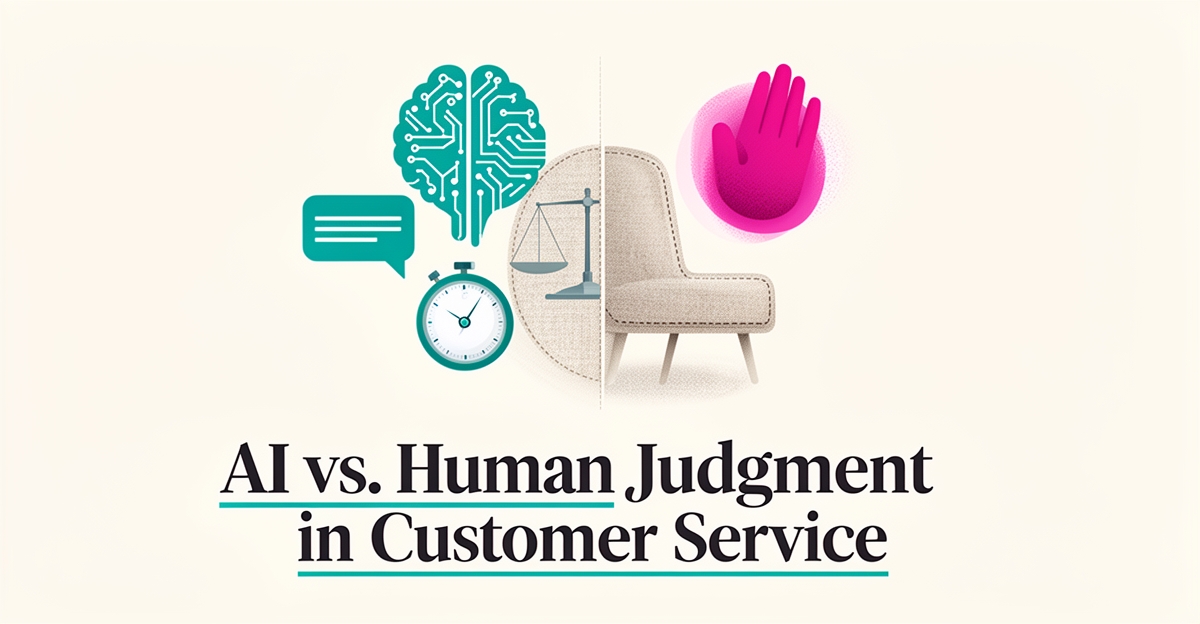
Humans remain indispensable in these high-stakes moments because they excel at forward-looking reasoning that lets them interpret subtle cues, exercise moral judgment, and provide the emotional connection needed to de-escalate tensions and preserve long-term relationships. Human agents can adapt to novel complaint types, read between the lines of a customer's tone, and negotiate solutions that uphold both business integrity and customer dignity. This capacity for empathy and ethical decision-making is not just a soft skill — human-AI teams consistently outperform either humans or AI working alone on complex, judgment-heavy tasks, a pattern the industry calls the centaur model.
The most effective approach for upholstery shops is not to choose between AI and humans, but to integrate them: AI manages routine workflows — instant acknowledgment of complaints, extraction of order details, and initial damage assessment via image analysis — while human agents focus on exceptions requiring judgment, negotiation, and relationship repair. This division of labor leverages AI's strength in handling high-volume, repetitive tasks, freeing human staff to concentrate on the emotionally complex, ambiguous, or high-value interactions that drive customer loyalty and trust. With transparent design and continuous human oversight, automation enhances rather than erodes the human touch essential to service excellence in repair environments.
Implementing AI in Your Upholstery Shop: A Practical, Low-Risk Path Forward
A low-risk rollout starts with the work upholstery shops already do repetitively, then expands as confidence grows. The goal is faster acknowledgment, consistent policy application, and freeing staff for relationship repair.
Start with AI-powered intake and data extraction. An AI agent captures submissions via email, portal or chat and parses free-text messages for order number, product details, purchase date, warranty status and return reason. This tagging happens instantly, and immediate acknowledgment typically cuts "where is my refund?" support tickets substantially.
Add computer vision for damage assessment. Customers upload photos or videos of the upholstery issue and vision models verify the product matches the order, assess severity, and flag signs of misuse versus manufacturing defects. AI can also detect stock photos or AI-generated images. This visual triage supports consistent, rules-based decisions and feeds fraud scoring by analyzing customer history, return frequency and photo analysis.
Enable policy-based auto-approvals for routine cases. Once data is extracted and verified, the claim is cross-referenced against return and warranty policies, product category and customer segment. AI can typically auto-approve a large share of routine claims this way, with average handling time dropping from 10–30 minutes manually to roughly 1–3 minutes, and time to resolution moving from 3–7 business days to same day or 24 hours for eligible claims.
Escalate complex cases to human agents with context. Claims that are high-value, ambiguous, flagged for fraud, or outside policy rules are routed to staff with a summary and recommended action. This centaur model leverages AI for execution and humans for judgment, which consistently outperforms either alone on complex tasks. Human oversight preserves empathy and ethical decision-making where context overrides rigid rules.
Continuous learning and fraud detection are built into the loop. Models learn from every processed claim to improve pattern recognition and fraud scoring, while analytics surface trends such as seasonal spikes or supplier quality issues. Operational costs commonly fall meaningfully through this automation, while accountability for high-stakes decisions stays with your team.
A practical entry point is an AI Employee pilot via the Start Monthly model. AIQ Labs deploys managed AI staff — receptionists, SDRs, dispatchers and 99+ other roles — trained for service-based repair environments, with build, training, tool integrations, monitoring and improvements included. The monthly plan costs roughly 80% less than a human hire and can be paused or adjusted anytime. If you'd rather fix one painful workflow first, AI Workflow Builds rebuild the single workflow that costs you the most at a fixed price.
Implementation can follow a clear progression:
- Intake and data extraction for order and warranty details
- Computer vision analysis of damage photos and authenticity checks
- Policy matching and rule application for auto-approve, auto-deny or escalate
- Human-in-the-loop escalation for exceptions and relationship repair
- Continuous learning, fraud scoring and analytics optimization
This staged approach delivers speed and consistency now, and can grow into a connected AI Operating System for the whole shop as the system learns your specific policies and customer patterns.
Still paying for 10+ subscriptions that don’t talk to each other?
We build custom AI systems you own outright. No vendor lock-in. Full control.
Not sure where to start? Ask our AI planner
Frequently Asked Questions
How much time can AI save on handling customer complaints in upholstery shops compared to manual processing?
Can AI fully replace human staff in handling complex customer complaints in auto upholstery?
What share of routine upholstery complaints can AI auto-approve, and how does that affect resolution time?
How does AI reduce 'where is my refund?' tickets in upholstery shops?
What is the centaur model in AI-human complaint handling, and why is it effective for upholstery shops?
Is implementing AI in an upholstery shop expensive or risky for small businesses?
The Hybrid Advantage: Where Speed Meets Soul in Customer Care
The verdict is clear: AI alone cannot replicate the empathy required for complex negotiations, yet human-only teams drown in manual data entry that stretches resolution to days. The winning strategy for upholstery shops is the centaur model — deploying AI for instant acknowledgment, photo analysis, and policy-based triage while reserving human expertise for high-stakes conversations and relationship repair. This hybrid approach turns complaint management from a cost center into a competitive advantage: no customer waits overnight for a response, and your technicians focus on the craftsmanship that drives revenue. AIQ Labs builds managed AI Employees specifically for service-based repair environments — 200+ multi-agent systems deployed and counting — handling the repetitive intake so your team can handle the exceptions. Ready to see how this fits your shop? Start with the two-minute Fit Check at aiqlabs.ai/apply, then book a free 30-minute strategy call to map your specific workflow — no obligation, just a clear roadmap for faster, more human customer care.
Make AI your competitive advantage — not just another tool.
Strategy, implementation and ongoing optimization. One partner, end to end.
Not sure where to start? Ask our AI planner