AI vs. In-House Cleaning Staff: Which Is Better for Healthcare Facilities?
Key Facts
- AI adoption in janitorial cleaning has grown significantly since 2022.
- Many commercial cleaning operations now use automated workflow systems.
- Healthcare facilities using AI-driven cleaning achieve 23-31% operational cost reductions.
- AI-powered scheduling delivers 28% faster job completion times than manual coordination.
- AI operating systems reduce travel time by 20-35% while scaling to hundreds of locations.
- Service quality metrics improve by up to 45% with AI cleaning systems.
- Younger staff under 35 adapt to AI systems 65% faster than cleaners over 45.
Hire a team member that works 24/7 — for less than a part-time wage.
AI receptionists, SDRs, dispatchers and 99+ roles. Trained on your business, fully managed.
Not sure where to start? Ask our AI planner
The Hidden Cost Burden of Traditional Healthcare Cleaning
Healthcare facilities face relentless pressure to keep environments sterile while controlling escalating operational costs. Relying solely on in-house cleaning teams creates a hidden cost burden that compounds over time.
Labor expenses dominate the budget and rise steadily. Traditional teams require salaries, benefits, taxes, recruiting and ongoing training, with adoption of mobile apps and automated check-in systems taking 3-6 weeks of consistent reinforcement. Younger staff under 35 adapt 65% faster than experienced cleaners over 45, creating uneven performance and supervisory overhead.
Scheduling and task completion inefficiencies erode margins daily. Manual processes rely on spreadsheets, paper checklists, and phone-based workflows that limit visibility. AI operating systems reduce travel time by 20-35% and scale to hundreds of locations, while manual coordination struggles with coverage gaps and overtime.
The data burden is significant before any improvement can be realized. Companies moving from paper-based or basic digital systems often need 60-90 days to clean and standardize historical data for effective utilization. Without standardized data, managers cannot verify compliance, track infection risk zones, or optimize staffing.
The strain shows up across the operation:
- High fixed labor costs with limited flexibility for surge demand or after-hours shifts
- Training overhead and adoption lag that delays process improvements
- Manual scheduling errors that increase travel time and reduce completed tasks per shift
- Paper-based compliance tracking that risks audit findings in regulated healthcare environments
Industry context underscores the shift. AI adoption in janitorial and cleaning has grown significantly since 2022, with 67% of commercial cleaning operations now using at least one automated workflow system. Organizations using AI-powered scheduling and dispatch see 28% faster job completion times compared to manual coordination.
This is where a balanced strategy matters. AIQ Labs works with healthcare facilities to map the optimal mix, using AI for scheduling, dispatch and compliance while retaining human staff for complex or sensitive tasks. The goal is not full replacement but removing hidden cost burden from the parts of cleaning that scale with software.
Traditional in-house models remain valuable for personal touch and thoroughness, but the financial and operational strain of doing everything manually is increasingly unsustainable.
How AI-Driven Cleaning Systems Are Transforming Healthcare Operations
Healthcare facilities face mounting pressure to maintain impeccable cleanliness standards while managing tight operational budgets. As infection control becomes increasingly critical, administrators are reevaluating traditional cleaning approaches in favor of smarter, technology-driven solutions. AI-powered cleaning systems are emerging as a transformative force, delivering measurable improvements in efficiency, cost-effectiveness, and service consistency across healthcare environments.
According to industry research, AI adoption in commercial cleaning has surged significantly since 2022, with 67% of operations now utilizing at least one automated workflow system. This widespread integration reflects growing confidence in AI’s ability to optimize core functions like scheduling, dispatch, and route planning, areas where manual coordination often creates inefficiencies. Facilities implementing these systems report 28% faster job completion times, enabling staff to cover more ground without sacrificing thoroughness.
The financial impact is equally compelling. Healthcare facilities using AI-driven cleaning operations achieve operational cost reductions of 23-31%, according to the same research. These savings stem from reduced labor overtime, minimized travel time between zones, and better allocation of resources based on real-time occupancy and contamination risk data. Additionally, service quality metrics improve by up to 45%, as AI systems enforce standardized protocols, track compliance in real time, and flag areas requiring re-cleaning before inspections occur.
- Intelligent scheduling reduces idle time by matching staff availability to peak traffic periods in high-risk zones
- Automated dispatch ensures the nearest qualified technician responds to spills or biohazard alerts
- Workflow automation generates digital audit trails for regulatory compliance and infection control reporting
- Predictive analytics anticipate cleaning needs based on patient flow, procedure types, and seasonal illness trends
- Centralized dashboards provide facility managers with real-time visibility into cleaning coverage and task completion
AIQ Labs supports healthcare organizations in navigating this shift through strategic AI transformation consulting, helping determine where automation delivers the greatest value, such as in routine floor disinfection or restroom sanitation, while preserving human expertise for sensitive tasks like patient room terminal cleaning or operating room turnover. The goal isn’t replacement, but intelligent augmentation: using AI to handle repetitive, data-driven workflows so skilled staff can focus on complex, judgment-intensive responsibilities that directly impact patient safety and satisfaction. This balanced approach maximizes both operational efficiency and clinical outcomes in demanding healthcare settings.
The Hybrid Model: Where AI Excels and Humans Remain Essential
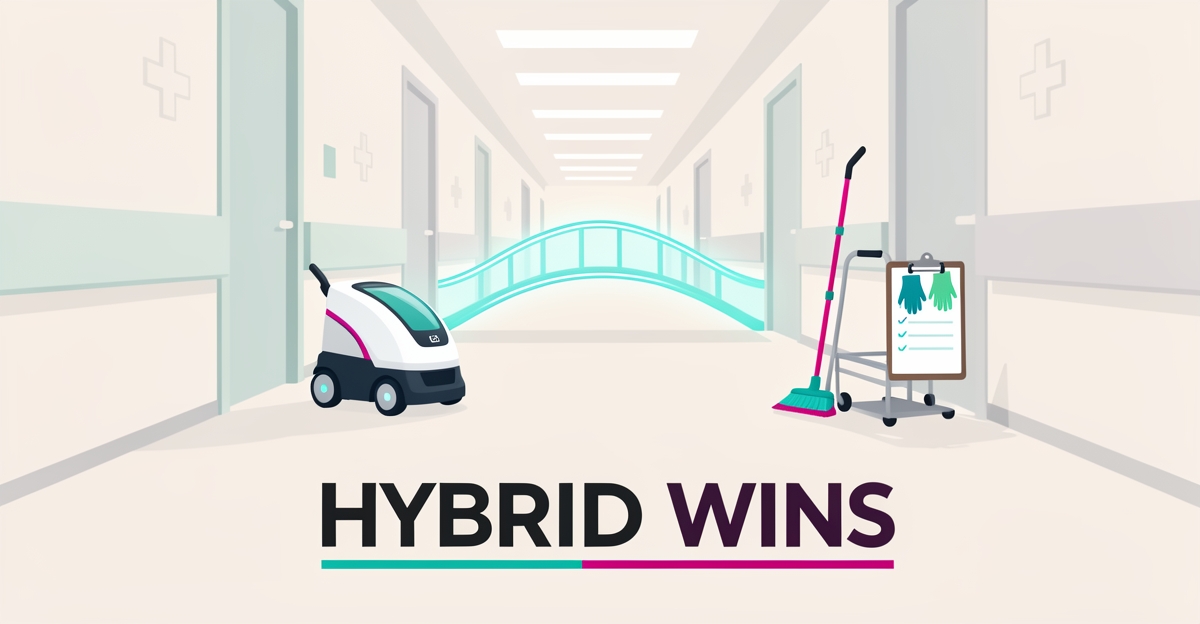
The most effective healthcare facilities don’t choose between AI and human cleaners, they design workflows where each handles what it does best. This hybrid approach is how leading organizations achieve the 23-31% operational cost reductions reported across the industry without sacrificing the nuanced judgment that patient environments demand.
AI excels at the operational backbone of healthcare cleaning: scheduling crews across departments, dispatching teams based on real-time census data, and tracking compliance documentation. According to industry research, AI-powered scheduling and dispatch features deliver 28% faster job completion times compared to manual coordination. These systems automate routing, monitor supply levels, and generate audit trails for regulatory inspections, tasks that consume hours of administrative time but follow predictable, rule-based logic.
However, human judgment remains irreplaceable for complex, sensitive, or patient-facing duties. Traditional in-house staff provide the adaptability required for biohazard containment, terminal cleaning in isolation units, and compassionate interaction in occupied patient rooms, scenarios where rigid automation falls short. These high-touch responsibilities demand the personal attention and situational awareness that only trained professionals deliver.
A balanced hybrid model typically divides responsibilities along these lines:
- AI manages: Dynamic scheduling, dispatch optimization, compliance tracking, supply chain forecasting, and routine quality assurance
- Humans manage: Terminal cleaning, infection control protocols, biohazard response, patient interaction, and sensitive clinical areas
- Shared oversight: AI flags anomalies or supply needs; human supervisors make final decisions on protocol adjustments
Implementing this balance requires more than purchasing software, it demands a strategic assessment of which workflows truly benefit from automation versus augmentation. This is where AIQ Labs provides value through AI implementation roadmaps that map specific facility needs against the optimal division of labor. By designing systems where AI handles the administrative burden while empowering staff to focus on high-skill sanitization, healthcare facilities achieve both the efficiency gains of automation and the reliability of human expertise.
Implementing AI in Healthcare Cleaning: A Practical Roadmap
Healthcare leaders can’t afford to pilot AI in cleaning without a clear path from assessment to scale, especially as adoption accelerates across the industry.
AI adoption in the janitorial and cleaning industry has grown significantly since 2022, with 67% of commercial cleaning operations now using at least one automated workflow system. That momentum is driven by measurable gains: operational cost reductions of 23-31% and improvements in service quality metrics of up to 45%. In healthcare, where compliance and responsiveness matter, a structured roadmap reduces risk while preserving human oversight for complex or sensitive tasks.
Readiness starts with data and systems. Facilities transitioning from paper-based or basic digital systems often need 60-90 days to clean and standardize historical data for effective AI utilization. Integration complexity is lower when organizations already use comprehensive platforms like ServiceTitan or Swept compared to cobbling together separate tools for scheduling, billing, and communication. An AI readiness evaluation maps current technology, data infrastructure, and team capabilities before any build begins.
Piloting should focus on scheduling and dispatch first. Cleaning businesses using AI-powered scheduling and dispatch features see 28% faster job completion times compared to manual coordination methods. AI operating systems automate routing, quality control, and client communication through a single platform, while manual processes rely on spreadsheets, paper checklists, and phone-based workflows. AI systems also reduce travel time by 20 to 35 percent and scale to hundreds of locations.
A practical implementation sequence for healthcare facilities includes:
- Assess readiness and define the optimal mix of AI and in-house staff for compliance-sensitive areas
- Pilot AI scheduling and dispatch in one unit or campus to measure completion times and quality metrics
- Integrate AI with existing facility management, CMMS, and compliance platforms for seamless data flow
- Train managers and technicians with 3-6 weeks of consistent reinforcement to drive adoption
- Scale responsibly with governance, audit trails, and human-in-the-loop controls for critical cleaning tasks
Staff adoption is a key lever. Cleaning operations managers report technician adoption of mobile apps and automated check-in systems requires 3-6 weeks of consistent reinforcement, with younger staff under 35 adapting 65% faster than experienced cleaners over 45. Change management should therefore be built into the rollout, not added after.
AIQ Labs supports this journey through its AI Transformation Consulting pillar, which provides AI readiness assessments, roadmap design, and implementation oversight for SMBs seeking owned systems rather than subscription lock-in. The approach aligns with AIQ Labs’ broader transformation consulting services, helping healthcare leaders determine where AI adds value for scheduling, dispatch, and compliance while retaining human staff for complex or sensitive tasks.
Still paying for 10+ subscriptions that don’t talk to each other?
We build custom AI systems you own outright. No vendor lock-in. Full control.
Not sure where to start? Ask our AI planner
Frequently Asked Questions
Will AI completely replace human cleaning staff in healthcare facilities?
How much can healthcare facilities save by implementing AI-driven cleaning systems?
What specific improvements do AI systems bring to healthcare cleaning operations?
How long does it take for cleaning staff to adapt to AI-powered mobile apps and automated check-in systems?
What data preparation is needed before implementing AI in healthcare cleaning?
What percentage of commercial cleaning operations now use automated workflow systems?
The Bottom Line: A Smarter Clean for Healthcare
The choice between AI and in-house cleaning staff isn’t binary. Healthcare facilities achieve the strongest outcomes by pairing AI’s operational strengths, scheduling, dispatch, and compliance tracking, with human expertise for complex, sensitive tasks. This hybrid model delivers measurable results: operational cost reductions of 23-31% and service quality improvements up to 45%, while preserving the personal touch required in patient environments. AIQ Labs helps healthcare leaders design this balance through AI readiness assessments and implementation roadmaps that map specific facility needs to the optimal mix of automation and human oversight. Ready to explore the right balance for your facility? Start with a free, no-obligation Fit Check at Apply, then book a 30-minute strategy call to map your highest-ROI opportunities, no sales pitch, just clarity on your next step.
Make AI your competitive advantage — not just another tool.
Strategy, implementation and ongoing optimization. One partner, end to end.
Not sure where to start? Ask our AI planner