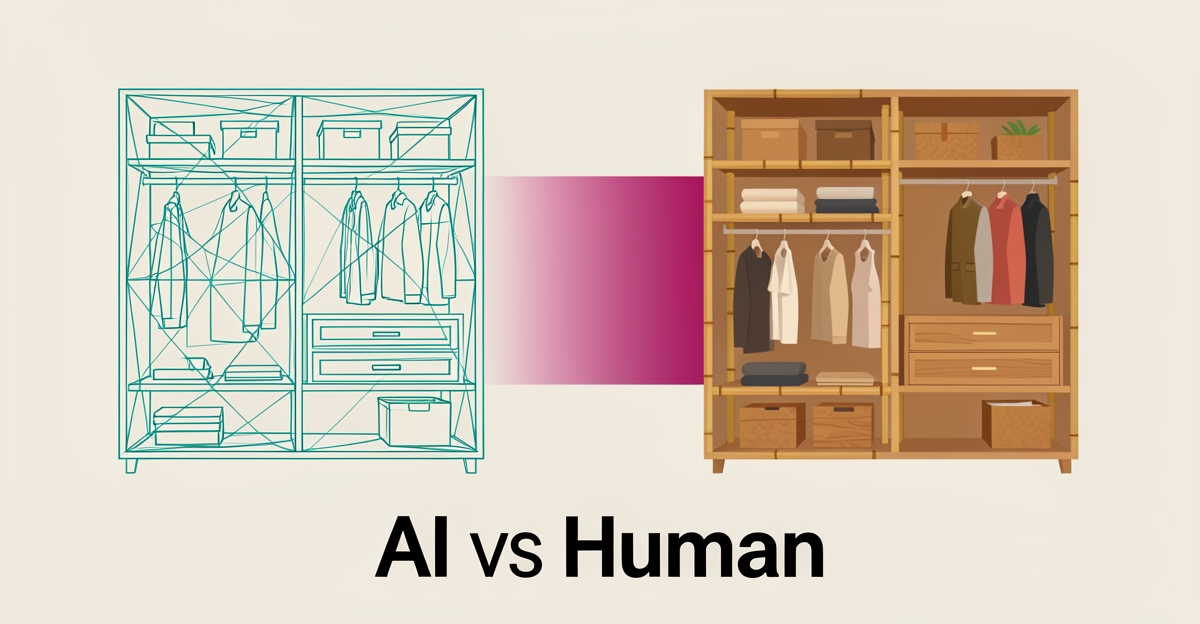
# AI vs In-House Closet Design: Which Is Better for Small Businesses?
**Quick Answer:** AI vs. in-house closet design: AI tools cut overhead dramatically and scale instantly, while human designers deliver judgment and customization. Find your fit with AIQ Labs' 2-minute Fit Check, then book a free strategy call.
## Key Facts
n
- Industry trend research suggests a strong majority of buyers now prioritize environmentally-friendly features like bamboo and recycled wood (PA Home walk-in closet trends)
- A majority of consumers will pay extra for custom closet features, making personalization a revenue driver, not a cost
- Roughly two-thirds of homeowners are actively reworking their master closets for better functionality, signaling sustained market demand
- AI design tools can substantially reduce overhead compared to in-house designers, who typically cost tens of thousands of dollars annually in salary alone
- AI can see a pattern and completely misclassify it, making human review checkpoints essential (as researchers warn)
- About half of homeowners specifically want adjustable storage, making modular design a baseline client expectation
- High-volume firms should leverage AI for speed while boutiques keep humans for premium client relationships
## Table of Contents
- [The Design Dilemma: Why Small Businesses Can't Afford to Guess](#the-design-dilemma-why-small-businesses-cant-afford-to-guess)
- [Head-to-Head: Cost, Scalability, and Accuracy Compared](#head-to-head-cost-scalability-and-accuracy-compared)
- [Matching the Solution to Your Business Reality](#matching-the-solution-to-your-business-reality)
- [Implementation Roadmap: From Assessment to First Design](#implementation-roadmap-from-assessment-to-first-design)
## The Design Dilemma: Why Small Businesses Can't Afford to Guess
Every closet design business eventually faces the same fork in the road: build an in-house design team or adopt AI-driven planning tools. The choice isn't just about technology, it's about whether your operation can keep pace with client expectations that are rising faster than most small businesses can hire.
The market signals make the stakes clear. Industry research suggests roughly two-thirds of homeowners are reworking their master closets to meet specific needs and improve functionality. That's not a niche request anymore, it's the majority of your potential client base asking for designs that are precise, functional, and tailored to how they actually live.
At the same time, clients expect more than a standard layout. Consumer research indicates a majority are willing to pay extra for custom features, and industry trend analysis shows most buyers now prioritize environmentally-friendly materials like bamboo, recycled wood, and non-toxic finishes. Meeting all three demands, customization, sustainability, and speed, is a tall order for a small design team.
The cost of guessing wrong shows up in two places:
- **Time-to-market:** in-house teams deliver human judgment and strategic decision-making, but hiring, training, and scaling designers takes months, while clients wait.
- **Cost exposure:** designers are expensive to employ and hard to keep busy during slow seasons, making fixed payroll a risky bet for lower-volume businesses.
- **Capability gaps:** AI tools score high on flexibility, customization, and sustainability support, but they carry their own risks, researchers note that AI "can see a pattern and completely misclassify it," meaning output still needs oversight.
Neither path is automatically right. A high-volume firm serving multiple regions has different needs than a single-location shop handling a handful of projects a month. Client volume, geographic reach, and operational capacity should drive the decision, not industry hype in either direction.
This is exactly the kind of decision that benefits from structured evaluation rather than instinct. AIQ Labs' 2-minute Fit Check examines your current technology stack, team capabilities, and business case to determine which path, in-house, AI-driven, or a hybrid, actually fits your operation. The goal is clarity before capital: know the trade-offs in cost, scalability, and time-to-market before you commit either a payroll budget or a software investment.
## Head-to-Head: Cost, Scalability, and Accuracy Compared
When evaluating design options, cost efficiency often drives the initial decision for small businesses. AI-powered closet design tools typically run on a flat monthly investment, eliminating the need for salaries, benefits, and recruiting expenses associated with an in-house team. This model can substantially reduce design-related overhead compared to hiring dedicated staff, particularly for businesses with fluctuating project volumes. In contrast, maintaining an in-house team typically involves fixed annual costs of tens of thousands of dollars per designer, plus additional expenses for training and software licenses. For a sense of scale: AIQ Labs' AI Employees, managed AI staff across 99+ roles, generally run at rou
AI Employees
Hire a team member that works 24/7 — for less than a part-time wage.
AI receptionists, SDRs, dispatchers and 99+ roles. Trained on your business, fully managed.
See If You’re a Fit — AI Employees from $700/mo
Not sure where to start? Ask our AI planner
ghly 80% less cost than an equivalent human hire.
Scalability presents another clear advantage for AI solutions, especially for businesses serving remote clients or experiencing seasonal demand spikes. AI tools can instantly generate multiple design variations without delays, supporting high-volume output and geographic flexibility. With most homeowners reportedly modifying their master closets for improved functionality, sustained demand is something AI systems can meet without capacity constraints. In-house teams, however, face limitations in handling sudden surges or providing consistent support across time zones without significant staffing adjustments.
Accuracy involves a more nuanced trade-off. While AI excels at rapid pattern recognition and applying established design rules, it carries known risks of misclassifying complex preferences or overlooking subtle contextual cues, such as misinterpreting a client's lifestyle needs as a generic storage requirement. Human designers, by contrast, bring strategic judgment and emotional intelligence to interpret unspoken needs, though their output may vary based on individual expertise and fatigue. For businesses prioritizing speed to first deliverable, AI tools often produce initial concepts within minutes, whereas in-house workflows typically require days for consultation, drafting, and revisions. This immediacy allows firms to respond quickly to inquiries, improving client engagement and reducing time-to-quote.
For guidance on aligning these trade-offs with your operational goals, start with AIQ Labs' Fit Check, then schedule a free 30-minute strategy call to explore how AI integration could streamline your design process without compromising quality.
## Matching the Solution to Your Business Reality
There's no universal winner in the AI vs. in-house closet design debate, the right choice depends entirely on your business's specific reality. Three factors determine which path delivers the best return: your client volume, your geographic reach, and your operational capacity.
**If you're a low-volume, high-touch boutique**, human designers remain your strongest asset. When clients are paying premium prices for one-on-one service, and a majority of consumers are willing to pay extra for custom features, the human expertise and strategic decision-making of an in-house team is exactly what justifies that price point. Boutique-inspired design, with its emphasis on high-end materials and personalized additions, depends on judgment and relationship-building that AI tools can support but not replace. In this model, AI works best behind the scenes, generating renderings and layout options your designer refines with the client.
**If you operate at high volume or across multiple regions**, AI-powered design tools offer a decisive edge. AI consistently outperforms small in-house teams on flexibility, customization speed, sustainability integration, and smart technology features, critical when most homeowners are modifying their master closets to improve functionality. AI systems can produce design variations, render photorealistic concepts, and reconfigure modular layouts far faster than a human team can, letting you handle more clients without adding headcount. With most buyers now prioritizing environmentally-friendly features, AI tools also make it easier to surface sustainable material options, bamboo, recycled wood, non-toxic finishes, at scale.
**If your operational capacity is limited**, the hybrid model is usually the smartest starting point. Rather than choosing one side, split the work by strength:
- Use AI for concept generation, renderings, and modular configuration options
- Keep human designers focused on final decisions and client relationships
- Let AI handle sustainability and smart-tech feature matching across your catalog
- Reserve staff time for the premium, high-touch projects that drive margin
This division of labor matters because AI has real limits. As researcher Christoph Adami noted in TechRadar, "AI has an Achilles' heel: it can see a pattern and completely misclassify it." A human checkpoint catches those errors before they reach a paying client.
If you're unsure which profile fits your business, that uncertainty itself is a signal to assess before investing. AIQ Labs' Fit Check evaluates your client volume, systems, and team capacity to identify whether AI, human talent, or a hybrid approach makes sense, and if there isn't a clear win, they'll tell you that too.
## Implementation Roadmap: From Assessment to First Design
Deciding between AI and an in-house design team is only half the battle, the real risk is implementing the wrong choice badly. A structured roadmap turns your decision into a controlled experiment rather than a costly leap of faith.
Start with an honest assessment of your current state. Determine your business volume, geographic reach, and operational capacity: how many design projects you handle monthly, how far your clients are scattered, and how many hours your team can realistically dedicate to design work. A shop handling a handful of local projects has very different needs than one serving clients across multiple regions.
Next, prioritize the features your buyers actually pay for. The market has already told you what matters, most buyers prioritize environmentally-friendly features, according to
AI Development
Still paying for 10+ subscriptions that don’t talk to each other?
We build custom AI systems you own outright. No vendor lock-in. Full control.
See If You’re a Fit — AI Employees from $700/mo
Not sure where to start? Ask our AI planner
underline decoration-amber hover:decoration-amber-deep hover:text-amber-deep underline-offset-4 transition-colors" href="https://pahome.com/blog/2024-walk-in-closet-trends-sustainable-smart-and-boutique-inspired-design-solutions/">walk-in closet industry research, while a majority of consumers will pay extra for custom features and about half of homeowners select adjustable storage. Whatever path you choose, make sure it can deliver sustainable materials, smart lighting, and modular, reconfigurable storage as core capabilities, not afterthoughts.
When you're ready to test AI, pilot it on a limited workflow before committing. Pick one stage of the design process, perhaps initial layout generation or render production, and run it alongside your existing method for a defined period. This lets you compare output quality, speed, and client reaction without betting the business on unproven tools. AIQ Labs' Workflow Builds follow exactly this pattern: rebuild the one workflow that costs you the most, at a fixed price, in phases, so you prove value before scaling.
Build human review checkpoints into every AI workflow from day one. AI has a documented weakness: as researcher Christoph Adami notes, AI can see a pattern and completely misclassify it. A designer should review every AI-generated layout for material errors, unrealistic dimensions, and misread client preferences before anything reaches a customer.
A practical rollout checklist:
- Audit your monthly design volume, client geography, and team capacity
- Map the features buyers pay for, sustainability, customization, adjustability, against each option
- Pilot AI tools on a single workflow with a defined evaluation window
- Establish human review checkpoints to catch misclassifications before client delivery
- Reassess quarterly and scale what works
If this process feels overwhelming, a structured evaluation is the lowest-risk starting point. AIQ Labs' Fit Check examines your current technology stack, data infrastructure, and team capabilities, then models the ROI of each path before you spend a dollar on tools or hires. It's the difference between guessing and knowing which route fits your business.
## Frequently Asked Questions
**How much can AI-powered closet design tools reduce design-related overhead compared to hiring an in-house designer?**
AI-powered tools can substantially reduce design-related overhead compared to hiring dedicated staff, particularly for businesses with fluctuating project volumes, by eliminating salaries, benefits, and recruiting expenses. Managed AI staff, like AIQ Labs' AI Employees, typically run at roughly 80% less than an equivalent human hire.
**What percentage of homeowners are modifying their master closets to improve functionality, and why does this matter for small closet design businesses?**
Industry research suggests roughly two-thirds of homeowners are modifying their master closets to meet specific needs and improve functionality, which means the majority of potential clients now expect precise, tailored designs, not just standard layouts.
**Are AI design tools accurate enough to use without human review, or do they risk making serious errors in closet design?**
AI tools can misclassify patterns or overlook subtle contextual cues, such as misinterpreting a client's lifestyle needs as generic storage, so human review is essential to catch errors before client delivery.
**What percentage of buyers prioritize environmentally-friendly features in walk-in closet design, and how can AI help meet this demand at scale?**
Industry trend research indicates a strong majority of buyers prioritize environmentally-friendly features like bamboo, recycled wood, and non-toxic finishes, and AI tools can surface sustainable material options across catalogs quickly and consistently.
**Is a hybrid approach using both AI and human designers effective for small businesses, and how should work be divided between them?**
Yes, a hybrid model works best for limited operational capacity: use AI for concept generation, renderings, and sustainability matching, while human designers focus on final decisions, client relationships, and high-touch premium projects.
**What is the first step a small closet design business should take before investing in AI tools or hiring designers?**
Start with AIQ Labs' 2-minute Fit Check to evaluate your current technology stack, team capabilities, and business case, this helps determine whether AI, in-house, or hybrid design is the right fit before spending on tools or payroll.
## Key Takeaways
**Design Smarter, Not Just Faster.** The choice between AI-driven design tools and an in-house team ultimately comes down to how your business actually operates, not which technology sounds more impressive. Small shops thrive on high-touch relationships where human judgment justifies premium pricing; high-volume operations win on speed and scale, which AI delivers without adding headcount. Whichever path fits, keep human review checkpoints in place, AI's pattern-matching strengths come with real misclassification risks. Start with the Fit Check, pilot one workflow, and scale what works. Questions? Reach the team at [email protected].
AI Transformation Partner
Make AI your competitive advantage — not just another tool.
Strategy, implementation and ongoing optimization. One partner, end to end.
See If You’re a Fit — AI Employees from $700/mo
Not sure where to start? Ask our AI planner