AI vs In-House Designers: Which Is Better for Small Landscape Firms?
Key Facts
- AI can generate multiple design concepts in minutes versus hours or days of manual rendering according to industry research
- One product design team reported roughly doubling their design speed by integrating AI into early-stage work based on user reports
- Consumer AI design apps have reached tens of millions of users globally according to app data
- Leading AI design apps maintain ratings above 4.5 stars on the App Store per user reviews
- Traditional in-house design typically carries higher labor costs per project than AI-assisted concepting according to design cost analysis
- AI lacks contextual understanding for client needs and site constraints, requiring human refinement for quality standards per creative industry insights
- AI enables rapid prototyping that turns rough sketches into visual concepts in minutes according to workflow research
Hire a team member that works 24/7 — for less than a part-time wage.
AI receptionists, SDRs, dispatchers and 99+ roles. Trained on your business, fully managed.
Not sure where to start? Ask our AI planner
The Small Landscape Firm Design Bottleneck
The landscape design proposal that took three days to draft may already be losing you the job. For small landscape firms, the gap between a client's first call and a finished concept has quietly become one of the most expensive bottlenecks in the business, and it compounds with every project in the queue.
Manual rendering is the first pressure point. Where AI tools now generate multiple design concepts in minutes, traditional in-house concepting still demands hours or days of manual rendering and revisions, according to industry research on AI in creative design. For a firm with one designer, or an owner wearing that hat, each proposal consumes a disproportionate share of the working week.
The cost side is equally unforgiving. Every hour spent sketching, modeling, and adjusting a concept is billable capacity diverted from site work, client relationships, and new business. Research comparing the two approaches notes that traditional in-house design typically carries higher labor costs per project, while AI-assisted concepting can lower the cost of early-stage exploration significantly.
Speed-to-proposal is where the bottleneck turns into lost revenue. Clients requesting quotes typically contact several firms at once, and the first polished, professional concept to land in their inbox sets the benchmark everyone else is judged against. When your turnaround is measured in days and a competitor's is measured in hours, win rates suffer regardless of design quality.
The constraints facing small firms typically stack up in predictable ways:
- Limited rendering capacity, one or two people handling every concept from scratch
- High per-project labor costs, senior-level hours burned on early-stage drafts
- Slow iteration cycles, each client revision adds hours or days to the timeline
- Throughput ceilings, turning away work because design capacity is maxed out
This is the quality-versus-throughput trap: produce fewer, slower, carefully crafted proposals and lose on speed, or rush concepts out and lose on polish. Neither path scales.
Notably, one product design team reported roughly doubling the speed of their design process by integrating AI into early-stage work, a benchmark that hints at what similar workflow automation could unlock for landscape concepting. At AIQ Labs, this is precisely the kind of bottleneck our AI Workflow Builds target: not replacing the designer's judgment, but removing the manual drag that keeps that judgment from reaching clients fast enough.
What Research Shows About AI Speed and Creative Exploration
Ask any landscape designer what eats up their week, and the answer is rarely the creative work, it's the rendering, revising, and re-rendering that comes with every client conversation. That's exactly where AI tools are changing the math for small firms.
The headline finding across recent research is speed. AI can generate multiple design concepts in minutes, a task that traditionally takes hours or days of manual rendering and adjustment, according to analysis of AI in creative design. For a small landscape firm pitching a residential client, that difference turns a multi-day concepting cycle into a same-day conversation.
The gains aren't just anecdotal. One product design team reported accelerating their design process by roughly 2x after integrating AI into their workflow. For firms where a designer's time is the scarcest resource, doubling throughput on early-stage concepts means more proposals sent, more clients served, and less overtime spent redrawing plans that missed the mark.
Beyond raw speed, AI changes what's possible in early exploration:
- Rapid prototyping, rough sketches and verbal ideas can be turned into visual concepts in minutes rather than hours.
- Wider option sets, AI generates a broader range of aesthetic directions than a single designer would typically produce, sparking ideas that traditional methods might never surface.
- Faster iteration, multiple variations can be generated and compared quickly, letting firms test more possibilities before committing to one.
- Freed-up senior time, with AI handling repetitive rendering, designers can shift toward strategy, client communication, and refining the strongest concepts.
That last point matters more than it first appears. The research is clear that AI works best as a design assistant, not a replacement. AI-generated output lacks the contextual understanding to fully grasp specific client needs, site constraints, or brand identity, and it often requires human refinement to meet quality standards. The workflow that emerges is a hybrid: AI produces the breadth, humans supply the judgment.
This shift is also changing what skill sets matter. Designers are becoming facilitators and curators of AI-generated ideas, and the ability to prompt effectively, evaluate output critically, and integrate results into a cohesive design is now a core competency. As one industry observation puts it, the designers growing fastest aren't the ones with flashiest visuals, they're the ones who know what to automate and where human thinking still matters most.
For small landscape firms weighing their options, the practical takeaway is that AI's speed advantage is real but conditional on having someone who can direct it. Firms evaluating where AI fits into their design workflow can benefit from a structured assessment, something the team at AIQ Labs offers through a free strategy call to map high-ROI automation opportunities before any build begins.
AI vs In-House: Cost, Quality and Context Trade-offs
AI is reshaping how small landscape firms approach early-stage design, offering speed and breadth that traditional methods struggle to match. AI-powered tools can generate multiple design concepts in minutes, a stark contrast to the hours or days required for manual rendering and revisions according to industry research. This acceleration allows firms to explore a wider range of aesthetic directions quickly, turning rough ideas into visual prototypes without the bottleneck of manual drafting as noted in design technology analyses. One product design team even reported a roughly 2x increase in process speed when integrating AI into their workflow based on user-reported performance data.
However, speed and idea volume come with trade-offs in depth and relevance. While AI excels at automation and rapid ideation, it often lacks the contextual understanding needed to align designs with specific client visions, site constraints, or brand identity as highlighted in creative industry insights. Human designers bring empathy, strategic judgment, and nuanced interpretation, qualities AI cannot replicate when assessing how a space will feel or function for real users. AI-generated outputs frequently require refinement to ensure practicality, quality, and buildability, shifting the designer's role toward curation and prompt engineering rather than pure execution per user experience reports.
This dynamic suggests a hybrid model works best for small firms: using AI to accelerate concept exploration and reduce time spent on repetitive tasks, while reserving human expertise for client alignment, strategic refinement, and final quality control. AIQ Labs supports this balance by helping firms integrate AI tools into their workflows without replacing the creative judgment that defines great landscape design. Rather than choosing between AI and in-house talent, firms can leverage both, letting AI handle the volume of early ideas so designers can focus on the thoughtful, client-centered work that drives satisfaction and referrals. The result is faster turnarounds, broader exploration, and designs that are not only quick to produce but deeply attuned to the people and places they serve.
The Hybrid Model: How Small Firms Use AI to Augment Design Teams
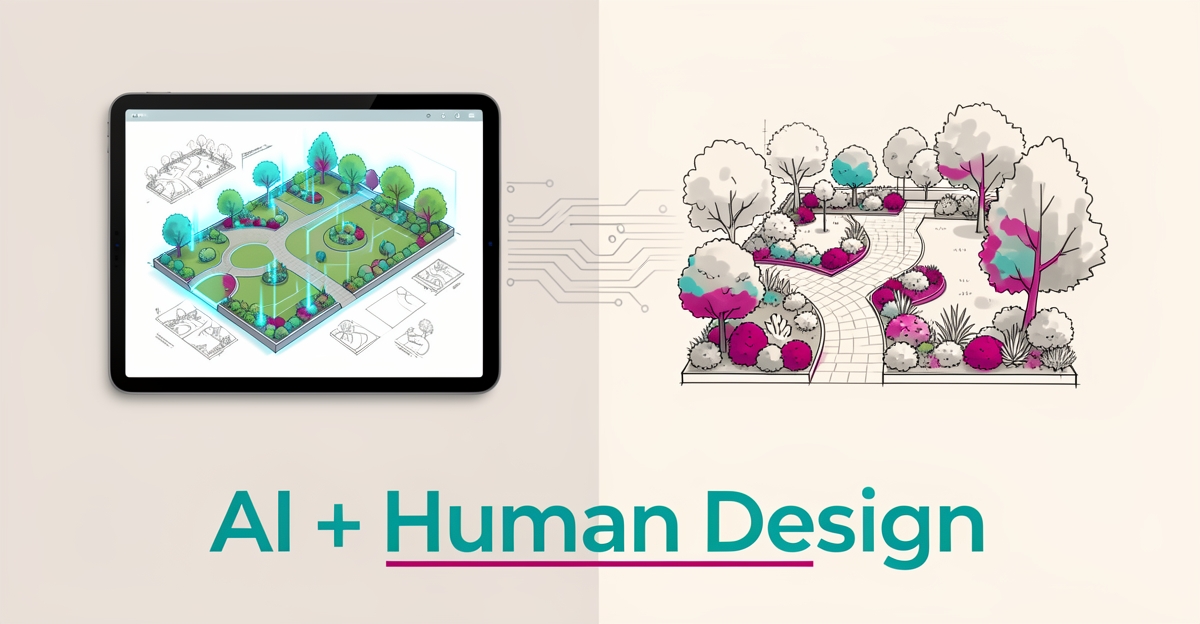
The most effective landscape design workflows today don't pit AI against human designers, they combine them. AI excels at rapidly generating initial concepts, exploring variations, and producing quick visualizations, allowing teams to explore dozens of ideas in minutes rather than hours or days according to industry research. This acceleration gives designers more time to focus on strategic vision, client needs, and refining the strongest options.
In a hybrid model, AI handles the heavy lifting of ideation and visualization while human designers curate, refine, and apply contextual understanding. One product design team reported accelerating their process by roughly 2x using AI for these early stages as noted in user reports, freeing up bandwidth for higher-value tasks like material selection, sustainability planning, and detailed client presentations. AI doesn't replace the designer, it amplifies their impact.
AIQ Labs supports this hybrid approach through AI Workflow Builds, which rebuild the one workflow that costs you the most, fixed price, delivered in phases, so repetitive design tasks and concept generation are integrated directly into how you already work. By automating initial drafts and variations, firms reduce manual workload without sacrificing creative standards or time-to-market. Designers remain in control, guiding AI output with their expertise while benefiting from faster iteration cycles.
This model allows small landscape firms to take on more projects, respond quicker to client requests, and explore bolder ideas, all while keeping the human touch at the heart of every design. The result is a more agile, responsive team that leverages technology to enhance, not replace, creative judgment.
- AI generates multiple concepts in minutes vs. hours/days manually
- Designers focus on strategy, refinement, and client alignment
- Hybrid workflow maintains quality while accelerating delivery
Still paying for 10+ subscriptions that don’t talk to each other?
We build custom AI systems you own outright. No vendor lock-in. Full control.
Not sure where to start? Ask our AI planner
Frequently Asked Questions
How much faster can AI generate landscape design concepts compared to traditional in-house methods?
Will using AI for landscape design replace the need for human designers in small firms?
What specific time savings have firms seen when integrating AI into their design workflow?
How does AI affect the cost of early-stage landscape design for small firms?
What are the main limitations of AI-generated landscape designs that require human oversight?
How can small landscape firms start using AI in their design process without disrupting their current workflow?
Design Smarter, Not Harder: Your Next Step Forward
For small landscape firms, the bottleneck isn't creativity, it's the time lost turning ideas into client-ready concepts. As we've seen, AI doesn't replace the designer's eye; it removes the manual drag of repetitive rendering, letting you explore more options faster while keeping human judgment at the core. The hybrid model, where AI handles rapid ideation and designers focus on strategy and refinement, delivers both speed and substance, turning proposal delays into competitive advantage. If you're ready to see where automation could unlock capacity in your workflow without sacrificing quality, the next step is simple: take the two-minute Fit Check to identify your highest-impact opportunity, then schedule a free 30-minute strategy call with AIQ Labs to map a clear, no-obligation path forward.
Make AI your competitive advantage — not just another tool.
Strategy, implementation and ongoing optimization. One partner, end to end.
Not sure where to start? Ask our AI planner