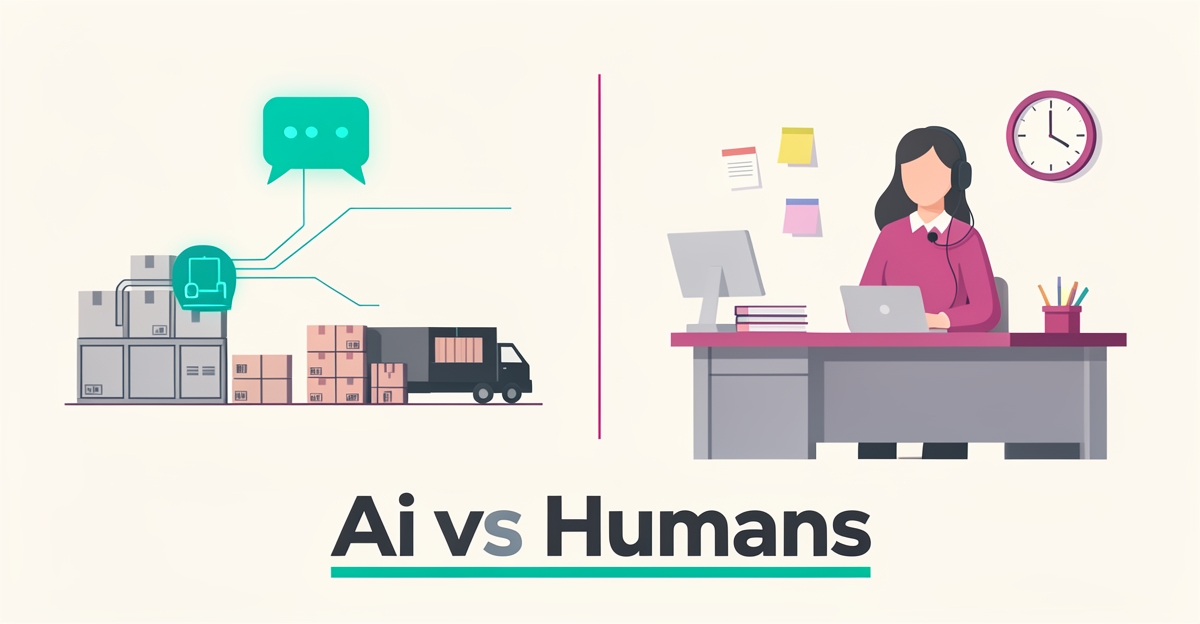
AI vs In-House Staff: Which Is Better for Handling Customer Inquiries in Medical Supply Distribution?
Key Facts
- Industry analyses commonly report that a large share of inbound calls to busy front desks goes unanswered during peak and after-hours periods
- Callers who reach voicemail frequently contact a competitor instead of calling back, per widely cited industry data
- A fully loaded in-house reception hire typically costs tens of thousands of dollars annually once salary, benefits, taxes and turnover are included
- AI Employees from AIQ Labs cost roughly 80% less than an equivalent human role while maintaining consistent response times
- AI systems can reduce no-show and missed-delivery rates through automated reminders and intelligent rescheduling
- AI can meaningfully increase after-hours bookings compared to human-only coverage, per booking metrics from AI deployments
Hire a team member that works 24/7 — for less than a part-time wage.
AI receptionists, SDRs, dispatchers and 99+ roles. Trained on your business, fully managed.
Not sure where to start? Ask our AI planner
The Hidden Cost of Missed Calls in Medical Supply Distribution
The financial drain of missed calls in medical supply distribution extends far beyond simple inconvenience. Industry analyses consistently find that busy front desks miss a substantial share of inbound calls, and that callers who hit voicemail often move straight to a competitor rather than leaving a message. This creates a silent revenue leak that compounds daily, especially when you consider that in-house staff typically cover about 40 hours per week against a 168-hour demand cycle.
This coverage gap isn't just about availability—it's a direct hit to operational sustainability. With a fully loaded in-house reception hire typically costing tens of thousands of dollars annually (salary, benefits, taxes, and turnover), every missed call represents wasted investment. The hidden costs multiply when factoring in recruitment expenses and training investments for each replacement, all while administrative turnover remains a persistent problem in healthcare-adjacent fields.
- A large share of inbound calls goes unanswered by in-house staff during peak and after-hours periods, per common industry findings
- Voicemail callers frequently choose competitors instead of calling back
- In-house coverage leaves most of the 168-hour weekly demand unattended (40 staffed hours vs 168 hours of demand)
The true cost becomes clearer when examining turnover impacts: each replacement drains thousands in recruitment and lost productivity, while management time for scheduling and feedback adds further annual overhead per receptionist. These expenses persist despite creating coverage gaps that directly enable competitor acquisition—particularly damaging since many customers simply won't leave a voicemail when faced with an automated system.
AIQ Labs addresses this systemic inefficiency through managed AI Employees—receptionists, dispatchers, SDRs and 99+ other roles—that provide 24/7 coverage at roughly 80% less cost than an equivalent human hire. By eliminating missed calls and their associated revenue loss, organizations recover immediate operational value while redirecting human staff toward high-value interactions requiring empathy and complex problem-solving—exactly where human judgment delivers irreplaceable impact.
Cost and Performance Comparison: AI Employees vs Human Reception
The financial disparity between AI and human reception is stark. Industry cost comparisons consistently show AI receptionist services running a small fraction of what a fully loaded in-house hire requires once you factor in salary, benefits, taxes, and turnover expenses.
This represents a cost reduction on the order of 80% that fundamentally changes the economics of customer service. For medical supply distributors operating on tight margins, these savings directly impact profitability.
The performance gap extends beyond cost. While human receptionists work roughly 40 hours weekly and handle one call at a time, AI systems operate 24/7 with unlimited simultaneous call capacity. This eliminates the coverage gaps that plague traditional staffing models.
Common industry findings show busy front desks miss a large share of calls, and callers who reach voicemail frequently contact competitors instead. AI receptionists answer every call, capturing revenue that would otherwise walk away.
AI also delivers measurable operational improvements. Deployments commonly report reduced no-show and missed-delivery rates through automated reminders and intelligent rescheduling, directly protecting recurring revenue.
However, the comparison isn't one-sided. AI excels at repetitive, rules-based tasks like appointment scheduling, call routing, and basic inquiries. Human staff remain superior for complex negotiations, emotionally sensitive situations, and decisions requiring contextual judgment.
The optimal approach combines both strengths:
- AI handles: High-volume routine inquiries, scheduling, after-hours coverage, and initial triage
- Humans manage: Complex negotiations, exception handling, relationship building, and strategic decisions
- Hybrid benefit: AI eliminates burnout from repetitive tasks while staff focus on high-value interactions
AIQ Labs specializes in this transition through structured change management and team training. The goal isn't replacement but optimization—deploying AI where it delivers measurable efficiency while preserving human judgment where it matters most.
For medical supply distributors, this means capturing every inquiry, cutting inquiry-handling costs by up to 80%, and freeing skilled staff to handle the complex customer relationships that drive long-term loyalty.
The Hybrid Model: Where AI Handles Volume and Humans Handle Value
Neither pure AI nor pure human staffing wins in medical supply distribution—the research consistently points to a third option. The most effective operational model is a hybrid approach, where AI absorbs the high-volume, structured workload while human staff concentrate on what machines cannot do: complex negotiations, ambiguous situations, and relationship-driven account management.
The division of labor maps directly to task type. AI is superior at repetitive, rules-based work—answering routine inquiries, initial triage, scheduling, and data entry—where it operates 168 hours per week and handles unlimited simultaneous calls. Humans retain the advantage in strategic decision-making and contextual adaptability, especially when data is limited or the stakes are high. The goal is to shift human effort from execution to oversight.
In practice, this means AI handles the structured front line:
- High-volume routine inquiries, order status checks, and appointment or delivery scheduling
- Initial triage and screening, routing only exceptions to human staff
- After-hours coverage, where AI deployments commonly report meaningful gains in after-hours bookings
- Data entry and documentation that would otherwise consume staff hours
The human side of the model is equally defined. Staff focus on exception handling, complex or multi-line orders, escalations, and the account relationships that drive retention in a regulated distribution environment. This shift changes the skill profile: junior staff often move into reviewing AI-generated work, which requires training in validation rather than production.
Governance is where hybrid models succeed or fail, particularly under HIPAA. AI systems must ensure data security through end-to-end encryption, secure portals, and Business Associate Agreements. And accountability does not transfer to the algorithm—it remains with the humans and organizations that deploy it. Many organizations evaluate what AI can do while neglecting whether they have the governance frameworks and human oversight capacity to control what it does.
Before deploying any AI into customer-facing workflows, evaluate candidates against the SAFE criteria: Safety (no harm to patients or customers), Fairness (no bias), Appropriateness (suitability for the specific task), and Validity (operational and clinical accuracy). Pair this with clear escalation paths, audit trails that document decision rationale, and human-in-the-loop controls for critical decisions.
Adoption also requires managing the human transition. Industry research on care-adjacent teams commonly finds a majority of staff express initial resistance to new technology, with typical training periods for AI tools running two to three weeks. Structured training on when to trust AI output—and when to escalate—addresses both. AIQ Labs supports this transition directly, training teams on validation workflows and managing AI integration with minimal disruption, so the hybrid model becomes an operating capability rather than a stalled pilot.
The financial case reinforces the structure: AI Employees cost roughly 80% less than equivalent human roles while maintaining consistent response times, freeing budget for the human talent that actually creates value.
Implementing AI Inquiry Support With Minimal Disruption
Medical supply distributors can't afford missed inquiries, but adding headcount creates cost and coverage gaps that scale poorly. A phased rollout keeps operations steady while capturing the substantial front-desk cost reduction that industry comparisons attribute to AI receptionists.
Start by mapping true workflow costs, not just salary. A fully loaded in-house inquiry hire typically runs tens of thousands of dollars annually when benefits, taxes, training and turnover are included, while AI systems cost a small fraction of that. That gap becomes most visible during peak and after-hours periods, when a single human covers 40 hours per week against round-the-clock demand.
Compliance must lead selection. In healthcare-adjacent distribution, choose HIPAA-compliant AI with end-to-end encryption, Business Associate Agreements and auditable logs. Governance is not optional in regulated environments; accountability stays with the organization deploying the system, not the algorithm.
Narrow the first use case. High-value, rules-based inquiries such as order status, scheduling and back-in-stock notifications deliver fast wins with low risk. This mirrors the hybrid model where AI handles high-volume structured work and staff retain complex negotiations and exceptions.
Staff adoption determines success. Research on care-adjacent teams commonly finds a majority of staff express initial resistance to new technology, and typical training periods for new AI tools run 2 to 3 weeks. Framing AI as workload relief rather than replacement reduces friction.
AIQ Labs supports the transition through change management and training focused on adoption, not just deployment. Teams learn how to evaluate AI output, define escalation paths and maintain human-in-the-loop oversight for ambiguous cases.
A practical rollout follows a contained sequence:
- Audit current inquiry volume, missed call rate and cost per hire to establish baseline ROI
- Pilot a narrow scope like order status and appointment scheduling with HIPAA-compliant AI and monitoring
- Run 2-3 week role-based training emphasizing evaluation, trust thresholds and escalation
- Measure recovery of missed revenue, response time and staff time freed for high-value interactions
Measure early and iterate. Many organizations reach break-even within the first few months, and even a modest number of recovered accounts can cover a monthly AI cost. With consistent response times and 24/7 availability, the system proves value before broader expansion.
Still paying for 10+ subscriptions that don’t talk to each other?
We build custom AI systems you own outright. No vendor lock-in. Full control.
Not sure where to start? Ask our AI planner
Frequently Asked Questions
How much money can I actually save by switching to AI receptionists instead of hiring staff?
Will AI receptionists actually answer calls better than my current staff?
What tasks should AI handle versus what should my human staff keep doing?
Is AI compliant enough for medical supply distribution, or will I run into HIPAA problems?
How do I get my team to actually use AI instead of resisting it?
What's the fastest way to implement AI inquiry support without disrupting current operations?
Capture Every Call, Keep Your Team Where It Matters Most
Medical supply distribution lives or dies on responsiveness, and the math is stark: in-house teams cover just 40 hours a week against round-the-clock demand, while industry findings consistently show busy front desks miss a large share of calls—and voicemail callers frequently move to competitors. AI doesn't replace that human judgment — it protects it. A hybrid model lets AI handle high-volume, rules-based inquiries, 24/7 scheduling and triage, while your staff focus on complex negotiations, exceptions and relationship-building where empathy and context drive retention. The business case is immediate: roughly 80% lower cost than an equivalent human hire, zero missed calls, and consistent response times that recover revenue currently leaking to competitors. Success hinges on governance, HIPAA-compliant deployment, and change management that frames AI as workload relief. AIQ Labs supports that transition through structured training and managed integration, helping teams learn validation workflows and escalation paths with minimal disruption. Map your current inquiry volume and missed-call cost, pilot a narrow use case like order status and scheduling, and measure recovery of revenue and staff time freed for high-value work. Ready to see where the fastest ROI is for your operation? Start the 2-minute Fit Check at https://aiqlabs.ai/apply, then book a free 30-minute strategy call to map your biggest bottleneck.
Make AI your competitive advantage — not just another tool.
Strategy, implementation and ongoing optimization. One partner, end to end.
Not sure where to start? Ask our AI planner