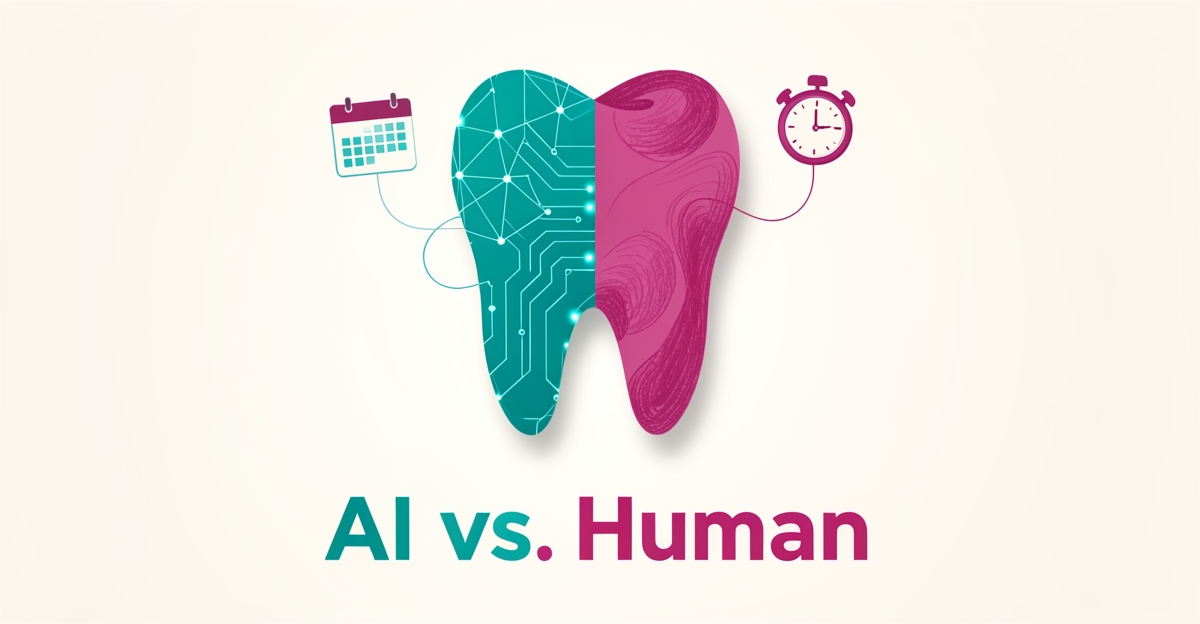
AI vs. In-House Staff: Which Is Better for Patient Follow-Up in Dental Practices?
Key Facts
- AIQ Labs' managed AI staff typically cost around 80% less than an equivalent human hire, with setup, training, integrations and monitoring included
- AI diagnostic tools have shown, in published research, meaningfully higher detection rates for calculus and early caries than visual examination alone
- Practices using AI-assisted case presentation often report higher case acceptance, as patients understand what they can see
- AI follow-up operates 24/7, removing time-zone and business-hour limits of staff
- Human follow-up staff incur ongoing salaries, benefits and training costs that scale with patient volume
Hire a team member that works 24/7 — for less than a part-time wage.
AI receptionists, SDRs, dispatchers and 99+ roles. Trained on your business, fully managed.
Not sure where to start? Ask our AI planner
The Rising Cost of Human-Driven Patient Follow-Up in Dental Practices
Dental practices face mounting pressure to maintain patient engagement while controlling operational expenses, and traditional human-driven follow-up is increasingly proving unsustainable. Relying solely on staff for post-visit tasks like appointment reminders, treatment tracking, and no-show reduction creates a financial and logistical burden that scales poorly with patient volume. A managed AI employee from AIQ Labs typically costs around 80% less than an equivalent human hire while maintaining 24/7 availability for timely patient outreach.
This cost advantage stems from eliminating recurring expenses tied to human labor, including salaries, benefits, training, and absenteeism, which can consume a substantial portion of a practice's administrative budget. Unlike human employees limited to standard business hours, AI systems operate continuously, ensuring patients receive timely reminders and follow-ups regardless of time zone or staff schedules. This round-the-clock functionality directly addresses common pain points like missed appointments and delayed treatment progression, which not only frustrate patients but also disrupt practice workflows and revenue streams.
The operational inefficiencies of manual follow-up extend beyond direct labor costs. Staff must juggle multiple systems, scheduling software, patient records, and communication tools, to track treatment progress and send personalized messages, increasing the risk of human error and inconsistent patient experiences. AI-driven automation streamlines these workflows by integrating with existing practice management systems to deliver tailored reminders, monitor adherence to treatment plans, and flag overdue follow-ups without manual intervention. That automation frees staff to focus on higher-value tasks like patient education and complex case coordination, rather than repetitive administrative duties.
- AI employees typically cost around 80% less than a human hire while ensuring 24/7 availability for reminders and tracking
- Human follow-up staff incur ongoing expenses including salaries, benefits, and training that scale linearly with patient volume
- Manual follow-up processes increase error risk and divert staff from clinical and relationship-building activities
- AI integration with practice management systems enables personalized, timely outreach without adding headcount
For dental practices grappling with rising overhead and staffing challenges, the shift toward AI-augmented follow-up isn't merely about cost savings, it's about reallocating human talent toward roles where empathy and clinical judgment deliver the greatest impact. By automating routine post-visit tasks, practices can reduce burnout among front-office staff while improving consistency in patient communication, ultimately strengthening both operational resilience and patient satisfaction.
How AI-Powered Automation Improves Patient Engagement and Clinical Outcomes
AI-powered automation transforms patient follow-up by delivering personalized reminders that keep patients engaged between visits, significantly reducing no-show rates and improving communication. AI systems can track treatment progress over time, flagging changes that might otherwise go unnoticed, and support clinical decisions with objective data analysis. This technology enables dental practices to maintain consistent, proactive contact with patients without overburdening staff.
Beyond follow-up, AI has a growing role in clinical support. Published research on dental AI diagnostic tools has found that AI-assisted radiographic analysis detects meaningfully more calculus and early caries than visual examination alone, giving dentists earlier intervention opportunities. These enhanced diagnostic capabilities not only improve clinical accuracy but also help patients visualize their oral health status, leading to better understanding and trust in recommended treatments.
By offering clear, visual explanations of conditions like early caries or calculus buildup, AI strengthens patient communication and supports informed decision-making. Practices using AI-assisted case presentation often report higher case acceptance, as patients are more likely to proceed with treatment when they can see and understand the issue. This combination of improved detection, clearer communication, and higher treatment adherence directly contributes to better long-term clinical outcomes and patient satisfaction.
Why the Best Results Come from Combining AI with Human Judgment, Not Replacing It
The debate between AI and human staff in dental follow-up often frames the choice as an either/or proposition, but the most effective practices recognize that true value emerges from collaboration, not replacement. AI excels at handling routine, data-intensive tasks like sending personalized reminders and tracking treatment progress, work that an AI employee can handle at a fraction of the cost of a human-only follow-up role. These automated touchpoints ensure consistent communication and improve patient engagement without adding strain to clinical teams.
Yet, when it comes to building trust, conveying empathy, and navigating complex patient concerns, human judgment remains irreplaceable. Follow-up staff play a vital role in relationship-building, which directly influences patient satisfaction and long-term loyalty. They can detect subtle emotional cues, adjust tone in real time, and provide reassurance that algorithms cannot replicate. The best professionals don't fear AI, they learn to use it to enhance their impact.
This synergy allows dental practices to leverage AI for efficiency while preserving the human elements that define quality care. AI can flag overdue recalls, surface treatment-plan gaps, and provide objective data that informs treatment discussions. Armed with these insights, human coordinators can then engage patients in meaningful conversations, using AI-generated visuals to explain conditions and recommendations clearly. The result is better communication and, in many practices, measurably higher case acceptance when AI supports clinical decision-making.
Ultimately, the goal isn't to choose between technology and people, but to design workflows where each amplifies the other's strengths. AI handles the repetitive and analytical; humans focus on connection, empathy, and complex judgment. When integrated thoughtfully, this partnership delivers superior patient outcomes, operational efficiency, and sustainable practice growth, proving that the future of dental follow-up isn't AI versus staff, but AI and staff, working together.
Implementing AI Follow-Up Systems in Dental Practices: A Practical, Low-Risk Path Forward
Dental practices can deploy AI follow-up without replacing their team or rebuilding their entire operation. The goal is rapid, measurable improvement in reminders, engagement, and treatment adherence with low upfront risk.
An AI employee handling post-visit automation typically costs around 80% less than a human follow-up hire, while still sending personalized reminders and tracking treatment progress. That cost advantage comes from automating routine outreach at scale, not from eliminating the human touch where it matters most.
Adoption works best when it maps to how practices already work. AIQ Labs offers three entry points that match risk tolerance and timeline, with three payment models: Start Monthly, Build in Milestones, and Own It Outright.
- Start Monthly, one AI employee with setup plus a flat monthly plan that costs far less than a part-time hire, including build, training, integrations, monitoring, and improvements. Pause or adjust anytime.
- Build in Milestones, one workflow rebuilt end-to-end, split into phases. Approve and pay per phase, stop anytime and keep everything built so far.
- Own It Outright, a full AI operating system with one project price. Full ownership of code, agents, and data when complete.
Start Monthly is ideal for a first follow-up pilot, such as an AI Patient Coordinator that handles post-visit reminders, recall scheduling, and treatment plan nudges. The system integrates with practice management software to pull appointment history and treatment notes, then sends timely, personalized messages without manual data entry.
Build in Milestones suits practices that want their single costliest follow-up workflow rebuilt end-to-end, for example post-op check-ins and hygiene recall automation. Each phase ships working software, so ROI can be tracked as soon as the first milestone goes live.
Own It Outright is for practices ready to standardize follow-up across locations. The custom system becomes a central intelligence hub for engagement, with full ownership and no vendor lock-in.
Integration is the critical success factor. AI follow-up must connect to existing scheduling, charting, and communication tools to ensure seamless data exchange and compliance. Practices also see clinical benefits when AI supports case presentation: published dental AI research has found AI-assisted radiographic analysis detects meaningfully more calculus and early caries than visual examination alone.
Those gains reinforce why follow-up matters: patients act when they understand the problem visually and receive consistent, timely outreach.
Measurable ROI tracking is built into the deployment. Response times, no-show rates, recall completion, and case acceptance are monitored from day one, with continuous optimization as the workflow learns practice-specific language and preferences. If you're unsure where to start, the two-minute Fit Check maps your practice to the right entry point.
Still paying for 10+ subscriptions that don’t talk to each other?
We build custom AI systems you own outright. No vendor lock-in. Full control.
Not sure where to start? Ask our AI planner
Frequently Asked Questions
Is AI really cheaper than hiring staff for patient follow-up?
Will AI replace my front desk team for follow-ups?
Can AI actually improve clinical outcomes, not just scheduling?
Do patients actually accept treatment more when AI is involved?
How quickly can we start using AI follow-up without overhauling our practice?
What should we watch out for when implementing AI follow-up?
The Future of Dental Follow-Up Is Collaborative, Not Competitive
The picture is clear: AI employees typically cost around 80% less than a human hire for patient follow-up while offering 24/7 availability and reducing no-show rates through personalized, timely outreach. Yet the true advantage lies not in replacing staff, but in augmenting them, freeing human teams from repetitive tasks so they can focus on empathy-driven interactions, complex case coordination, and building the trust that drives long-term patient loyalty. When AI handles reminders, tracking, and data analysis, dental coordinators gain the bandwidth to use visual insights to lift case acceptance, turning follow-up into a strategic advantage. For practices ready to test this synergy without overhaul or risk, the path forward starts with a focused conversation. Take the two-minute Fit Check at aiqlabs.ai/apply, then book a free 30-minute strategy call to explore how an AI Patient Coordinator can integrate with your existing workflows and deliver measurable ROI from day one.
Make AI your competitive advantage — not just another tool.
Strategy, implementation and ongoing optimization. One partner, end to end.
Not sure where to start? Ask our AI planner