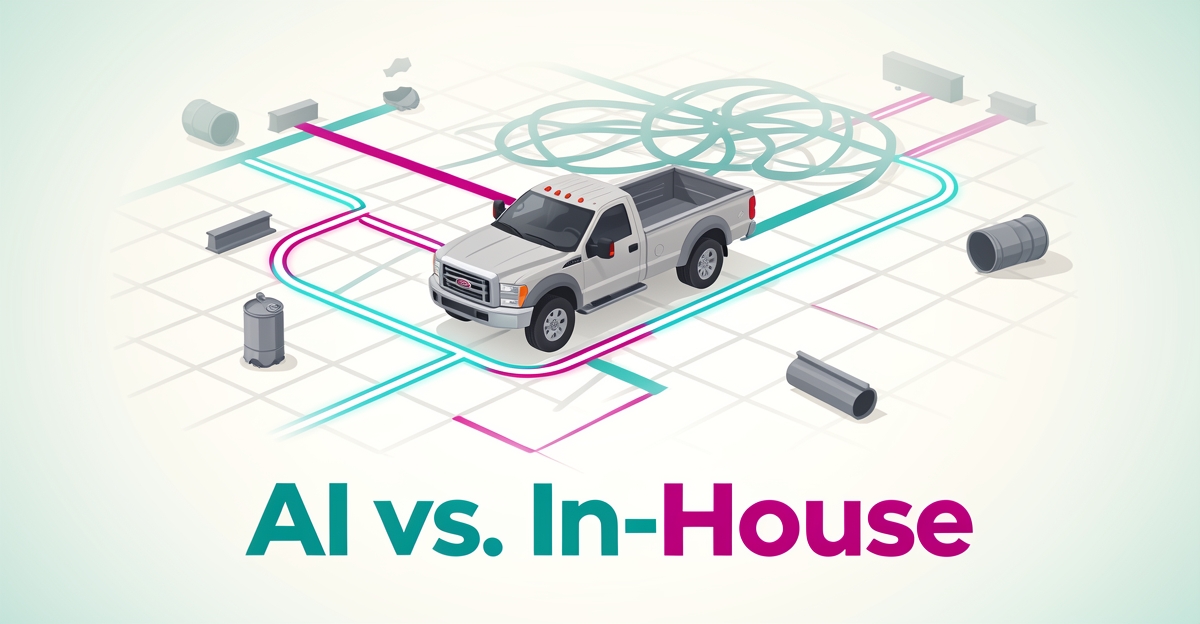
AI vs. In-House Staff: Which Is Better for Scrap Metal Pickup Scheduling?
Key Facts
- Knowledge workers typically spend a large share of their day, often cited around 30%, simply gathering information before making decisions
- AI scheduling tools can cut the time spent on scheduling tasks dramatically, per recent reviews of scheduling software
- AI agents execute end-to-end pickup scheduling autonomously, while assistants only react to requests
- AI dispatchers optimize routes using real-time traffic, metal volume, and vehicle availability to cut idle time and fuel costs
- AI works alongside human teams handling routine coordination while dispatchers manage exceptions and customer relationships
- AIQ Labs has deployed 200+ multi-agent systems and runs 4 live SaaS products daily, this is proven infrastructure, not theory
Hire a team member that works 24/7 — for less than a part-time wage.
AI receptionists, SDRs, dispatchers and 99+ roles. Trained on your business, fully managed.
Not sure where to start? Ask our AI planner
The Hidden Costs of Manual Scrap Metal Scheduling
Manual coordination looks manageable until the calls start stacking up. Dispatchers juggle phone requests, driver availability, traffic spikes, and fluctuating metal volumes, all while trying to keep trucks moving and customers happy.
In-house teams spend a disproportionate share of their day simply gathering information to make a decision. Industry research consistently suggests knowledge workers lose roughly 30% of their time to information gathering and research, hundreds of hours per person each year. That time is not spent optimizing routes or closing revenue.
Scrap metal pickup amplifies the problem. Each request requires confirming material type, estimated weight, site access, and safe handling requirements. Dispatchers then cross-check driver location, truck capacity, and current traffic to build a viable slot. The loop repeats for every pickup, creating delays and idle time.
The cost shows up in three ways teams feel every week.
- Idle trucks and missed windows when manual updates lag behind real conditions
- Fuel and labor waste from inefficient routing and backtracking
- Customer churn after repeated reschedules and slow responses
Even with experienced staff, manual scheduling cannot react fast enough. Recent reviews of AI scheduling tools report that automation can cut the time spent on scheduling tasks dramatically, often by well over half. The gap between what humans can coordinate and what the operation demands keeps growing.
Data quality and complexity add friction. Pickup optimization depends on accurate metal volume estimates, vehicle availability, and live traffic. When that data lives in spreadsheets, texts, and call notes, dispatchers spend more time reconciling than dispatching. Errors compound, and oversight becomes a full-time job.
This is where AI Workflow Builds change the equation. AIQ Labs rebuilds the one workflow that costs you the most, and for haulers, that is usually dispatch. AI dispatchers work alongside human teams to optimize pickup times based on traffic, metal volume, and vehicle availability, handling routine coordination continuously and reducing idle time and fuel costs without replacing the judgment of the team.
The result is a leaner operation. Dispatchers stop chasing information and start managing exceptions. Trucks run fuller, customers get reliable windows, and the business captures margin that was lost to manual overhead.
How AI Dispatchers Optimize Routes, Fuel, and Fleet Use
Scrap metal pickup scheduling has long been a manual bottleneck, consuming valuable time that could be spent on core operations. AI-powered dispatch systems now solve this by analyzing real-time traffic patterns, incoming metal volume reports, and vehicle availability to optimize every route. This dynamic adjustment ensures trucks spend less time idling and more time collecting valuable materials.
For scrap metal haulers, this means dispatchers no longer juggle spreadsheets and phone calls but instead rely on intelligent systems that continuously refine pickup sequences based on live conditions, directly translating to fewer empty miles and lower fuel consumption.
AIQ Labs deploys these AI dispatchers to work alongside human teams, creating a hybrid approach where technology handles route optimization while staff focus on customer relationships and operational oversight. The result is a streamlined workflow that minimizes delays caused by traffic congestion or inefficient sequencing.
- Real-time traffic analysis prevents delays from accidents or construction
- Volume-based routing prioritizes high-yield scrap locations
- Vehicle availability tracking ensures optimal fleet utilization
By eliminating manual scheduling inefficiencies, companies see measurable reductions in both idle time and fuel costs, critical advantages in an industry where margins depend on operational efficiency. The shift from reactive to proactive dispatch not only cuts expenses but also increases the number of pickups completed per shift without expanding the fleet.
AI Agents vs. AI Assistants: Picking the Right Dispatch Tool
Not every AI tool that answers questions can run a dispatch board. For scrap metal pickup scheduling, the difference between a helpful chatbot and true automation is the difference between constant human input and autonomous execution.
AI assistants are reactive, performing tasks at the user's request, while AI agents are proactive, autonomously planning and taking actions to achieve a defined goal. Agents can move beyond a purely chat-based interface, enabling proactive planning, decision-making, and task execution, a distinction IBM's AI overview frames as machines simulating learning, problem-solving, decision-making, and autonomy.
That distinction matters on the road. An assistant can confirm a pickup window when asked, but it still requires a dispatcher to gather availability, check traffic, and assign a truck. An agent owns the workflow end-to-end.
AI-powered scheduling systems can optimize pickup times based on traffic, metal volume, and vehicle availability, leading to improved efficiency and productivity. The effectiveness depends on data quality, task complexity, and human oversight.
AI agents deliver value where assistants stop:
- Proactive planning: autonomously sequences pickups by volume, route density, and truck capacity
- Real-time decision-making: adjusts for traffic delays and last-minute cancellations without prompting
- End-to-end execution: books the slot, notifies the driver, updates the customer, and logs the job
- Continuous learning: improves routing based on actual drive times and fuel use
Assistants streamline conversations. Agents streamline operations. For pickup scheduling, a true AI agent is necessary for end-to-end automation, not just a simple chatbot.
AIQ Labs helps scrap metal companies deploy AI dispatchers that work alongside human teams, reducing idle time and fuel costs. The approach mirrors a comparison of manual scheduling versus AI-driven dispatch systems that optimize pickup times based on traffic, metal volume, and vehicle availability.
Human oversight remains essential. AI may struggle with complex tasks that require human judgment, and systems require high-quality data to function effectively. Integration with existing systems can also be a challenge.
Choose an assistant for answers. Choose an agent for execution.
Making It Work: Data, Integration, and Human Oversight
Getting AI dispatch live for scrap metal pickups rarely fails because the model is bad. It fails because the data feeding it is messy, the systems it needs to touch don't talk to each other, and no one defined where human judgment stays in the loop.
AI-powered scheduling systems can optimize pickup times based on traffic, metal volume, and vehicle availability, leading to improved efficiency and productivity. The effectiveness of AI in scheduling depends on various factors, including the quality of data, the complexity of the task, and the level of human oversight.
Data quality is the first bottleneck. Dispatch AI is only as good as the routes, load weights, truck capacity, and customer windows it sees. Incomplete or siloed records force the system to guess, which creates missed pickups and driver idle time. High-quality, unified data is a prerequisite before any automation promise holds.
Integration is the second hurdle. Scrap operations typically run dispatch boards, telematics, CRM notes, and weighing scales as separate tools. An AI dispatcher that cannot read and write across those systems creates manual re-entry work for the team. Deep integration with existing systems is the biggest implementation challenge, and it requires custom connectors, not a generic widget.
Human oversight remains essential because pickup scheduling is not purely algorithmic. Weather, road closures, hazardous loads, and customer access constraints demand judgment. AI agents are proactive, autonomously planning and taking actions to achieve a defined goal, while AI assistants are reactive. That distinction matters when both are deployed in the field.
In practice, AI works best alongside human teams, not replacing them. Dispatchers set guardrails, approve exceptions, and train the model on real outcomes. This hybrid model reduces repetitive coordination while keeping accountability with people.
AIQ Labs designs AI dispatchers that work alongside human teams to reduce idle time and fuel costs, with integration and oversight built in from day one, the same way we build managed AI employees for other workflows.
Key implementation priorities for scrap metal pickup scheduling:
- Clean and unify source data for routes, volumes, and vehicle status before training
- Build two-way API integrations with dispatch, telematics, and weighing systems
- Define human-in-the-loop escalation rules for complex or high-risk pickups
- Monitor performance and retrain on real dispatch outcomes, not just historical data
When data is reliable, systems are connected, and humans retain final say on exceptions, AI dispatch becomes a force multiplier. It handles the routine optimization, the team handles the judgment, and the operation runs tighter without losing control.
Deploying Your AI Dispatcher: A Practical Roadmap
Transitioning from manual to AI-driven scheduling starts with clear workflow mapping. Begin by documenting your current pickup process, including how you gather job details, assign trucks, and communicate with customers. This baseline helps identify where AI can add the most value, especially in eliminating the repetitive scheduling tasks that eat your team's week.
AIQ Labs' AI Employees model provides a managed dispatcher that works around the clock, integrating directly with your existing tools like CRM, calendar, and payment systems, at roughly 80% less cost than a human hire. The AI handles initial job intake, optimizes routes based on real-time traffic and metal volume, and dispatches trucks with minimal human intervention, freeing your team to focus on exceptions and customer relationships.
Key implementation steps include:
- Defining the dispatcher's role and decision boundaries
- Connecting to your operational tools via secure API integrations
- Training the AI on your specific scheduling rules and priorities
- Running a pilot phase with human oversight to validate accuracy
- Gradually expanding autonomy based on performance metrics
Throughout deployment, continuous monitoring ensures the AI adapts to changing conditions like seasonal volume shifts or new service areas. Human oversight remains critical for complex judgments, but the system reduces cognitive load by automating data gathering and route optimization.
The result is a scalable scheduling system that lowers fuel costs through optimized routes, minimizes idle time between pickups, and scales with your business without proportional staffing increases. If dispatch is just the first of many workflows you want to connect, intake, billing, customer service, AI Operating Systems build one connected layer across the whole operation, in phases, owned outright. To explore how this approach fits your specific operations, start with the two-minute Fit Check, then book a free 30-minute strategy call.
Still paying for 10+ subscriptions that don’t talk to each other?
We build custom AI systems you own outright. No vendor lock-in. Full control.
Not sure where to start? Ask our AI planner
Frequently Asked Questions
How much time can AI really save in scrap metal pickup scheduling compared to manual methods?
Will using an AI dispatcher replace my human team, or do I still need them involved?
What's the difference between an AI assistant and an AI agent in scrap metal dispatching?
What are the biggest risks when implementing AI for scrap metal pickup scheduling?
How do I know if my scrap metal business is ready to adopt an AI dispatcher?
Can AI dispatchers handle real-time changes like traffic delays or last-minute cancellations?
The Winner Isn't AI or Staff, It's the Operation That Runs Both
The question was never whether AI or in-house staff wins. Manual scheduling breaks down because dispatchers burn hours gathering information, often cited as roughly 30% of their time, while trucks idle and customers wait. AI dispatchers close that gap by optimizing pickup times against live traffic, metal volume, and vehicle availability. But the real answer is hybrid: AI agents handle end-to-end execution while your team keeps judgment, oversight, and customer relationships. Getting there takes clean data, deep integrations with your dispatch and telematics systems, and clearly defined human-in-the-loop rules, which is exactly how AIQ Labs builds AI dispatchers that work alongside scrap metal teams rather than replacing them. With 200+ multi-agent systems deployed and 4 live SaaS products we run daily, this is work we know how to ship. If you're ready to see what that looks like for your routes and fleet, start with the two-minute Fit Check at aiqlabs.ai/apply, then book a free 30-minute strategy call. It's a working session with an AI engineer to map your biggest bottleneck, and if there isn't a clear win, we'll tell you that too.
Make AI your competitive advantage — not just another tool.
Strategy, implementation and ongoing optimization. One partner, end to end.
Not sure where to start? Ask our AI planner