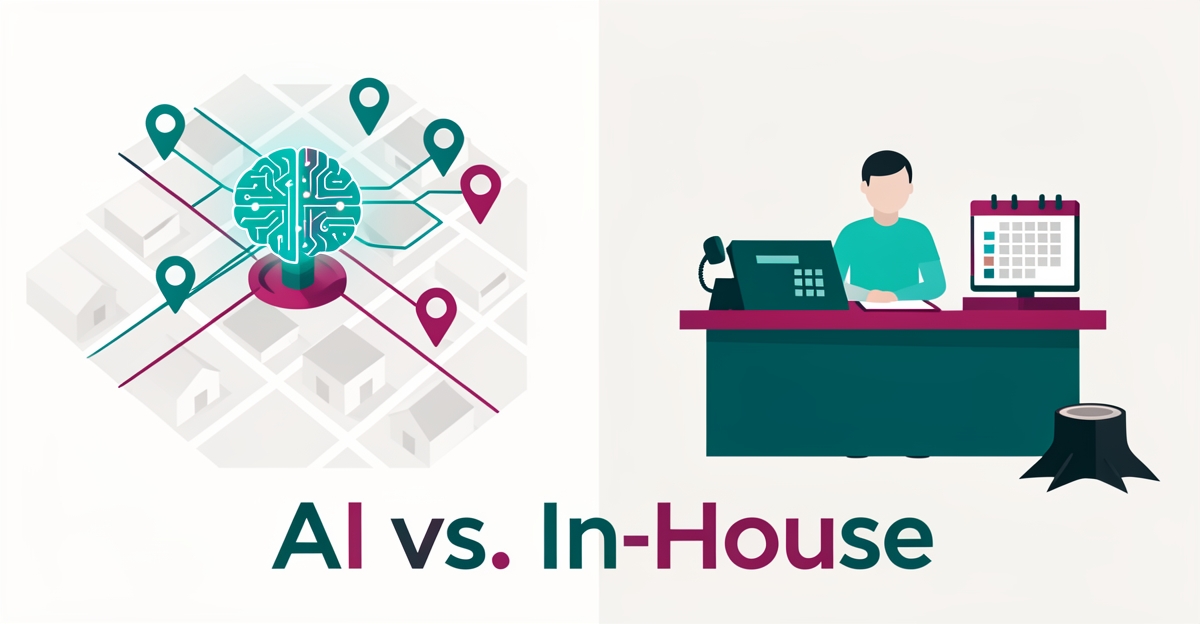
AI vs. In-House Staff: Which Is Better for Stump Grinding Service Dispatch?
Key Facts
- AI dispatch agents typically cost a small fraction of what a fully loaded human hire does per conversation, as of late 2026, managed AI staff run at roughly 80% less than the cost of a human hire
- Many consumers now prefer automated service when they want an immediate response, especially for scheduling and status updates
- Building in-house AI dispatch typically takes a year or more; managed external solutions can be live in weeks to a few months
- For most stump grinding operators, dispatch is an efficiency lever, not a competitive moat, which shifts the calculus toward speed and cost containment
- Hybrid teams commonly deflect a large share of routine volume to AI, freeing skilled staff for complex, high-value decisions
- Clean AI-to-human handoffs matter: customers rate experiences significantly worse when forced to repeat information during escalations
Hire a team member that works 24/7 — for less than a part-time wage.
AI receptionists, SDRs, dispatchers and 99+ roles. Trained on your business, fully managed.
Not sure where to start? Ask our AI planner
The Dispatch Bottleneck Costing Stump Grinding Companies Time and Money
Human field managers in stump grinding operations face a critical dispatch bottleneck that silently erodes revenue and customer satisfaction. Relying on manual routing and scheduling, they struggle to adapt to real-time traffic, last-minute job changes, or emergency requests without significant delays. This inefficiency directly impacts the bottom line, as every minute a technician spends idle or driving suboptimal routes represents lost billable hours and increased fuel costs. A fully loaded human dispatcher, salary, benefits, and overhead, compounds quickly in high-volume dispatch environments, which is why managed AI staff that run at roughly 80% less than a human hire have become a practical alternative for field service companies.
The consequences of delayed dispatch extend beyond labor inefficiency to tangible revenue loss and diminished customer trust. When response times lag, customers perceive the service as unresponsive, increasing the likelihood they'll turn to competitors who offer faster scheduling. Many consumers now expect instant, automated coordination for scheduling and status updates, especially when speed is the deciding factor. For stump grinding companies, this expectation translates into real risk: each delayed response can cost not just the current job but future referrals and repeat business, particularly in markets where speed is a key differentiator.
Operational constraints further amplify the bottleneck, as human managers simply cannot process the volume of data required for true route optimization at scale. They lack the capacity to simultaneously track technician locations, job durations, equipment availability, traffic patterns, and customer priorities across multiple jobs in real time. This limitation forces reactive rather than proactive dispatching, leading to inefficient routes, missed time windows, and unnecessary overtime. Building an in-house AI dispatch system typically takes a year or more to reach production, a timeline that leaves most small and medium-sized stump grinding businesses unable to compete with faster-moving alternatives. Meanwhile, the hybrid model emerging as best practice combines AI for routine routing with human oversight for exceptions, freeing skilled staff to focus on complex, high-value decisions.
- AI handles route optimization, schedule updates, and customer notifications
- Humans manage emergencies, complex complaints, and strategic planning
- Hybrid teams reduce routine human workload substantially while improving response consistency
Build vs Buy vs Hybrid: Cost, Timeline, and Control Trade-offs
Choosing how to power dispatch can define a stump grinding company's growth speed, and the math is stark between building, buying, or blending.
Building an in-house AI dispatch system typically takes a year or more to full production, with the first several months spent on talent acquisition and infrastructure, followed by model development, testing, and deployment. A managed external solution can be live in weeks to a few months, with basic integration first and advanced customization after. In fast-moving service markets, even a six-month delay can mean lost market share.
Cost compounds the timeline gap. Building in-house means hiring a team of AI specialists, funding ongoing model retraining, and absorbing compute costs that grow every year. Buying or subscribing to a managed solution converts that multi-year capital risk into a predictable monthly operating expense, AIQ Labs' AI Employees, for example, run at roughly 80% less than the cost of a human hire, with no recruiting, benefits, or retraining overhead.
Control is the trade-off. Build delivers complete ownership, data residency and customization, but requires a specialist team, ongoing model maintenance, and compute cost growth year over year. Buy gives speed to value and lower headcount, but can introduce vendor dependency and switching costs. A third option, having a partner build it and own it outright, splits the difference: AIQ Labs' AI Operating Systems approach builds one connected operating layer in phases that the customer owns outright, avoiding both vendor lock-in and the burden of building from scratch.
For most stump grinding operators, dispatch is an operational efficiency lever, not a core competitive moat, which shifts the calculus toward speed and cost containment.
A hybrid model captures both benefits. AI handles high-volume routine work while humans retain judgment for exceptions.
- AI manages route optimization, schedule updates, customer notifications and routine rescheduling 24/7
- Humans manage emergencies, complex complaints, strategic capacity planning and key account relationships
- Context engineering ties the two together: instructions, examples, domain knowledge, memory, tools and tool results
Well-run hybrid teams deflect a large share of routine volume to AI, freeing field managers to focus where empathy and authority matter. That balance mirrors how AIQ Labs approaches dispatch automation for field services, deploying managed AI employees that work alongside human teams rather than replacing them outright.
The decision ultimately hinges on maturity and risk appetite. Operators early in their automation journey benefit most from buying for quick wins. More mature firms can run a hybrid build-core, buy-peripherals strategy. Full build makes sense only when AI dispatch is a strategic differentiator and the company can absorb a multi-year timeline and significant investment.
Speed to value and cost control favor buy, control and differentiation favor build, and hybrid delivers optimal coverage for stump grinding dispatch today.
What AI Dispatch Agents Can and Can't Do in Field Services
Not every "AI dispatcher" is created equal. The difference between a chatbot that answers questions and an AI agent that actually runs your schedule is the difference between a gimmick and a genuine operational upgrade, and knowing which tier you're buying matters before you spend a dollar.
The industry generally recognizes three capability tiers. A basic chatbot is single-domain and reactive: it can tell a customer "your technician arrives between 1 and 3 PM," but it can't reroute a crew when a job runs long. An AI virtual assistant works across multiple domains, retains context between sessions, and can execute tasks inside integrated systems, updating schedules, checking technician locations, and notifying customers. An AI agent goes further still, running autonomous multi-step workflows across systems with persistent learning context.
For stump grinding dispatch, that third tier is where the real value sits. A properly built AI agent can independently determine optimal routes, handle routine rescheduling, and execute dispatch decisions without step-by-step human instruction, at a small fraction of the cost of a fully loaded human agent. AIQ Labs builds dispatch agents at this level, trained on a company's service area, job durations, and customer priorities.
But context is everything. As practitioners in the field commonly put it: we blame AI for being unreliable or unpredictable, when in practice it is usually doing exactly what we asked, just without the context we assumed was obvious. An agent needs six things to dispatch well: clear instructions, example scenarios, domain knowledge, short- and long-term memory, tool integrations, and feedback from past outcomes. Skip any of these and you get an agent that schedules confidently and incorrectly.
Even the best agent has hard limits, which is why the hybrid model outperforms full automation. Well-run hybrid teams deflect a large share of routine volume to AI, meaning AI handles most of the routine work while humans focus on what actually requires judgment.
In a stump grinding operation, the division of labor looks like this:
- AI handles: route optimization, schedule updates, customer notifications, routine rescheduling, and traffic rerouting
- Humans handle: emergency calls, complex complaints, strategic capacity planning, and key account relationships
- Both handle: escalations, where the AI hands off cleanly with full context, never forcing the customer to repeat themselves
That last point is critical. Customers consistently rate their experience significantly worse when forced to repeat information during AI-to-human escalations. The goal is not maximum AI coverage; it is optimal AI coverage.
The takeaway: AI agents excel at execution and struggle with inferring intent. Give them the routine work they're built for, keep humans on emergencies and high-value accounts, and you get faster response times and lower labor costs without sacrificing the judgment calls that keep customers loyal.
Implementation Roadmap for Stump Grinding Dispatch Automation
Deploying AI dispatch for stump grinding requires a structured roadmap focused on context engineering to ensure the system understands operational nuances from day one. The process begins with defining clear instructions for the AI dispatcher, such as minimizing travel time while respecting service windows and technician skill sets, followed by embedding domain knowledge like local traffic patterns, job duration estimates, and customer priority tiers. AIQ Labs emphasizes that context engineering, covering instructions, examples, knowledge, memory, and tool integration, is the most critical factor for AI agent success, directly impacting routing accuracy and decision quality.
Next, short-term memory is configured to track real-time variables like current job status and live traffic feeds, while long-term memory stores customer preferences, recurring access issues, and seasonal demand patterns to improve future scheduling. Tool integration connects the AI dispatcher to essential systems including GPS tracking, scheduling software, customer databases, and communication platforms, enabling actions like updating job statuses, sending SMS notifications, and optimizing routes dynamically. Feeding tool results back into the system creates a feedback loop that refines routing decisions over time, turning each dispatch into a learning opportunity.
For stump grinding companies seeking low-risk adoption, AIQ Labs' Start Monthly payment model offers a practical entry point: a managed AI dispatcher, part of the AI Employees service, running at roughly 80% less than a human hire, covering build, training on business-specific processes, tool integrations, monitoring, and continuous improvements, with the flexibility to pause or adjust anytime. Companies that want to go deeper can rebuild their single most expensive workflow at a fixed price through AI Workflow Builds, or move toward one connected operating layer they own outright with AI Operating Systems. This approach avoids the year-plus timeline and heavy investment of building in-house AI, instead enabling deployment in weeks to a few months. By focusing on routine routing and schedule optimization, tasks AI handles best, while reserving human judgment for emergencies and complex exceptions, companies can deflect a large share of routine volume, freeing staff for higher-value interactions without compromising customer experience.
Still paying for 10+ subscriptions that don’t talk to each other?
We build custom AI systems you own outright. No vendor lock-in. Full control.
Not sure where to start? Ask our AI planner
Frequently Asked Questions
Can AI actually handle dispatching for a stump grinding business, or do I still need a human dispatcher?
How much does it cost to build an AI dispatch system in-house versus buying one?
Will customers be annoyed dealing with an AI instead of a person?
What's the difference between a chatbot and a real AI dispatch agent?
How long does it take to get an AI dispatcher up and running?
What makes an AI dispatch agent actually work well instead of making mistakes?
The Dispatch Decision That Pays for Itself
The choice between AI and human dispatch isn't binary, it's about matching the right tool to the right task. AI agents handle route optimization, scheduling updates, and customer notifications at a small fraction of the cost of a human hire, while human managers excel at emergency response and complex relationship management. For most stump grinding operations, the hybrid model delivers the strongest return: AI handles the routine volume so your team can focus on exceptions that actually require judgment. The barrier to entry has dropped significantly. Instead of the year-plus timeline and heavy investment required to build in-house, companies can now deploy managed AI dispatch agents in weeks. AIQ Labs approaches this through their Start Monthly model, a managed AI dispatcher at roughly 80% less than a human hire, with training, integrations, and ongoing optimization included. If you're ready to eliminate dispatch bottlenecks without the enterprise overhead, start with the two-minute Fit Check at https://aiqlabs.ai/apply, then book a free 30-minute strategy call to see if there's a clear win for your operation.
Make AI your competitive advantage — not just another tool.
Strategy, implementation and ongoing optimization. One partner, end to end.
Not sure where to start? Ask our AI planner