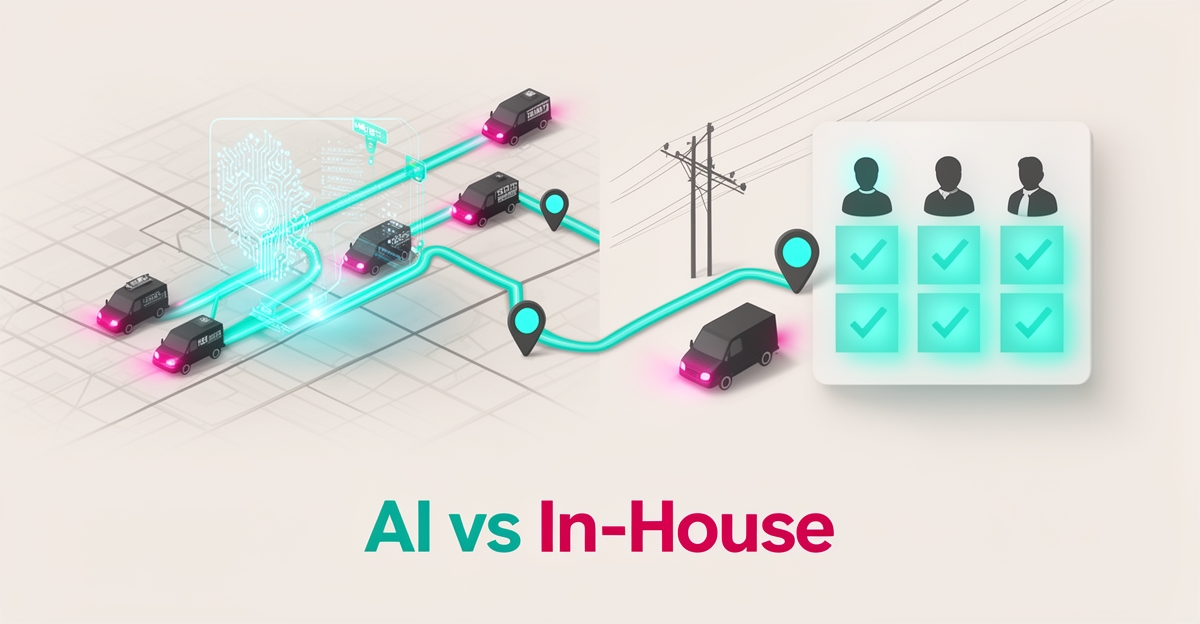
AI vs In-House Teams: Which Is Better for Dispatching Utility Field Crews?
Key Facts
- AI dispatchers operate 24/7 without shift boundaries, fatigue, or performance variation
- AIQ Labs has deployed 200+ multi-agent systems and runs 4 live SaaS products daily
- AI Employees cover 99+ roles, including dispatchers, at roughly 80% less cost than a comparable human hire
- Implementation typically takes 4–12 weeks depending on scope, deployed in phases
- Payment models: Start Monthly, Build in Milestones, or Own It Outright
Hire a team member that works 24/7 — for less than a part-time wage.
AI receptionists, SDRs, dispatchers and 99+ roles. Trained on your business, fully managed.
Not sure where to start? Ask our AI planner
The Dispatch Bottleneck Utility Crews Face 24/7
A storm knocks out power at 2 AM, and the call lands on a dispatcher who's been on shift for ten hours. That moment, when response speed, crew availability, and real-time decision-making all collide, is where human-only dispatch operations break down. Utility field crews operate around the clock, but the dispatch function supporting them doesn't, and that mismatch creates measurable operational and financial damage.
The core problem is structural. Human dispatchers are limited to business hours and shift patterns, and performance degrades with fatigue and attention. AI dispatching systems, by contrast, operate 24/7 without breaks or performance variation, a capability gap that AIQ Labs builds into its AI Employees specifically to reduce idle time and improve first-call resolution rates. When a crew sits idle because no one is available to route them to the next job, that's direct revenue leakage.
The costs stack up in three ways:
- Response time delays during off-hours, when urgent calls wait for the next shift instead of being routed immediately.
- Idle crew costs from inefficient job matching, since AI systems can continuously optimize assignments while human dispatchers handle matching manually.
- Real-time issue resolution gaps, because manual handling of calls, emails, and paperwork consumes hours that should go to exception handling and strategic planning.
The administrative burden alone is significant. AI dispatcher deployments in dispatch operations typically eliminate hours of weekly administrative tasks, time that human dispatchers currently spend on routine communications and paperwork rather than actually coordinating crews. This matters because the economics of dispatch are unforgiving: every delayed routing and unresolved issue translates into idle labor costs and slower restoration times.
None of this means human dispatchers lack value. Complex negotiations, nuanced customer relationships, and exception handling remain human strengths. The bottleneck isn't the people, it's the structural limits of human-only coverage: shift boundaries, fatigue, and the inability to monitor every variable in real time. The question utility operators face is whether those limits are acceptable costs, or whether a dispatch model built for 24/7 operation delivers the response times, crew utilization, and first-call resolution their operation demands.
How AI Dispatchers Outperform Human Teams on Speed and Revenue
AI-powered dispatchers deliver advantages in speed and coverage that human teams simply cannot sustain. Their 24/7 availability ensures no urgent service request is missed during nights, weekends, or holidays, critical windows when storm response and emergency calls peak. Unlike human dispatchers constrained by shift schedules and fatigue, AI employees maintain consistent performance without degradation, continuously monitoring job queues and optimizing routes in real time.
This constant operation directly reduces idle time and improves first-call resolution rates, as AI systems handle communications, updates, and administrative tasks instantly. By taking over routine dispatch work, AI employees free human teams to focus on complex negotiations and exception handling. And because managed AI staff typically run at roughly 80% less cost than a comparable human hire, the coverage upgrade doesn't require a proportional budget increase.
- Real-time route and assignment optimization maximizes crew utilization
- Continuous job matching reduces travel time between assignments
- Instantaneous decision-making processes multiple variables faster than humanly possible
These capabilities translate into tangible financial outcomes. By automating routine dispatch functions, AIQ Labs' AI Dispatchers enable utility field crews to spend more time on billable work and less time waiting for assignments, directly improving utilization rates and revenue potential without requiring additional headcount. If you'd rather rebuild the single workflow that costs you the most first, a fixed-price Workflow Build is a focused way to start.
Human-AI Collaboration Model for Field Operations
The debate around AI in dispatch operations often misses a critical point: technology works best when it amplifies human strengths rather than attempts to replicate them. Rather than replacing dispatchers, AI systems take over routine communications and administrative work, allowing human teams to focus on what they do best, complex negotiations and exception handling. This collaborative approach leverages AI's consistency and 24/7 availability while preserving the judgment and relationship skills that only humans can provide.
This model delivers practical benefits across operations. AI employees handle routine communications, updates, and issue resolution in real time, typically removing hours of weekly administrative burden from dispatch teams. Human dispatchers, in turn, spend less time on manual data entry and call logging, and more time on strategic activities like managing unexpected field issues, coordinating with contractors, and optimizing long-term resource allocation.
The human-AI collaboration model works because it assigns each party to their comparative advantage: AI excels at speed, consistency, and data processing, while humans bring creativity, emotional intelligence, and adaptive problem-solving to situations that fall outside standard protocols. AI augments dispatch work rather than simply automating it, creating roles where human expertise becomes more valuable, not obsolete.
- AI handles routine communications and administrative tasks 24/7
- Human dispatchers focus on complex negotiations and exception handling
- Collaboration model increases productivity and job satisfaction
- AI augments rather than replaces human judgment in field operations
Implementation Roadmap for Utility Dispatch AI
For utility companies ready to modernize field crew dispatch, AIQ Labs provides a structured deployment roadmap, typically 4–12 weeks depending on scope, that balances speed with operational readiness. This phased approach ensures AI dispatchers integrate smoothly with existing systems while delivering measurable improvements in response time and resource allocation from day one.
The process begins with a discovery phase where AIQ Labs analyzes current dispatch workflows, data quality, and integration points with scheduling, workforce, and asset management systems. This foundational step identifies optimization opportunities and establishes baseline metrics for measuring AI impact, following the principle that successful deployment requires clean data and standardized processes before introducing automation.
The build phase focuses on development and integration, where AIQ Labs builds custom dispatch AI agents trained on your specific utility operations, service territories, and compliance requirements. The system connects to your existing dispatch software and scheduling platforms, creating a unified operational ecosystem. During this phase, teams receive targeted training on AI collaboration models, learning how the technology handles routine communications and administrative tasks while freeing human dispatchers for complex negotiations and exception handling. AI Employees cover 99+ roles, including dispatchers, at roughly 80% less cost than a comparable human hire.
The final phase covers deployment, team enablement, and optimization setup. AIQ Labs oversees production rollout with performance monitoring configured to track key metrics like first-call resolution rates, idle time reduction, and crew utilization improvements. Ongoing optimization continues beyond the initial deployment, with regular performance reviews and system refinements based on real-world operational data. For utilities that want dispatch connected to billing, scheduling, and customer communication as one system, an AI Operating System builds that connected layer in phases, and you own it outright. To explore how this framework applies to your utility dispatch operations, start with a free strategy call to assess your readiness and identify high-impact automation opportunities.
Still paying for 10+ subscriptions that don’t talk to each other?
We build custom AI systems you own outright. No vendor lock-in. Full control.
Not sure where to start? Ask our AI planner
Frequently Asked Questions
Will AI dispatchers replace my human dispatch team?
How much faster can AI dispatchers respond compared to in-house teams?
What kind of revenue impact does AI dispatching actually deliver?
Is AI dispatching only for big utilities or can smaller operations use it?
How does AI handle compliance and safety requirements?
What's the cost difference between AI dispatchers and hiring more people?
Dispatch That Never Sleeps, Crews That Never Wait
The choice between AI and in-house dispatching isn't about replacing people, it's about removing the structural limits that keep crews idle. Human dispatchers bring judgment for complex negotiations and exceptions, but shift boundaries, fatigue, and manual admin create response delays, idle crew costs, and real-time resolution gaps. AI Dispatchers from AIQ Labs fill that coverage gap with 24/7 operation, continuous job and route optimization, and instant handling of communications and paperwork, freeing your team for high-value work. If you're ready to test the model for your utility operations, start with the two-minute Fit Check at aiqlabs.ai/apply to book a free 30-minute strategy call at aiqlabs.ai/book. We'll map your biggest dispatch bottleneck and identify high-ROI automation opportunities, with no obligation.
Make AI your competitive advantage — not just another tool.
Strategy, implementation and ongoing optimization. One partner, end to end.
Not sure where to start? Ask our AI planner