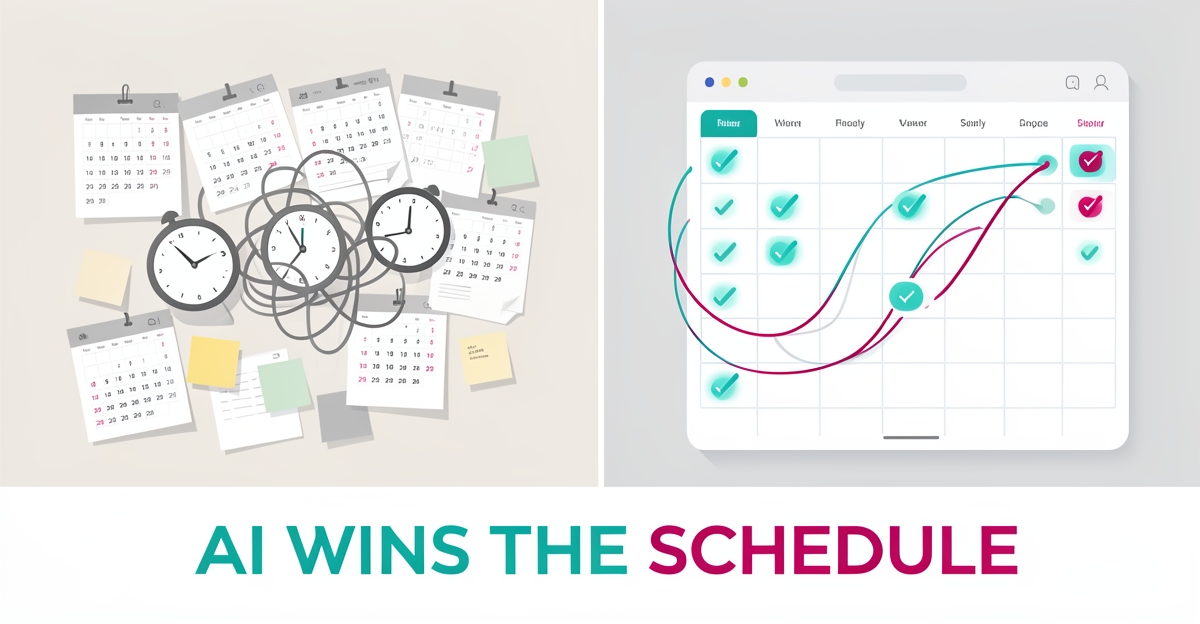
AI vs. In-House Teams: Which Is Better for Hoarding Cleanup Scheduling?
Key Facts
- Manual scheduling typically takes 5-10 minutes per appointment in field service businesses.
- Manually managed calendars commonly see error rates in the 5-15% range for double-bookings and incorrect details.
- Small service businesses often spend 5+ hours per week on manual scheduling tasks.
- As of late 2026, most standard bookings can be automated, with only a small share needing human oversight.
- Manual scheduling typically becomes unsustainable around 10-15 appointments per day.
Hire a team member that works 24/7 — for less than a part-time wage.
AI receptionists, SDRs, dispatchers and 99+ roles. Trained on your business, fully managed.
Not sure where to start? Ask our AI planner
The High Cost of Manual Scheduling in Hoarding Cleanup
Hoarding cleanup businesses often underestimate the hidden drain of manual scheduling. What seems like a simple task, booking a crew, confirming a time, updating a calendar, typically consumes 5-10 minutes per appointment. For teams handling even modest daily volumes, this adds up to five or more hours per week lost to administrative work that doesn’t directly serve clients or clear properties.
These inefficiencies compound quickly. Manual scheduling commonly carries error rates in the 5-15% range for double-bookings and incorrect details, leading to missed jobs, frustrated customers, and costly rescheduling. In an industry where timing and discretion are critical, such mistakes undermine trust and operational reliability. The administrative burden isn’t just tedious, it’s a direct hit to profitability and scalability.
AIQ Labs helps hoarding cleanup providers replace this manual drag with intelligent workflow automation. By deploying AI-driven scheduling, businesses eliminate repetitive data entry, reduce errors to near zero, and free staff to focus on high-value tasks like client assessment and on-site coordination. The result is a leaner, more accurate operation that scales with demand, without adding headcount or sacrificing service quality.
To explore how AI workflow automation can transform your scheduling process, start with a free strategy call at AIQ Labs. This no-obligation session identifies your biggest bottlenecks and maps high-ROI automation opportunities tailored to your cleanup business.
AI scheduling eliminates most human error and saves time, with near-zero admin time spent on routine scheduling tasks once implemented. For hoarding cleanup teams, this means reclaiming hours each week previously lost to manual coordination, time better spent serving clients and growing the business.
- 5-10 minutes per appointment typically spent on manual scheduling tasks
- 5-15% error rate commonly seen in manually managed appointment calendars
- 5+ hours per week often spent on manual scheduling by small service businesses
The Breaking Point: Why Manual Scheduling Fails at Scale
As hoarding cleanup businesses grow, the hidden cost of manual scheduling begins to erode operational efficiency. What starts as a manageable task quickly becomes a bottleneck when appointment volume increases, forcing teams to choose between overworking staff or turning away business. Without a scalable system, growth itself becomes the enemy of service quality.
Manual scheduling demands 5-10 minutes per appointment, a time investment that compounds rapidly as daily bookings climb. At just 10-15 appointments per day, this administrative burden consumes over two hours of staff time, time that could be spent on client engagement, job preparation, or business development. This threshold marks the breaking point where manual processes can no longer keep pace with demand without sacrificing accuracy or responsiveness.
As volume fluctuates, common in hoarding cleanup due to seasonal trends or urgent referrals, manual systems struggle to adapt. Each new booking requires the same labor-intensive effort, leading to scheduling conflicts, missed follow-ups, and inconsistent client communication. Manually managed calendars commonly suffer error rates in the 5-15% range for double-bookings and incorrect details, undermining trust and creating costly rescheduling needs. These inefficiencies don’t just waste time; they directly impact revenue and reputation.
- 5-10 minutes spent per appointment on manual scheduling tasks
- 10-15 appointments per day: the volume at which manual scheduling typically becomes unsustainable
- 5-15% error rate for double-bookings and data entry in manual calendars
AIQ Labs helps hoarding cleanup businesses overcome this scaling barrier by deploying AI-driven scheduling systems that eliminate manual bottlenecks. Unlike human-dependent processes, AI workflows handle fluctuating demand with consistent speed and precision, whether managing five appointments or fifty, without requiring additional headcount. This allows teams to maintain high service standards during peak periods while avoiding the overhead of seasonal hiring. By automating routine scheduling, businesses reclaim administrative time, reduce errors, and ensure every client inquiry is met with a timely, accurate response, turning scheduling from a liability into a competitive advantage.
The AI Alternative: Accuracy, Efficiency, and Scale
Manual scheduling was built for a slower era. For hoarding cleanup teams juggling crews, trucks, and sensitive client windows, that era is over.
AI-driven scheduling replaces repetitive admin with near-zero error rates and instant scale. Where manual booking typically costs 5-10 minutes per appointment, automated systems remove that drag entirely and deliver near-zero admin time on routine scheduling tasks.
Accuracy is the first operational win. Manually managed calendars commonly carry a 5-15% error rate for double-bookings and data entry mistakes. AI scheduling eliminates most of that human error and saves time, with routine bookings requiring no admin involvement at all. That reliability matters when a missed cleanup slot means a crew sitting idle and a vulnerable client waiting.
Scalability is the second. Manual scheduling breaks down at scale, with each new booking requiring the same manual effort. Manual processes typically become unsustainable around 10-15 appointments per day. AI scheduling handles 5 or 500 bookings per day with the same effort, and the large majority of standard bookings can be automated while only a small share require human oversight.
For hoarding cleanup businesses, this translates to stable operations without adding headcount. AI workflows route requests, check crew availability, enforce travel logic, and confirm appointments in real time. The result is consistent coverage, fewer reschedules, and more completed jobs per week.
AIQ Labs helps cleanup businesses deploy AI workflows that scale with demand without requiring full-time staff. The approach mirrors how we build production AI systems, 200+ multi-agent systems deployed, and four live SaaS products we run daily, where multi-agent orchestration handles high-volume, rules-based work reliably.
Key advantages teams see immediately include:
- Near-zero admin time on routine bookings, freeing staff for client care and field support
- Near-zero error rates on double-bookings and data entry
- Scale from a handful to hundreds of daily appointments
- Most standard bookings automated, with human review reserved for edge cases
Efficiency gains compound. With scheduling automated, dispatchers focus on exceptions, crews start on time, and clients get faster confirmations. That is how operational stability becomes growth capacity.
The Hybrid Model: Combining AI Efficiency with Human Expertise
The most effective hoarding cleanup operations don’t treat scheduling as an either-or decision. They run a hybrid model where AI handles the predictable volume and humans step in for the moments that genuinely require empathy and judgment.
The split is lopsided in AI’s favor. In most field service operations, the large majority of standard bookings can be fully automated, while only a small fraction involve situations complex or sensitive enough to demand personal attention. For hoarding cleanup specifically, that human share might include calls from distressed family members, multi-day projects requiring specialized crew coordination, or situations involving biohazards that need careful intake conversations.
Here’s how the split typically works in practice:
- AI handles: initial booking requests, appointment confirmations, rescheduling, reminder sequences, and crew dispatch coordination
- Humans handle: emotionally charged intake calls, scope assessments for severe hoarding cases, and any situation requiring real-time judgment about client wellbeing
- Shared workflow: AI flags unusual requests or keyword patterns that signal a conversation needs human takeover
This division matters because manual scheduling carries real costs. Manual processes typically eat 5-10 minutes per appointment and produce error rates in the 5-15% range for double-bookings and incorrect details. When your team is already stretched managing emotionally complex cleanup jobs, losing hours to phone tag and calendar corrections isn’t just inefficient, it pulls attention away from clients who need it most.
The hybrid model flips that equation. AI absorbs the repetitive coordination work that scales linearly with volume, while your experienced staff focuses exclusively on the conversations that build trust and ensure appropriate service delivery. The goal isn’t replacing human judgment but reserving it for where it creates genuine value.
At AIQ Labs, we build these hybrid workflows for field service businesses by deploying AI employees trained on your specific intake criteria and escalation protocols. The system learns which booking patterns your business considers routine and which automatically route to a human coordinator. You maintain complete control over the handoff rules.
The result is a scheduling operation that scales without sacrificing the human touch where it matters. Your AI dispatcher handles the routine bookings that follow predictable patterns, while your team invests their expertise in the clients whose situations demand compassion, discretion, and creative problem-solving.
Making the Switch: Your Path to Automated Scheduling
The path to automated scheduling starts with recognizing that the time spent on manual coordination is time not spent on cleanup operations. For hoarding cleanup businesses, every minute saved on scheduling is a minute gained for actual remediation work. Small service businesses often spend 5+ hours per week on manual scheduling tasks, a burden that scales directly with appointment volume and typically becomes unsustainable at just 10-15 appointments per day.
Making the switch doesn’t require overhauling your entire operation overnight. Begin by mapping your current scheduling workflow, identify where double-bookings occur, how much time is spent on data entry, and which steps consistently create bottlenecks. This clarity ensures the AI system is built around your actual processes, not a generic template. Initial configuration is necessary to define service types, staff availability, geographic zones, and emergency protocols, but this setup phase is a one-time investment that eliminates recurring administrative drag.
Once configured, AI-driven scheduling delivers measurable improvements almost immediately. The system eliminates the 5-10 minutes per appointment typically lost to manual coordination, and with near-zero error rates for double-bookings and scheduling conflicts, compared to the 5-15% error rate common in manual systems, your team spends less time fixing mistakes and more time on-site. The system handles most standard bookings autonomously, reserving only the exceptions for human oversight when special circumstances arise.
For hoarding cleanup businesses looking to implement this without building internal AI expertise, AIQ Labs offers a done-for-you solution through our AI Employees service. We build, train, and manage a scheduling-specific AI Employee that integrates with your existing tools, calendars, CRM, and dispatch systems, so you gain the benefits of automation without the complexity of development or maintenance. If your bottleneck goes beyond scheduling into a broader operational workflow, our Workflow Builds rebuild the one workflow that costs you the most, at a fixed price. This approach lets you scale scheduling capacity with demand, whether you're handling five jobs a week or fifty, without adding administrative headcount.
To explore how this applies to your specific operations, start with a free strategy call. We’ll assess your current scheduling pain points, map high-ROI automation opportunities, and show you exactly how an AI Employee can eliminate scheduling bottlenecks in your cleanup workflow. If there isn’t a clear win, we’ll tell you that too, no obligation, just clarity on your path forward.
Still paying for 10+ subscriptions that don’t talk to each other?
We build custom AI systems you own outright. No vendor lock-in. Full control.
Not sure where to start? Ask our AI planner
Frequently Asked Questions
How much time does manual scheduling actually waste for cleanup businesses?
Can AI really handle the sensitive nature of hoarding cleanup calls?
What happens to booking errors when we switch from manual to AI scheduling?
Will I need to hire more office staff if my cleanup business grows?
How difficult is it to set up AI scheduling for a hoarding cleanup operation?
What if a client has a complex emergency that doesn't fit standard booking rules?
Turn Scheduling From a Cost Center Into a Growth Engine
Manual scheduling quietly drains hoarding cleanup teams: 5-10 minutes per appointment, error rates in the 5-15% range for double-bookings, and five or more hours a week lost to admin work that doesn’t clear a single property. That burden typically becomes unsustainable around 10-15 appointments per day, where mistakes erode trust and growth forces a choice between overworked staff or turned-away business. The hybrid alternative keeps the human touch where it matters while letting AI handle the predictable volume. AI-driven scheduling delivers near-zero error rates, near-zero admin time on routine bookings, and scale without headcount, with most standard appointments automated and only the exceptions routed for human judgment. For hoarding cleanup businesses, that means stable coverage, faster confirmations, and crews starting on time. AIQ Labs helps teams deploy these workflows as managed AI Employees that integrate with existing calendars and dispatch tools, or as a phased AI Operating System if you want one connected layer across the whole operation. Start the Fit Check at https://aiqlabs.ai/apply for a free 30-minute strategy call to map your biggest scheduling bottleneck and see if there’s a clear, high-ROI automation path. If not, we’ll tell you that too.
Make AI your competitive advantage — not just another tool.
Strategy, implementation and ongoing optimization. One partner, end to end.
Not sure where to start? Ask our AI planner