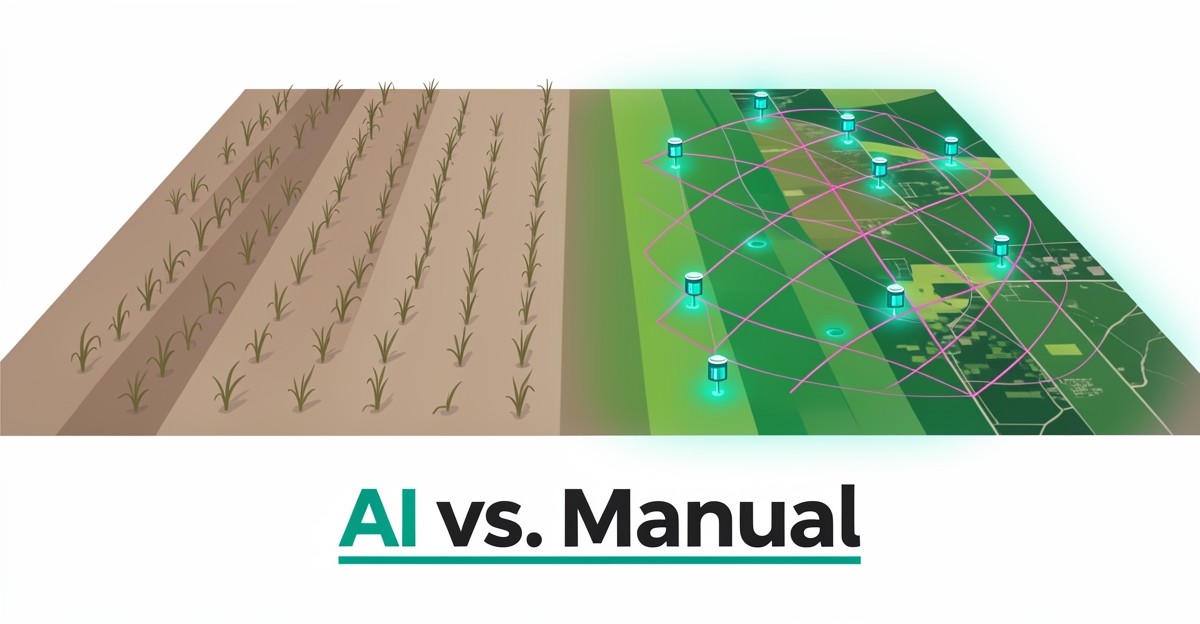
AI vs. Manual Field Monitoring: Which Is Better for Small-Scale Farms?
Key Facts
- Smartphone diagnostic apps such as Plantix are widely used to identify crop diseases from photos, with reported accuracy typically above 90% across dozens of crops per Fast.io research.
- Free satellite NDVI platforms like OneSoil are used by well over 100,000 farmers globally to track vegetation health without field visits per Fast.io.
- Computer-vision spraying systems such as John Deere See & Spray have reported herbicide reductions of roughly 70% or more in field conditions per Fast.io.
- AI advisory platforms in emerging markets have reached millions of smallholder farmers, showing the model scales far beyond enterprise agriculture per Fast.io.
- Human-led inspections suffer from fatigue, distractions and time constraints, producing inconsistent coverage per safety monitoring research.
- AI monitoring augments human oversight by extending visibility and accelerating hazard detection per Business Partner Magazine.
Hire a team member that works 24/7 — for less than a part-time wage.
AI receptionists, SDRs, dispatchers and 99+ roles. Trained on your business, fully managed.
Not sure where to start? Ask our AI planner
The Hidden Costs of Walking Every Row
Walking a 20-acre field takes hours, but the real cost isn't time — it's what gets missed between the rows. Research on industrial monitoring shows human-led inspections suffer from fatigue, distractions, and time constraints that create inconsistent coverage and missed violations, with reports often delayed or incomplete. safety monitoring studies confirm these attention lapses translate directly into blind spots where disease establishes before a farmer ever sees it.
- Early infection windows close while walking rows manually
- Fatigue reduces detection accuracy after the first hour
- Incomplete notes create false confidence in clean fields
- Opportunity cost pulls focus from irrigation, markets, and labor planning
The treatment window for fungal diseases like powdery mildew or botrytis can shrink to roughly 48 hours once spores land. A farmer walking fields twice a week leaves multi-day gaps where infection spreads unchecked. Satellite-based tools like OneSoil's NDVI monitoring now track vegetation stress across hundreds of thousands of farms globally, flagging problem zones before symptoms appear visible. Smartphone diagnostics such as Plantix typically diagnose with over 90% accuracy across dozens of crops and hundreds of symptoms, turning a pocket camera into a plant pathologist.
AIQ Labs builds custom monitoring workflows that fuse drone imagery, sensor data, and satellite indexes into a single decision dashboard — so the farmer spends morning coffee reviewing prioritized alerts instead of afternoon boots checking healthy rows. The shift isn't about replacing judgment; it's about ensuring expertise gets applied where it actually changes outcomes. For farms that want this handled end to end, our [AI Workflow Builds](/workflow-builds) rebuild the one workflow that costs the most, at a fixed price.
How AI Monitoring Changes the Economics of Scouting
For small-scale farms, the economics of scouting have always been a brutal trade-off: walk every acre and lose precious hours, or skip rows and risk missing the early signs of disease. AI-powered monitoring flips that equation by delivering continuous, data-driven visibility at a fraction of the labor cost. Satellite-based NDVI monitoring now catches crop stress before symptoms appear to the naked eye, while smartphone diagnostics eliminate the guesswork that leads to wasted treatments.
- Continuous NDVI satellite monitoring (like OneSoil's free tier) tracks crop development and spots stress areas before they become visible, serving a large global farmer base with regular imagery updates
- Smartphone-based disease diagnosis (Plantix, typically 90%+ accuracy across dozens of crops) turns a pocket camera into an agronomist, removing the need for costly lab samples or specialist visits
- Precision spraying systems (John Deere See & Spray, with reported herbicide reductions of roughly 70%+) apply inputs only where weeds exist, slashing chemical costs and environmental impact in a single pass
The subscription-free and low-cost accessibility of these tools is the real game-changer. Unlike enterprise platforms that demand five-figure contracts, OneSoil's free tier and Plantix's open access put enterprise-grade intelligence directly in the hands of growers managing 50 or 500 acres. This democratization means a farmer can validate a disease alert on their phone at 6 a.m., target a spray run by noon, and document the outcome for organic certification — all without hiring a scout or signing a SaaS agreement. AIQ Labs helps small farms deploy scalable AI systems that work alongside human farmers without replacing their expertise, turning these accessible tools into integrated workflows that reduce manual bottlenecks. The shift isn't about replacing boots on the ground; it's about making every step count.
The Hybrid Model: Keeping Farmer Judgment, Adding Machine Scale
The most successful farms don't choose between technology and experience — they design workflows where each amplifies the other. Industrial safety programs have already proven this model: continuous AI surveillance handles the exhausting work of constant pattern detection, while human experts apply contextual judgment to verify alerts and decide on treatment. According to workplace safety research, this augmentation approach extends visibility and accelerates hazard detection without removing the human oversight that catches what algorithms miss.
- Pilot AI monitoring on your highest-risk zones first — the fields with recurring disease pressure or irrigation variability
- Use AI-generated structured data to supplement, not replace, walkthrough notes so historical context stays intact
- Run side-by-side comparisons for a full season before shifting decision authority to the system
- Let the AI flag anomalies at leaf level while you validate and prescribe — tools like Plantix already demonstrate strong accuracy across a wide range of crops
This phased transition builds trust the same way safety teams adopted computer vision: by proving the machine catches what fatigue causes humans to miss, then letting farmers do what they do best — interpret the finding in the context of weather history, variety susceptibility, and market timing. AIQ Labs applies this same augmentation over replacement framework when deploying AI workflow automation for agricultural operations, ensuring the system learns from farmer feedback rather than overriding it. The result is a monitoring loop that scales across acres without losing the nuance that separates a timely intervention from an unnecessary spray.
Choosing Your First AI Monitoring Stack
Starting small with AI field monitoring means matching tools to your farm's specific needs without overcommitting resources. For row crops like corn or soybeans, free satellite NDVI platforms such as OneSoil offer accessible entry points, providing regular vegetation health updates that help spot stress patterns early without requiring field visits or hardware investments. Specialty crop growers often benefit more from smartphone diagnosis apps like Plantix, which uses deep learning to identify hundreds of symptoms across dozens of crops with high accuracy, turning a phone camera into a rapid scouting tool for diseases, pests, or nutrient issues. High-value per-acre operations such as vineyards or orchards may find periodic drone services worthwhile for detailed leaf-level scouting, especially when targeting early signs of stress invisible to the naked eye. Diversified farms managing multiple crop types gain the most from integrated platforms that combine satellite, sensor, and imagery data into a single dashboard, reducing the complexity of juggling separate tools.
Before deploying any system, assess three critical factors: data connectivity in your fields to ensure reliable uploads and downloads, tool interoperability so your chosen AI solution can work with existing farm management software, and realistic training time allocation—typically a few hours for basic app proficiency or up to a full day for drone service coordination. Begin with a single crop or field zone, measure time saved versus manual scouting, and track reductions in input use or yield loss to calculate ROI. This phased approach lets you validate benefits, build confidence, and scale gradually while avoiding vendor lock-in by prioritizing tools with open data exports and no long-term contracts. AIQ Labs supports this journey with flexible payment models — Start Monthly, Build in Milestones, or Own It Outright — so farms can evaluate and implement monitoring stacks that complement human expertise rather than replace it. See [our pricing](/pricing) or start with the two-minute [Fit Check](/apply).
Still paying for 10+ subscriptions that don’t talk to each other?
We build custom AI systems you own outright. No vendor lock-in. Full control.
Not sure where to start? Ask our AI planner
Frequently Asked Questions
How much time can AI-powered monitoring save compared to walking fields manually for small-scale farms?
What is the treatment window for fungal diseases like powdery mildew, and why does manual monitoring often miss it?
How accurate are smartphone-based disease diagnosis tools like Plantix for small-scale farmers?
Can AI monitoring actually reduce input costs like herbicides or fungicides on small farms?
Does using AI for field monitoring mean replacing the farmer's judgment and experience?
What should small-scale farmers consider before choosing their first AI monitoring tools?
The Fields You Don't Have to Walk Anymore
The choice between AI and manual field monitoring isn't about replacing your boots with servers—it's about deciding where your expertise actually moves the needle. While walking every row might feel thorough, fatigue and time constraints create blind spots where diseases establish before you ever see them. Today's tools, from free satellite NDVI platforms to smartphone diagnostics with 90%+ accuracy, deliver enterprise-grade visibility without enterprise contracts. The hybrid model lets you start small: pilot AI monitoring on your highest-risk zones, validate alerts with your own eyes, and scale only when the data proves itself. AIQ Labs has deployed 200+ multi-agent systems and runs four live SaaS products daily — we build monitoring workflows the same way we run our own. Ready to see what your fields look like when you're not walking them? Take the two-minute Fit Check at aiqlabs.ai/apply, then book a free 30-minute strategy call to map your highest-impact monitoring upgrade.
Make AI your competitive advantage — not just another tool.
Strategy, implementation and ongoing optimization. One partner, end to end.
Not sure where to start? Ask our AI planner