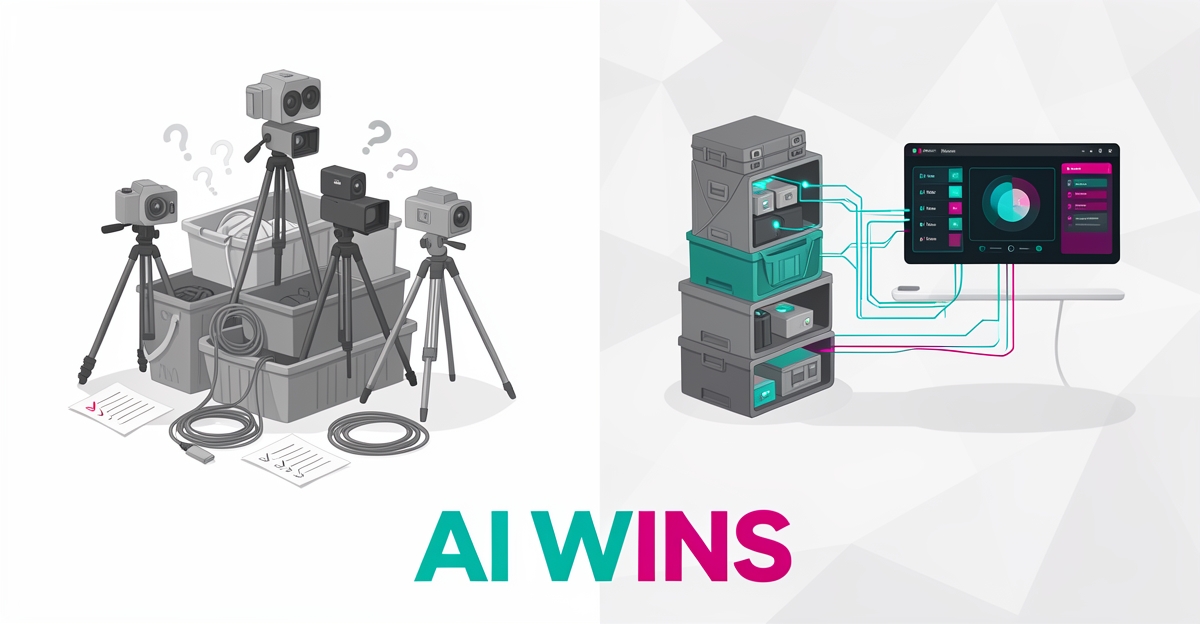
AI vs. Manual: Which Is Better for Managing Photo Booth Equipment in High-Demand Events?
Key Facts
- AI enables computers to simulate human learning, decision-making, and problem-solving, as IBM defines it, which is exactly what equipment tracking demands
- Modern AI systems learn, reason, and perform tasks that used to require a human on-site, per Google Cloud
- Manual spreadsheets and clipboard checklists can't react in real time, every update is only as current as the last person who typed it
- AIQ Labs has deployed 200+ multi-agent systems and runs 4 live SaaS products daily, this isn't theoretical automation
- AIQ Labs builds in milestones with fixed pricing, and you own your system outright, no vendor lock-in
Hire a team member that works 24/7 — for less than a part-time wage.
AI receptionists, SDRs, dispatchers and 99+ roles. Trained on your business, fully managed.
Not sure where to start? Ask our AI planner
The Hidden Costs of Manual Equipment Tracking at Events
Most photo booth companies don't lose money on the events they can see going wrong. They lose it in the gaps between spreadsheets: the backup camera that's listed as "in van 2" but is actually in a storage unit across town, the printer that failed at last weekend's wedding and never got flagged for repair, the booth that's double-booked because two coordinators updated different versions of the same sheet.
Manual tracking fails at high-demand events for predictable reasons:
- It's only as accurate as the last update. During a busy Saturday with four simultaneous events, nobody stops to log gear movements. The spreadsheet is stale by noon.
- Wear goes unnoticed until it becomes failure. A flash unit that's degrading doesn't get flagged in a spreadsheet. It fails mid-event, and you eat the cost of a refund or a rushed replacement.
- Allocation is guesswork. Deciding which booth, which backdrop, and which spare parts go to which event is done by memory and text messages, usually the night before.
- Loss is invisible. Cables, remotes, and mounts walk out of venues constantly. Without a check-in/check-out system that actually gets used, you find out weeks later when the kit comes up short.
The real cost isn't the lost gear. It's the emergency rentals, the late-night scrambles, the refunds, and the reputation damage when a booth goes dark during a client's event. That's the price of manual tracking, and it compounds with every event you add.
How AI-Powered Systems Transform Photo Booth Equipment Management
AI, in IBM's definition, is technology that enables machines to simulate human learning, comprehension, and decision-making. Applied to equipment management, that means a system that doesn't just store your inventory data, it acts on it.
Here's what that looks like in practice for a photo booth operation:
- Real-time inventory visibility. Every kit, booth, and accessory is tracked as it moves, checked out to an event, returned, flagged as damaged. No stale spreadsheets, no "I think it's in van 2."
- Predictive maintenance. The system tracks usage hours and performance patterns across your gear. A printer that's trending toward failure gets flagged for service before your peak Saturday, not after it.
- Automated allocation. When bookings come in, the system assigns equipment based on availability, event requirements, and maintenance status. Two coordinators can't double-book a booth that the system already committed elsewhere.
- Loss prevention. Anything that leaves the warehouse without a check-out record gets flagged. Missing gear surfaces in hours, not weeks.
- Event-day triage. When something breaks mid-event, the system knows what's where and what's available, so the fix is a dispatch, not a scramble.
The difference isn't just efficiency. It's that the failure modes of manual tracking, stale data, unnoticed wear, double-booking, stop being possible. If you're curious how far automation can go beyond equipment, AI Employees can handle dispatching, booking intake, and customer communication the same way.
Implementing AI Equipment Management: From Assessment to Full Automation
You don't rip out your whole operation on day one. The sensible path is phased:
- Assess the workflow that hurts most. Usually it's the booking-to-dispatch chain: what gear goes to which event, tracked where, updated by whom. This is exactly what AIQ Labs' AI Workflow Builds target, one broken workflow, rebuilt at a fixed price, in phases.
- Build the tracking layer first. Get real-time inventory and check-in/check-out working before adding anything clever. This alone eliminates most loss.
- Add prediction and allocation. Once the data is flowing, the system can start flagging wear and auto-assigning gear. This is where downtime drops.
- Connect it to the rest of the business. Eventually, equipment management becomes one part of a connected operating layer, bookings, dispatch, inventory, and customer comms in a single system. That's what an AI Operating System delivers, built in phases and owned outright.
On payment: you can start monthly, build in milestones, or own the system outright. No fake prices, no lock-in, the numbers come after we understand your operation, not before. The first step is a two-minute Fit Check, followed by a free 30-minute strategy call.
Still paying for 10+ subscriptions that don’t talk to each other?
We build custom AI systems you own outright. No vendor lock-in. Full control.
Not sure where to start? Ask our AI planner
Frequently Asked Questions
Can AI really predict equipment failures before they happen?
Isn't manual tracking cheaper than investing in AI systems?
How does AI auto-allocate equipment during busy events?
What if my team isn't tech-savvy enough to use AI systems?
Can AI workflow automation handle complex equipment logistics?
What's the real cost difference between AI and manual equipment management?
The Bottom Line: Manual Tracking Fails When It Matters Most
High-demand events are precisely when manual tracking breaks down, too many moving pieces, too little time to update records, too much riding on every booth working. AI-powered equipment management removes the failure modes: stale data, unnoticed wear, double-booked gear, and invisible loss. AIQ Labs has deployed 200+ multi-agent systems and runs 4 live SaaS products daily, so this is proven territory, not a pitch. You can start with one workflow rebuilt at a fixed price, or go further toward a full operating layer you own outright, no vendor lock-in. Don't wait for the next mid-event failure to make the decision. Take the two-minute Fit Check at AIQ Labs, then book your free 30-minute strategy call. Your gear, and your weekends, will thank you.
Make AI your competitive advantage — not just another tool.
Strategy, implementation and ongoing optimization. One partner, end to end.
Not sure where to start? Ask our AI planner