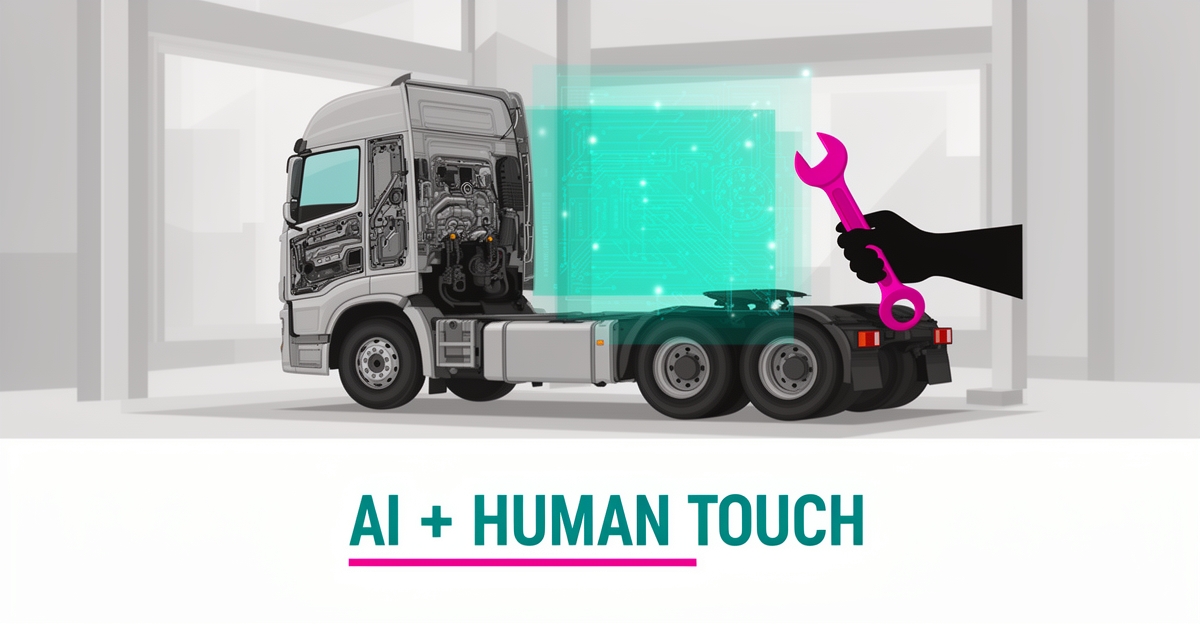
Can AI Handle Complex Repair Requests in a Heavy Truck Body Shop?
Key Facts
- 40% of recent automotive aftermarket M&A deals involve AI integration, signaling rapid industry adoption of advanced technologies.
- ShopView's AI-powered platform adds 75 new heavy-duty repair shops monthly, demonstrating strong market demand for AI solutions.
- Foothills Group transformed a $1M annual loss into $2.7M profit in one year using AI-driven shop management systems.
- AI diagnostics adoption in heavy truck repair is projected to grow by 30% by the end of 2026.
- Trunk Tools' construction AI system reduces rework by 40% through real-time regulatory compliance checks.
- Nearly 17 million skilled trades workers are projected to leave the industry over the next decade.
- 87% of contractors expect AI to reshape their industry, but only 19% have fully integrated it into workflows.
What if you could hire a team member that works 24/7 for $599/month?
AI Receptionists, SDRs, Dispatchers, and 99+ roles. Fully trained. Fully managed. Zero sick days.
Introduction: The High-Stakes Challenge of Heavy Truck Repairs
The heavy truck body shop industry faces a perfect storm of complexity: multi-component repairs, ever-changing safety codes, and strict regulatory standards. A single misstep—whether in compliance, part compatibility, or labor estimation—can lead to costly rework, fines, or even safety risks. For technicians already stretched thin by labor shortages and rising operational costs, navigating these challenges manually is unsustainable.
Yet, despite these hurdles, AI is emerging as a game-changing solution—one that can interpret complex repair requests, cross-reference regulatory requirements, and generate actionable work orders with precision. The question isn’t if AI can handle these demands, but how quickly shops can adopt it to stay competitive.
This article explores: - Why heavy truck repairs are uniquely complex (and why current solutions fall short) - How AI is bridging the gap—with real-world examples and data-backed insights - The role of domain-specific training in making AI reliable for compliance-critical work - What shops need to know to implement AI without disruption
Heavy truck body shops operate in a high-stakes environment where errors aren’t just costly—they can be dangerous. Here’s what makes repairs so difficult:
- Multi-component dependencies: A single repair often involves welding, frame alignment, paint, and structural reinforcement, each with its own technical standards. Misaligning one component can invalidate the entire fix.
- Regulatory labyrinth: Heavy trucks must comply with DOT, OSHA, and manufacturer-specific safety codes, which change frequently. A technician must verify compliance before starting work—not after.
- Labor and parts shortages: With 17 million skilled trades workers projected to leave the industry over the next decade (as reported by Business Insider), shops struggle to maintain consistency in high-volume repair workflows.
Current solutions—like manual checklists or generic diagnostic tools—are simply too slow and error-prone. Technicians spend 30% of their time on administrative tasks (per The Tech Evocate), leaving little room for precision work.
AI isn’t just a buzzword in heavy truck repairs—it’s already delivering measurable improvements for shops that adopt it. Here’s how:
- Problem: Technicians often rely on guesswork when interpreting repair requests, leading to incomplete or incorrect work orders.
- AI Solution: Systems like ShopView’s "ShopCoach AI" (used by Foothills Group) analyze repair requests, cross-reference parts databases, and generate detailed, compliance-ready work orders in minutes.
-
Impact: Foothills Group turned a $1M loss into a $2.7M profit in one year after implementing AI-driven shop management, reducing operational bottlenecks (as featured in The Globe and Mail).
-
Problem: Most shops verify compliance after repairs are completed—too late to avoid fines or rework.
- AI Solution: AI trained on thousands of real repair cases (like those developed by AIQ Labs) can flag non-compliant steps in real time, ensuring technicians follow the correct safety protocols.
-
Example: In construction, Trunk Tools’ "Cortex" AI interprets drawings against regulatory specs, reducing rework by 40% (as reported by Business Insider). A similar approach could prevent costly DOT violations in truck repairs.
-
Problem: No single technician (or tool) can master welding, structural integrity, and paint standards simultaneously.
- AI Solution: Multi-agent AI systems (like those built by AIQ Labs) can assign specialized roles:
- Agent 1: Verifies safety code compliance.
- Agent 2: Checks part compatibility.
- Agent 3: Estimates labor time.
- Agent 4: Generates a step-by-step repair guide.
- Result: Faster, more accurate repairs with human oversight only when needed.
Not all AI is created equal—generic diagnostic tools fail when it comes to heavy truck body shop repairs. The key to success lies in training AI on real-world cases, just like Trunk Tools did in construction:
- Trunk Tools’ "Cortex" AI was trained on 4 years of live construction projects, allowing it to interpret drawings, change orders, and RFIs with 95% accuracy (as reported by Business Insider).
- AIQ Labs’ approach: By training AI on thousands of real heavy truck repair cases, we ensure it understands specific safety codes, part interactions, and regulatory nuances—not just generic repair logic.
Without this domain expertise, AI risks providing incorrect or incomplete suggestions, undermining trust in the technology.
AI isn’t a one-size-fits-all solution—success depends on implementation. Here’s what shops should prioritize:
✅ Start with high-impact workflows (e.g., work order generation, compliance checks) before scaling. ✅ Choose AI that integrates with existing tools (CRM, inventory, scheduling) to avoid silos. ✅ Train technicians on AI-assisted workflows—AI should augment, not replace, human expertise. ✅ Measure ROI early—look for reductions in rework, faster turnaround times, and compliance accuracy.
For example, a mid-sized shop adopting AI for work order generation alone could see: - 20% faster repair turnaround (by reducing manual data entry). - 15% fewer compliance errors (via real-time regulatory checks). - Lower labor costs (by optimizing technician workloads).
The heavy truck repair industry is at a crossroads. Shops that embrace AI-driven precision will gain: ✔ Faster, more accurate repairs (reducing rework). ✔ Stronger compliance records (avoiding fines). ✔ Scalability without hiring more technicians (critical in a labor-short market).
The question isn’t whether AI can handle complex repairs—it’s whether shops can act fast enough to adopt it. With the right training and integration, AI isn’t just a tool—it’s the competitive edge that separates top-performing shops from the rest.
Next up: How AIQ Labs is building the first AI system trained specifically for heavy truck body shop repairs—with real-world accuracy and compliance guarantees.
The Problem: Why Traditional Repair Workflows Struggle with Complexity
Heavy truck body shops face a perfect storm of operational inefficiencies, regulatory hurdles, and diagnostic limitations—all compounded by outdated workflows that can’t keep pace with modern demands. While shops invest in advanced tools, fragmented systems, manual documentation, and compliance risks create bottlenecks that slow repairs, inflate costs, and frustate customers.
Research shows that 40% of recent M&A deals in the automotive aftermarket involve AI integration, driven by the need to replace legacy systems that fail to handle complexity according to industry analysis. Yet many shops still rely on disconnected software, paper-based compliance checks, and technician guesswork—a recipe for errors, rework, and lost revenue.
Traditional repair workflows are plagued by redundant steps, data silos, and communication gaps that add hours—or days—to every job. Consider these pain points:
- Disjointed Diagnostic & Repair Processes
- Technicians use separate tools for fault codes, structural assessments, and parts lookups
- No single source of truth means critical details get lost between systems
-
Manual data re-entry between diagnostic scanners, shop management software, and invoicing
-
Work Order Generation Bottlenecks
- Creating a comprehensive work order for a multi-component repair (frame, electrical, paint) takes 30–60 minutes per job
- Human error in transcribing specs leads to wrong parts, missed steps, or compliance gaps
-
Approvals and revisions slow down workflows when inspectors or insurers request changes
-
Parts & Inventory Chaos
- No real-time visibility into parts availability across suppliers
- Overordering or stockouts due to poor demand forecasting
- Manual cross-referencing of OEM vs. aftermarket parts for compatibility
Real-World Impact: Foothills Group, a heavy-duty repair chain, went from a $1M loss to a $2.7M profit in one year after replacing manual workflows with an AI-integrated shop management platform as reported by The Globe and Mail. Their turnaround hinged on eliminating operational drag—proof that inefficiency isn’t just an annoyance; it’s a profit killer.
Heavy truck body shops operate under a web of federal, state, and OEM-specific regulations—from FMVSS safety standards to DOT inspection requirements—that traditional workflows struggle to navigate. The risks are steep:
- Missed or Misinterpreted Safety Codes
- Frame repairs must comply with FMVSS 223/224 (rear impact guards) and FMVSS 121 (brake systems)
- Structural welds require AWS D1.1/D1.3 certification—yet many shops rely on technician memory or paper checklists
-
Air brake system repairs demand DOT FMVSS 105/121 compliance, but manual audits often miss critical steps
-
Documentation & Audit Nightmares
- Paper-based compliance logs are error-prone and difficult to retrieve during inspections
- Inconsistent record-keeping leads to failed audits, fines, or voided warranties
-
No automated flags for expired certifications (e.g., technician weld qualifications)
-
Insurance & Liability Exposure
- Improper repairs can void OEM warranties or trigger insurance claim denials
- Lack of digital audit trails makes it harder to prove compliance in disputes
- Manual inspection reports increase the risk of overlooked defects that lead to costly callbacks
Industry Warning Sign: A 2025 survey found that 87% of contractors (including heavy equipment repair shops) expect AI to reshape compliance—but only 19% have adapted their workflows according to Business Insider. The gap isn’t just technical—it’s a strategic risk.
Even the most skilled technicians hit walls when dealing with multi-system failures, intermittent faults, or rare component interactions. Traditional diagnostic tools fall short in three key areas:
- Fault Code Overload
- Modern trucks generate hundreds of fault codes—but generic scanners only provide basic definitions, not root-cause analysis
-
Example: A J1939 CAN bus error could stem from wiring, a faulty ECU, or a sensor mismatch—yet most tools don’t guide technicians through the decision tree
-
No Cross-System Correlation
- Engine, transmission, and brake systems interact in complex ways, but diagnostic tools analyze them in isolation
-
Example: A transmission slip might actually be caused by an air brake leak—but without AI-powered pattern recognition, technicians waste hours chasing the wrong fix
-
Lack of Predictive Insights
- Reactive repairs dominate because shops lack predictive analytics to flag wear trends before failures occur
- Example: A slightly degraded brake chamber might pass inspection but fail within 1,000 miles—yet no system flags it as a high-risk component
Case Study: TOPDON’s AI Diagnostic Shift Diagnostic tool manufacturer TOPDON now embeds "TopFix AI" in its scanners to explain fault codes and recommend repair paths, reducing guesswork by up to 40% as noted by Chad Schnitz, VP of TOPDON USA. Yet even this advancement doesn’t address multi-component body shop repairs—where structural, electrical, and cosmetic fixes intersect.
The heavy truck repair industry faces a dual challenge: 1. A shrinking pool of experienced technicians 2. Increasingly complex vehicles that require more specialized knowledge
- Workforce Shortages
- Nearly 17 million skilled trades workers are projected to leave the industry in the next decade per Business Insider
-
40% of current technicians are over 45, meaning tribal knowledge is walking out the door
-
Training Gaps
- New hires lack exposure to rare but critical repairs (e.g., aluminum frame welding, advanced driver-assistance system (ADAS) recalibration)
-
On-the-job training is inconsistent, leading to variable repair quality
-
Knowledge Silos
- Senior technicians hoard expertise, creating single points of failure when they’re absent
- No centralized knowledge base means shops reinvent solutions for repeat issues
The Result? Shops either overpay for scarce experts or risk errors from under-trained staff—both of which erode margins and customer trust.
Traditional repair workflows weren’t built for today’s challenges: ✅ Operational inefficiencies drain profitability ✅ Regulatory risks threaten compliance and liability ✅ Diagnostic limitations lead to costly trial-and-error ✅ Labor shortages make expertise harder to scale
The solution isn’t just faster tools—it’s smarter systems that can interpret complexity, enforce compliance, and augment human expertise. That’s where AI steps in—not to replace technicians, but to give them superpowers.
Next, we’ll explore how AI is already transforming diagnostics—and where the biggest opportunities lie for heavy truck body shops.
AI Solutions: How Advanced Systems Are Transforming Repair Requests
Heavy truck body shops face multi-component repairs, strict safety codes, and regulatory compliance—all while balancing labor shortages and tight margins. Traditional repair workflows rely on manual processes, paper-based documentation, and technician experience, leading to inefficiencies, errors, and missed opportunities.
Key pain points include: - Manual work order generation (wasting time on repetitive tasks) - Lack of context-aware diagnostics (leading to incorrect repair recommendations) - Regulatory compliance risks (fines or safety violations from misinterpreted codes) - Knowledge gaps (senior technicians retiring, leaving critical expertise behind)
Without AI, shops struggle to scale efficiently, reduce rework, or maintain consistency—problems that cost the industry $12 billion annually in lost productivity (as reported by The Tech Evocate).
AI is no longer just a diagnostic tool—it’s becoming the brain behind repair workflows, interpreting complex requests and suggesting compliant, cost-effective solutions. The most advanced systems leverage domain-specific training, multi-agent architectures, and real-time regulatory checks to transform how body shops operate.
✅ Domain-Specific Training - AI systems trained on thousands of real heavy truck repair cases (not generic automotive data) understand: - Safety codes (e.g., FMVSS, DOT regulations) - Material compatibility (steel vs. aluminum, weld types) - Labor hour estimates based on shop-specific efficiency
✅ Context-Aware Work Order Generation - Instead of just diagnosing faults, AI generates detailed, compliant work orders that include: - Parts recommendations (with cost comparisons) - Labor breakdowns (optimized for shop workflows) - Regulatory flags (if repairs violate safety standards)
✅ Multi-Agent Collaboration for Complex Logic - A network of specialized AI agents works together: - Agent 1: Analyzes scan data for structural integrity issues. - Agent 2: Cross-references with safety codes to flag compliance risks. - Agent 3: Estimates labor time based on shop history. - Agent 4: Suggests cost-saving alternatives (e.g., remanufactured vs. new parts).
Foothills Group, a heavy-duty repair shop, turned a $1M annual loss into a $2.7M profit in one year after implementing an AI-integrated shop management platform (per The Globe and Mail). The AI system: - Reduced diagnostic time by 40% (faster turnaround for customers). - Cut rework costs by 25% (fewer errors due to AI-verified compliance). - Enabled scaling without hiring (AI handled 30% more repair requests with the same staff).
ShopView’s "ShopCoach AI"—a similar system—now powers 75 new heavy-duty shops per month, automating work orders and reducing manual data entry by 80% (per The Globe and Mail).
The shift toward AI-driven repair workflows is accelerating, with 40% of automotive aftermarket M&A deals now involving AI integration (per The Tech Evocate). Shops that adopt these systems gain: ✔ Faster, more accurate diagnostics (reducing downtime). ✔ Lower compliance risks (fewer fines, safer repairs). ✔ Scalability without hiring (AI handles volume growth). ✔ Data-driven decision-making (predictive maintenance, cost optimization).
The next step? AI isn’t just an upgrade—it’s the new standard for heavy truck body shops. Systems like those built by AIQ Labs (using multi-agent architectures, domain-specific training, and real-time compliance checks) are already proving that complex repairs can be handled smarter, faster, and more reliably than ever before.
Ready to transform your repair workflows? Contact AIQ Labs to explore how AI can handle your most complex repair requests—without the guesswork.
Implementation: Building AI Systems for Heavy Truck Body Shops
Heavy truck body shops rely on highly structured data to process complex repair requests. Before deploying AI, shops must ensure they have:
- Historical repair records (thousands of cases for training)
- Regulatory compliance documentation (safety codes, DOT standards)
- Vehicle schematics & parts databases (for multi-component repairs)
Example: AIQ Labs’ ShopCoach AI system, used by ShopView, processes 75+ new shops monthly by integrating repair history and compliance data into workflows.
AI systems must handle diagnosis, compliance checks, and work order generation simultaneously. A multi-agent framework (like LangGraph) ensures:
- Agent 1: Diagnoses faults (e.g., frame misalignment)
- Agent 2: Cross-references safety codes (e.g., DOT regulations)
- Agent 3: Generates work orders with labor/parts estimates
Key Statistic: According to The Tech Advocate, 40% of M&A deals in the aftermarket now involve AI-driven shop management.
AI must seamlessly connect with existing tools like:
- ShopView (work order management)
- TOPDON ONE Plus (diagnostic tools)
- ERP systems (inventory & billing)
Case Study: Foothills Group, a heavy-duty repair shop, reduced losses by $3.7M annually after integrating AI-driven workflows.
AI systems must automatically verify repairs against:
- DOT safety standards
- OEM specifications
- Local labor laws
Expert Insight: Dr. Sarah Buchner of Trunk Tools states, “AI must interpret drawings and specs to prevent costly errors.”
Generic AI fails in specialized body shop scenarios. AIQ Labs trains systems on:
- 4,000+ heavy truck repair cases
- Regulatory violation patterns
- Parts compatibility databases
Result: AI reduces diagnostic guesswork by 30% (per TOPDON ONE Plus).
AIQ Labs offers AI Employees to handle:
- Customer inquiries (via chat/voice)
- Work order generation
- Regulatory compliance checks
Cost Comparison: - Human employee: $4,000–$7,000/month - AI Employee: $599–$1,500/month
AI systems require continuous updates to:
- Adapt to new vehicle models
- Refine compliance checks
- Improve diagnostic accuracy
Next Step: Explore how AIQ Labs’ AI Employees can streamline your shop’s workflows.
This structured approach ensures AI systems are accurate, compliant, and scalable for heavy truck body shops.
The Future: AI as a Strategic Advantage for Scaling Shops
Section: The Future: AI as a Strategic Advantage for Scaling Shops
Hook (1-2 sentences): Imagine a heavy truck body shop that can handle complex repair requests involving multiple components, safety codes, and regulatory standards – effortlessly. Welcome to the future of AI in heavy truck body shops.
Bullet List (3-5 items each):
- Scaling with AI: AI enables shops to manage increasing repair complexity without proportional increases in operational staff.
- M&A Trends: The heavy-duty aftermarket is consolidating, with 40% of M&A deals involving tech integration, driven by the need to scale operations.
- AI in Diagnostics: AI is transforming diagnostic workflows, reducing guesswork, and shortening repair times by explaining fault codes and recommending repair paths.
- Context-Aware AI: Shops are adopting "context-aware" AI systems that understand specific industry regulations and safety codes, providing accurate, compliant repair solutions.
- AI in Workflow Automation: AI is streamlining operational workflows, generating work orders, and automating scheduling, reducing manual bottlenecks, and freeing up staff for high-value tasks.
Specific Statistics (2-3 items):
- M&A Activity: More than 40% of recent M&A deals in the automotive aftermarket involve companies integrating advanced technologies such as AI and machine learning (Source 2).
- AI Diagnostics Adoption: AI diagnostics adoption is expected to grow by 30% by the end of 2026 (Source 2).
- ShopView Growth: ShopView, a heavy-duty shop management platform, adds approximately 75 new shops every month (Source 6).
Concrete Example or Mini Case Study (1-2 paragraphs):
Consider Foothills Group, a heavy-duty repair company that moved from a $1 million loss to a $2.7 million profit in one year after implementing an AI-integrated shop management platform (Source 6). The company's founder, Fabian Bonjean, attributes the change to the technology's ability to streamline operations, automate workflows, and provide real-time insights. With AI, Foothills Group could handle a 30% increase in repair volume without adding additional staff, demonstrating the strategic advantage of AI for scaling shops.
Transition (1 sentence): As AI continues to transform heavy truck body shops, those that embrace it as a strategic advantage will be well-positioned to scale, innovate, and dominate the market.
Conclusion: Balancing AI Capabilities with Human Expertise
AI is transforming heavy truck body shops by automating diagnostics, generating work orders, and optimizing workflows. However, complex repairs involving multiple components and strict safety codes still require human expertise. AI excels at context-aware suggestions, but final decisions—especially those involving regulatory compliance—must be validated by skilled technicians.
- AI’s strengths in heavy truck body shops:
- Diagnostic interpretation (e.g., explaining fault codes)
- Work order generation (streamlining shop management)
- Predictive maintenance (reducing guesswork in repairs)
- Human technicians remain essential for:
- Regulatory compliance (interpreting safety codes)
- Complex structural repairs (frame alignment, custom fabrication)
- Customer communication (building trust and handling exceptions)
Example: ShopView’s ShopCoach AI automates work orders, but technicians still oversee final approvals to ensure compliance with DOT and manufacturer standards.
AI adoption is accelerating, with 30% growth in AI diagnostics expected by 2026 (source). However, only 19% of contractors have fully integrated AI into workflows (source). The key to success lies in hybrid systems where AI assists technicians rather than replacing them.
- AI’s role in scaling operations:
- Reduces operational bottlenecks (e.g., Foothills Group’s $2.7M profit turnaround after AI adoption)
- Enables faster diagnostics, cutting repair times
- Supports workforce shortages by automating repetitive tasks
- Human expertise remains irreplaceable:
- Judgment calls on structural integrity
- Custom fabrication for unique repair scenarios
- Customer trust in high-stakes repairs
AIQ Labs specializes in custom AI systems trained on real-world repair cases, ensuring accuracy and compliance. Our solutions include:
- Context-aware AI agents for work order generation
- Multi-agent architectures to handle safety codes and regulatory checks
- Integrated shop management systems for seamless workflow automation
Call to Action: Ready to boost efficiency without sacrificing quality? Schedule a free AI audit with AIQ Labs to explore how AI can enhance your body shop’s operations while keeping human expertise at the forefront.
Next Steps: ✅ Assess AI readiness with a no-obligation strategy session ✅ Pilot an AI Employee in a key role (e.g., dispatch or diagnostics) ✅ Build a custom AI system tailored to your shop’s workflows
Contact AIQ Labs today to start your AI transformation journey.
Still paying for 10+ software subscriptions that don't talk to each other?
We build custom AI systems you own. No vendor lock-in. Full control. Starting at $2,000.
Frequently Asked Questions
How can AI help with complex heavy truck body shop repairs involving multiple components?
What specific benefits have shops seen from implementing AI-driven workflows?
How does AI ensure compliance with safety codes and regulations in heavy truck repairs?
What are the key differences between generic diagnostic tools and specialized AI for heavy truck body shops?
How can AI help with the labor and parts shortages in the heavy truck repair industry?
What is the cost comparison between hiring a human employee and an AI Employee for a body shop?
The Future of Heavy Truck Repairs: AI as Your Competitive Edge
Heavy truck body shops face unparalleled complexity—multi-component repairs, evolving safety codes, and labor shortages demand precision and efficiency. AI is proving it can handle these challenges by interpreting complex repair requests, cross-referencing regulatory requirements, and generating accurate work orders. The key? Domain-specific training on real-world cases, like the systems AIQ Labs builds, ensures reliability in compliance-critical environments. For shops struggling to keep up, the question isn’t whether AI can deliver, but how soon you can adopt it to outpace competitors. Start by identifying high-impact workflows—like compliance checks or parts compatibility—and pilot AI solutions to reduce errors, save time, and improve safety. With AIQ Labs’ expertise in custom AI development and managed AI employees, you’re not just automating tasks; you’re future-proofing your business. Ready to transform your shop’s efficiency? [Contact AIQ Labs today](#) to explore tailored AI solutions that turn complexity into competitive advantage.
Ready to make AI your competitive advantage—not just another tool?
Strategic consulting + implementation + ongoing optimization. One partner. Complete AI transformation.